How to Write a Blog Post That Ranks on Google (2026 Format)
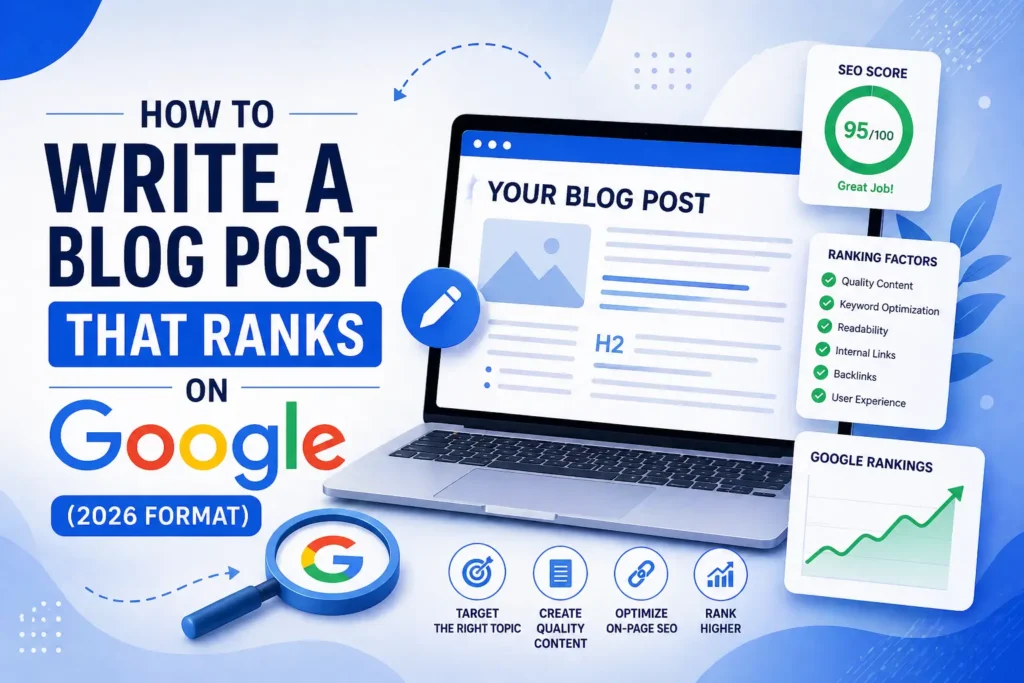

Blog post writing in 2026 is fundamentally different from what it was two or three years ago – and most content creators haven’t caught up yet. Google’s algorithms now evaluate your post for E-E-A-T (Experience, Expertise, Authoritativeness, Trustworthiness), AI search engines like ChatGPT and Perplexity actively crawl and cite web content, and 60% of searches now end without a click as AI Overviews answer queries directly. At Search Savvy, we produce and optimise blog content for both traditional search rankings and AI citation visibility – and in 2026, a blog post that ranks requires a very specific format that serves two audiences simultaneously: human readers and AI engines.
In this article19 sections
This guide gives you the exact 2026 blog post format – from keyword research and structure to on-page optimisation and schema markup – so every post you publish is built to rank, built to be cited, and built to convert.
What Makes a Blog Post Rank on Google in 2026?#
Blog post success in 2026 comes down to three fundamental questions Google asks about every piece of content:
- Does it fully satisfy the searcher’s intent? – Not partially. Completely. Google rewards posts that answer the entire query, including related questions the user might ask next.
- Is it written by a credible, identifiable person? – Faceless content is being filtered out of both Google rankings and AI citations. Named authors with linked credentials are now table stakes for competitive topics.
- Is it structured for both humans and machines to extract information? – AI engines extract answers top-down. If your direct answer isn’t in the first section, you lose the citation to a page that leads with it.
Blog post quality in 2026 is no longer just about writing well – it’s about being architecturally sound. The format matters as much as the content.
Step 1: How Do You Research Keywords for a Ranking Blog Post?#
Blog post keyword research in 2026 starts with understanding search intent before selecting a keyword. The same topic can have radically different intent – someone searching “what is keyword research” wants a definition; someone searching “keyword research tools for beginners” wants recommendations. Your content must match the format that intent demands.
The 2026 keyword research process:
1. Choose your primary keyword Use Google Keyword Planner, Ahrefs Keywords Explorer, or Semrush Keyword Magic Tool to identify a primary keyword with realistic ranking potential for your domain authority. Focus on long-tail keywords (3–5 words) for newer sites – they’re more specific, less competitive, and often convert at higher rates.
2. Identify the SERP format Google rewards Google the keyword and analyse the top 5–7 results. Are they how-to guides? Listicles? Definitions? Comparisons? The format dominating the first page tells you exactly what format your post must use to compete.
3. Mine “People Also Ask” for your subheadings The People Also Ask (PAA) section in Google results is a direct window into the sub-questions users ask around your topic. Each PAA question is a potential H2 or H3 subheading – and answering them directly makes your post far more likely to earn featured snippet placement and AI Overview citations.
4. Identify semantic keywords Beyond your primary keyword, note the related terms, synonyms, and entity associations that appear in top-ranking results. Tools like Surfer SEO or Semrush’s SEO Writing Assistant identify which semantic terms are expected in your post based on what Google already rewards.
Step 2: What Is the Ideal Blog Post Structure in 2026?#
Blog post structure is the single most under-appreciated ranking factor. Google cannot rank what it cannot understand – and a poorly structured post forces Google’s crawler to work harder to interpret your content, which consistently produces lower rankings than a post with the same information and a cleaner structure.
The 2026 blog post format:
The Title Tag (60 characters max)#
Your title tag – the HTML <title> element – is the clickable headline in Google search results. It must:
- Include your primary keyword in the first 5 words
- Stay under 60 characters to avoid truncation
- Include a year (e.g., “2026”) for freshness signalling
- Promise a specific value: a number, a method, a result, or a format
Good: “How to Write a Blog Post That Ranks (2026 Format)” Weak: “Guide to Writing Blog Posts That Perform Well on Google”
The H1 Heading#
Your H1 – the on-page heading users actually see – should be closely aligned with (but not necessarily identical to) your title tag. One H1 per page. It should contain your primary keyword and set a clear expectation for what the post delivers.
The Introduction (First 100–150 Words)#
Blog post introductions in 2026 must answer the “why should I keep reading?” question within the first sentence. Lead immediately with the most compelling reason: a surprising statistic, a bold claim, a direct statement of the reader’s problem, or a promise of the specific outcome this post delivers.
Critically: AI engines extract answers top-down. If your introduction doesn’t contain a clear, direct response to the query, you lose the AI citation to a page that does. Aim to address your primary question within the first 100 words.
H2 and H3 Subheadings (As Questions)#
Blog post subheadings in 2026 should be phrased as questions wherever possible. This serves three purposes simultaneously:
- Matches the natural language of voice search queries
- Mirrors the format of People Also Ask boxes (increasing featured snippet eligibility)
- Signals to AI search engines that your post contains a direct answer to each question
Structure your H2s logically – each should cover a distinct sub-topic or step, progressing from foundational to advanced. H3s break down the detail within each H2 section.
Short Paragraphs and Scannable Formatting#
Blog post formatting must account for how people actually read online: they scan. Research consistently shows that users look at headings, bold text, bullet points, and numbered lists – often before reading a single body paragraph. If they can’t extract the key information from your visual hierarchy in 10 seconds, they leave.
Formatting rules for 2026:
- Maximum 3–4 lines per paragraph
- Bullet points for lists of 3+ items
- Numbered lists for step-by-step processes
- Bold text for the most critical phrase per paragraph (sparingly)
- Break content after every 2–3 paragraphs with a new subheading
Media: Images, Videos, and Tables#
Blog post media enhances both user engagement and SEO signals in 2026. Add:
- A featured image with a descriptive, keyword-inclusive alt text
- Screenshots or diagrams for complex processes
- A comparison table where relevant (Google frequently extracts tables for featured snippets)
- Embedded YouTube video (where the topic benefits from visual explanation)
Every image must have descriptive alt text – not “image1.jpg,” but “diagram showing the ideal blog post structure for 2026 SEO.”
Step 3: How Do You Optimise a Blog Post for On-Page SEO?#
Blog post on-page SEO in 2026 requires precise placement of your primary keyword and supporting semantic terms throughout the post. Here’s the exact placement checklist:
| Element | Requirement |
| Title tag | Primary keyword in first 5 words, under 60 chars |
| Meta description | Primary keyword, value promise, 150–160 chars |
| H1 heading | Contains primary keyword |
| First 100 words | Primary keyword appears naturally |
| At least 2 H2 headings | Include primary keyword or close variant |
| Image alt text | Descriptive, includes keyword where natural |
| URL slug | Short, keyword-inclusive (e.g., /how-to-write-blog-post-2026) |
| Internal links | 2–4 links to related content on your site |
| External links | 3–5 links to authoritative sources |
About keyword density: There is no magic percentage. In 2026, Google’s algorithm understands semantic context – it knows what your post is about from the surrounding language, not just keyword repetition. Write naturally. Forcing keyword repetition beyond what reads well is worse than not mentioning it at all.
Step 4: What E-E-A-T Signals Does a Blog Post Need in 2026?#
Blog post credibility in 2026 is evaluated by Google through its E-E-A-T framework: Experience, Expertise, Authoritativeness, and Trustworthiness. These signals have become especially important as AI-generated content floods the web – Google is actively filtering for genuine human expertise.
E-E-A-T signals to add to every blog post:
- Named author with a linked bio – a real person’s name, credentials, and a link to an author page that includes their professional background. In 2026, faceless content is being filtered from AI citations.
- First-hand experience – include one specific example from your own practice or client work that demonstrates you’ve actually done what you’re writing about
- Original data or research – even a small dataset, a survey result, or a proprietary statistic makes your post citable by AI engines that prefer sources containing data not found elsewhere
- Transparent sourcing – link every statistic and claim to its original source. This signals credibility to both Google and AI systems.
- Updated dateModified – add Article Schema with a dateModified value reflecting when the post was last refreshed. AI engines strongly favour content updated within the past 90 days.
At Search Savvy, we add a visible “Last Updated: [Month Year]” line near the top of every blog post and update the dateModified in our Article JSON-LD schema – this single change consistently improves AI Overview citation rates for existing content.
Step 5: How Do You Add Schema Markup to a Blog Post?#
Blog post schema markup is the 2026 element most content teams are still missing – and it’s one of the highest-impact changes you can make for both Google rankings and AI search visibility.
Essential schema types for every blog post:
{
“@type”: “BlogPosting”,
“headline”: “Your Blog Post Title”,
“author”: {“@type”: “Person”, “name”: “Author Name”},
“datePublished”: “2026-04-01”,
“dateModified”: “2026-04-21”,
“description”: “Your meta description here”
}
FAQPage Schema: Add to every FAQ section. This directly signals to Google and AI engines that your FAQ answers are authoritative Q&A pairs eligible for direct citation in AI Overviews.
A real-world case study: A new website added FAQPage schema to a single blog post in mid-2025. Within two weeks, a single FAQ answer was cited directly in a Google AI Overview for the target query – appearing alongside established national competitors with years of domain authority. No paid promotion. No link building. Just well-structured content with the right schema markup.
Add schema via Yoast SEO Premium, Rank Math Pro, or manually in your theme’s <head>. Validate using Google’s Rich Results Test.
Step 6: How Do You Write a Blog Post Conclusion That Converts?#
Blog post conclusions in 2026 serve three purposes: summarising key takeaways, reinforcing your primary keyword, and directing the reader to a clear next step. Never let a page be a dead end.
Conclusion structure:
- A 3–5 bullet point summary of the post’s key actionable points (skimmable format)
- 1 sentence reinforcing the primary takeaway
- A direct, specific CTA – not “learn more” but “download our checklist,” “book a free audit,” or “read our [related guide]”
- 2–3 internal links to related content (topical cluster support)
People Also Ask: Blog Post Writing Questions#
How long should a blog post be to rank on Google in 2026?#
There is no ideal word count – length should match the depth required to fully satisfy the search intent. According to Backlinko’s analysis of ranking factors, the average first-page result contains approximately 1,400 words. Top-ranking posts for competitive keywords often exceed 2,500 words. The correct length is: as long as necessary to cover the topic more completely than the current top-ranking results, and no longer.
How often should I publish blog posts for SEO?#
Consistency and quality matter far more than frequency. Publishing 2–4 high-quality, fully optimised blog posts per month consistently outperforms publishing 10 thin posts per month. Each post should serve a unique search intent with no keyword overlap with existing content (to avoid cannibalization). Updating existing posts quarterly is equally important as publishing new ones.
Does my blog post need a specific word count to rank in the Google 3-Pack?#
No – Google’s local pack is driven by Google Business Profile signals, reviews, and local SEO factors, not blog post word count. However, a well-written blog post targeting local keywords (e.g., “best SEO agency in Mumbai”) supports your local organic rankings and can appear in both the standard organic results and AI Overviews for local queries.
Frequently Asked Questions (FAQ)#
Q1: What is the most important element of a blog post for SEO in 2026? Search intent match – your blog post must deliver exactly the type of content (format, depth, and angle) that Google is already rewarding for your target keyword. A technically perfect post that mismatches user intent will always underperform a simpler post that delivers exactly what the searcher needs. Use the SERP to determine what format dominates your target keyword before writing a single word.
Q2: Do I need to include a FAQ section in every blog post? Not in every post – but in most informational and how-to posts, a FAQ section adds significant value. FAQs with FAQPage schema markup are the most commonly cited element in Google AI Overviews. They directly answer the sub-questions users are asking, improve your featured snippet eligibility, and signal to AI engines that your content is a comprehensive, authoritative source.
Q3: How do I write a blog post introduction that keeps readers on the page? Lead with your most compelling hook in the first sentence – a surprising statistic, a bold claim, or a direct statement of the reader’s problem. State the promise of your post (what they’ll know or be able to do after reading) by the third sentence. Keep the introduction under 150 words. According to Search Savvy’s content framework, the introduction is the highest-bounce risk section of any blog post – if readers don’t see immediate value, they leave before you have a chance to deliver it.
Q4: How does internal linking improve my blog post’s ranking? Internal links serve two functions: they distribute PageRank (link authority) from high-authority pages to newer posts, and they signal to Google that your posts are part of a coherent topical cluster. Aim for 2–4 contextual internal links per post using descriptive anchor text that reflects the target keyword of the linked page. Every new post you publish should be linked to from at least one existing high-authority page on your site.
Q5: Should I include the year in my blog post title? Yes – for most informational and how-to content. Including “2026” in your title signals freshness to both searchers and Google’s algorithm, which weights recency heavily for topics where information changes regularly. Update the year when you refresh the post. However, for evergreen content (definitions, fundamentals, timeless processes), a year modifier can actually hurt click-through rate once the year passes – use your judgment based on the topic.
Q6: How do I make my blog post visible in Google AI Overviews? Structure your post so that the direct answer to the query appears within the first 100 words of the relevant section. Use question-based H2/H3 headings. Add FAQPage schema to your FAQ section. Include verifiable statistics with linked sources. Update your dateModified schema field when refreshing content. Ensure AI bots (GoogleBot, GPTBot, PerplexityBot) can crawl your pages – check your robots.txt. These structural elements simultaneously improve traditional rankings and AI citation rates.
Final Thoughts#
Blog post writing in 2026 is more demanding – and more rewarding – than ever. The bar is higher because AI-generated content has flooded the web with mediocre posts, which means genuinely well-structured, expertly written, schema-optimised content stands out more clearly than it did three years ago.
The format in this guide is not a checklist to mechanically complete – it’s a framework that reflects how Google actually evaluates content in 2026 and how AI engines actually select sources to cite. Execute it consistently and the compounding effect of a well-structured, regularly updated blog will deliver organic traffic that grows month over month.
Search Savvy helps businesses build blog content strategies that produce rankings, AI citations, and real business results – using data-driven processes built around the 2026 content format your audience and the algorithms both reward.