

A business owner once spent eight months chasing “digital marketing agency” – a keyword with massive search volume and an equally massive list of established competitors who had been building authority for a decade. Zero rankings. Zero traffic. Eight months of content that nobody would ever read.
In month nine, the strategy changed. Instead of one broad term, the focus shifted to dozens of specific, low competition keywords: “digital marketing agency for Ayurvedic brands in India,” “performance marketing for D2C skincare startups,” “SEO agency for SaaS companies under 50 employees.” Individually, each phrase had modest search volume. Collectively, they began driving consistent, high-intent traffic within weeks – not months.
This is the core lesson behind every successful low competition keyword strategy: low competition keywords are not a consolation prize for sites that cannot compete for the big terms. They are the smarter strategy – one that drives higher-intent traffic, faster rankings, and better conversions, regardless of your domain authority. A broad term like “coffee” is nearly impossible to rank for and tells you nothing about what the searcher actually wants. A phrase like “organic fair-trade dark roast coffee beans for cold brew” tells you exactly what they want – and faces dramatically less competition for that precision.
At Search Savvy, finding the right low competition keywords is one of the first things we do for any new client engagement, because it is consistently the fastest, most reliable path to real, compounding organic traffic. This article walks through exactly how to find them, the tools that work in 2026, and the framework to turn them into actual rankings.
What Makes a Keyword “Low Competition” in 2026?
Low competition keywords are search terms where relatively few high-authority websites are actively competing for the top rankings, making them realistically achievable for a smaller or newer site without years of accumulated domain authority.
This is a distinct concept from low search volume, even though the two are sometimes confused. A keyword can have meaningful search volume and still be low competition if the sites currently ranking for it are weak, outdated, or poorly optimised. Conversely, a keyword can have low search volume and still be highly competitive if major, well-established brands are fighting over that specific niche term.
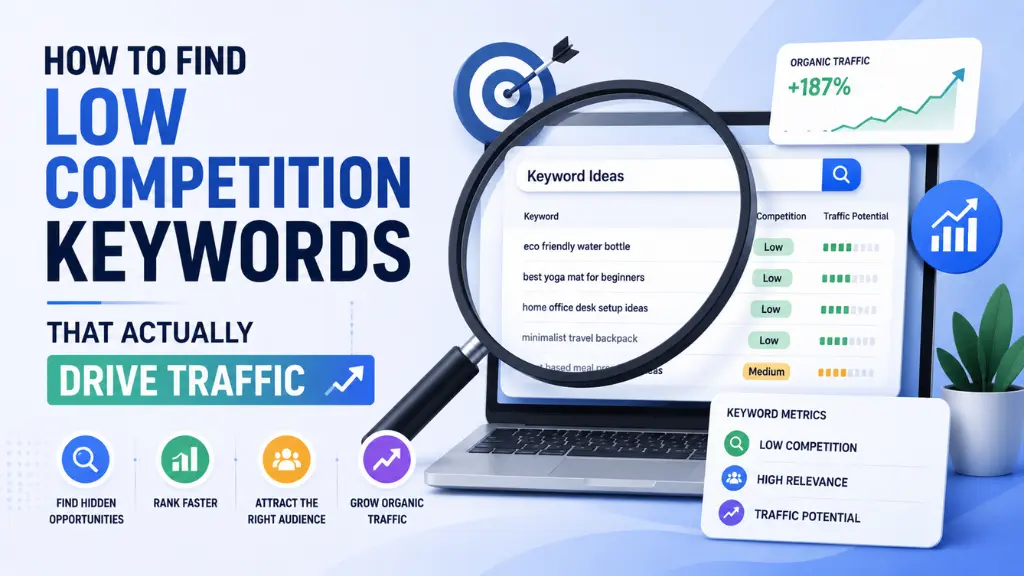
The standard technical benchmark used across most 2026 SEO tools: a Keyword Difficulty (KD) score under 30 is the target zone for most sites with a domain authority under 50. For genuinely new domains with little or no accumulated authority, the realistic starting target narrows further, to a KD of 0–15. These are estimates from tools like Ahrefs and Semrush, not guarantees – which is why a manual SERP check remains an essential final verification step, regardless of what any individual tool’s difficulty score suggests.
People Also Ask: What KD (Keyword Difficulty) score should I target for low competition keywords? Short Answer: Target a Keyword Difficulty score under 30 for most established sites with domain authority under 50. For brand-new domains with little existing authority, narrow that target to KD 0–15 initially. KD scores from tools like Ahrefs and Semrush are estimates, not guarantees – a manual review of the actual ranking pages for that keyword remains the most reliable final verification, since a tool’s difficulty score cannot account for every nuance of how strong the current top-ranking pages genuinely are.
Why Should You Prioritise Low Competition Keywords in 2026?
Low competition keywords deserve strategic priority in 2026 for reasons that go well beyond simply being “easier” – they reflect a fundamentally smarter approach to how organic search traffic actually compounds.
Speed to rank. Low competition keywords offer a faster path to the top of search results compared to fiercely contested head terms, where established competitors have spent years accumulating the authority signals required to dominate page one. For a new or growing site, this speed difference is the practical difference between seeing meaningful traffic within months versus waiting years for the same outcome.
Volume in aggregate. Around 80% of all online searches are long-tail queries – meaning the bulk of genuine search traffic lives in the tail of specific, lower-volume terms, not concentrated at the very top of the popularity curve where head terms sit. Long-tail keywords specifically (typically four or more words) drive roughly 70% of all searches, despite each individual term carrying comparatively modest volume on its own.
Higher conversion rates. Long-tail keywords reflect a searcher who is further along in their decision-making process – someone typing “best running shoes for flat feet” has a much clearer, more specific need than someone typing simply “shoes.” This specificity translates directly into measurably stronger conversion performance.
Direct relevance to AI search. In 2026, AI Overviews, ChatGPT, and Perplexity all favour content built around specific, naturally phrased questions – precisely what low competition, long-tail keyword optimisation produces by design. As AI-mediated search continues capturing a growing share of overall query volume, content built around precise, specific questions is structurally better positioned for AI citation than content built around broad, generic head terms.
People Also Ask: Why are long-tail keywords considered low competition keywords? Short Answer: Long-tail keywords are typically more specific, multi-word phrases that reflect a clearer, narrower search intent than broad head terms. Because they are more specific, fewer websites are actively optimising content around the exact same phrase, resulting in lower competition. Around 80% of all online searches are long-tail queries, and they typically carry a Keyword Difficulty score under 30 – giving smaller websites a realistic path to page-one rankings without requiring the massive domain authority that broad head terms demand.
How Do You Find Low Competition Keywords Using Free and Paid Tools?
Low competition keywords can be discovered through a layered tool approach in 2026, combining free discovery methods with more advanced paid platforms for verification and scale.
Start with Google’s own free signals. Google autocomplete and the “People Also Ask” boxes that appear directly in search results are genuinely useful, completely free starting points – these surface the actual phrasings and related questions real users are searching for, often revealing long-tail variations you would not have considered starting from a single seed keyword.
Use Semrush’s free keyword tools for initial discovery. The Semrush Free Keyword Tool provides keyword ideas, search volumes, and difficulty scores in seconds, making it a strong no-cost entry point before committing to a paid subscription.
Move to dedicated platforms for deeper research. Ahrefs and Semrush’s Keyword Magic Tool – drawing from a database of over 27 billion keywords – offer the advanced filtering needed to sort by exact match, related keywords, and precise Keyword Difficulty thresholds at scale.
Use AI chatbots for ideation, not for difficulty scoring. ChatGPT and Perplexity do not provide reliable Keyword Difficulty scores, but they are genuinely useful for brainstorming keyword ideas, particularly conversational, long-tail queries that a human would naturally ask but might not think to type into a traditional keyword tool. In 2026, one of the most valuable uses of AI tools for keyword research is that the query phrasings they suggest are often not yet tracked in traditional keyword databases at all – making them effectively zero-competition starting points, provided you validate the underlying KD manually once you have a candidate list.
Be cautious relying solely on Google Search Console for full keyword discovery. Google’s own Performance report documentation confirms that the report shows only non-anonymised query strings, stores top data rows rather than all rows, and can lose long-tail data entirely when results are grouped or filtered by query. If Search Console is your only keyword research source, you are working from a useful but genuinely incomplete picture – the long tail is partially hidden by design.
People Also Ask: Can ChatGPT or Perplexity help find low competition keywords? Short Answer: They are useful for ideation but not for verification. ChatGPT and Perplexity do not provide Keyword Difficulty scores or realistic SEO metrics, but they are excellent for brainstorming conversational, long-tail query variations that a real person would naturally ask – phrasings that traditional keyword tools sometimes miss entirely. The recommended workflow is using AI tools to generate a broad list of natural-language keyword ideas, then validating the actual difficulty and search volume for each candidate using a dedicated tool like Ahrefs or Semrush.
What Is the Step-by-Step Process for Finding Low Competition Keywords?
Low competition keywords are found most reliably through a structured, repeatable six-step process – not by randomly testing individual phrases against a difficulty checker one at a time.
Step 1 – Start broad with your core topic. Begin with the general subject area your business operates in – the kind of broad term that is far too competitive to target directly, but that serves as the seed for everything that follows.
Step 2 – Narrow to specific problems your audience actually has. Move from the broad topic toward the specific pain points, questions, and scenarios your real customers are searching for. This is where Google autocomplete, “People Also Ask” boxes, and AI brainstorming tools are most useful.
Step 3 – Filter candidates to KD under 30. Run your growing keyword list through Ahrefs or Semrush and filter out anything above the KD 30 threshold (or KD 15 for newer domains), narrowing your list down to the genuinely realistic opportunities.
Step 4 – Verify search intent matches your content plan. Ensure each keyword’s underlying intent – informational, commercial investigation, or transactional – matches what you actually intend to build. A keyword wanting a calculator, tool, or product page will consistently lose to a competing blog post, no matter how well written that blog post is, because it fundamentally fails to match what the searcher and the SERP both expect.
Step 5 – Mine competitor gaps for additional opportunities. Review what your direct competitors are ranking for and identify specific subtopics or angles they have not adequately covered – these gaps frequently represent genuinely low competition keyword opportunities hiding in plain sight within an otherwise competitive niche.
Step 6 – Expand into long-tail variations. For each validated core keyword, expand outward into four-or-more-word long-tail variations that capture more specific intent and consistently lower competition than the original seed term.
People Also Page: What is the fastest way to find low competition keywords for a new website? Short Answer: Start with Google autocomplete and “People Also Ask” boxes around your core topic, filter the resulting candidate list by Keyword Difficulty under 15 to 30 depending on your domain’s current authority, then cluster related terms together and connect every resulting page to a central content pillar. This six-step sequence – broad to specific, filtered, intent-verified, competitor-checked, and expanded into long-tail variations – consistently produces a realistic, prioritised keyword list faster than testing individual phrases one at a time.
What Mistakes Should You Avoid When Researching Low Competition Keywords?
Low competition keyword research has several well-documented failure patterns that consistently undermine otherwise sound strategy – recognising them in advance saves significant wasted effort.
Chasing volume before fit. Sorting your keyword list by search volume first causes you to overvalue keywords that look impressively large but do not actually send meaningful traffic or revenue once you account for genuine relevance and intent match. Volume is a starting point for evaluation, not a verdict on whether a keyword deserves priority.
Ignoring the expected content type. If the current SERP for a given keyword is dominated by tools, calculators, templates, or product pages, a standard blog post usually loses regardless of its writing quality – match the expected content format to the keyword first, before investing in production.
Writing one thin page per keyword variation. This common mistake creates internal competition between your own pages, produces thin individual content, and builds a weak overall topical footprint. The corrected approach clusters related keywords together into a single, more comprehensive page rather than fragmenting coverage across many shallow ones – one well-developed page can realistically rank for many related queries simultaneously when it covers a topic with genuine depth.
Treating AI content generation as a simple publish button. Google’s generative AI guidance is explicit that AI can assist with research and structure, but scaled, low-value content produced without genuine human review can violate the platform’s spam policies. Accuracy and genuine usefulness still matter regardless of how the first draft was produced.
Skipping the manual SERP check. Keyword Difficulty scores are estimates produced algorithmically, not guarantees of actual ranking ease. A manual review of the SERP for any priority keyword takes roughly 60 seconds and reveals what no automated tool fully can – specifically, whether the pages currently ranking are genuinely weak enough to realistically outrank.
Not connecting long-tail pages to a content pillar. Standalone long-tail pages, published in isolation with no internal linking structure connecting them to broader topic coverage, build essentially no topical authority on their own. Every cluster article should link to its pillar page, allowing authority to compound across the entire cluster rather than remaining isolated on individual pages.
According to Search Savvy’s insights from running keyword strategy for clients across multiple industries, the single most common and costly mistake we see is businesses sorting their initial keyword research purely by search volume, then becoming discouraged when the resulting “big” keywords prove impossible to rank for – when a more deliberate, intent-and-competition-led approach would have surfaced dozens of realistic, traffic-driving opportunities from the very same research session.
People Also Ask: What is the difference between low-competition and low-traffic keywords? Short Answer: Low-competition means relatively few high-authority sites are actively targeting that specific keyword, making it realistically achievable to rank for. Low-traffic means the keyword simply has limited search volume, regardless of how competitive it is. These are independent dimensions – a keyword can be both low competition and low traffic, or low competition with meaningful traffic (the ideal combination), or genuinely high competition despite low individual search volume if established brands have specifically targeted that niche term.
How Do You Identify Commercial Intent Within Low Competition Keywords?
Low competition keywords vary significantly in their actual business value depending on the underlying commercial intent – and identifying genuine buying intent within your keyword list is essential for prioritising which opportunities to pursue first.
Several reliable signals indicate stronger commercial intent within a candidate keyword:
- Commercial modifiers – words like “best,” “vs,” “for [specific industry],” “pricing,” or “tool” within a keyword phrase signal active buying research rather than purely informational curiosity.
- Cost per click (CPC) data – a high CPC for a given keyword means advertisers already know that traffic converts well enough to justify paying for it. A CPC above roughly $3 to $5 in your specific niche generally indicates meaningful commercial intent behind that term.
- SERP composition – if paid advertisements appear above the organic results for a given keyword, that placement itself confirms the keyword has proven commercial value worth advertisers’ budget.
For e-commerce brands specifically, pairing low competition organic targeting with paid advertising on the same validated keyword cluster can meaningfully reduce blended customer acquisition cost – the organic and paid efforts reinforce each other on keywords already confirmed to convert.
People Also Ask: How do I know if a low competition keyword will actually drive valuable traffic? Short Answer: Check for commercial intent signals: commercial modifiers within the keyword phrase itself (such as “best,” “vs,” “for [industry],” or “pricing”), a meaningfully high cost-per-click in advertising platforms (generally above $3 to $5 depending on your niche), and the presence of paid ads above the organic results on that keyword’s SERP. These signals collectively confirm that real commercial demand exists behind a keyword, distinguishing genuinely valuable low competition opportunities from low competition keywords that may never convert into meaningful business outcomes.
How Should You Structure Content Around Low Competition Keywords?
Low competition keywords perform best when organised into a deliberate cluster structure, rather than treated as a list of isolated, unrelated targets to be picked off one at a time.
The recommended structural approach: build one comprehensive pillar page covering your core topic broadly, supported by multiple focused cluster pages exploring specific long-tail subtopics in greater depth – with every cluster page linking back to its pillar, allowing topical authority to compound across the full structure rather than remaining fragmented across disconnected individual pages.
Within each individual page, target one primary keyword, supported by five to ten semantically related variations worked in naturally throughout the content. Attempting to rank a single page for twenty unrelated keywords dilutes topical focus and weakens the page’s overall relevance signal – Google consistently rewards pages that clearly and thoroughly address one specific topic in depth over pages attempting to cover too much ground superficially. If you have identified multiple genuinely distinct keyword clusters within your research, the correct response is building a separate, dedicated page for each cluster rather than combining them.
People Also Ask: How many low competition keywords should I target on a single page? Short Answer: Target one primary keyword per page, supported by five to ten closely related semantic variations woven naturally throughout the content. Trying to rank a single page for many unrelated keywords dilutes topical focus and weakens overall relevance, since search engines reward pages that thoroughly address one clear topic rather than superficially covering many. If your research surfaces multiple genuinely distinct keyword clusters, build a separate, dedicated page for each rather than combining them onto one page.
FAQ: Low Competition Keywords – Your Questions Answered
Q1: How long does it take to rank for a low competition keyword? This varies based on your domain’s existing authority, content quality, and the specific KD score of the target keyword, but low competition keywords with KD under 30 generally rank meaningfully faster than competitive head terms – often within weeks to a few months for newer sites, compared to many months or years for highly competitive broad terms. Genuinely new domains should expect the standard evaluation period most new websites experience before any keyword fully matures in rankings, even a low competition one, though long-tail terms typically show movement earliest within that broader timeline.
Q2: Is there a minimum word count required for a keyword to be considered “long-tail”? No strict rule exists. While most long-tail keywords are three to five or more words, the defining characteristic is genuine specificity and clear search intent – not a precise word count. A two-word phrase within a sufficiently niche industry can behave exactly like a long-tail keyword if it is highly specific and faces genuinely low competition, while a longer phrase that remains generic in intent may not qualify as meaningfully “long-tail” despite its length.
Q3: Should I prioritise search volume or competition level when choosing between keyword candidates? Competition level and intent match should generally take priority over raw search volume, particularly for newer or smaller sites. A keyword with modest volume but low competition and clear commercial intent will typically generate more realistic, valuable traffic than a high-volume keyword you have little realistic chance of ranking for in any reasonable timeframe. The strongest approach evaluates all three factors together – volume, competition, and intent – rather than optimising for any single metric in isolation.
Q4: Do low competition keywords still matter as AI Overviews and AI search grow in 2026? Yes, and arguably more than ever. AI Overviews appear more frequently for short and broad mid-tail queries specifically, while AI Overviews, ChatGPT, and Perplexity all favour content built around specific, naturally phrased questions for citation purposes – precisely the structure that long-tail, low competition keyword content naturally produces. As AI-mediated search captures a growing share of overall query volume, content built around precise, specific questions is increasingly well-positioned for AI citation, reinforcing rather than diminishing the strategic value of a strong low competition keyword strategy.
Q5: Can I find low competition keywords without paying for a tool like Ahrefs or Semrush? Yes, to a meaningful extent. Google autocomplete, “People Also Ask” boxes, and Semrush’s free keyword tool together provide a genuinely useful starting point for both ideation and basic difficulty estimation at no cost. AI chatbots like ChatGPT and Perplexity add further value for brainstorming natural-language query variations. However, for precise Keyword Difficulty scoring, large-scale competitive analysis, and bulk filtering across thousands of candidate keywords, a paid tool eventually becomes valuable as your keyword research scales beyond an initial, smaller-scope strategy.
Q6: What is the biggest advantage of low competition keywords for a brand-new website specifically? For brand-new domains with no existing authority or backlink history, low competition keywords represent the only realistic path to meaningful early rankings. Because fewer high-authority sites are competing for these specific terms, it becomes genuinely achievable for a new site to rank within its first several months – building the initial traffic, authority, and confidence that eventually supports competing for more difficult, higher-volume keywords later. Without this foundation, new sites typically spend months or years producing content for competitive terms with effectively no realistic chance of ranking in that timeframe.
Spending time and budget on content that is not generating traffic, or unsure which keywords genuinely match your site’s current ranking potential? Visit Search Savvy for a keyword strategy audit that identifies the specific low competition opportunities your business should be targeting right now.