
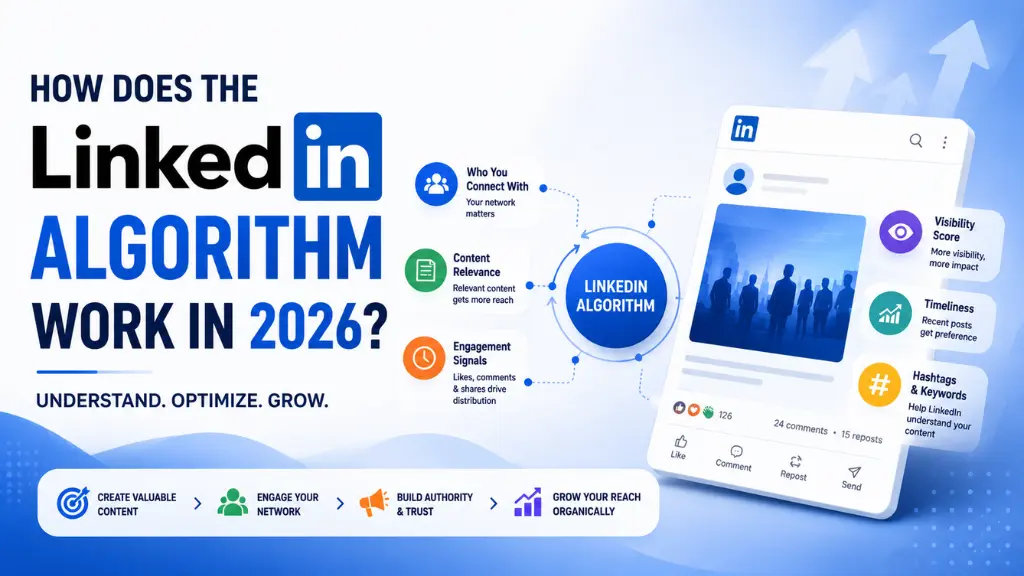

Only 1% of LinkedIn users post regularly, yet the platform drives 40% of high-quality B2B leads. That gap between who is showing up and who is winning is exactly why understanding how does the LinkedIn algorithm work in 2026 has become a genuinely high-stakes question for any business or professional using the platform seriously.
The honest answer is that LinkedIn’s algorithm no longer rewards who shouts the loudest – it rewards who knows the most. In March 2026, LinkedIn replaced its traditional signal-based ranking system with 360Brew, a 150-billion-parameter AI model that reads and understands the actual meaning of your posts, your profile, and your audience’s professional context – rather than simply counting clicks, hashtags, and engagement metrics. This is not an incremental update. It is a fundamentally different evaluation system, and most LinkedIn strategies built on pre-2026 advice are now working against the platform rather than with it.
At Search Savvy, we manage LinkedIn content strategy alongside broader social and SEO work – and the businesses seeing genuine growth right now are the ones who understand precisely what 360Brew evaluates, rather than chasing tactics that worked under the old system. This article breaks down exactly how does the LinkedIn algorithm work in 2026 – the technical architecture, the confirmed ranking signals, and the specific actions that drive real reach.
How Does the LinkedIn Algorithm Work – At a Technical Level?
How does the LinkedIn algorithm work fundamentally differently now compared to before March 2026? The platform’s ranking system shifted from a deterministic calculator of user actions to a probabilistic reasoner of user intent.
360Brew narrowed the candidate pool dramatically: the system filters 300 million posts down to roughly 2,000 candidates per user through LLM embeddings introduced as part of the October 2025 architecture update that preceded the full March 2026 rollout. This cohort-based embedding retrieval learns which audience segments engage with specific content types, then replicates distribution to similar professional profiles – including people who do not yet follow the creator.
How does the LinkedIn algorithm work to evaluate a single post under this system? It enables zero-shot reasoning – evaluating content it has never seen before by understanding semantic patterns, rather than relying on keyword matching or metadata. The system reads the creator’s profile (headline, About section, Experience) as part of every single ranking decision, and processes natural language to infer context, expertise, and relevance directly from the content itself.
The practical consequence: there is no “hack” for a system designed to understand language, context, and reasoning. The old game of sending isolated engagement signals is over – the new game is genuine expertise and genuine conversation, evaluated holistically rather than through individually gameable metrics.
People Also Ask: What is 360Brew and how does it change the LinkedIn algorithm? Short Answer: 360Brew is LinkedIn’s 150-billion-parameter AI model, fully deployed in March 2026, that replaced the platform’s previous signal-counting ranking system. Rather than measuring clicks, hashtags, and isolated engagement metrics, 360Brew reads and semantically understands the actual content of posts, the creator’s full professional profile, and audience interest patterns. It narrows 300 million daily posts down to roughly 2,000 candidates per individual user through LLM-based embedding retrieval, distributing content based on genuine topical relevance and demonstrated expertise rather than engagement volume alone.
How Does the LinkedIn Algorithm Work Through Its Three-Stage Distribution Process?
How does the LinkedIn algorithm work in terms of the actual sequence a post goes through after publishing? LinkedIn’s ranking system operates as a real-time, three-stage distribution process, regardless of the underlying AI model evaluating each stage.
Stage 1: Quality Filtering
How does the LinkedIn algorithm work immediately after a post is published? The system first runs a quality and policy check – filtering out spam, policy violations, duplicate or reposted content, and content carrying low creator trust signals. Posts that fail this initial gate never reach a meaningful audience regardless of their content quality, making this an invisible but critical first hurdle.
Stage 2: The Golden Hour Test
How does the LinkedIn algorithm work once a post clears the quality gate? It pushes the post to a small initial audience – typically a fraction of the creator’s first-degree network – and observes how that audience responds. This is the “Golden Hour” concept: the first 60 minutes after publishing are the single most consequential window in a post’s entire lifecycle.
LinkedIn’s algorithm decides a post’s fate in the first hour based primarily on engagement rate and dwell time. Data shows that replying to all comments within the first two hours generates 30% more engagement across the post’s full lifecycle – because the algorithm uses early engagement as a direct signal of content quality, and posts receiving comments quickly are assumed to be valuable and are shown to progressively wider audiences as a result.
Stage 3: Extended Distribution
How does the LinkedIn algorithm work for posts that perform strongly in the Golden Hour? Posts scoring well in this second stage break beyond a creator’s immediate network entirely, reaching second and third-degree connections, hashtag followers, and topical interest groups matched through 360Brew’s semantic understanding. Strong posts can remain in active distribution for days or even weeks if engagement velocity – the speed at which a post generates engagement after publication – remains sufficiently high throughout that extended window.
People Also Ask: What is the “Golden Hour” on LinkedIn and why does it matter? Short Answer: The Golden Hour is the first 60 minutes after a LinkedIn post is published, during which the algorithm tests the post against a small initial audience sample before deciding whether to expand its distribution further. Engagement rate and dwell time during this specific window are the primary factors determining whether a post advances to wider distribution. Replying to comments within the first two hours has been shown to generate roughly 30% more total engagement across a post’s lifecycle, because rapid early engagement signals quality to the algorithm.
How Does the LinkedIn Algorithm Work With Dwell Time as the Primary Ranking Signal?
How does the LinkedIn algorithm work to measure content quality beyond simple click counts? Dwell time – the duration users spend actually reading or interacting with a post before scrolling past – has become the primary measure of content quality in 2026, confirmed directly in LinkedIn’s own ranking guidance, which explicitly includes “user attention” as a stated evaluation factor.
The scale of this shift is significant. A post someone reads for 30 seconds outperforms one with 50 quick likes. The system now actively detects “click bounces” – instances where people click into a post but leave almost immediately – and deprioritises that content accordingly. Posts that capture only 0 to 3 seconds of dwell time limp along with engagement rates around 1.2%, a clear demonstration of how heavily this single signal now influences distribution outcomes.
How does the LinkedIn algorithm work to detect dwell time specifically, beyond simply timing how long a post stays on screen? Several supplementary indicators contribute to the overall measurement:
- “See more” expansion rate – whether people actively choose to open and read your full long-form post, rather than scrolling past after seeing only the preview text
- Save behaviour – content people bookmark for later reference signals genuine, lasting value rather than momentary interest
- Profile actions following a post view – visiting a creator’s profile after engaging with their content is a strong downstream signal of genuine interest and relevance
How does the LinkedIn algorithm work for posts that fail to generate meaningful dwell time despite strong initial impressions? They are throttled relatively quickly, regardless of how many people saw them – because impressions alone are now treated as the lowest-value engagement signal available to the algorithm, well below comments, saves, and sustained reading time.
People Also Ask: Why does dwell time matter more than likes on LinkedIn in 2026? Short Answer: LinkedIn’s own ranking guidance explicitly cites “user attention” as a core evaluation factor, and dwell time – how long someone actually spends reading a post – has become the platform’s primary quality signal. A post generating 30 seconds of genuine reading time outperforms a post collecting 50 quick likes, because dwell time reflects genuine value delivered, while a like requires minimal effort and can be given without any real engagement with the content. The algorithm specifically detects and deprioritises “click bounces,” where users open a post and leave almost immediately.
How Does the LinkedIn Algorithm Work to Rank Comments Versus Likes?
How does the LinkedIn algorithm work when weighing different types of engagement against each other? Comments remain the most powerful visible signal available to creators – significantly more valuable than reactions, though the often-cited “15x more valuable than likes” figure circulating across creator advice is an industry estimate without a clearly traceable primary source.
A more conservative, better-sourced estimate places comments at roughly twice the algorithmic weight of likes, with NLP-aware quality scoring layered on top of that base weighting – meaning generic replies like “Great post!” no longer meaningfully boost distribution, while specific questions, genuine personal experience, and substantive professional insight signal high-value engagement that the algorithm rewards more heavily.
How does the LinkedIn algorithm work specifically for comment threads – back-and-forth conversations occurring within a post’s comment section? These trigger aggressive reach expansion. A post that generates a genuine back-and-forth discussion, rather than a series of isolated, disconnected comments, is treated as significantly stronger evidence of content value than the same total comment count delivered as unconnected one-off replies.
How does the LinkedIn algorithm work to detect and penalise manipulative engagement tactics? Engagement bait – content explicitly designed to generate artificial interaction, such as “Comment YES if you agree” – is detected and actively penalised by the algorithm, rather than rewarded for the engagement volume it might otherwise generate.
People Also Ask: Are comments really worth more than likes on LinkedIn? Short Answer: Yes, though the precise multiplier varies by source. A widely cited but loosely sourced estimate suggests comments carry roughly 15 times the algorithmic weight of likes, while more conservative analysis places the gap closer to twice the weight, with additional NLP-based quality scoring applied on top. In either case, comments – particularly substantive ones that spark further discussion – are confirmed to carry significantly more ranking influence than reactions. Generic comments no longer receive meaningful credit; specific, thoughtful engagement is what the algorithm now identifies and rewards.
How Does the LinkedIn Algorithm Work Across Different Content Formats?
How does the LinkedIn algorithm work differently depending on whether you post text, images, video, or documents? Format significantly affects both dwell time potential and overall distribution, and the 2026 performance hierarchy has shifted meaningfully from previous years.
Text posts continue to outperform video in many contexts specifically because they create longer dwell time relative to their consumption effort. Posts with 1,000 to 1,300 characters often outperform shorter posts, because they generate more sustained reading time while remaining genuinely consumable rather than overwhelming.
Document carousels are currently experiencing exceptional reach, frequently outperforming equivalent text posts by 5 to 10 times. This format works because it requires more investment to create – signalling quality to the algorithm – and because each swipe through a multi-slide document counts as an additional discrete engagement signal, compounding dwell time and interaction depth simultaneously. Educational documents, frameworks, templates, and structured guides perform particularly well in this format.
Multi-image carousels significantly outperform single static images – achieving roughly 6.6% engagement compared to single-image posts, which underperform text-only content by approximately 30%, landing around 4.85% engagement. The mechanism is the same as document carousels: requiring a swipe to view all content generates additional engagement signal per post.
Polls have become a genuinely powerful engagement tool, reaching a 4.40% engagement rate – roughly double their 2023 performance – by directly inviting users to share their perspective with minimal friction, generating strong comment activity as people explain their vote.
Native video keeps users on the platform, which the algorithm explicitly rewards, but its dwell time advantage depends heavily on whether the content genuinely holds attention throughout, rather than benefiting from format alone the way carousels and documents currently do.
People Also Ask: What type of content performs best on LinkedIn in 2026? Short Answer: Document carousels are currently the standout performer, often outperforming equivalent text posts by 5 to 10 times in reach, particularly for educational frameworks, templates, and structured guides. Multi-image carousels significantly outperform single static images (roughly 6.6% versus 4.85% engagement). Long-form text posts between 1,000 and 1,300 characters continue to perform strongly due to sustained dwell time. Polls now achieve a 4.40% engagement rate, roughly double their 2023 level. The common thread across all top-performing formats is that each requires active interaction – swiping, reading, voting – rather than passive scrolling past.
How Does the LinkedIn Algorithm Work With External Links?
How does the LinkedIn algorithm work when a post includes a link directing users away from the platform? It actively penalises that behaviour, because the platform’s core incentive is keeping users engaged in conversation on LinkedIn itself, not redirecting them elsewhere.
The algorithm wants to keep people on LinkedIn, engaged in conversations. Comments support that goal directly; link clicks work against it. Posts containing external links in the main post body can see significantly reduced distribution – commonly cited at around a 60% reach penalty compared to equivalent link-free posts.
How does the LinkedIn algorithm work around this limitation for creators who genuinely need to share external resources? The established workaround is placing the link in the first comment rather than the post body itself – preserving the post’s full distribution potential while still making the resource accessible to anyone who scrolls into the comments. Native format support across tools and platforms increasingly automates this workflow, customising link posts to add URLs as automated first comments by default.
People Also Ask: Does including a link in a LinkedIn post hurt its reach? Short Answer: Yes, significantly. Posts containing external links directly in the post body commonly see around a 60% reduction in distribution compared to equivalent link-free posts, because the algorithm prioritises keeping users engaged on LinkedIn itself rather than redirecting them elsewhere. The standard workaround is publishing the post without a link in the main body, then adding the link as the first comment – preserving the post’s distribution potential while still making the external resource accessible.
How Does the LinkedIn Algorithm Work to Evaluate Creator Authenticity?
How does the LinkedIn algorithm work to distinguish genuine expertise from generic, templated content? Creator authenticity signals are one of the three core evaluation pillars in 2026, alongside Golden Hour engagement and sustained dwell time.
How does the LinkedIn algorithm work to score expertise specifically? 360Brew weighs several signals simultaneously: topic expertise demonstrated through a creator’s consistent posting history in a specific area, clarity of expression in how ideas are communicated, and identity alignment – whether a creator’s actual professional background and stated expertise genuinely match the topics they are posting about.
This has a direct and significant implication for AI-generated content. Write like a human – avoid templated, overly-polished AI tone. The algorithm’s semantic understanding capability means it can increasingly distinguish between genuinely human, specific, experience-based writing and generic AI-generated content lacking distinctive perspective, even when both are grammatically correct and well-structured.
How does the LinkedIn algorithm work for accounts publishing inconsistently across unrelated topics? It weakens the topical authority signal that 360Brew relies on for distribution decisions, since the system specifically learns and rewards demonstrated, consistent expertise in a defined professional area – making scattered, unfocused posting a structural disadvantage independent of any individual post’s quality.
People Also Ask: Does using AI to write LinkedIn posts hurt your reach in 2026? Short Answer: Generic, templated AI-generated content without genuine personal perspective is increasingly identifiable and disadvantaged by 360Brew’s semantic understanding capabilities. The algorithm specifically rewards creator authenticity signals – clarity of genuine expression, demonstrated topical expertise, and content that reflects real, specific experience rather than generic, broadly applicable advice. AI tools can still support drafting and structuring, but content lacking a distinctive, specific human perspective increasingly underperforms content with genuine personal insight, regardless of how polished the AI-assisted writing is.
What Practical Changes Should You Make Based on How the LinkedIn Algorithm Works in 2026?
How does the LinkedIn algorithm work in a way that should directly shape your posting strategy? The confirmed 2026 signals point toward a clear, consistent set of practical priorities.
Prioritise document carousels and structured long-form text as your primary content formats, given their significantly stronger dwell time and engagement performance compared to single images or short video clips.
Never include external links in your post body. Place any necessary link in the first comment instead, preserving the roughly 60% distribution advantage of keeping the main post link-free.
Treat the first 60 to 120 minutes after publishing as a non-negotiable active engagement window. Reply to every comment promptly during this period – data confirms this single behaviour generates approximately 30% more total engagement across a post’s full lifecycle.
End posts with a genuine, specific question rather than generic engagement bait. A question that invites substantive professional perspective generates the kind of comment-thread activity the algorithm now rewards most heavily, without triggering the penalty applied to detected engagement-bait patterns.
Maintain consistent topical focus rather than posting across disconnected, unrelated subjects. This builds the demonstrated expertise signal that 360Brew increasingly relies on for distribution decisions, compounding your reach advantage over time within a defined professional niche.
Write with genuine specificity and personal experience rather than generic, broadly applicable advice – both because this directly satisfies the creator authenticity signal and because specific, concrete writing naturally generates the substantive comments the algorithm values most.
According to Search Savvy’s insights from managing LinkedIn strategy across multiple client industries in 2026, the single most common mistake we see is creators continuing to optimise for impressions and likes – the two lowest-weighted signals in the current system – while ignoring dwell time and comment depth, which now drive the overwhelming majority of actual distribution outcomes.
People Also Ask: What is the single most important thing to optimise for on LinkedIn in 2026? Short Answer: Dwell time and genuine comment depth, not impressions or likes. LinkedIn’s own ranking guidance explicitly prioritises user attention, and 360Brew’s evaluation system rewards content that holds genuine reading time and generates substantive, specific conversation. The practical priorities that follow from this: choose formats that naturally extend dwell time (document carousels, structured long-form text), avoid external links in post bodies, and actively engage with comments in the first one to two hours after publishing.
FAQ: How Does the LinkedIn Algorithm Work in 2026 – Your Questions Answered
Q1: Should I use LinkedIn’s Creator Mode in 2026? Activating Creator Mode is generally recommended for businesses and professionals publishing consistent, topic-focused content. It enables follower-focused distribution rather than connection-limited reach, which improves algorithmic performance for accounts building a defined professional audience around specific subject matter. It is less relevant for accounts using LinkedIn primarily for one-to-one networking rather than broader content distribution.
Q2: How often should I post on LinkedIn given how the algorithm works in 2026? Posting more frequently does not automatically translate to lower reach per individual post, despite a common assumption to the contrary – large-scale analysis of millions of posts has found this relationship does not consistently hold. The more important factor is maintaining a sustainable, consistent cadence rather than maximising posting volume; overposting in short windows can appear spammy to both human audiences and the algorithm’s quality filtering stage, while genuine, well-spaced, high-quality posts consistently outperform high-frequency, lower-effort publishing.
Q3: Does profile completeness affect how the LinkedIn algorithm distributes my posts? Yes. Creator signals – including profile completeness – are factored into the relevance score 360Brew calculates for every post. The system explicitly reads a creator’s headline, About section, and Experience details as part of every ranking decision, meaning an incomplete or vague profile provides less context for the algorithm to confirm topical authority and identity alignment, potentially weakening distribution even for genuinely strong content.
Q4: Does LinkedIn’s algorithm favour first-degree connections over a wider audience? Initially, yes – but this changes as a post performs well. Posts from first-degree connections or people you regularly interact with often appear higher in a user’s feed than trending content from strangers, particularly during the early Golden Hour evaluation window. However, posts that perform strongly during that initial test reliably break beyond first-degree networks entirely, reaching second and third-degree connections and topical interest groups identified through 360Brew’s semantic matching – meaning strong content is not capped by network size.
Q5: How is the LinkedIn algorithm different for video content specifically compared to text or documents? Video keeps users on the platform, which the algorithm rewards structurally, but its dwell time advantage is less automatic than that of document carousels or long-form text, since video requires the content itself to genuinely hold attention throughout rather than benefiting from a format-driven interaction requirement like swiping. In current 2026 data, single-image posts underperform text-only content by roughly 30%, while well-executed video can perform strongly, but document carousels and multi-image carousels currently show the most consistent format-driven engagement advantage across the available analysis.
Q6: Can a small business or individual professional realistically compete with large accounts under the 2026 LinkedIn algorithm? Yes, more realistically than under engagement-volume-based systems. Since 360Brew evaluates content based on genuine topical expertise, dwell time, and authentic engagement rather than raw network size or historical follower count, a smaller account publishing genuinely specific, expertise-driven content in a consistent niche can outperform larger accounts publishing generic, broadly applicable content. Given that only 1% of LinkedIn users post regularly, the competitive bar for consistent, focused, authentic content remains comparatively low relative to the platform’s overall professional audience.
Posting on LinkedIn consistently but not seeing the reach or engagement your content deserves? Visit Search Savvy for a LinkedIn content strategy audit that maps your current approach against what 360Brew is actually rewarding in 2026.