
A bakery owner once spent six months optimising a page titled “How to Bake a Cake” for the exact keyword her competitors were ranking for. She matched their word count. She matched their keyword density. She even matched their heading structure almost line for line.
Her page never cracked page two.
The problem was never her keywords. It was her intent mismatch. Her page sold pre-made celebration cakes with a “Buy Now” button above the fold. Everyone searching “how to bake a cake” wanted a recipe – a step-by-step, informational answer – not a sales page. Google’s algorithms understood that mismatch instantly, even though every keyword on her page was technically correct.
Search intent is the reason that page failed, and search intent is the single most decisive ranking factor in SEO in 2026. Search intent has become the foundational principle of effective SEO. Google’s primary objective is matching users with content that satisfies their underlying goals – whether that is finding information, making a purchase, navigating to a specific site, or completing a specific task. Keywords tell Google what a page is about. Search intent tells Google what a page is for – and in 2026, that distinction decides who ranks and who does not.
At Search Savvy, nearly every underperforming page we audit shares the same root cause: strong keywords paired with the wrong intent. This article explains exactly what search intent is, the four types you need to understand, why it has overtaken keyword optimisation as the dominant ranking signal, and the practical framework for matching your content to it correctly.
What Is Search Intent in SEO?
Search intent is the underlying goal or purpose behind a person’s search query – the actual outcome they are trying to achieve, distinct from the literal words they typed into the search box.
Every time a customer uses a search engine, they are signalling what they want. The query itself is only the surface. “Best running shoes” could mean someone wants to read reviews, compare prices, or buy a specific pair right now – three different intents hiding behind one search phrase. Search intent is the discipline of identifying which of those underlying goals a specific query represents, and building content that satisfies that specific goal completely.
This is fundamentally different from how SEO worked a decade ago, when a page could rank simply by containing the right words in the right density. Search intent has changed that equation entirely. Google’s algorithms can now divide intent into smaller, more precise groups and rank pages based on how well they serve a user’s underlying – sometimes unstated – goal, not just their literal search terms.
People Also Ask: What is the simplest definition of search intent? Short Answer: Search intent is the real reason behind a search query – what the person actually wants to accomplish, not just the words they typed. A search for “best running shoes” might represent a desire to read reviews, compare options, or buy immediately – three different intents behind the same three words. Identifying which intent a query represents, and building content that satisfies it, is the foundation of effective SEO in 2026.
What Are the Four Types of Search Intent?
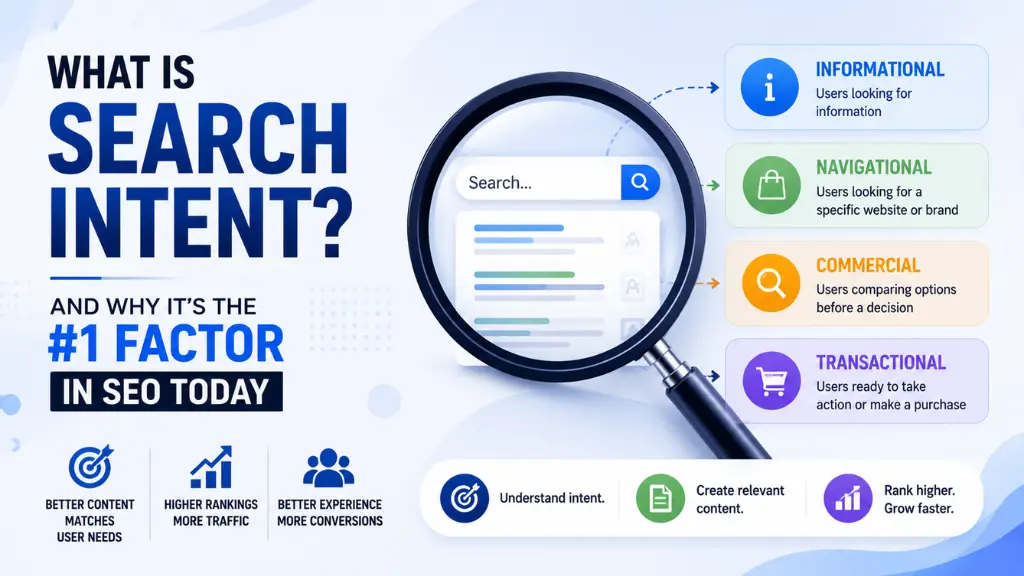
Search intent is generally classified into four distinct categories, and most professional SEO strategy is built around correctly identifying which category a target keyword falls into before any content is written.
Informational Intent
Search intent here reflects a user’s purpose to acquire knowledge or understanding. The searcher wants to learn something – a definition, an explanation, a how-to guide, a comparison of ideas. “How to bake a cake,” “what is search intent,” and “best time to post on Instagram” are all informational queries. The expected content format is typically a comprehensive guide, blog post, or explainer – not a sales page.
Navigational Intent
Search intent here means the user has a clear idea of the destination they want to reach. They are using the search engine as a shortcut to a specific website or page rather than to discover new information. Searches like “Search Savvy login” or “YouTube” are navigational – the user already knows exactly where they want to go.
Commercial Investigation Intent
Search intent at this stage means the user is in the process of making a decision but has not committed yet. They are comparing options, reading reviews, and weighing alternatives. “Best SEO agency for small business” or “WordPress vs Wix vs Squarespace” represent commercial investigation – the user is closer to a purchase than an informational searcher, but they are not ready to buy yet. The expected content format is comparison articles, reviews, and “best of” listicles.
Transactional Intent
Search intent here indicates that the user is ready to take action – usually to make a purchase, sign up, or complete a specific task immediately. “Buy running shoes online,” “SEO services Mumbai,” or “sign up for [tool] free trial” are transactional queries. The expected content format is a product page, service page, or landing page with a clear, immediate call to action.
People Also Ask: What are the four main types of search intent? Short Answer: The four main types of search intent are informational (the user wants to learn something), navigational (the user wants to reach a specific website), commercial investigation (the user is comparing options before deciding), and transactional (the user is ready to take action, typically a purchase). Each type expects a different content format, and ranking well requires matching that expected format precisely.
Why Has Search Intent Become the #1 Ranking Factor in 2026?
Search intent has overtaken every other ranking factor in 2026 because of a structural shift in how Google’s algorithms evaluate content – moving from literal keyword matching toward genuine semantic and contextual understanding.
Large language models now power core ranking systems, enabling Google to understand nuance, context, and intent with unprecedented accuracy. The days when keyword density and backlink quantity could manipulate rankings are definitively over. Google’s algorithms can now understand synonyms, related concepts, entity relationships, and contextual meaning with remarkable sophistication. A query like “best phone for photography under $500” triggers understanding of smartphone categories, price constraints, and camera quality factors – without those exact words needing to appear anywhere in the content.
This shift is reinforced directly by Google’s own ranking systems. Search intent drives what format, depth, and angle Google expects from a page. When a page matches that expected intent, it improves dwell time, click-through rate, and overall satisfaction – signals that reinforce rankings over the long term. The reverse is equally true and equally severe: if your page targets “best running shoes” but reads like a generic product category with no genuine guidance or comparison, the mismatch between expected format and actual content directly suppresses your ranking, regardless of how well-optimised the page is in every other respect.
The consequence for SEO strategy is direct: in 2026, Google measures intent satisfaction depth – did the page solve the user’s problem in one visit, or did they need to continue searching elsewhere? If content targets a keyword without satisfying the real intent behind it, Google reduces visibility regardless of any other optimisation applied to that page.
People Also Ask: Why does Google prioritise search intent over keywords in 2026? Short Answer: Because Google’s algorithms now use large language models to understand the meaning and context behind a query, not just the literal words. This allows Google to detect when a page’s content format does not match what a searcher actually needs – even if every targeted keyword appears correctly on the page. Google rewards pages that satisfy the complete underlying intent of a query and suppresses pages that match keywords without matching the expected content format or depth.
How Does Search Intent Mismatch Actually Hurt Your Rankings?
Search intent mismatch is one of the most common – and most expensive – SEO mistakes, because it is invisible to anyone evaluating a page purely on keyword presence or on-page optimisation checklists.
A common and costly issue is serving the wrong kind of page for a query’s intent. A business might try to rank a hard-selling service page for a search that clearly carries informational intent, or publish a long, educational blog post for a query where the searcher is actually ready to buy immediately. In both cases, the keyword targeting can be technically correct while the page fundamentally fails the searcher’s actual need.
Consider how this plays out for a real commercial keyword: the search term “SEO services” looks transactional or commercial at first glance, but the actual intent is more nuanced – buyers searching this term are typically still evaluating providers, looking for proof of results, transparent pricing, and trust signals before committing, rather than expecting an immediate checkout flow. A page built purely as a hard sell, without the comparative and credibility-building content that satisfies this specific stage of decision-making, mismatches the true intent even though the keyword itself appears commercial.
The behavioural consequence of intent mismatch is measurable and directly tied to ranking signals. When users land on a page that does not match what they expected, they leave quickly, generating exactly the engagement signals – high bounce rate, low dwell time, rapid return to the search results – that confirm to Google the page failed to satisfy the query. These behavioural signals compound: pages that consistently fail to satisfy intent see declining visibility over time, even without any specific manual penalty being applied.
People Also Ask: What happens when a page’s content does not match search intent? Short Answer: Even technically well-optimised pages will underperform if they do not match the searcher’s actual underlying need. The consequence shows up as poor engagement signals – high bounce rate, low dwell time, and searchers quickly returning to the results page to find a better match. Google interprets these behavioural signals as evidence the page failed to satisfy intent, leading to declining visibility over time, regardless of keyword targeting accuracy or other on-page optimisation.
How Do You Identify the Search Intent Behind a Keyword?
Search intent identification is a structured process, not guesswork – and the most reliable method does not require expensive tools, only careful observation of what Google itself is already telling you.
Analyse the current top-ranking pages for your target keyword. This is the single most reliable method available. Google has already done the intent-classification work for you by deciding which pages currently satisfy that specific query best. If the top five results for your target keyword are all comprehensive guides, the intent is informational – building a product page for that keyword will not outrank them, no matter how well-optimised it is. If the top results are all product or category pages, the intent is transactional or commercial, and a long blog post will struggle to compete.
Examine the SERP features Google displays for the query. The presence of a featured snippet, a “People Also Ask” box, or a knowledge panel typically signals informational intent. The presence of Shopping ads, a local map pack, or pricing comparisons typically signals transactional or commercial intent. Google’s own SERP design for a given query is a direct, observable signal of how its systems have classified that query’s intent.
Pay attention to modifiers within the keyword itself. Words like “how,” “what,” “why,” and “guide” typically signal informational intent. Words like “best,” “vs,” “top,” and “review” typically signal commercial investigation intent. Words like “buy,” “price,” “discount,” “near me,” and “for sale” typically signal transactional intent. While not absolute, these linguistic patterns are a fast first-pass filter before deeper SERP analysis.
Use tools like Google Search Console and Ahrefs to study existing query data. If you already have a website, examining which of your existing pages attract clicks for which queries – and cross-referencing that against your conversion data – reveals patterns in how your specific audience’s intent maps to your content.
People Also Ask: What is the easiest way to determine search intent for a keyword? Short Answer: The most reliable method is analysing the pages that already rank in the top five results for your target keyword. Google has already classified that query’s intent by deciding which type of content satisfies it best – if the top results are comprehensive guides, the intent is informational; if they are product pages, the intent is transactional. SERP features (featured snippets versus Shopping ads versus local map packs) provide an additional, fast confirmation signal.
How Do You Optimise Content to Match Search Intent?
Search intent optimisation requires building content that matches the expected format, depth, and stage of the customer journey that a specific query represents – not simply inserting the right keyword into an existing content template.
The practical framework for matching content to intent:
- Match the content format to the intent type. Informational queries expect comprehensive guides or explainer content. Commercial investigation queries expect comparisons, reviews, and structured pros-and-cons breakdowns. Transactional queries expect clear product or service pages with an immediate, unambiguous call to action. Publishing the wrong format for the intent – a sales page for an informational query, or a long educational article for a transactional one – is the single most common intent mismatch error.
- Match the content depth to where the user is in their decision journey. A user with informational intent at the very start of their research needs broader context and education. A user with commercial investigation intent needs specific comparisons and proof points. A user with transactional intent needs minimal friction and maximum clarity – they do not want to read another 2,000-word guide; they want to act.
- Structure content for both intent satisfaction and AI readability. Distinct headings, FAQs, schema markup, and a logical flow help both human readers and AI systems read and trust your content. Content format must be aligned with the kind of intent represented, and page layout should be built for the featured snippets and AI summaries that increasingly answer queries directly within the search results.
- Address the full intent, not just the surface keyword. A user searching “best SEO agency for small business” is not just asking for a list of names – they likely want to understand pricing transparency, see proof of past results, and assess trustworthiness signals. Pages that provide complete answers to the implicit questions behind a query consistently outrank pages stuffed with keywords but lacking that depth, even when the keyword-stuffed page uses the target phrase more frequently.
- Test and refine based on engagement data, not just rankings. Even after publishing intent-matched content, monitor dwell time, bounce rate, and scroll depth in Google Analytics 4 to confirm the page is genuinely satisfying the intent it was built for – and refine it where the data suggests a gap remains.
According to Search Savvy’s insights from auditing client websites across multiple industries, the single most common intent mismatch we find is businesses building transactional service pages for keywords that are actually still in the commercial investigation stage – meaning the audience searching that term is not yet ready to commit, and needs comparison-style content, proof, and trust-building first. Recognising which stage of the journey a keyword actually represents, rather than assuming every commercially-flavoured keyword is ready for a hard sell, is consistently the highest-leverage fix we make.
People Also Ask: Can one page satisfy multiple types of search intent at once? Short Answer: Generally, no – and attempting to do so usually weakens performance across every intent it tries to serve. Pages that try to cover too many intents at once often fail to fully satisfy any single searcher’s actual need. The stronger approach is building separate, clearly intent-matched pages: an informational guide for top-of-funnel research queries, a comparison page for commercial investigation queries, and a focused service or product page for transactional queries – each linked together to support the user’s journey across stages rather than forcing one page to do every job at once.
How Does Search Intent Relate to AI Overviews and Zero-Click Search?
Search intent has become even more important as zero-click searches and AI-generated answers reshape what “ranking well” actually means in 2026.
Most searches are now completed without any click on a website at all, because Google increasingly provides direct answers within the search results page itself. This means owning visibility within the search results – being the source an AI Overview cites, or the page a featured snippet pulls from – has become as important as the traditional blue-link ranking position.
This shift reinforces, rather than diminishes, the importance of search intent. AI systems give precedence to content that demonstrably and completely satisfies a specific intent, because that completeness is precisely what makes content easy to extract, summarise, and cite confidently. Pages that answer the full scope of a query’s implicit questions are the ones AI Overviews and other generative answer engines are most likely to select as a trustworthy source – meaning intent-matched content is now a prerequisite for AI citation, not just traditional ranking.
People Also Ask: Does search intent matter for AI Overviews, not just traditional Google rankings? Short Answer: Yes, and arguably even more so. AI Overviews and other generative search features select source content based on how completely and clearly it satisfies the intent behind a query. Content that fully addresses the implicit questions behind a search – structured with clear headings, direct answers, and logical organisation – is significantly more likely to be cited by AI systems than content that only partially matches the literal keyword without addressing the underlying need.
FAQ: Search Intent – Your Questions Answered
Q1: Can search intent change over time for the same keyword? Yes, and monitoring for this shift is an important ongoing SEO practice. A keyword’s dominant intent can shift due to seasonal trends, new product launches, cultural events, or changes in how Google’s systems interpret a query. The most reliable way to detect a shift is periodically re-checking the SERP for your priority keywords – if the type of content ranking in the top results has changed (for example, shifting from informational guides to product comparison pages), the dominant intent behind that keyword has likely shifted too, and your content strategy for that term should be revisited accordingly.
Q2: Is it possible for a keyword to have mixed or ambiguous search intent? Yes. Some keywords genuinely sit between two intent categories, and the SERP itself often reflects this ambiguity by displaying a mix of content formats – for example, both informational guides and product pages appearing in the same top-ten results. In these cases, examine which content type occupies the higher positions specifically, since position often reveals which intent Google’s algorithms judge to be slightly more dominant, even within an apparently mixed SERP.
Q3: Does optimising for search intent mean I should stop using keywords altogether? No. Keywords still matter, but they are no longer the main focus on their own. In 2026, keywords must be used naturally within high-quality, intent-focused content rather than being over-optimised or repeated excessively. Keywords remain essential for helping both search engines and AI systems understand what topic your content addresses – but search intent determines the format, depth, and angle that content needs to take in order to actually satisfy the person searching for that keyword.
Q4: How quickly can fixing a search intent mismatch improve rankings? Results vary by competition level and how severe the original mismatch was, but many businesses see measurable movement within 4 to 8 weeks of correcting a clear intent mismatch – for example, replacing a hard-sell page with an informational guide for a query that was genuinely informational. More competitive keywords, or pages with little existing authority, may take 3 to 6 months to show the full ranking benefit of an intent correction, consistent with typical SEO timelines for on-page and content-based improvements.
Q5: Do informational pages ever convert into customers, or are they only useful for traffic? Informational pages convert customers regularly – just not through an immediate transaction on that same page. Their primary role is building trust and demonstrating expertise early in a customer’s decision journey, which increases the likelihood that the same visitor returns later, searches a more commercial or transactional query, and chooses a business they already recognise as credible. Internal linking from informational content toward relevant commercial and transactional pages is the standard mechanism for guiding that visitor naturally toward conversion at the appropriate stage, rather than forcing a premature sales pitch into content that was never meant to close the deal.
Q6: How does local search intent differ from the four main intent types? Local intent typically overlaps with transactional or commercial investigation intent but carries an additional geographic urgency – searches like “SEO agency near me” or “best dentist in Mumbai” signal that the user wants a specific, local solution, often soon. For these queries, Google heavily weights Google Business Profile signals, proximity, reviews, and local citation consistency alongside the standard intent-matching principles. Businesses targeting local search intent should ensure their Google Business Profile is fully optimised and consistent with their website’s NAP (Name, Address, Phone) data, in addition to building intent-matched landing pages for their core local service queries.
Suspect your content might be technically optimised but missing the actual intent behind your target keywords? Visit Search Savvy for a search intent audit that maps your existing pages against what Google’s SERPs are actually rewarding – and a clear plan to close the gap.