

You launched your website three weeks ago. You wrote good content. You set everything up properly. And Google Search Console shows exactly four clicks.
This is not a sign that something is broken. It is the normal, predictable starting condition for almost every new website – and how you respond in the next 90 days determines whether you are still at four clicks a year from now, or generating real, compounding organic traffic.
SEO for new websites is genuinely different from SEO for an established site. The tactics that work for a domain with five years of history, hundreds of indexed pages, and an existing backlink profile are not the right starting point for a site Google has never seen before. Most business owners apply established-site advice to a brand-new domain, get discouraged when nothing happens in the first month, and either give up or chase the wrong fixes entirely.
At Search Savvy, nearly every new website we work with arrives in exactly this position – built, published, technically functional, and invisible to search. This article is the realistic, sequenced starting point: what to expect, what to do first, and what to genuinely ignore until your site has earned the right to worry about it.
Why Does SEO for New Websites Take So Long to Show Results?
SEO for new websites is governed by a documented industry phenomenon known as the Google Sandbox – a period during which a newly launched site is fully indexed by Google but does not rank for its main target keywords, even with strong content and proper technical setup.
New websites lack historical data, so Google needs to first crawl, index, and determine where your site fits in the grand scheme of things. Google’s algorithms work to understand a site’s content, relevance, and trustworthiness, often testing new sites before determining their final ranking position. Google has never officially confirmed the existence of a formal “sandbox” filter, but the pattern is consistent enough across the SEO industry’s observation data that it functions as a practical planning reality, regardless of its exact mechanism.
The realistic timeline: this evaluation period may take a few weeks to a few months but is usually estimated to be around 6 to 9 months based on observation figures from numerous SEO professionals monitoring new website performance. SEO for new websites in YMYL categories specifically – health, finance, legal – faces an extended version of this period. Google’s March 2026 Core Update enforced E-E-A-T (Experience, Expertise, Authoritativeness, Trustworthiness) signals at unprecedented scale, meaning the evaluation period for new sites in these categories now functionally extends until enough trust signals have accumulated to meet a meaningfully higher quality bar.
It is also important to recognise that not every case of slow new-site traffic is actually the Sandbox effect specifically. Market saturation, thin content, poor technical setup, and insufficient link building all cause slow rankings independently of any sandbox phenomenon – and confusing these causes leads many site owners toward the wrong fix entirely.
People Also Ask: How long does it take for a new website to start ranking on Google? Short Answer: Most SEO professionals estimate the evaluation period for new websites – sometimes called the Google Sandbox – at 6 to 9 months for meaningful ranking movement on competitive keywords, though this varies by niche competitiveness and content quality. Some long-tail, low-competition keywords can begin ranking within weeks. Websites in YMYL categories (health, finance, legal) typically face an extended evaluation period due to stricter E-E-A-T requirements introduced in Google’s 2026 core updates.
What Should You Set Up First for SEO on a Brand-New Website?
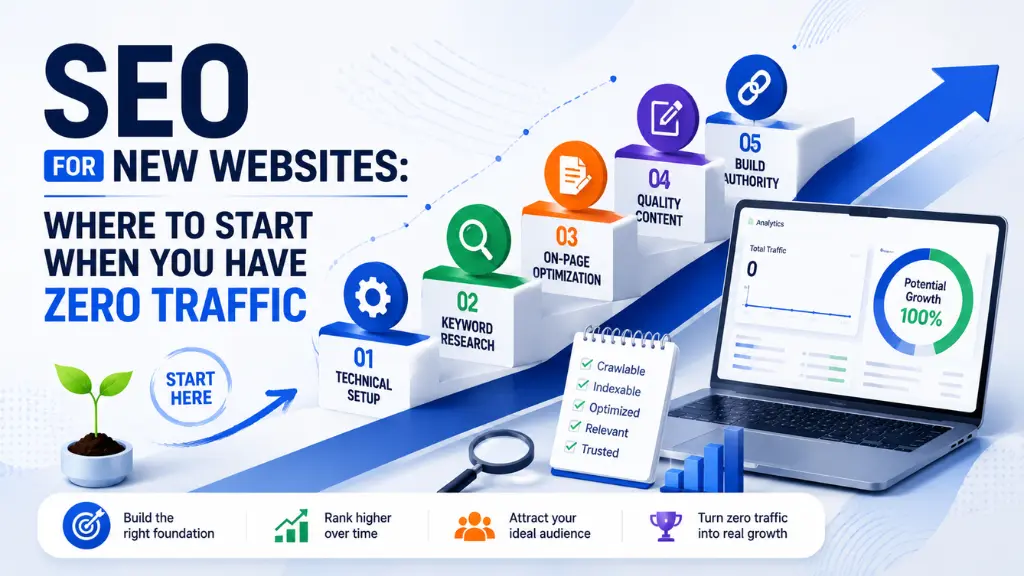
SEO for new websites should begin with foundational technical setup – completed before any content is published, not added retroactively after you notice traffic is not arriving.
Set up and verify Google Search Console immediately. This is non-negotiable and should happen on day one. Google Search Console is how Google communicates indexing status, crawl errors, and search performance data directly to you – and it is also the tool you will use throughout this entire process to monitor progress.
Connect Google Analytics 4. GA4 tracks your actual visitor behaviour once traffic begins arriving, giving you the data needed to understand which pages and channels are working as your site grows.
Submit your XML sitemap. A clean, accurate sitemap tells Google exactly which pages on your site you want crawled and indexed – accelerating the discovery process for a domain Google has no prior history with.
Confirm your technical foundations are clean before publishing at scale. SSL certificate installed and active, mobile responsiveness verified, page speed tested through Google PageSpeed Insights, and a logical, crawlable site structure with no broken internal links. A real case study from a dermatology practice that launched in 2025 with excellent content and proper technical setup – schema, XML sitemap, SSL, Google Business Profile connected – still saw near-zero organic traffic for two full months. Strong technical setup does not bypass the evaluation period; it simply ensures you are not adding unnecessary additional delay on top of it.
Connect Google Business Profile if you have any local presence. For any business with a physical location or defined service area, claiming and fully completing your Google Business Profile supports local search visibility on a timeline that is often faster than core organic ranking for competitive national keywords.
People Also Ask: What is the first thing I should do for SEO on a new website? Short Answer: Set up and verify Google Search Console on day one, before publishing significant content. This is the tool that confirms whether Google has discovered and indexed your pages, surfaces crawl errors, and provides the search performance data you will rely on throughout the entire growth process. Submitting a clean XML sitemap and confirming basic technical health – SSL, mobile responsiveness, page speed – should happen alongside Search Console setup, before scaling content production.
How Should You Choose Keywords for SEO on a New Website?
SEO for new websites requires a fundamentally different keyword strategy than an established site can use – because competing directly for high-volume, high-competition keywords is close to impossible for a domain with no ranking history or authority signal yet.
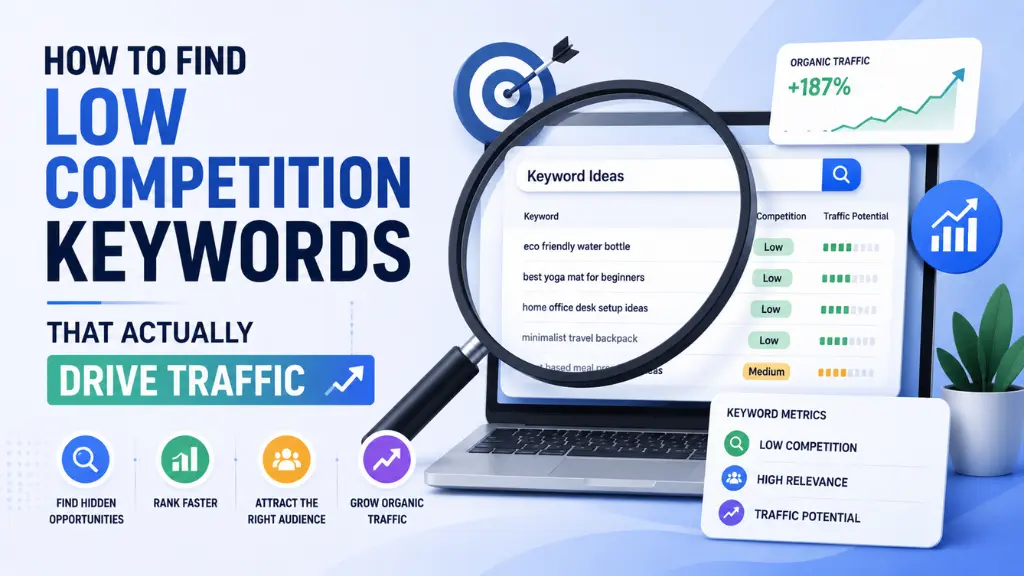
Starting with long-tail keywords can be highly effective for new websites. These keywords are less competitive and more specific, which means they can attract targeted traffic faster than broad, high-volume terms that established competitors already dominate. A new business consultancy targeting “business consulting” will struggle for years against established competitors. The same business targeting “business consulting for first-time exporters in Maharashtra” faces dramatically less competition and can realistically rank within months, not years.
The practical keyword selection process for SEO for new websites:
- Identify long-tail variations of your core topics – specific, multi-word phrases that reflect exactly what a narrower segment of your audience is searching for, rather than broad single or two-word terms.
- Prioritise keywords with clear search intent match to your content. A keyword where the searcher’s intent aligns precisely with what your page offers converts and ranks better than a higher-volume keyword with ambiguous or mismatched intent.
- Check the actual competition for each keyword, not just search volume. Use Google Search Console data once available, or tools like Ahrefs or Semrush, to evaluate which keywords have realistically rankable competition for a brand-new domain.
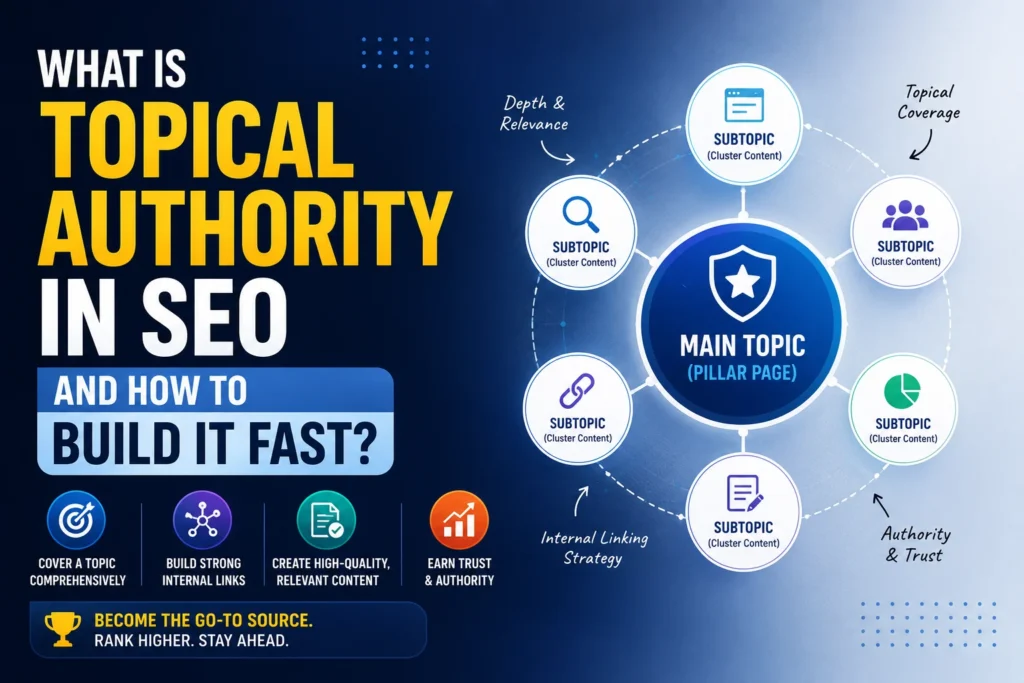
- Build a pillar-and-cluster structure from the start, even with a small initial content set. One comprehensive pillar page covering your core topic, supported by several focused cluster articles on specific subtopics – all internally linked together – establishes topical authority signals far more effectively than scattered, disconnected individual articles.
People Also Ask: Should new websites target high-volume keywords or long-tail keywords first? Short Answer: New websites should prioritise long-tail keywords first. These are more specific, multi-word search phrases with lower competition, making them realistically rankable for a domain with no existing authority or backlink history. High-volume, broadly competitive keywords are typically dominated by established sites and are extremely difficult for a new domain to rank for in its first 6 to 12 months. Building initial traffic and authority through long-tail keywords creates the foundation that eventually supports competing for more competitive terms.
How Much Content Do You Need to Publish for SEO on a New Website?
SEO for new websites benefits more from consistency and depth than from raw publishing volume – a distinction that often surprises business owners eager to scale traffic quickly.
For new sites, aim for 2 to 4 high-quality articles per month minimum, prioritising depth over frequency. One comprehensive 2,000-word guide consistently outperforms four shallow 500-word posts covering the same general territory, because Google’s quality evaluation systems reward genuine depth and information completeness over surface-level coverage spread across more individual pages.
The recommended approach for new sites specifically:
- Write for search intent first, then determine length. Cover the topic completely enough to satisfy what the searcher actually needs, then let the natural depth of that coverage determine the final word count – rather than targeting an arbitrary length before considering what the topic genuinely requires.
- Build a deliberate pillar-and-cluster content structure, even in your first month. A pillar page covering your primary topic comprehensively, with cluster pages exploring specific subtopics in more depth, all internally linked together, demonstrates topical authority far more effectively to Google’s evaluation systems than the same number of disconnected articles.
- Use 4 to 5 relevant internal links per page, checking carefully for genuine topical relevance to the linked content rather than linking indiscriminately. Internal links help pass link equity from stronger pages to newer or lower-authority pages, accelerating how quickly your full site structure builds authority together.
- Optimise images for SEO from the start. Images are an important and often overlooked part of SEO, helping generate a meaningful amount of organic traffic through Google Image Search specifically – a discovery channel many new sites ignore entirely in their first months.
People Also Ask: How many blog posts does a new website need before it starts ranking? Short Answer: There is no fixed number, but consistency matters more than volume – 2 to 4 high-quality articles per month is a realistic and sustainable benchmark for new sites. Prioritising fewer, more comprehensive articles structured around a pillar-and-cluster topic architecture builds topical authority signals faster than publishing a higher volume of shallow, disconnected content. Most new sites see initial ranking movement on long-tail keywords within the first few months, with broader authority building over 6 to 12 months of consistent publishing.
What Technical SEO Elements Matter Most for New Websites?
SEO for new websites requires getting a specific set of technical fundamentals right from the outset – not because technical perfection accelerates the Sandbox evaluation period, but because technical problems compound and become significantly harder to fix once a site has scaled.
Schema markup helps search engine bots better understand the context of your web page or content, supporting both traditional rich result eligibility and the AI citation systems that increasingly determine visibility in 2026’s search landscape. Implementing basic Organisation and Article schema from your very first published pages establishes this foundation correctly rather than retrofitting it later across hundreds of pages.
A clean, logical URL structure that reflects your site’s topic hierarchy supports both user navigation and search engine crawling efficiency – and changing URL structures after a site has accumulated some initial indexing and ranking history risks losing the early progress you have made.
Mobile responsiveness and Core Web Vitals are confirmed ranking factors that apply equally to new and established sites – meaning a new site with poor mobile performance is at a real, measurable disadvantage from its very first indexed page, not just once it scales.
A logical internal linking structure built in from the beginning, rather than retrofitted after dozens of pages already exist without connection to each other. Establishing this discipline early, while your site is small enough to manage manually, prevents the much larger remediation project that comes from untangling poor internal linking across a site that has grown to 100+ pages without it.
According to Search Savvy’s insights from launching and growing new websites across multiple industries, the most common technical mistake we see is businesses treating technical SEO as a “fix it later” item once traffic starts appearing. By the time traffic justifies the fix, the site has often scaled to a size where the same fix requires significantly more time and resources than it would have during initial launch.
People Also Ask: Does schema markup help new websites rank faster? Short Answer: Schema markup does not bypass the new-site evaluation period, but it does help search engines and AI systems understand your content’s context more precisely from the moment it is indexed – supporting both traditional rich result eligibility and the AI citation systems increasingly relevant to 2026 search visibility. Implementing basic schema (Organisation, Article, LocalBusiness where applicable) from a site’s earliest pages is significantly easier than retrofitting it across a larger, established site later.
How Should You Build Authority and Backlinks for a New Website?
SEO for new websites requires off-page authority building that complements, rather than substitutes for, the on-page and technical fundamentals already in place – and backlink strategy for a brand-new domain looks meaningfully different from backlink strategy for an established one.
The realistic off-page priorities for a new site’s first several months:
- Claim and complete consistent business listings across relevant directories, ensuring your Name, Address, and Phone (NAP) data matches exactly across every platform – a foundational local SEO signal that is faster to establish than competitive organic authority.
- Pursue genuine, relevant backlinks rather than volume. A small number of links from genuinely relevant, reasonably authoritative sites in your industry carries significantly more weight for a new domain than a large volume of low-quality, irrelevant links – and irrelevant or spammy link volume can actively work against a new site’s trust evaluation.
- Leverage existing relationships and partnerships for initial link opportunities – suppliers, partners, industry associations, and any organisations your business already has genuine relationships with are often the fastest, most legitimate early link sources available to a new site.
- Publish genuinely citable content – original data, case studies, or comprehensive resources that other sites in your industry would want to reference naturally, rather than relying entirely on manual outreach for every single link.
People Also Ask: Do new websites need backlinks to start ranking? Short Answer: Backlinks support authority building, but they are not the first priority for a brand-new website – strong on-page content, technical health, and search intent matching matter more in the earliest months, when long-tail keywords with realistic competition are the primary ranking opportunity. As a new site matures and begins targeting more competitive keywords, a small number of genuinely relevant, quality backlinks becomes increasingly important – significantly more so than pursuing high link volume, which can actively damage trust signals for an unestablished domain.
How Do You Measure Progress When SEO for a New Website Has Zero Traffic?
SEO for new websites requires measuring genuinely meaningful leading indicators during the period before traffic itself becomes a usable metric – because waiting for traffic alone to validate your strategy means waiting months before knowing whether your approach is actually working.
The metrics worth monitoring weekly and monthly during the early months:
- Indexed page count in Google Search Console – confirms Google is actually discovering and indexing your content, the essential prerequisite before any ranking can occur at all.
- Impressions, even without clicks – Search Console will show impression data (how often your pages appear in search results) often well before meaningful click-through traffic arrives, and rising impressions are a genuine early signal that your content is being considered for relevant queries.
- Average position movement for target keywords, tracked over time even while still ranking on page 2 or 3 – gradual upward movement is a meaningful leading indicator of progress, even before that movement crosses onto page 1.
- Core Web Vitals scores via PageSpeed Insights, checked monthly to confirm technical health is being maintained as new pages and features are added.
Sites that maintain a weekly and monthly SEO rhythm consistently outrank those that rely on occasional large audits. Start with weekly Search Console checks and monthly content publishing – these two habits alone compound measurably over 12 months, even when the early weeks show very little visible movement.
People Also Ask: How do I know if my new website’s SEO strategy is working before I see real traffic? Short Answer: Monitor leading indicators in Google Search Console rather than waiting for traffic alone to validate your approach. Rising indexed page count confirms Google is discovering your content. Growing impressions – even without proportional clicks yet – show your pages are being considered for relevant search queries. Gradual average position improvement for target keywords, even while still ranking on page 2 or 3, is a genuine early signal of progress that typically precedes visible traffic growth by several weeks to a few months.
FAQ: SEO for New Websites – Your Questions Answered
Q1: Is it normal to see zero or near-zero traffic for the first few months of a new website? Yes, entirely normal. The evaluation period commonly referred to as the Google Sandbox is widely estimated at 6 to 9 months for meaningful ranking movement, based on observation across the SEO industry. Even sites with strong content and proper technical setup frequently see minimal organic traffic in their first two to three months. This is a predictable starting condition for new domains, not necessarily a sign that something is fundamentally wrong with your strategy – though it is worth confirming basic technical health (indexing, crawl errors, mobile usability) to rule out genuine problems alongside the normal evaluation period.
Q2: Should I focus on SEO or paid ads first for a brand-new website? Many businesses use both in combination during the early months specifically because of the SEO evaluation timeline. Since quick organic wins are rare for genuinely new sites, businesses needing immediate traffic and leads often invest in paid ads or social media as a bridge during the first several months, while SEO fundamentals are being built and the evaluation period plays out in the background. This is not a sign that SEO failed – it is a recognition that SEO and paid acquisition operate on fundamentally different timelines, and using paid channels for early traction while SEO compounds in the background is a common, sensible strategy.
Q3: What is the single biggest mistake new websites make with SEO? The most common mistake is abandoning a sound strategy too early because results have not appeared within the first 4 to 8 weeks – a timeline that is simply too short to evaluate SEO for a new domain fairly, given the realistic 6 to 9 month evaluation period most new sites experience. The second most common mistake is targeting broad, highly competitive keywords from the start rather than building initial traction through long-tail, lower-competition terms first. Both mistakes stem from applying established-site SEO expectations to a brand-new domain that has not yet had the opportunity to build the trust and authority signals Google’s evaluation systems require.
Q4: Does the type of website (blog, e-commerce, service business) change the SEO approach for new sites? The core fundamentals – technical setup, search intent matching, long-tail keyword targeting, and consistent content publishing – apply across all website types. However, the specific priorities differ: e-commerce sites should prioritise product and category page optimisation alongside content, service businesses should prioritise local SEO signals (Google Business Profile, local citations, NAP consistency) if they serve a defined geographic area, and content-focused sites should prioritise the pillar-and-cluster content architecture described in this article as their primary growth lever from day one.
Q5: How important is E-E-A-T for a brand-new website specifically? Increasingly critical, particularly following Google’s March 2026 Core Update, which enforced E-E-A-T (Experience, Expertise, Authoritativeness, Trustworthiness) signals at unprecedented scale. For new sites in YMYL categories – health, finance, legal – the evaluation period now functionally extends until sufficient E-E-A-T signals have accumulated, meaning sites with unnamed authors, no visible expert credentials, and no demonstrable real-world experience may struggle to exit the evaluation period regardless of how long they wait. Establishing named author attribution, visible credentials, and transparent business information from a site’s very first pages is now a foundational requirement, not an optional enhancement, for any new site in a sensitive category.
Q6: Can hiring an SEO agency speed up results for a new website? An experienced agency can help avoid common early mistakes, accelerate technical setup, and build a more strategically sound content and keyword foundation than most businesses would establish independently – but no agency can fully bypass the underlying evaluation period new domains genuinely experience. The realistic value of professional support for SEO for new websites is ensuring the foundational work is done correctly the first time, avoiding the wasted months that come from chasing the wrong keywords, publishing disconnected content, or fixing technical problems retroactively – rather than promising to eliminate the evaluation timeline entirely, which is not something any agency can legitimately guarantee.
Launched a new website and not sure whether your zero-traffic period is normal or a sign something needs fixing? Visit Search Savvy for a new-site SEO audit that confirms your technical foundation, keyword strategy, and content plan are correctly set up for the months ahead.