
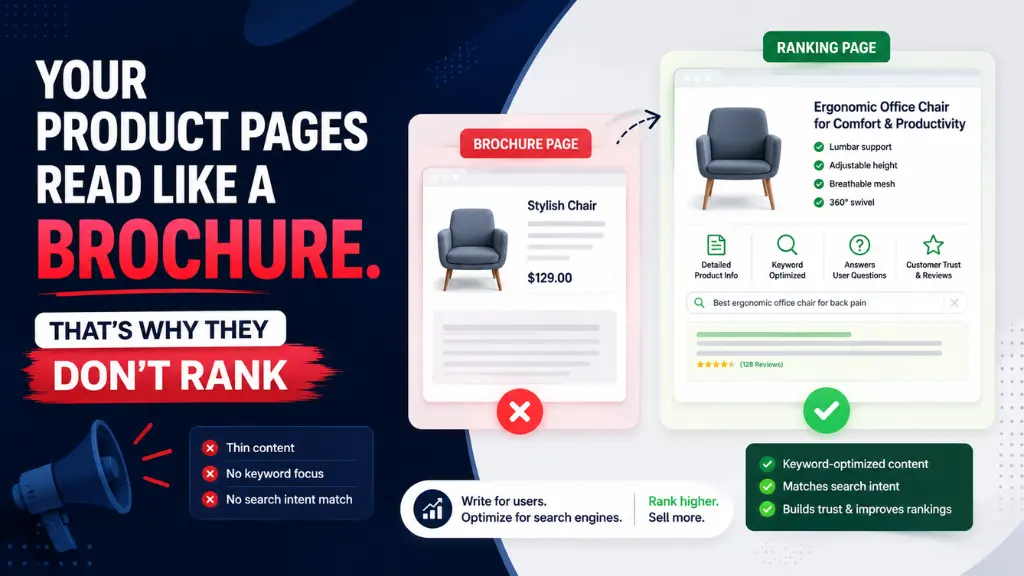

Ecommerce product page SEO is where most online stores leave the most significant organic growth opportunity untouched – not because the opportunity is hidden, but because the product page itself is built for the customer who is already convinced, not the customer who is still searching.
A brochure presents features. A product page that ranks answers questions. The difference sounds simple. In practice, it is the gap between a page that converts the traffic your ads bring and a page that earns the traffic your competitors are paying for.
The 2026 ecommerce SEO landscape has sharpened this gap further. Google AI Mode launched on January 27, 2026. Only 38% of AI-cited product pages rank in the traditional top 10 – meaning you can rank #1 and still be absent from the AI Overview box, or rank #15 and appear in the AI answer if your structured data, content, and trust signals are stronger. The rules changed. Most product pages have not.
At Search Savvy, ecommerce SEO audits are part of our core service offering – and the finding that comes up most consistently is this: product descriptions are written for brochure reading, not intent matching. The keywords are there. The images are good. The schema is partially implemented. And the page is invisible in organic search because it doesn’t answer the questions a buyer actually asks before clicking “Add to Cart.”
This post covers every element of ecommerce product page SEO that determines rankings and AI Overview eligibility in 2026 – and the specific mistakes that most Indian D2C brands and ecommerce stores are making right now.
What Makes an Ecommerce Product Page Rank in 2026?
Ecommerce product page SEO in 2026 operates on four pillars simultaneously. Pages that lean on one pillar – schema only, or speed only, or content only – are no longer enough. The four pillars that win rankings and AI citations in 2026 are:
- Technical performance – Core Web Vitals, mobile-first loading, INP (Interaction to Next Paint)
- Structured data – attribute-rich Product, Offer, Review, and FAQ schemas
- Buyer-intent content – product descriptions written for the questions buyers ask, not just features they’ll read after purchase
- Trust signals – real reviews, transparent pricing, identifiable brand, return policy clarity
A critical 2026 shift makes this framework more urgent: ecommerce SEO is no longer only about ranking in blue links. Product pages now need to be eligible for AI Overviews, AI Mode, Shopping panels, and Google’s Merchant Center product display simultaneously. Google has formalised that the same foundational requirements apply across all these surfaces: crawlable, indexed, meeting snippet eligibility, structured data present, and content matching the page accurately.
The good news embedded in that data point about 38% of AI-cited pages ranking outside the traditional top 10: strong product page foundations can earn AI visibility before traditional ranking authority. The content and schema strategy determines AI eligibility. The traditional authority signals determine ranking position. Both matter. Neither alone is sufficient.
Why Do Most Product Descriptions Fail for SEO?
Ecommerce product page SEO fails at the description level because most product copy is written from the seller’s perspective, not the buyer’s search intent. A classic brochure-style product description looks like this:
“Our premium camphor tablets are crafted from 100% natural ingredients using our proprietary cold-press extraction process. Available in 10g, 25g, and 50g variants, our tablets deliver a pure, intense fragrance for your daily rituals. Manufactured to ISO 9001 standards.”
This description is not wrong. It contains accurate information. But it answers no question a buyer would actually type into Google before purchasing. It will not rank for “camphor tablets for pooja how much to use” or “are camphor tablets safe to burn indoors” or “camphor tablets vs liquid camphor for home” – the queries that capture buyers at the decision stage.
What Google actually evaluates on product pages in 2026:
- Does the page answer the questions buyers ask before purchasing this product?
- Does it demonstrate product expertise through specific, useful detail?
- Does the on-page content match what the structured data claims?
- Does it contain trust signals (reviews, brand information, clear return policy) that indicate a legitimate seller?
- Is the content unique – not the manufacturer’s default description that appears on 50 other sites?
The buyer-intent content that earns rankings asks: What does this customer need to know before they feel confident purchasing?
That question produces completely different content from “what features should I list?” It produces answers to common objections, comparisons with alternatives, use case guidance, dosage or application instructions, and the specific details that a buyer on Google is searching for when they are close to a purchase decision.
How Do You Write Ecommerce Product Descriptions That Actually Rank?
Ecommerce product page SEO at the content level requires a structural approach that most product teams have never been taught, because most product copywriting training focuses on conversion psychology, not search intent matching.
The Product Description Framework for 2026
Section 1: The Keyword-Led Answer Opening (50–80 words)
The first paragraph of your product description – visible before the “Read More” fold – should answer the primary commercial intent query that brought the buyer to this page. If a buyer searched “waterproof running shoes for flat feet men,” your opening paragraph should confirm that the product matches that intent with specific, direct language.
This is not about keyword stuffing. It is about intent alignment – the page’s first visible content should confirm to both the buyer and Google that they arrived at the right page for their query.
Section 2: Specific Feature-to-Benefit Translation (100–200 words)
Features mean nothing without the user benefit they deliver. “500-thread-count Egyptian cotton” is a feature. “Stays cool even in Mumbai summer humidity – you’ll notice the difference the first time you sleep on it” is a benefit. Every technical specification should be translated into the outcome the buyer experiences.
Buyers search for outcomes: “best pillow for neck pain side sleeper,” not “orthopedic memory foam 60 density pillow.” Your description should bridge the feature and the outcome explicitly.
Section 3: Use Case and Buyer Context (100–150 words)
Who is this product for? What situations does it solve? What should the buyer know about using it? This section captures the long-tail queries that drive the highest-converting product page traffic – because buyers who search specific use cases are closer to purchase than buyers searching generic category terms.
“Best for: home pooja rituals, yoga spaces, and car fragrancing. Use 2–3 tablets at a time in a heat-resistant holder. Avoid use in sealed rooms with poor ventilation.”
That 30-word use case section captures queries that a feature list never would – and captures buyers at high intent.
Section 4: Differentiation From Alternatives (50–100 words)
Why this product over the alternatives? This section serves both buyers comparing options and the “X vs Y” query cluster that generates significant commercial intent traffic. Briefly, specifically, and honestly addressing how your product compares to the obvious alternatives – not in a promotional way but in a factual, helpful way – adds search relevance and buyer confidence simultaneously.
What Structured Data Does an Ecommerce Product Page Need in 2026?
Ecommerce product page SEO in 2026 requires structured data that extends well beyond a basic Product schema block. Google’s official documentation is explicit: to be eligible as a supporting link in AI Overviews and AI Mode, your page must meet Search technical requirements – and structured data is part of that eligibility.
The required schema stack for product pages:
Product Schema (mandatory):
- name – the product’s exact title
- description – matches the visible page description (schema and page content must match)
- image – high-resolution, multiple angles preferred
- sku – unique product identifier
- brand – with @type: Brand and the brand name
Offer Schema (within Product, mandatory):
- price – current selling price
- priceCurrency – INR for Indian stores
- availability – InStock, OutOfStock, or PreOrder
- url – canonical product URL
AggregateRating Schema (high priority):
- ratingValue – average rating
- reviewCount – number of reviews
- This data displays as star ratings in search results – one of the strongest CTR improvement levers available
Review Schema (supplementary):
- Individual review data: author, rating, review body, and date
- Freshness of reviews is evaluated – old reviews with no new additions signal stale product trust
FAQPage Schema (for products with common buyer questions):
- Include 3–5 questions buyers actually ask about this product category
- These questions contribute directly to AI Overview eligibility – the product FAQ is one of the most reliable AI citation surfaces on an ecommerce site
One critical 2026 rule: Google explicitly recommends using structured data correctly and ensuring it matches what’s visible on the page, and Merchant Center product data quality impacts whether products appear in Shopping features. Schema that diverges from page content creates a policy violation that can suppress all structured data features from your pages.
How Does Duplicate Product Content Hurt Ecommerce SEO?
Ecommerce product page SEO is significantly damaged by duplicate content at the product level – the most common and least-addressed technical issue in most online stores.
Duplicate product content appears in three forms:
1. Manufacturer or supplier descriptions The vast majority of product descriptions on multi-brand ecommerce stores are the same manufacturer copy that appears on every retailer selling the same product. Google indexes this content from the manufacturer or the largest authority site first and treats all subsequent uses as duplicate. Your product page, using the manufacturer’s default description, has zero differentiating content from a search perspective.
2. Product variant duplication A blue 500ml water bottle and a red 500ml water bottle with identical descriptions, pointing at essentially the same content with only a colour parameter in the URL, create a duplicate content cluster. Each variant should have a canonical URL pointing to the primary variant unless the variants have genuinely distinct content (size, material, use case).
3. Category and tag URL proliferation Filtering parameters (colour, size, material), pagination pages, and tag archives all create URL variants of the same product content. Without canonical tags, robots.txt rules, or proper parameter handling in Google Search Console, these proliferate as thin or duplicate content that wastes crawl budget and dilutes ranking signals.
The fix hierarchy:
- Write unique, buyer-intent-focused descriptions for every product (or at minimum every product category’s top-performing pages)
- Use rel=canonical to point all variant URLs to the primary product URL
- Configure URL parameters in Google Search Console to prevent thin filter pages from consuming crawl budget
- Implement breadcrumb schema and clear category hierarchies that help Googlebot understand your product architecture
Why Do Product Page Images Matter for SEO in 2026?
Ecommerce product page SEO in 2026 requires treating image optimisation as a ranking and conversion issue simultaneously. Google’s guidance is explicit: alt text matters and helps Google understand images alongside the page content.
Keep in mind that in e-commerce, image quality can be a decisive factor in the purchase decision – a highly compressed but pixelated image can lead to a rejection of the purchase. This dual pressure – Google needs readable alt text, buyers need quality images – requires a specific optimisation approach.
Product image SEO requirements:
- Alt text: descriptive, specific, not keyword-stuffed – “black leather ankle boots with side zip for women size 6–9” is correct; “buy leather boots cheap India” is not
- File format: WebP for all product images in 2026 – 25–35% smaller than JPEG/PNG at equivalent quality
- File naming: descriptive filenames (“organic-camphor-tablets-25g-pack.webp”) rather than manufacturer codes (“SKU-04451-A.jpg”)
- Image sitemap: for stores with large product catalogs, a dedicated image sitemap ensures Google discovers all product images
- Page weight: all product images combined should load the above-the-fold content in under 2.5 seconds – unoptimised product images are the primary cause of poor LCP scores on ecommerce pages
- Multiple angles: Google’s product image guidance for Shopping results and AI product panels favours multiple high-quality images (front, back, lifestyle, detail) – single-image product pages rank less well in image-dependent shopping surfaces
How Should Ecommerce Product Pages Handle Reviews for SEO?
Reviews are one of the most underused ecommerce product page SEO assets – because most ecommerce teams treat them as a trust signal for buyers and miss their significance as a ranking signal for Google.
Product reviews serve ecommerce SEO in three distinct ways:
Fresh content signals: Every new review adds genuinely new content to the page. Google’s freshness signals treat product pages with recent, frequent reviews as actively maintained and relevant – a strong quality indicator for competitive ecommerce queries.
Long-tail keyword capture: Customer reviews naturally contain the language buyers use to describe the product – not the marketing language the brand uses. “Works great for my sensitive skin even in Delhi summer” contains intent-specific language (“sensitive skin,” “summer”) that the brand’s description might never include but that buyers searching those terms will find.
AggregateRating schema in search results: Star ratings displayed directly in search results are one of the highest-impact CTR improvements available for product pages. Pages with visible star ratings consistently achieve higher click-through rates than equivalent pages without – meaning more of your existing organic traffic converts from impression to click without any improvement in ranking position.
What Is the Ecommerce Product Page SEO Audit Checklist for 2026?
According to Search Savvy’s ecommerce SEO framework, a complete product page audit covers these elements in priority order:
Technical foundation:
- Product page LCP under 2.5 seconds (verified via Google PageSpeed Insights)
- INP under 200ms – no render-blocking scripts on product pages
- Mobile-optimised product images and tap targets
- Canonical URLs for all product variants
- URL parameter configuration in Google Search Console
Structured data:
- Product schema with complete name, description, image, sku, brand, and offers
- AggregateRating schema (if reviews exist on the page)
- FAQPage schema with 3–5 product-specific buyer questions
- Schema validated via Google’s Rich Results Test
- Schema content matches visible page content exactly
Content:
- Unique product description (not manufacturer’s default copy)
- Keyword-led opening paragraph answering the primary commercial intent query
- Feature-to-benefit translation for every key specification
- Use case section capturing long-tail buyer query intent
- Word count: 200–500 words for product descriptions (enough for content substance, not so much that conversion friction increases)
Trust signals:
- Product reviews visible on the page (minimum 5 for schema eligibility)
- Clear return and refund policy (linked, not buried)
- Brand information visible (About section or brand schema)
- Shipping information with specific delivery windows
FAQ: Ecommerce Product Page SEO in 2026
Q1: How long should an ecommerce product description be for SEO? For most product pages, 200–500 words is the optimal range in 2026 – enough to include buyer-intent content, use case guidance, and keyword-relevant specifics without creating conversion friction. Product pages are not informational blog posts; they serve commercial intent, and length beyond 500 words often increases bounce rates without improving rankings. The exception is complex or high-ticket products where buyers need extensive information to make a purchase decision – these can justify 800–1,200 words.
Q2: Does copying manufacturer product descriptions hurt SEO? Yes – significantly. Manufacturer descriptions appear on every retailer selling the same product, creating duplicate content that Google’s systems identify immediately. The original source (manufacturer or largest authority retailer) receives the content credit. Your product page, using identical copy, receives no ranking benefit and may be suppressed in favour of the original. Writing unique product descriptions is the highest-impact content investment for ecommerce stores with large catalogs – prioritise your top-20 products first.
Q3: What schema markup does a product page need to appear in Google Shopping and AI Overviews? At minimum: Product schema with name, description, image, sku, brand, offers (with price, priceCurrency, and availability). For AI Overview and AI Mode eligibility, add AggregateRating (from real reviews), Review schema, and FAQPage schema for common buyer questions. Google explicitly requires that schema content matches what is visible on the page – mismatches are a policy violation that suppresses all structured data features.
Q4: How do product reviews improve ecommerce SEO? Product reviews improve SEO in three ways: they add fresh content to the page, which Google’s freshness signals interpret as an actively maintained product; they naturally include the long-tail buyer language that manufactured descriptions miss; and AggregateRating schema from reviews enables star ratings in search results, which improves CTR from organic impressions without requiring any ranking improvement. Stores that systematically request reviews after purchase consistently see higher organic CTR and dwell time than equivalent stores that don’t.
Q5: How do ecommerce product pages rank in Google AI Overviews? Only 38% of AI-cited product pages rank in the traditional top 10 for the same query – meaning strong structured data and content signals can earn AI Overview inclusion before high ranking authority. For product page AI Overview eligibility: ensure the page is indexed, meets Core Web Vitals thresholds, has complete Product and AggregateRating schema, includes a buyer FAQ section with FAQPage schema, and contains content that directly answers the queries AI Overviews are typically triggered by (comparison queries, “best X for Y” queries, and “how to use” queries for the product category).
Q6: Why do product pages rank lower than category pages for the same keywords? Category pages typically have stronger internal linking, higher crawl priority, and broader content coverage than individual product pages. For competitive category-level keywords, category pages are usually the correct ranking target – product pages should rank for specific product model queries, long-tail buyer-intent queries, and use-case specific searches. Attempting to rank a product page for a broad category keyword (“running shoes”) instead of a specific product query (“Nike Air Zoom Pegasus 42 men’s wide fit”) is a common intent-mismatch error. Align your product page keyword targeting to the buyer’s decision stage, not the awareness stage.
The Bottom Line
Ecommerce product page SEO in 2026 requires that your product pages do two jobs simultaneously: serve the buyer who is ready to purchase, and answer the questions of the buyer who is still researching. Most product pages do only the first – and they reach only the buyers that paid advertising sends directly to them, while leaving organic search traffic to competitors whose pages do both.
The shift is not complicated. Replace manufacturer copy with unique, buyer-intent content. Implement the complete structured data stack – not just basic Product schema. Build a buyer FAQ section that captures the long-tail queries your category generates. Make every image work for both the buyer’s confidence and Google’s image search. And measure AI Overview citation frequency alongside traditional ranking positions, because in 2026 you can rank #1 and still be invisible in the AI box that appears above your listing.
At Search Savvy, the ecommerce SEO work we do consistently produces the same finding: the stores gaining organic share in 2026 are not the ones with the most products or the biggest paid budgets. They are the ones whose product pages answer the questions the buyer was already asking before they arrived – and whose structured data tells Google exactly what to cite when those questions are asked in an AI Overview.
If you want an ecommerce product page SEO audit that benchmarks your pages against 2026 ranking and AI citation requirements, reach out to the Search Savvy team.