
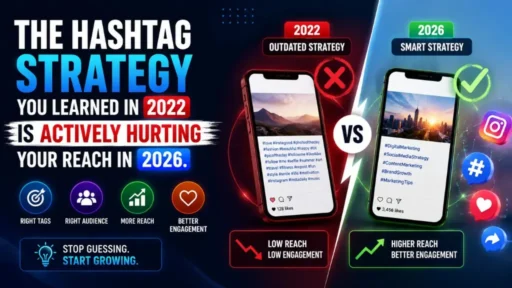
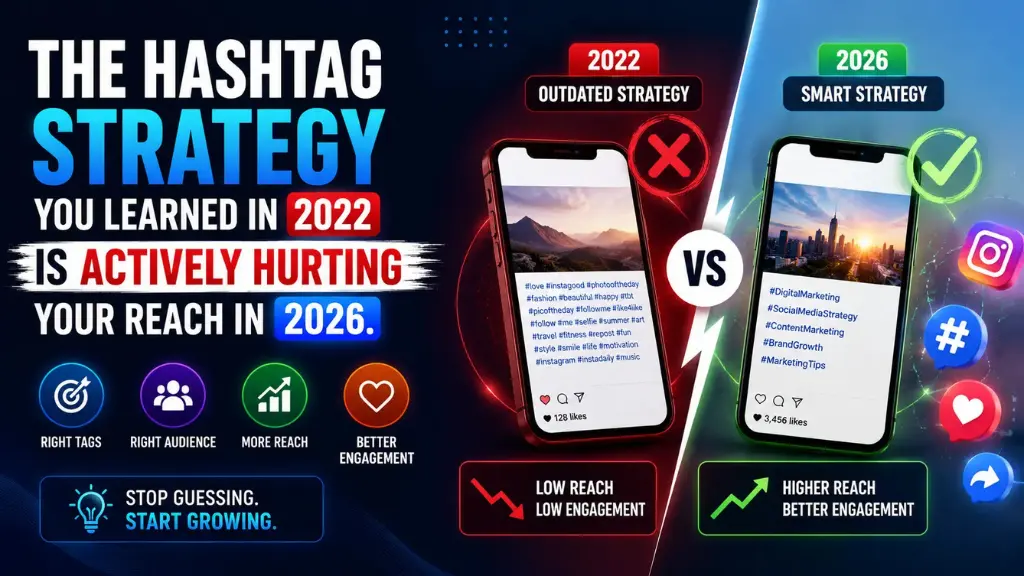

Hashtag strategy has changed more dramatically in the last three years than in the entire decade before it – and the 2022 playbook that most brands are still running is not just ineffective, it is actively working against them. If you are posting 20–30 hashtags on every Instagram post, copying those same hashtags across your LinkedIn content, and measuring hashtag success by impressions from large trending tags, you are following a strategy that the platforms themselves have explicitly stated they no longer reward.
This is not a minor recalibration. Adam Mosseri, head of Instagram, stated plainly in 2025 that hashtags are now categorisation signals, not reach amplifiers. LinkedIn removed hashtag following entirely, repositioning hashtags as SEO signals rather than discovery tools. TikTok’s algorithm rewards visual content quality and watch time so heavily that hashtags are a distant supporting signal rather than the distribution engine they once appeared to be.
At Search Savvy, we see the consequences of outdated hashtag strategy in social media audits constantly: accounts with consistent posting, strong content, and 25-hashtag stacks that are reaching a fraction of their potential audience – not because the content is wrong but because the signal it sends to the algorithm is. This post gives you the current, platform-specific hashtag strategy that works in 2026, and explains precisely what changed and why.
What Changed About Hashtag Strategy Between 2022 and 2026?
Hashtag strategy worked on a fundamentally different principle in 2022 than it does today. Understanding the shift is the foundation of not repeating the same mistakes at a higher frequency.
In 2022, hashtags were primarily discovery mechanisms. Users on Instagram followed hashtags. Search results on LinkedIn surfaced posts by hashtag. TikTok’s early algorithm used hashtag signals heavily because it had less behavioural data on users to work with. The “more is more” philosophy – 20–30 hashtags on Instagram, 10–15 on LinkedIn – had genuine reach logic behind it: more hashtags meant more surfaces on which your content could appear.
By 2026, the fundamental role of hashtags on every major platform has changed:
- Instagram removed the ability to follow hashtags in a 2023 update, eliminating the primary mechanism by which hashtag-following reached new users. Posts no longer appear in “following” feeds based on hashtag use.
- LinkedIn removed hashtag following, eliminated hashtag profile displays, and stopped surfacing hashtags in dropdown search – repositioning them explicitly as algorithm context signals, not user-facing discovery tools.
- Instagram’s internal tests confirmed that using more than five hashtags can signal to the algorithm that a post is low-intent – causing it to be shown less in feeds and Reels.
- LinkedIn’s algorithm now treats posts with 10+ hashtags as potential spam, which actively reduces organic reach rather than extending it.
The direction of travel across all platforms is identical: fewer, more relevant hashtags as semantic signals, not many hashtags as reach-maximisation tools. The accounts still running the old playbook are not just wasting characters – they are sending a negative signal to the algorithm with every post.
How Does Hashtag Strategy Work on Instagram in 2026?
Hashtag strategy on Instagram has the clearest documented shift of any platform. The guidance from Instagram itself, confirmed by Adam Mosseri’s public statements and internal platform data in 2025, is a dramatic reduction from the 20–30 hashtag norm of 2022.
The 2026 Instagram hashtag standard:
- Recommended count: 3–5 hashtags per post
- Instagram allows up to 30, but officially recommends keeping to 3–5
- Posts with more than five hashtags may see reduced reach – the algorithm now prioritises quality categorisation over quantity coverage
- Hashtags are categorisation signals – they tell the algorithm what your post is about so it can be distributed to the right users
- They are no longer standalone discovery tools since the removal of hashtag following
What this means for your content:
The 2022 approach was to load captions with a mix of large, medium, and small hashtags – the “30 hashtag stack” built on the theory that some would land in the right feeds and generate reach. That theory was always somewhat tenuous, but it worked at scale when hashtag following was active. With following removed, that mechanism is gone.
In 2026, the question is not “which 25 hashtags should I use?” – it is “which 3–5 hashtags most precisely describe what this post is about?” The algorithm uses your hashtags to categorise your content, match it to user interest profiles, and decide which non-followers to show it to via Explore. Precision categorisation from 3–5 well-chosen tags outperforms broad coverage from 25 loosely-relevant ones.
The 2026 Instagram hashtag formula:
- 1 broad industry hashtag (e.g., #DigitalMarketing) – reach signal
- 1–2 niche-specific hashtags (e.g., #SEOIndia, #ContentStrategy2026) – precise categorisation
- 1 branded hashtag (e.g., #SearchSavvy) – brand community building
- Optional: 1 local hashtag if location-relevant (e.g., #MumbaiBusiness)
What to avoid:
- Generic high-volume hashtags (#instagood, #photooftheday, #love) – no categorisation value for brand content and now widely identified as spam signals
- Copying the same hashtag set to every post – stale hashtag use is detected and downweighted
- Placing all hashtags in the first comment instead of the caption – the 2026 evidence suggests caption placement performs equally well or better
How Does Hashtag Strategy Work on LinkedIn in 2026?
Hashtag strategy on LinkedIn has undergone the most significant structural change of any platform – not just in recommended count, but in the fundamental nature of what hashtags do on the platform.
LinkedIn’s changes between 2024 and 2026:
- Hashtag following removed – users can no longer follow hashtags to see content in their feed
- Hashtag profile displays eliminated – hashtags no longer appear as featured elements on personal profiles
- Dropdown hashtag search removed – hashtags are no longer surfaced as interactive discovery elements in search
What remains: hashtags function as algorithm topic signals – they tell LinkedIn’s AI what your post is about and contribute to how the algorithm categorises and distributes your content to relevant professional audiences.
The 2026 LinkedIn hashtag standard:
- Optimal count: 3–5 hashtags per post (LinkedIn’s official recommendation)
- Posts with 1–3 hashtags average 14.7 likes – the highest engagement efficiency benchmark
- Posts with 10+ hashtags are treated as potential spam and see reduced organic reach
- Hashtags should be placed at the end of the post, never in the first two lines – the first lines are visible before the “see more” cutoff and hashtags in that position waste prime real estate
The 2026 LinkedIn hashtag formula:
- 1 broad professional category tag (e.g., #Marketing, #SEO, #DigitalTransformation)
- 2 niche/industry-specific tags (e.g., #B2BMarketing, #SEOIndia, #ContentMarketing)
- 1 optional thought leadership or trending topic tag
Critically: LinkedIn’s algorithm cross-references your hashtags against your post content. Using hashtags that are irrelevant to your content’s actual topic – the old “tag for reach” approach – is explicitly counterproductive in 2026. Mismatched hashtags reduce distribution rather than expanding it.
How Does Hashtag Strategy Work on TikTok in 2026?
TikTok’s hashtag strategy has always operated differently from Instagram and LinkedIn – and in 2026, the gap has widened further as TikTok’s algorithm has matured from a hashtag-signal-dependent system to a highly sophisticated content analysis engine.
How TikTok’s algorithm actually works in 2026:
TikTok’s “For You Page” (FYP) algorithm distributes content based primarily on watch time, completion rate, and early engagement – not hashtags. The platform has enough behavioural data on users that it can accurately predict whether a given user wants to see a piece of content based on what they have watched, liked, saved, and shared – without needing hashtags to interpret the content.
What hashtags still contribute on TikTok:
- Content categorisation for the FYP algorithm – hashtags help the AI place your content in the right topic cluster for distribution to interested users
- Search discoverability – TikTok’s search function (used by an increasing percentage of Gen Z as a search engine alternative) surfaces content by hashtag and keyword
The 2026 TikTok hashtag standard:
- Optimal count: 4–6 hashtags
- Mix of broad, niche, and trending topic tags
- Focus on content category tags rather than generic lifestyle tags
- Trending hashtags (visible on the Discover page) can provide a short-term reach boost for content that genuinely fits the trend context
What not to do on TikTok:
- Avoid #fyp, #foryou, #viral – these are massively overcrowded, add no categorisation value, and signal low-intent posting
- Do not use unrelated trending hashtags to hijack attention – TikTok’s algorithm is sophisticated enough to detect content/hashtag mismatch and the FYP will not surface the content to relevant users regardless
How Does Hashtag Strategy Work on Other Platforms in 2026?
The hashtag strategy principles extend across every major platform – with important platform-specific adaptations:
Facebook’s algorithm has never been primarily hashtag-driven, and in 2026, this is more true than ever. The platform’s algorithm favours natural, text-first posts – posts that look like genuine human communication rather than keyword-tagged content.
The 2026 Facebook hashtag standard:
- 1–2 targeted hashtags per post maximum for most brands
- Place hashtags at the end of the post, not woven into the body text
- Primary value: minor categorisation support, not meaningful reach amplification
Threads
Threads is currently a low-hashtag environment. The platform’s algorithm in 2026 rewards conversational engagement and reply activity, not hashtag categorisation. Threads posts with 0–2 hashtags typically outperform heavily-tagged equivalents because the algorithm reads hashtag volume as a spam signal on a platform built around authentic conversation.
The 2026 Threads standard: 0–2 hashtags or none at all. Focus on conversation quality over categorisation.
YouTube
YouTube hashtags appear in video titles and descriptions. In 2026, they function primarily as search categorisation signals for YouTube’s search algorithm rather than as recommendation signals for the main feed. 3–5 relevant hashtags in the video description improve search visibility without risk of penalty.
What Is the Platform-by-Platform Hashtag Cheatsheet for 2026?
| Platform | Optimal Count | Primary Function | Key Rule |
| 3–5 | Categorisation signal | 5+ may reduce reach | |
| 3–5 | Algorithm topic signal | 10+ treated as spam | |
| TikTok | 4–6 | FYP categorisation | Watch time matters more |
| 1–2 | Minor categorisation | Natural text-first posts | |
| Threads | 0–2 | Minimal signal | Conversation > hashtags |
| YouTube | 3–5 | Search categorisation | Description placement |
| X (Twitter) | 1–2 | Topic context | Thread posts get 4.3x impressions |
What Does the New Hashtag Strategy Actually Look Like in Practice?
According to Search Savvy’s social media strategy framework, the shift from quantity to precision requires a different research and selection process than the 2022 hashtag stack approach.
Step 1: Research with intent
Stop looking for hashtags with the highest follower count. In 2026, the research question is: What hashtag would a person who is genuinely interested in this post’s specific topic be following or searching?
For a post about local SEO for Indian restaurants:
- Old approach: #seo #digital #marketing #restaurant #india #business #food #local #google #small business #growth [+15 more]
- New approach: #LocalSEO #IndiaRestaurantMarketing #GoogleBusinessProfile
The three tags in the new approach tell Instagram’s algorithm with precision that this content belongs to a specific professional cluster. The 20 tags in the old approach tell the algorithm almost nothing useful – and now trigger a quality penalty.
Step 2: Build a categorised hashtag library
Maintain a curated list of 15–20 hashtags across 3–4 content pillars – not to use all at once, but to select from for each specific post. Refresh this list quarterly: hashtag popularity shifts, tags get oversaturated, and new relevant industry tags emerge.
Step 3: Vary your hashtag set
Using identical hashtag sets on every post is detected by Instagram’s algorithm as repetitive behaviour associated with spam. Rotate through your curated library, ensuring each post uses a fresh, post-specific selection rather than a copy-pasted stack.
Step 4: Track with actual data
Platform analytics show hashtag reach separately from other reach sources on Instagram. Review which hashtag sets are generating reach and which are producing nothing. Audit quarterly. Discard underperformers. Test new niche tags from your refreshed library.
FAQ: Hashtag Strategy in 2026
Q1: How many hashtags should I use on Instagram in 2026? Instagram officially recommends 3–5 hashtags per post in 2026. Internal platform tests have shown that using more than five hashtags can signal low-intent content to the algorithm, causing reduced reach in feeds and Reels. This is a complete reversal of the 2022 guidance that recommended 20–30 hashtags per post. The shift from hashtag-as-discovery to hashtag-as-categorisation-signal means precision selection of 3–5 relevant tags now outperforms volume coverage with 25 loosely-related ones.
Q2: Do hashtags still work on LinkedIn in 2026? Yes – but their function has fundamentally changed. LinkedIn removed hashtag following, eliminated hashtag profile displays, and stopped surfacing hashtags in dropdown search between 2024 and 2026. Hashtags now function as algorithm topic signals – they help LinkedIn’s AI understand what your post is about and distribute it to relevant professional audiences. Use 3–5 targeted, topically-matched hashtags per post, placed at the end of the post text. Avoid 10+ hashtags, which LinkedIn’s algorithm now treats as spam and actively penalises with reduced organic reach.
Q3: Do hashtags boost reach on TikTok in 2026? Hashtags have a supporting but secondary role on TikTok in 2026. TikTok’s algorithm is sophisticated enough to distribute content accurately based on watch time, completion rate, and engagement signals without heavy reliance on hashtags. Using 4–6 relevant content category tags still helps the FYP algorithm place your content correctly and improves discoverability in TikTok search. However, popular hashtags like #fyp and #viral add no meaningful categorisation value and should be avoided.
Q4: Is hashtag stuffing (20–30 hashtags) harmful in 2026? Yes – on Instagram, it can actively reduce reach. Instagram’s internal data indicates that posts with more than five hashtags may be flagged by the algorithm as low-intent, leading to reduced distribution in feeds and Reels. On LinkedIn, 10+ hashtags are treated as spam signals that reduce organic reach. On Facebook and Threads, heavy hashtag use conflicts with the platforms’ natural, conversation-first content preferences. The 2022 “more is more” hashtag strategy is now a 2026 reach penalty.
Q5: What hashtags should I avoid in 2026? Avoid generic, massively high-volume hashtags that provide no meaningful categorisation signal: #instagood, #photooftheday, #love, #like4like, #follow, #viral, #fyp, #foryoupage. These tags are overcrowded with low-quality content, provide no useful topic context to the algorithm, and are widely identified as spam-associated signals. Also avoid hashtags that are irrelevant to your post’s specific topic – LinkedIn and TikTok’s algorithms cross-reference your content against your hashtag claims and penalise mismatches.
Q6: How often should I update my hashtag strategy? Review and refresh your hashtag library every quarter. Hashtag popularity and relevance shift over time – a niche tag that was well-targeted in Q1 may be oversaturated by Q3. Quarterly review also lets you add new industry-specific tags that have emerged and remove tags that are no longer generating meaningful categorisation value. Check your platform analytics monthly to see which hashtag sets are contributing to reach versus producing nothing, and use that data to inform your quarterly refresh.
The Bottom Line
Hashtag strategy in 2026 is not about maximising hashtag count – it is about sending the algorithm a precise, accurate categorisation signal with the minimum number of tags needed to communicate your content’s topic clearly. Every platform that matters has moved in the same direction: fewer, more relevant hashtags as semantic signals, not many hashtags as reach amplifiers.
The brands still running the 2022 playbook – 25-tag stacks, generic lifestyle hashtags, identical hashtag sets copy-pasted to every post – are not just failing to benefit from hashtags. They are actively suppressing their own reach with a spam signal the algorithm now recognises and responds to with reduced distribution.
The fix is simple, but it requires changing a deeply ingrained habit. Stop asking “which 20 hashtags should I use?” and start asking “what 3–5 tags most precisely describe what this specific post is about?” That question leads to a completely different hashtag library, a different selection process, and dramatically better categorisation alignment with every platform algorithm that matters.
At Search Savvy, the hashtag recommendation we give every client is the same: quality over quantity, precision over volume, and platform-specific strategy over a one-size-fits-all stack. If you want a social media content audit that covers your hashtag strategy, content format mix, and algorithm alignment across every platform you are active on, get in touch with the Search Savvy team.