
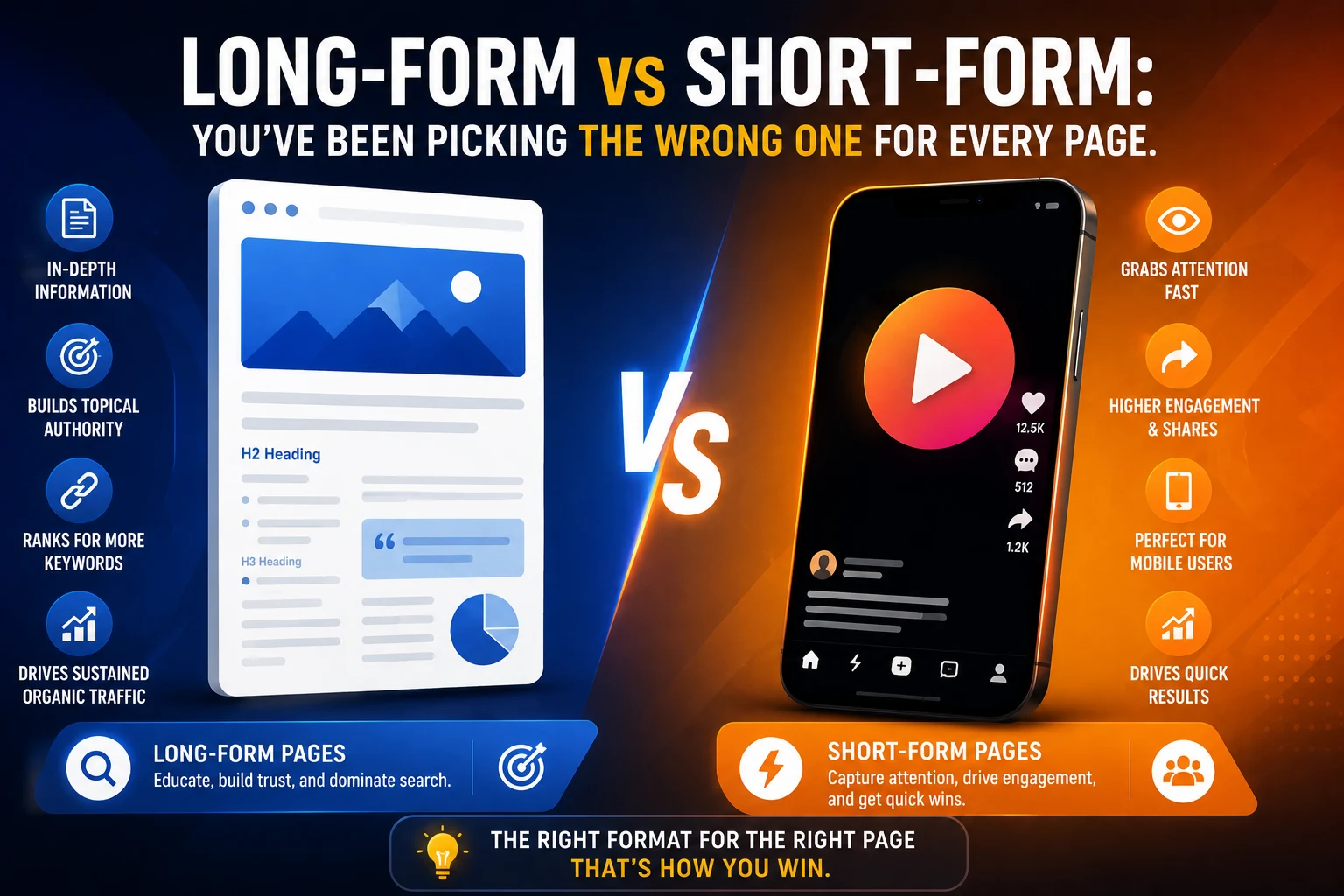

Long form vs short form content SEO is a debate that has generated more contradictory advice than almost any other topic in content marketing. “Long-form always ranks better.” “Nobody reads long content anymore.” “Aim for 2,500 words minimum.” “Google doesn’t care about word count.” All of these statements appear in respected guides. Some of them are true. All of them are incomplete. And the specific way most content teams have internalised the debate is producing content strategies that are miscalibrated at the page level – the right format in the wrong place, every single time.
Here is the honest 2026 answer: word count is not a ranking factor. Google has confirmed this explicitly. But content length is a meaningful correlate of ranking performance – because the pages that most thoroughly satisfy a specific type of search intent tend to be a specific length. The mistake is treating that correlation as a rule and applying a single length preference to every page you publish.
A product page with 3,000 words of marketing copy does not rank better than a 300-word product page with perfect clarity. A comprehensive guide to a complex technical topic does not rank at 600 words when every competing page covers the same ground in 2,500. The content length question is not “long or short?” – it is “how long does this specific search intent require?”
At Search Savvy, this is the reframe that changes content strategy decisions immediately: stop asking how long your content should be and start asking what a fully satisfied user would need before they stopped searching.
What Is the Real Relationship Between Content Length and SEO in 2026?
Long form vs short form content SEO has a more nuanced foundation than the debate usually acknowledges. Word count is not what Google’s systems evaluate directly. What they evaluate are the signals that correlate with content length in specific intent categories.
Google does not optimise for length as a standalone metric – there is no preference in the algorithm for a 2,000-word page over a 500-word page simply because of the word count. What it does optimise for, and what has become more sophisticated with every update since the March 2023 Helpful Content integration, is:
- Query satisfaction – does the page answer the user’s full question, including the follow-up questions they would likely ask?
- Dwell time – do users who land on the page stay long enough to indicate that they found what they needed?
- Pogo-sticking rate – do users return to the search results immediately after clicking (signalling the page didn’t help), or do they stay?
- Topical depth – does the page cover the subject with enough detail to demonstrate genuine expertise?
- Information gain – does the page add something to the existing web, or does it restate what competing pages already say?
For most complex informational queries, the page that satisfies these signals tends to be long, because the query is complex and a complete answer genuinely requires space. For most navigational and transactional queries, the page that satisfies these signals tends to be short, because the user knows what they want and the fastest path to conversion is the best answer.
Three additional 2026 dynamics change the equation compared to prior years:
AI content saturation has raised average SERP word counts while lowering quality. Since 2024, AI-generated long-form content has pushed average word counts across competitive SERPs upward while genuine insight has often declined. Google’s Helpful Content guidelines now actively penalise thin AI content that hits a word count target without adding genuine insight. The March 2026 Core Update confirmed this: the bar is no longer longer content, it is more specific content.
AI Overviews extract from short passages, not full articles. Google AI Overviews pull from well-structured passages of 134–167 words that directly answer a query. A 3,000-word guide can be cited in an AI Overview based on a single well-constructed passage within it. A 300-word page can also be cited if that passage is perfectly structured. In the world of AI-powered search, the extraction unit is the passage, not the article.
Intent matching is stricter in 2026. Pages that match navigational or commercial intent now rank with significantly less content than informational queries. A landing page that is too long creates conversion friction. A comparison page that is too short creates trust deficits. The intent categories have specific length requirements that are independent of the general “long-form is better” argument.
How Do You Decide Between Long Form vs Short Form Content SEO for Each Page?
The long form vs short form content SEO decision has a reliable process once you stop treating it as a preference and start treating it as a page-level audit. The correct length for any piece of content is determined by three variables: search intent, competitive landscape, and information gain requirements.
Step 1: Classify the Search Intent
Every search query falls into one of four intent categories, and each has a length range that the algorithm has consistently rewarded across 2026 benchmark data:
Informational intent (“how does X work”, “what is Y”, “why does Z happen”)
- Target range: 1,500–3,000 words
- Why: The user has a question. A complete answer requires explaining context, addressing follow-up questions, and providing enough depth that a user would not need to return to search.
- AI Overview alignment: Comprehensive informational content is the primary source for AI Overview citations. A long-form informational page with multiple well-structured passages has significantly more citation surface area than a shorter equivalent.
Navigational intent (branded searches, “X website”, “[company] login”)
- Target range: 100–300 words (if a content page is even necessary)
- Why: The user knows where they are going. Your only job is to not obstruct them. A long-form page on a navigational query is confusing, not helpful.
Commercial intent (“best X for Y”, “X vs Y”, “[product category] review”)
- Target range: 1,500–2,500 words
- Why: The user is evaluating options. A thorough comparison, clear criteria, specific examples, and honest assessment require space. But there is an upper bound – beyond 2,500 words, commercial intent pages start to feel like they are padding.
- AI Overview alignment: Comparison pages with clear, structured assessments are among the most-cited content types in AI Overviews for commercial queries.
Transactional intent (“buy X”, “X price”, “[product] coupon”)
- Target range: 200–600 words for product/service pages
- Why: The user is ready to act. Your job is to provide the information that completes the conversion – specifications, trust signals, pricing, CTA – not an essay.
Step 2: Audit the Competitive Landscape
Long form vs short form content SEO should always be calibrated against what is actually ranking for your target query. Before writing a word, analyse the top-ranking pages using Ahrefs or Semrush. If the top three results are all 2,000–2,500 words, a 600-word page will not compete regardless of quality. If the top three are all 400–700 words, a 3,000-word page is likely misaligned with what users actually want for that query.
This competitive calibration is the single most reliable length signal available – more reliable than any benchmark or word count guideline – because it reflects what Google has already determined satisfies the specific query’s intent.
Step 3: Apply the Information Gain Test
Long form vs short form content SEO decisions must be filtered through the information gain framework. A long page should be long because the topic genuinely requires depth – not because a template says “aim for 2,500 words.” A short page should be short because the query is genuinely simple – not because the writer gave up at 500 words.
The test: If you removed 30% of the content from this page, would the user’s question still be fully answered?
- If yes, the page has padding. Reduce it.
- If no, the length is justified.
Padding – filler content that adds words without adding information – is actively penalised in 2026. AI-generated padding at scale is the primary target of Google’s Helpful Content enforcement. A tight 1,200-word post that answers the question clearly beats a 2,500-word post that repeats itself in multiple variations.
What Are the 2026 Word Count Benchmarks by Content Type?
Long form vs short form content SEO has a practical word count guide by page type that reflects current 2026 intent-matching data:
| Content Type | Recommended Range | Primary Goal |
| Blog post (informational) | 1,500–2,500 words | Rank, educate, build authority |
| Pillar page / ultimate guide | 2,500–4,000 words | Topical authority, AI citation surface |
| Comparison / review page | 1,500–2,500 words | Commercial intent, decision support |
| FAQ page | 2,000–3,500 words | Multiple intent sub-queries, AI Overview |
| Product page (e-commerce) | 200–500 words | Conversion, specifications, trust signals |
| Landing page (paid / service) | 400–800 words | Conversion, CTA clarity |
| News / PR article | 300–600 words | Timeliness, quick indexing |
| Local service page | 600–1,200 words | Local relevance, service specificity |
| Case study | 1,200–2,000 words | Authority, social proof, E-E-A-T |
The 300-word minimum threshold matters in 2026. Pages with fewer than 200–300 words are at elevated risk of being classified as low-quality under Google’s Helpful Content guidelines. They are less likely to rank in competitive results and are essentially invisible in AI-generated summaries. A practical minimum for any page you want to rank is 300–400 words for the simplest content types, with most competitive content requiring 1,000 words or more to be competitive.
How Does Long-Form Content Affect AI Overview Citations Specifically?
Long form vs short form content SEO now has a specific AI dimension that changes the calculus for certain content types. Comprehensive, long-form content has a structural advantage in AI Overview citation that shorter content rarely replicates.
The mechanism is not about length itself – it is about citation surface area. A 3,000-word resource on a topic contains many distinct answerable passages. Each passage is a potential AI Overview citation point for a different query variant. A 500-word overview on the same topic has a single answerable passage, which may or may not align with the specific query variant the AI Overview is responding to.
Research supports this: a 3,000-word resource on citation building will be relevant to more AI queries than a 500-word overview – giving it more citation opportunities. Additionally, longer content is more likely to include the specific statistics, definitions, and expert claims that AI models prefer to source formally rather than paraphrase from thinner material.
This does not mean every page should be 3,000 words. It means that pillar pages, comprehensive guides, and FAQ pages – content types designed to answer multiple related questions – benefit specifically from long-form depth because each additional sub-question they answer adds another AI citation surface.
At Search Savvy, the content architecture we build for AI Overview visibility uses pillar pages (2,500–4,000 words) as the primary AI citation assets, with shorter supporting content serving specific transactional and navigational functions. The pillar pages earn AI citations. The shorter pages earn conversions. They are not in competition – they serve different roles in the same intent ecosystem.
What Are the Most Common Long-Form vs Short-Form Content Mistakes in 2026?
Long form vs short form content SEO fails in predictable patterns. The mistakes are consistent regardless of industry:
Mistake 1: Publishing long-form content on transactional pages A product page with 2,500 words of marketing copy creates conversion friction. Users on transactional pages want specifications, pricing, trust signals, and a clear CTA – not a deep-dive into the product’s history and use cases. Long-form content on transactional pages increases bounce rates and suppresses conversions without improving rankings for the transactional queries those pages target.
Mistake 2: Publishing short-form content on competitive informational queries A 600-word blog post targeting a competitive informational query with top-ranking competitors averaging 2,200 words is competing with both hands tied. The content may be high quality. The length tells Google’s intent-matching systems it is not comprehensive enough for the query’s satisfaction requirements. Length is not the ranking factor – but length inadequacy is a disqualification for competitive informational queries.
Mistake 3: Padding long-form content to hit a target word count The single most common content marketing failure in 2026. Teams briefed to produce “2,000-word blog posts” produce content that hits 2,000 words by repeating points, adding unnecessary context, and including filler transitions. The resulting pages are long in word count and thin in information gain – exactly the profile that Google’s Helpful Content system is designed to penalise.
Mistake 4: Treating all blog posts as the same format A news response post and a comprehensive technical guide are both “blog posts.” They should not be the same length. A news post covering a recent industry announcement earns quick indexing and relevance with 400–600 words. A comprehensive technical guide covering a foundational topic earns rankings and AI citations with 2,000–3,000 words. Treating both as “we write 1,200-word blog posts” is a strategy that serves neither.
Mistake 5: Not adjusting length to match the competitive evolution of a query Query landscapes change. A 1,500-word post that was competitive for a query in 2022 may now face top-ranking pages averaging 2,500 words as the topic has matured and competing content has deepened. Treating content length decisions as one-time choices rather than regular calibration tasks creates a progressive length disadvantage on your most important pages.
How Do You Build a Content Length Framework for Your Entire Site?
Long form vs short form content SEO at the site level requires a content length architecture – a systematic approach that assigns appropriate length ranges to each content type in your site structure, rather than making ad hoc decisions post-production.
The four-layer architecture:
Layer 1: Pillar pages (2,500–4,000 words) One per core topic cluster. These are your AI citation assets, your authority anchors, and the pages that demonstrate topical depth to Google’s systems. Every pillar page covers a subject comprehensively, includes original data or frameworks, and links to supporting cluster content.
Layer 2: Cluster blog posts (1,200–2,500 words) Informational content on specific sub-topics within each pillar’s domain. These pages target long-tail queries, build topical authority through interlinking, and feed the pillar page’s authority signals. Length calibrated to competitive landscape for each target query.
Layer 3: Commercial and comparison pages (1,500–2,500 words) Service pages, category pages, comparison content, and case studies. These pages serve high-commercial-intent queries where depth of information supports conversion decisions. Trust signals, specific outcomes, and comparative frameworks justify the length.
Layer 4: Conversion pages (200–600 words) Product pages, landing pages, pricing pages, and contact pages. Clarity and conversion architecture – not word count – determine performance here. The goal is the fastest path from intent to action.
This four-layer architecture ensures that every piece of content in your site structure is the right length for its intent level and its role – without defaulting to a single length preference that serves no specific function well.
FAQ: Long Form vs Short Form Content SEO in 2026
Q1: Does long-form content rank better than short-form content in 2026? Not automatically – but for most competitive informational queries, it does. Long-form content ranks better when the query requires comprehensive coverage, the user’s intent involves learning or decision-making, and competitors are publishing thorough content. Short-form content ranks better for navigational queries, transactional queries, and simple informational queries where the question can be fully answered quickly. The correct principle is not “longer is better” – it is “the length that fully satisfies the specific search intent performs best.”
Q2: What is the ideal blog post word count for SEO in 2026? For a standard informational blog post, 1,500–2,000 words is a reasonable default starting point. For competitive topics, 2,000–3,000 words is typically necessary to match the comprehensiveness of top-ranking pages. For pillar pages and comprehensive guides, 2,500–4,000 words is appropriate. The correct method is to analyse the top three currently-ranking pages for your target query and calibrate to their length – neither significantly shorter nor padded beyond their coverage.
Q3: Does word count directly affect Google rankings in 2026? No – Google has confirmed that word count is not a direct ranking factor. It does not optimise for length as a standalone metric. However, word count correlates strongly with ranking performance in competitive informational categories because comprehensive content naturally demonstrates the depth, topical coverage, dwell time, and information gain that Google’s systems reward. Thin content – under 300 words on complex topics – is at elevated risk of being classified as low-quality under Helpful Content guidelines.
Q4: How does content length affect AI Overview citations? Longer, more comprehensive content has more AI Overview citation surface area – each answerable passage within a long article is a potential citation point for a different query variant. A 3,000-word pillar page may be cited across dozens of related AI Overview queries, while a 500-word overview on the same topic has limited citation opportunities. For AI visibility specifically, pillar pages and comprehensive guides (2,500–4,000 words) are the highest-value investment because they create the most citation opportunities across query variants.
Q5: What is the minimum word count for a page to rank in 2026? Pages with fewer than 200–300 words are at elevated risk of being classified as low-quality under Google’s Helpful Content guidelines and are essentially invisible in AI-generated search results. A practical minimum for any page targeting competitive rankings is 300–400 words for simple content types (FAQs, product pages) and 1,000+ words for competitive informational content. There is no absolute minimum – a perfectly crafted 300-word product page can outrank a 3,000-word product page – but thin content creates a quality floor problem for most content types.
Q6: How do you decide whether to write long-form or short-form content for a specific page? Apply a three-step process: First, classify the search intent (informational, navigational, commercial, or transactional) and match to the appropriate length range for that intent category. Second, audit the top three currently-ranking pages for your target query and calibrate your length to their competitive standard. Third, apply the information gain test – if removing 30% of your planned content would still leave the user’s question fully answered, the additional 30% is padding. If removing it would leave the answer incomplete, the length is justified.
The Bottom Line
Long form vs short form content SEO in 2026 has a clear answer – but it is not the one most content guides give you. The answer is not “long-form is better” or “short-form is more digestible.” The answer is that intent determines length, and every page you publish that uses the wrong length for its intent is underperforming by design.
Product pages with 3,000 words of copy are creating conversion friction. FAQ pages with 400 words are competing with both hands tied. Informational guides padded to 2,500 words with 800 words of genuine content are earning penalties, not rankings. These are not edge cases. They are the default outcomes of a content strategy built around length preferences rather than intent analysis.
The reframe is straightforward: every page in your site structure has a job. That job – informing, comparing, converting, navigating – determines how much content is needed to do it well. The length that does the job efficiently and completely is the right length. Everything beyond that is padding. Everything short of it is incompleteness.
According to Search Savvy’s content audit practice, the most common corrective action we recommend after reviewing a site’s content architecture is not to write more – it is to right-size. Trim the padded long-form pages. Expand the incomplete short-form pages. And build a systematic content length framework that makes the right call at the page level, every time.
If you want a content length audit across your existing site – identifying which pages are the wrong length for their intent and what the impact on rankings and AI visibility would be from correcting them – get in touch with the Search Savvy team.