

A creator with 18,000 subscribers uploaded a video in February 2026 using the exact strategy that had worked for two straight years: a punchy clickbait title, a thumbnail with a shocked face, and a long runtime designed to maximise total watch time.
It got 1,200 views. Their previous average was 40,000.
Something fundamental had changed – and it had nothing to do with bad luck. In January 2026, YouTube integrated Google’s Gemini AI directly into the core recommendation architecture. This was not a feature update. The entire way YouTube evaluates and distributes content was rebuilt from the ground up, and creators who were still optimising for the old signals were not just failing to grow – they were actively confusing a system that no longer worked the way it used to.
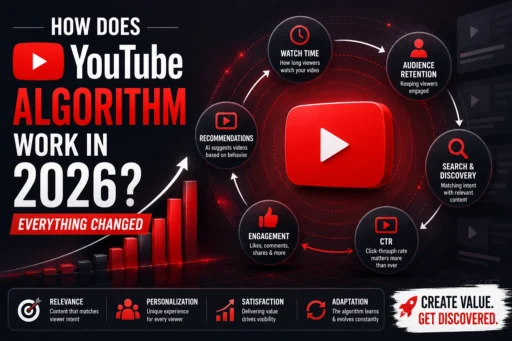
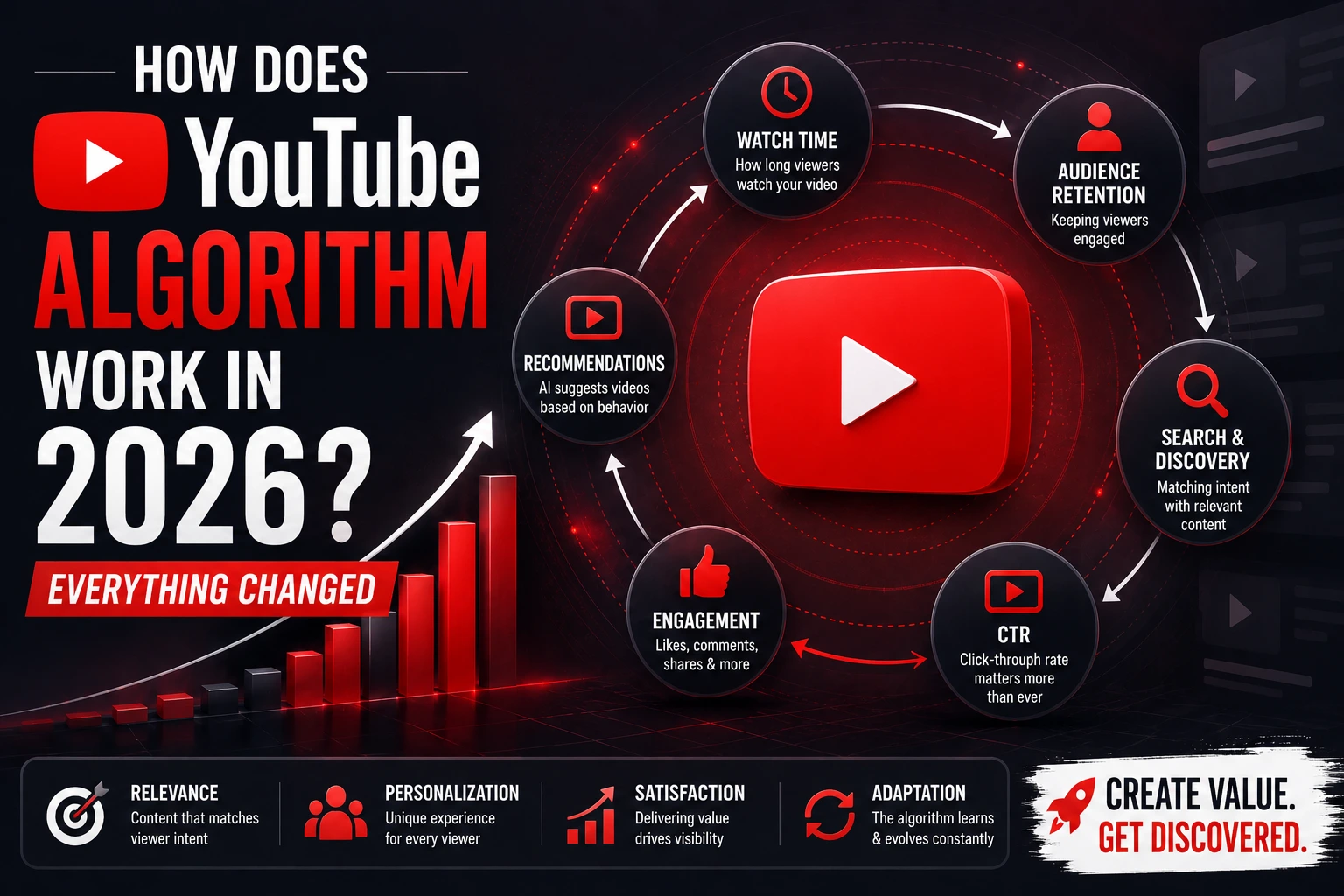
How does the YouTube algorithm work in 2026 is a genuinely different question than it was even twelve months ago. The shift from raw watch time to viewer satisfaction, the complete separation of the Shorts and long-form ranking systems, and the AI’s new ability to understand video content frame-by-frame rather than just reading titles and tags – these are not incremental tweaks. They represent the most significant change to how YouTube decides what to recommend since the platform’s recommendation engine first went algorithmic.
At Search Savvy, we advise content teams and creators across multiple platforms – and YouTube’s 2026 shift is the one generating the most confusion among teams still running last year’s playbook. This article breaks down exactly how the YouTube algorithm works now, system by system, with the specific signals that actually matter.
How Does the YouTube Algorithm Work – In Simple Terms?
How does the YouTube algorithm work at its core in 2026? It is a machine-learning system that predicts which videos each individual viewer will watch, enjoy, and return for – then ranks every candidate video by that predicted satisfaction, not by raw view count or upload recency.
Every minute, creators upload more than 500 hours of video to YouTube. The algorithm’s single job is to sort through that volume and match each viewer with the video most likely to leave them satisfied, in that specific moment, on that specific device. It is not one unified system – it is several distinct recommendation systems, each governing a different part of the app: Browse (the Home feed), Search, Suggested (sidebar and end-screen recommendations), the Shorts feed, Subscriptions, and Notifications. A video can perform brilliantly in Search while performing poorly in Browse. A Short can go viral in the Shorts feed while generating zero traffic through Suggested. Understanding which surface you are actually optimising for changes nearly every creative decision.
How does the YouTube algorithm work when evaluating a new upload specifically? It tests the video with a small sample audience first – and the test sample’s response, not the creator’s subscriber count or upload history, determines whether the video gets pushed further. In 2026, small channels have a genuine shot at wide reach, because the algorithm cares more about viewer response than subscriber counts.
People Also Ask: What is the single biggest change to how the YouTube algorithm works in 2026? Short Answer: The integration of Google’s Gemini AI directly into YouTube’s core recommendation architecture in January 2026. This rebuilt how the system evaluates content – shifting from reading titles, tags, and descriptions to frame-by-frame AI analysis of the actual video content. Combined with viewer satisfaction overtaking raw watch time as the primary ranking signal, this represents the most significant overhaul to YouTube’s recommendation system in its history.
How Does the YouTube Algorithm Work Across Its Different Surfaces?
How does the YouTube algorithm work differently depending on where a viewer encounters your content? Each of YouTube’s six primary surfaces runs its own distinct logic, and a strategy optimised for one can actively underperform on another.
Browse (the Home Feed)
How does the YouTube algorithm work for the Home feed specifically? YouTube has rolled out deeper personalisation in Browse, using viewer watch history clusters rather than broad topic categories – meaning niche content has seen increased visibility as the system gets better at matching very specific viewer interests rather than general subject areas. Personalisation also extends to behavioural patterns: YouTube’s own Senior Director of Growth and Discovery, Todd Beaupré, has confirmed the recommendation system uses time of day and device as signals, identifying whether a viewer tends to prefer news in the morning and comedy at night, and adjusting their Browse feed accordingly.
Search
How does the YouTube algorithm work for Search specifically? Search ranking weighs relevance signals – titles, descriptions, transcripts, and on-screen text – more heavily than Browse does, because a Search query represents explicit, stated intent rather than passive browsing behaviour. YouTube’s AI has become significantly better at understanding what a video actually is at a structural level, recognising whether a “how-to” video is expert-led or beginner-friendly, for example – meaning surface-level keyword stuffing is increasingly ineffective compared to genuinely matching search intent.
Suggested (Sidebar and End Screens)
How does the YouTube algorithm work for Suggested recommendations? This surface prioritises session contribution – the combined watch time and engagement that a recommendation generates across an entire viewing session, not just for a single video. End screens and cards placed in the last 5 to 20 seconds of a video, directing viewers to a next video or playlist, directly increase session contribution – a metric that now carries significant algorithmic weight on this surface specifically.
Shorts Feed
How does the YouTube algorithm work for Shorts in 2026? As of late 2025, YouTube fully separated the Shorts recommendation engine from long-form video. Shorts are ranked based on swipe-through rate, loop rate, shares, and engagement within the first few seconds – an entirely independent evaluation that does not affect, or get affected by, a channel’s long-form performance. With 200 billion daily Shorts views in 2026, this independent system is now one of the largest discovery engines on the platform in its own right.
Subscriptions and Notifications
How does the YouTube algorithm work for subscriber-facing surfaces? These are the most direct, least algorithmically filtered surfaces – content from channels a viewer has subscribed to appears with minimal additional ranking logic, though notification delivery timing is still optimised based on each individual viewer’s typical activity patterns.
People Also Ask: Does the YouTube Shorts algorithm work the same way as the long-form algorithm? Short Answer: No. As of late 2025, YouTube fully separated the Shorts recommendation engine from long-form video. Shorts are ranked primarily on swipe-through rate, loop rate, and early engagement within the first few seconds – distinct signals from the satisfaction and session-contribution metrics that govern long-form recommendations. A channel’s Shorts performance does not influence its long-form reach, and vice versa, making them genuinely independent growth channels requiring separate strategies.
How Does the YouTube Algorithm Work With Satisfaction Versus Watch Time?
How does the YouTube algorithm work when deciding between a video that holds attention and a video that genuinely satisfies a viewer? In 2026, these are no longer treated as the same thing – and the distinction is the most consequential change creators need to understand.
Watch time remains important but is no longer the dominant signal. YouTube shifted toward viewer satisfaction in 2024–2025, and by 2026, satisfaction scores carry significantly more algorithmic weight. The practical comparison: a viewer who watches 100% of an 8-minute video and clicks “like” sends a stronger ranking signal than a viewer who watches 40% of a 25-minute video and leaves – even though the second viewer technically generated more raw watch-time minutes.
How does the YouTube algorithm work to actually measure “satisfaction” if it is not simply watch time? Through a combination of explicit and implicit signals:
- Post-video surveys – YouTube periodically asks viewers directly whether they were satisfied with what they watched
- Return behaviour – Whether a viewer comes back to the same channel or topic area afterward
- The “Not Interested” button – A strong negative signal that the algorithm weighs heavily against future recommendations of similar content
- Contextualised early exits – Early exits shifted from always being a negative signal to being judged as “good” or “bad” based on context. A viewer who leaves a 10-minute tutorial after 90 seconds because they got the specific answer they needed is now read differently than a viewer who leaves because the content failed to deliver
If your video leaves people feeling satisfied, it is more likely to rank. If not, it might quietly get deprioritised, even if viewers technically watched until the end. This is the core principle driving the entire 2026 shift: YouTube no longer wants to simply keep viewers watching as long as possible – it wants viewers leaving genuinely satisfied, because satisfied viewers return to the platform more reliably over the long term.
People Also Ask: Is watch time still important for YouTube ranking in 2026? Short Answer: Watch time remains a relevant signal, but it is no longer the dominant one. Viewer satisfaction – measured through post-video surveys, return behaviour, the “Not Interested” button, and contextualised analysis of early exits – now carries more algorithmic weight than raw watch-time duration. A shorter video that leaves viewers satisfied will consistently outperform a longer video that holds attention through length alone but fails to deliver genuine value.
How Does the YouTube Algorithm Work With AI Video Understanding?
How does the YouTube algorithm work to understand what a video is actually about in 2026? Through frame-by-frame AI analysis of the video’s actual visual and audio content – a fundamental shift away from relying primarily on the metadata a creator provides.
Video understanding shifted from reading titles, tags, and descriptions to genuine frame-by-frame AI analysis of your actual content. This is the direct product of the January 2026 Gemini AI integration into YouTube’s core recommendation architecture. The system can now recognise tone, format, structure, and even a creator’s specific delivery style – meaning a “how-to” video is automatically classified as expert-led or beginner-friendly based on how the content actually presents itself, not based on keywords stuffed into the description.
How does the YouTube algorithm work for metadata as a result of this shift? Tags, titles, and descriptions remain a starting signal – but they are no longer the primary mechanism the algorithm relies on. Metadata is a starting signal, but YouTube’s AI now understands video content at a deep level. Viewer behaviour – retention, engagement, satisfaction – determines long-term ranking far more than metadata accuracy or keyword density.
This shift has a direct, practical consequence for thumbnail and title strategy: misleading titles or thumbnails might still attract an initial click, but they now lead to higher bounce rates and lower retention almost immediately – which the AI’s deeper content understanding identifies and penalises faster than it could when metadata was the primary signal of truth.
People Also Ask: Does keyword stuffing still work for YouTube SEO in 2026? Short Answer: No. YouTube’s AI, following the January 2026 Gemini integration, now analyses actual video content frame-by-frame rather than relying primarily on titles, tags, and descriptions. Metadata still serves as a useful starting signal for search relevance, but the algorithm’s deeper content understanding means keyword stuffing without genuine content-to-keyword alignment is significantly less effective than it was in previous years, and misleading metadata is identified and penalised more quickly.
How Does the YouTube Algorithm Work With AI-Generated Content?
How does the YouTube algorithm work when a video contains AI-generated or AI-altered elements? Through a mandatory disclosure system that determines whether the content is treated normally or flagged as a transparency risk.
YouTube requires creators to label realistic AI-generated visuals, voices, or scenarios as “Altered or Synthetic” in the platform’s content settings. The algorithm uses this disclosure signal specifically to support viewer safety and appropriate recommendation context – not as an automatic penalty against AI-assisted creation itself.
Failure to label qualifying AI content correctly can result in algorithmic suppression or removal from the YouTube Partner Program – a significant and direct consequence for non-disclosure. However, properly disclosed AI content is not penalised in 2026. Low-quality AI content that fails to satisfy viewers faces exactly the same retention and satisfaction headwinds as any other unsatisfying content – the AI origin itself is not the deciding factor in ranking; the resulting viewer satisfaction is.
How does the YouTube algorithm work for creators using AI-assisted production tools more broadly? YouTube has rolled out a suite of native AI-assisted creation tools – including Generate Video, Edit with AI, and Extend with AI – specifically designed to help creators produce clearer, more structured content that is easier for the algorithm to evaluate and recommend. This signals that YouTube views AI as a production tool to be integrated into the platform, not a category of content to be suppressed by default.
People Also Ask: Does using AI tools to create YouTube videos hurt your ranking in 2026? Short Answer: Not inherently. YouTube requires creators to label realistic AI-generated or significantly AI-altered visuals, voices, or scenarios as “Altered or Synthetic.” Properly disclosed AI content faces no automatic ranking penalty. Failure to disclose qualifying AI content, however, can result in algorithmic suppression or removal from the Partner Program. The deciding ranking factor remains viewer satisfaction – low-quality AI content underperforms for the same reason any unsatisfying content underperforms, not because of its AI origin.
How Does the YouTube Algorithm Work for Small and New Channels?
How does the YouTube algorithm work to give smaller, newer channels a genuine opportunity to reach a wide audience in 2026? Through equal initial seeding based on viewer response rather than subscriber count or channel history.
Small channels shifted from being structurally disadvantaged to receiving equal seeding, where viewer behaviour – not subscriber count or upload history – decides ultimate reach. In practice, this means YouTube tests a new upload from any channel, regardless of size, against a comparably sized initial audience sample. If that sample responds with strong satisfaction signals, the video gets pushed to a progressively wider audience, irrespective of whether the channel has 200 subscribers or 2 million.
This is a meaningful structural opportunity for any business or creator starting fresh on YouTube in 2026 – but it cuts both ways. A large, established channel with a poor satisfaction score on a specific upload will see that individual video throttled just as readily as a small channel would, because the system is evaluating the video’s performance against its test audience, not the channel’s accumulated authority.
People Also Ask: Can a brand-new YouTube channel reach a large audience in 2026? Short Answer: Yes – more realistically than in previous years. YouTube’s 2026 algorithm gives small and new channels equal initial seeding, testing every upload against a comparable sample audience regardless of subscriber count or channel history. If that test audience responds with strong satisfaction signals, the video is pushed to progressively wider audiences. Viewer response, not channel authority, determines whether reach expands – making 2026 a genuinely favourable environment for new channel growth, provided the content delivers real satisfaction.
How Does the YouTube Algorithm Work With Comments and Community Signals?
How does the YouTube algorithm work to evaluate the comments section beneath your videos? Through sentiment analysis rather than simple comment-count volume – a meaningful shift in how community engagement contributes to ranking.
Comment value shifted from raw volume counting to sentiment analysis, where toxicity is actively penalised. A video generating 500 comments filled with negativity, complaints, or hostile exchanges is no longer treated as more algorithmically valuable than a video generating 80 comments that are overwhelmingly positive and constructive. Community engagement is now an elevated ranking signal overall in 2026 – but the quality and sentiment of that engagement matters as much as its quantity.
This reflects the same underlying philosophy driving the satisfaction-over-watch-time shift: YouTube is optimising for content that leaves its audience and community in a genuinely better state, not content that simply generates the most raw activity by any means, including controversy or conflict.
What Are the Practical Strategy Implications of How the YouTube Algorithm Works in 2026?
How does the YouTube algorithm work in a way that should directly change your content strategy? The confirmed 2026 signals point to a clear, consistent set of practical priorities.
Prioritise viewer satisfaction over attention-holding tricks. Misleading titles or thumbnails might still generate an initial click, but they lead to high bounce rates and low retention that the algorithm’s deeper content understanding now identifies and penalises faster than ever. Authentic, relevant content that delivers on its promise is the only sustainable strategy.
Structure content for clarity, not just length. Break videos into clear sections that allow viewers to jump to relevant portions – this improves user satisfaction directly and boosts visibility through YouTube and Google search snippets simultaneously. There is no single “perfect” video length; viewer retention and satisfaction matter more than hitting a specific runtime target.
Use end screens and cards strategically. Placing end screens and cards in the final 5 to 20 seconds of a video, directing viewers toward a logical next video or playlist, increases session contribution – a metric carrying significant algorithmic weight on the Suggested surface specifically.
Treat Shorts and long-form as genuinely separate channels. Since these systems are now fully independent, a Shorts strategy built around swipe-through rate and early-second engagement should be developed and measured separately from a long-form strategy built around satisfaction and session contribution.
Disclose AI-assisted content correctly. Label realistic AI-generated visuals, voices, or scenarios as “Altered or Synthetic” in YouTube’s settings. This protects your channel from algorithmic suppression while allowing you to use YouTube’s native AI production tools without ranking concern.
Monitor Audience Retention graphs directly in YouTube Analytics. Review where engagement drops within your videos to identify structural or pacing problems, and treat sudden drop-off points as direct evidence of dissatisfaction, separate from your overall watch-time figures.
According to Search Savvy’s insights from advising content teams across multiple platforms in 2026, the single most common mistake we see is treating YouTube’s six distinct surfaces as one undifferentiated algorithm – optimising a video’s title for Search relevance while ignoring that the same video’s performance on Browse and Suggested depends on an entirely different set of signals. Understanding which surface is actually driving your views changes nearly every subsequent strategic decision.
People Also Ask: What is the most important thing to optimise for on YouTube in 2026? Short Answer: Viewer satisfaction, measured through genuine retention quality, post-video survey response, and return behaviour – not raw watch time or view count. The clearest practical signal: structure content so it delivers fully on what the title and thumbnail promise, break long content into clear, navigable sections, and use the Audience Retention graph in YouTube Analytics to identify and fix specific points where viewers are leaving unsatisfied rather than simply trying to extend total runtime.
FAQ: How Does the YouTube Algorithm Work in 2026 – Your Questions Answered
Q1: What was YouTube’s biggest confirmed announcement about the algorithm in 2026? YouTube CEO Neal Mohan confirmed $60 billion in annual revenue, 200 billion daily Shorts views, and Ask Studio AI reaching 20 million users, alongside expanded AI editing features for creators. Combined with the January 2026 Gemini AI integration into the core recommendation architecture, these confirm that 2026 represents both a commercial and technical inflection point for the platform – the recommendation system has been rebuilt around AI-driven content understanding at the same time the platform’s AI creator tools and Shorts ecosystem have scaled dramatically.
Q2: Does the YouTube Trending page still exist in 2026? The Trending page has been confirmed as removed as part of YouTube’s broader 2026 changes, reflecting the platform’s shift toward fully personalised, satisfaction-based discovery over a single, universal list of popular videos. This aligns with the platform’s overall direction: recommendations in 2026 are built around individual viewer patterns – time of day, device, watch history clusters – rather than any centralised, one-size-fits-all popularity ranking.
Q3: How long does it take for a new video to know if the algorithm will push it wider? YouTube tests new uploads on a small sample audience first, and early satisfaction and engagement signals from that test group determine whether the video is pushed to a progressively wider audience. While YouTube does not publish an exact timeframe, creators commonly observe meaningful distribution signals – whether a video is being pushed or quietly throttled – within the first 24 to 48 hours after publishing, based on how that initial test audience responds.
Q4: Should I optimise my YouTube videos differently for Search versus Browse in 2026? Yes. Search ranking weighs relevance signals – titles, descriptions, transcripts, and on-screen text – more heavily, because a search query represents explicit stated intent. Browse ranking relies more heavily on personalisation signals like watch history clusters, time of day, and device type. A video aiming primarily for search traffic should prioritise clear, descriptive metadata and on-screen text matching likely search queries; a video aiming primarily for Browse discovery should focus on broader satisfaction and retention signals that align with a specific niche audience’s established viewing patterns.
Q5: Does commenting and replying to comments help your YouTube ranking in 2026? Indirectly, yes. Community engagement is an elevated ranking signal in 2026, but the algorithm now evaluates comment sentiment through analysis rather than simply counting comment volume – meaning toxicity and negativity in a comment section are actively penalised rather than treated as engagement value. Actively replying to comments and fostering constructive discussion supports a healthier sentiment profile in your comments section, which contributes positively to the community engagement signal without risking the toxicity penalty that high-volume but hostile comment sections now face.
Q6: Is it still worth posting both Shorts and long-form videos on the same channel? Yes, and this remains a strong strategy in 2026 – but the two formats should be approached as genuinely separate growth channels rather than one strategy supporting the other. Since the Shorts and long-form recommendation systems are now fully independent, Shorts can introduce new viewers to your channel through swipe-through and loop-rate-driven discovery, while long-form content builds deeper satisfaction and retention with that audience once they arrive. Treat the two formats as complementary acquisition and retention tools rather than expecting performance in one to directly drive performance in the other.
Trying to grow on YouTube but still optimising for signals that stopped mattering after January 2026? Visit Search Savvy for a content strategy audit that maps your channel against the algorithm’s actual current priorities – across Search, Browse, Suggested, and Shorts.