
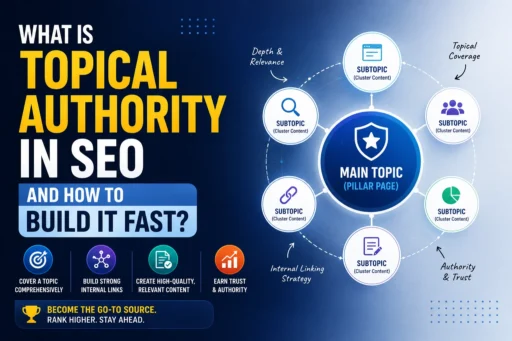

A B2B founder once showed an SEO agency his blog: 83 published posts, real content, original screenshots, genuine opinions, no shortcuts. Three of those 83 posts ranked anywhere in the top 100 for a commercial keyword. Two of those three ranked only because they included his brand name.
He could not understand it. The content was good. Competitors with objectively worse writing were beating him. The diagnosis, once someone mapped his blog onto a topical structure, was immediate: 83 posts spread across 19 completely unrelated subjects. Sales psychology one week, AI productivity the next, a tangent into hiring advice after that. He had volume. He did not have topical authority in SEO.
This is the single most common – and most expensive – mistake businesses make with content in 2026. Topical authority in SEO is now widely recognised as the biggest ranking lever available, because both Google and AI answer engines select sources at the topic level, not the keyword level. Publishing scattered, unconnected articles – no matter how well written – does not build the signal that earns rankings or AI citations.
At Search Savvy, we have rebuilt content strategies for businesses with exactly this problem: good writing, zero structural authority. This article explains precisely what topical authority in SEO means, why it has become the dominant ranking signal, and the fastest legitimate framework to build it in 2026 – including what “fast” honestly means and what it does not.
What Is Topical Authority in SEO?
Topical authority in SEO is the degree to which your website demonstrates depth, consistency, and credibility on a defined subject area – measured by how comprehensively and authoritatively you cover that subject, as assessed by search engines and increasingly by AI answer systems.
This is fundamentally different from ranking for individual keywords. Topical authority in SEO is not “write a lot about marketing.” It is “own a tightly defined topic by covering the questions, mechanisms, and proof points around it.” That distinction decides whether your site becomes a recognised source or simply a content landfill that happens to share a domain name.
For years, SEO was treated as a collection of isolated keyword battles – find a high-volume term, publish a page optimised for it, build a few links, and wait. That approach produced diminishing returns as Google’s algorithms grew more sophisticated at understanding semantic relationships between content, not just keyword matches.
Topical authority in SEO is now directly linked to citation probability in AI-generated answers, making it a critical factor for both traditional SEO and the emerging discipline of Generative Engine Optimisation (GEO). Google and AI search engines increasingly favour sources that demonstrate deep, interconnected expertise over sites publishing isolated, keyword-targeted pages with no relationship to each other.
People Also Ask: What is the difference between topical authority and domain authority? Short Answer: Domain authority is a general, third-party metric estimating a site’s overall ranking strength across all topics. Topical authority is specific to a defined subject area and is built through comprehensive, interconnected content coverage – not backlinks alone. A site can have high topical authority on one narrow subject while having low overall domain authority, and still outrank larger, more authoritative domains on queries within that specific topic.
Why Is Topical Authority in SEO So Important in 2026?
Topical authority in SEO has become important for a structural reason: Google’s Helpful Content systems and AI answer engines now evaluate the depth and breadth of your coverage across an entire topic – not the quality of any single page in isolation.
The data confirms this shift decisively. A site with 20 interconnected articles on a specific topic consistently outranks a site with one 5,000-word guide on the same topic, even if the single article is technically superior. Sites that sustain cluster publishing for 12 or more months see 40% higher organic traffic than comparable single-page content strategies. Content clusters increase organic traffic by 40% through topical authority specifically – not through any other ranking factor.
The 2026 algorithm environment has made this even more pronounced. Google’s March 2026 core update decimated scaled content sites – the loosely connected, high-volume publishing approach that worked in previous years no longer survives algorithmic scrutiny. Sites without genuine topical structure are now actively penalised, not just ignored.
Topical authority in SEO also extends beyond traditional rankings into a second, equally important arena: AI citation. With AI Overviews appearing in roughly 20–25% of searches as of early 2026, the architecture choice compounds across more of the result page every quarter. Both Google’s AI Overviews and tools like ChatGPT and Perplexity select sources at the topic level – meaning a site demonstrating genuine subject-matter depth is significantly more likely to be cited than one with isolated, disconnected content covering the same surface-level ground.
People Also Ask: Does topical authority matter more than backlinks in 2026? Short Answer: For sustained rankings, topical authority has become the more foundational signal. Backlinks remain valuable, but they amplify authority that has already been established through content depth – they cannot create that authority from scratch. A site with strong topical authority and a modest backlink profile frequently outranks a site with strong backlinks but scattered, shallow content coverage in 2026’s algorithm environment.
How Does Topical Authority in SEO Actually Work?
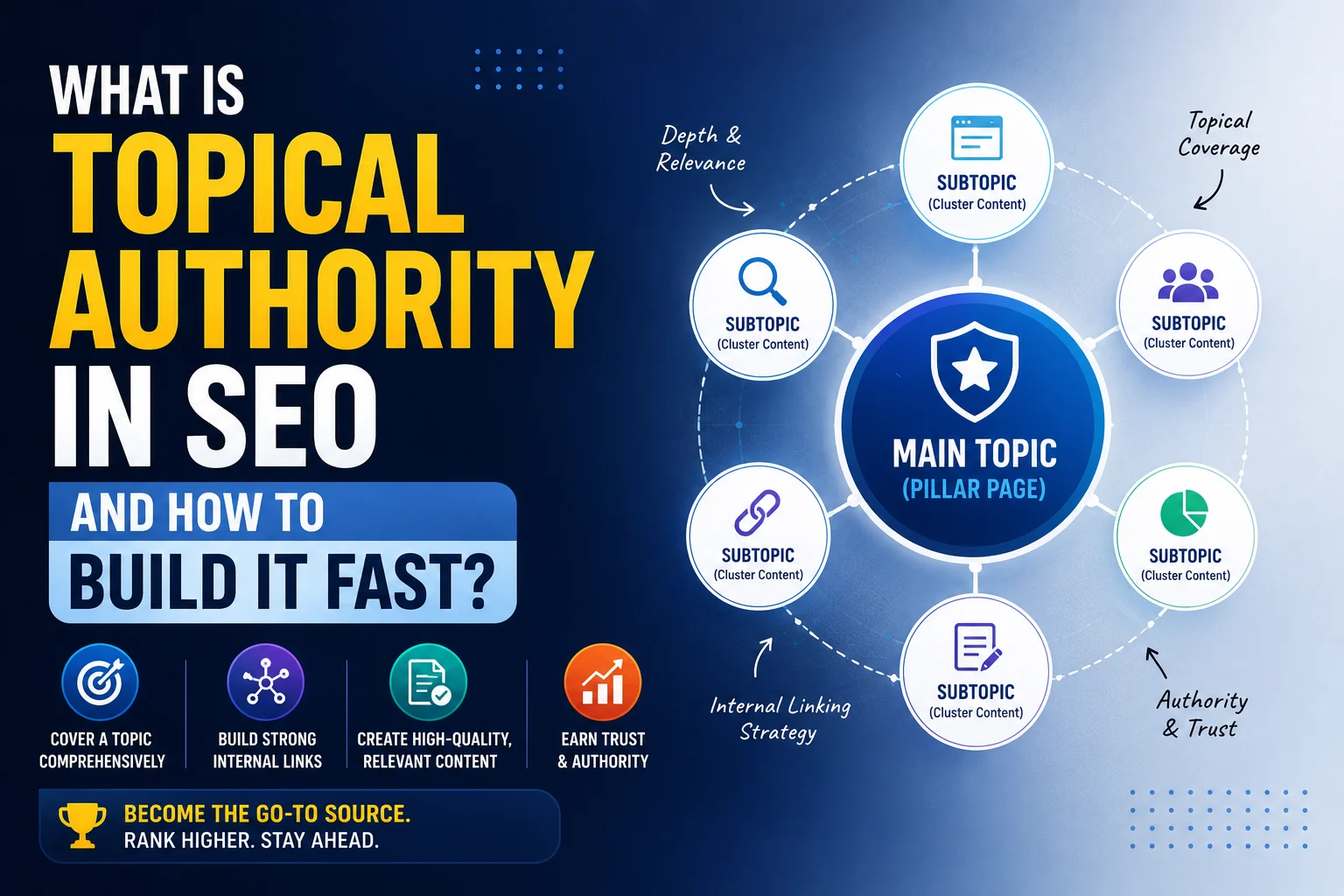
Topical authority in SEO is built through a specific, well-documented architecture: the pillar-cluster content model. Understanding the mechanics of this model is the foundation for everything else in this article.
A pillar page is a comprehensive, authoritative piece of content that covers a broad topic in its entirety – typically 3,000 to 5,000 words, addressing every major aspect of the subject with enough depth to be genuinely useful and enough breadth to serve as a hub for more detailed subtopic content.
Cluster pages are focused articles exploring specific subtopics within the pillar’s scope in greater depth than the pillar itself provides. Each cluster page targets a narrower keyword set and provides detailed, actionable information on that specific subtopic – typically 1,000 to 2,500 words.
The architecture relies entirely on deliberate internal linking to function. Every cluster article links back to the pillar page. This tells Google that the pillar is the authoritative hub for the topic and channels link equity to it. The pillar page, in turn, links out to every cluster article – creating a bidirectional structure that distributes PageRank and reinforces topical signals to crawlers simultaneously.
Topical authority in SEO requires a third architectural layer that many guides overlook: supporting assets. These are narrower pages – checklists, templates, glossaries, comparison pages, FAQs, and case studies – that fill the gaps between pillar and cluster content, demonstrating the comprehensive, interconnected expertise that distinguishes genuine authority from a list of blog posts that happen to share a topic tag.
People Also Ask: How many cluster pages do I need to build topical authority? Short Answer: Break the topic into 8 to 15 subtopics for an initial cluster, each targeting a specific keyword or search intent. For broader, more competitive subjects, you may need 5 to 12 cluster pages to start, expanding over time. Most successful topical authority builds need at least 50 to 100 articles for initial authority across a full content programme, with 150 or more showing significant results – though the exact number depends heavily on niche competition.
What Are the Real Signals That Build Topical Authority in 2026?
Topical authority in SEO is built through five specific, confirmed signals – and missing any one of them weakens the overall authority signal even if the others are strong.
Content Depth and Topic Coverage
Topical authority in SEO begins with refusing to settle for shallow content. Shallow content does not build authority. Google rewards websites that comprehensively cover core themes and related questions – not websites that touch on a topic briefly and move on to the next keyword opportunity.
Search Intent Matching
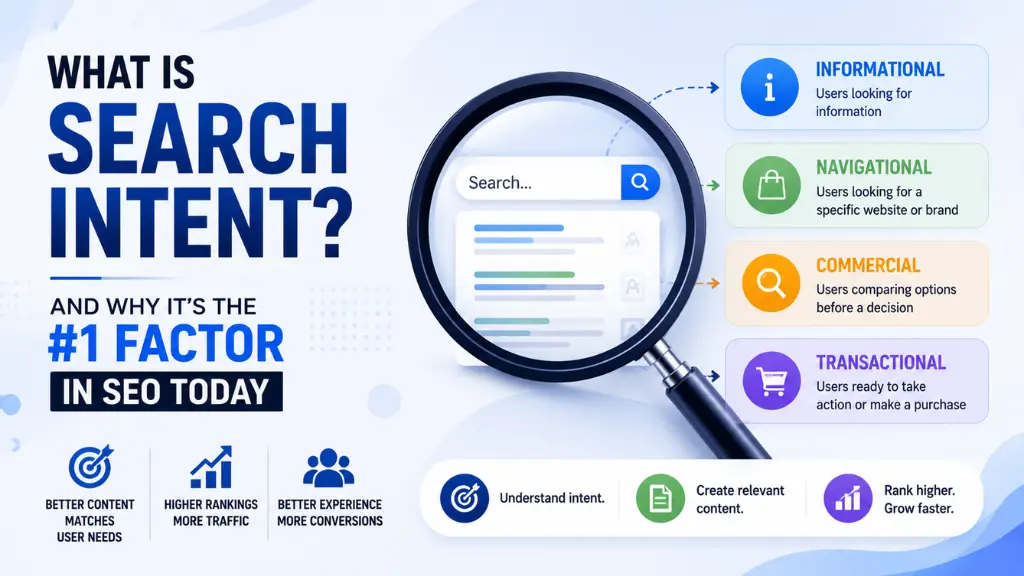
Topical authority in SEO requires answering the exact questions your ideal audience is asking, at the exact stage of their journey when they are asking them. A cluster built around informational queries will not convert the same way as one built around commercial-investigation or transactional queries – the cluster needs to span the full range of intent within the topic to demonstrate genuine coverage.
Internal Linking Architecture
Topical authority in SEO is structurally dependent on internal linking – not as an afterthought, but as the mechanism that physically demonstrates the relationship between your content pieces to Google’s crawlers. Strategic linking patterns that reinforce topic relationships are a confirmed technical optimisation supporting topical authority, alongside logical URL structures that reflect topic hierarchies.
Backlinks and External Validation
Topical authority in SEO is reinforced – not created – by external validation. When other trusted websites link to your well-structured content, it validates your expertise to search engines. This is why topical authority and backlink building are not competing strategies: a strong topical cluster earns more natural backlinks than scattered content, because journalists, researchers, and other site owners are more likely to cite a recognised, comprehensive source than an isolated post.
Content Freshness and Maintenance
Topical authority in SEO is not a one-time build. Authority is not static – Google favours websites that are actively maintained and updated. A cluster that was comprehensive in 2024 but has not been touched since is losing ground to competitors who are updating their equivalent content with current data, new subtopics, and refreshed statistics.
People Also Ask: Can small businesses build topical authority in SEO? Short Answer: Yes – and small, focused businesses often build topical authority faster than larger, more generic competitors. Small businesses can build topical authority by focusing on a narrow niche, targeting long-tail keywords, and creating content clusters around specific customer problems. Clear structure and relevance matter more than overall site size or domain age. A business coach who writes exclusively about scaling tech startups will build authority much faster than one writing generic business advice across unrelated subjects.
How Do You Build Topical Authority in SEO – Step by Step?
Topical authority in SEO follows a repeatable, seven-step process. This is the framework that converts the concept into an actual content programme.
Step 1 – Define your topical territory precisely. Choose a core subject narrow enough to dominate, but broad enough to support 8–15+ subtopics. “Local SEO for service businesses” is a workable topical territory. “Marketing” is not.
Step 2 – Map the keyword and question universe. Use tools like Google Search Console, Ahrefs, Semrush, or Google Trends to identify every related query, long-tail variant, and “People Also Ask” question within your territory. This becomes the architecture document governing your content strategy for the next 12–24 months – not a simple keyword spreadsheet.
Step 3 – Build the pillar page first. Write your 3,000–5,000-word comprehensive guide covering the topic at a high level. This page should target the primary head keyword and serve as the canonical resource users return to repeatedly.
Step 4 – Build cluster content systematically. Publish 8–15 cluster pages addressing specific subtopics, each linking back to the pillar and being linked from it. Prioritise clusters that address genuine gaps in existing top-ranking content – competitive coverage analysis at this stage reveals the highest-ROI additions.
Step 5 – Add supporting assets. Layer in checklists, comparison pages, glossaries, and case studies that demonstrate the comprehensive, practical expertise that separates genuine authority from a list of articles sharing a topic tag.
Step 6 – Implement technical optimisation. Ensure logical URL structures reflecting your topic hierarchy, schema markup that helps search engines understand content relationships, and fast page speed that supports the user engagement signals that reinforce ranking.
Step 7 – Maintain and expand continuously. Topical authority in SEO compounds over 6–12 months, but only if the publishing and updating continue. Cluster performance compounds as Google indexes more cluster pages and as internal links pass equity through the structure – stopping after the initial build undermines the compounding effect entirely.
How Do You Build Topical Authority in SEO Fast – Without Sacrificing Quality?
Topical authority in SEO has historically required months of manual research and content production – but AI-assisted workflows in 2026 have genuinely compressed that timeline, provided the acceleration is applied to research and structure, not to skipping the strategic thinking entirely.
The most significant change: topic universe mapping, keyword clustering, and competitive coverage analysis – work that previously required weeks of manual analysis – now takes 2–3 days with AI assistance. Businesses using AI strategically for authority building are outpacing traditional approaches by 3–5x in both speed and comprehensiveness, according to agency data compiled across hundreds of client engagements in 2026.
The fast-but-correct build sequence:
Use AI for topic mapping, not for skipping strategy. AI doesn’t just speed up content production – it fundamentally changes how you map subject matter expertise before writing a single word. Tools like ChatGPT Plus, Claude, and specialised topical mapping platforms can generate hundreds of related keywords and identify content gaps in minutes rather than days – but the decision about which topical territory to claim still requires human strategic judgment about your business’s actual expertise and competitive position.
Establish a sustainable publishing velocity matched to your stage. Pre-revenue businesses and early-stage teams should target 1–2 posts per week, focused on building foundational pillar content and topical authority in 2–3 core clusters. Growth-stage teams can sustain 2–4 posts per week – the velocity that compounds organic growth without overwhelming a lean content team, achievable in roughly 5 hours per week with an efficient content workflow.
Use structured human overlay on AI-assisted drafts. The biggest mistake in fast topical authority building is treating AI like a content factory with no human input. The correct workflow implements structured overlay – adding proprietary insights, case studies, and expert perspectives to AI-generated drafts, combined with systematic quality controls including factual verification and brand voice consistency checks.
Reduce the research bottleneck, not the publishing standard. AI compresses research and mapping timelines from months to weeks without sacrificing content quality – when the human strategic layer (topic selection, expert review, proprietary data integration) remains intact. The acceleration comes from eliminating wasted research time, not from publishing thinner content faster.
According to Search Savvy’s insights from running accelerated content programmes for clients, the realistic “fast” timeline in 2026 looks like this: topic mapping and cluster architecture in 1–2 weeks (down from the 4–6 weeks this previously required), pillar page and first 8–10 cluster pages published within 4–8 weeks, and initial ranking movement on lower-competition cluster terms visible within 2–4 weeks of publication. This is significantly faster than the traditional 6+ month research-to-publish cycle – but it is not instant, and any service promising topical authority in days rather than weeks is not describing a real, sustainable process.
People Also Ask: Can AI tools really speed up building topical authority in SEO? Short Answer: Yes, specifically for research and content mapping – topic universe mapping, keyword clustering, and competitive gap analysis that previously took weeks now takes 2–3 days with AI assistance. However, AI accelerates the planning and drafting phases; it does not eliminate the need for human strategic decisions about topical territory, expert review of content accuracy, or the sustained publishing timeline required for Google to index and recognise the cluster as authoritative. Treating AI as a way to skip strategy entirely, rather than to accelerate research, is the most common mistake in fast-build approaches.
How Long Does It Honestly Take to Build Topical Authority in SEO?
Topical authority in SEO requires honest timeline expectations, even with AI-accelerated workflows – because overpromising speed leads to abandoned content programmes before the compounding effect has a chance to materialise.
Most sites see Google impressions within 2–4 weeks of consistent publishing and meaningful traffic within 6–8 weeks if targeting genuinely low-competition keywords within a well-structured cluster. For more competitive topical territories, it typically takes 3–6 months to see meaningful ranking movement, depending on domain authority and publishing consistency.
The full compounding effect – where new content ranks faster because of established authority, AI tools cite the site more frequently, and backlinks accumulate naturally because other sites reference the depth of coverage – is the actual destination of topical authority building, and it generally requires sustained publishing for 6–12 months minimum, not weeks.
This is precisely why topical authority in SEO functions as a competitive moat. It is hard to replicate quickly – and that difficulty is the entire point. The brands investing in topical authority today are building protection for their search visibility over the next 3–5 years, regardless of how AI search continues to evolve. A competitor cannot simply publish ten articles next month and catch up to a year of compounding, interconnected authority signal.
People Also Ask: How long does it take to see results from topical authority SEO? Short Answer: Initial Google impressions typically appear within 2–4 weeks of consistent publishing on a well-structured cluster, with meaningful organic traffic following at 6–8 weeks for lower-competition terms. For competitive topical territories, meaningful ranking movement generally takes 3–6 months. The full compounding benefit – faster indexing of new content, increased AI citation frequency, and natural backlink accumulation – typically requires 6–12 months of sustained, consistent publishing to materialise fully.
FAQ: Topical Authority in SEO – Your Questions Answered
Q1: What is the minimum number of articles needed to establish topical authority? There is no universal minimum, but practical benchmarks from 2026 case studies suggest 50–100 articles for initial authority signal within a defined topic, with 150+ articles showing significant, sustained results. The exact number depends heavily on niche competition – a narrow, low-competition local service topic may establish authority with 20–30 well-structured cluster articles, while a competitive national topic like “digital marketing” may require significantly more. Focus on comprehensive coverage of genuine subtopics rather than hitting an arbitrary article count.
Q2: Should I focus on one topic or build authority across multiple subjects simultaneously? Start with one tightly defined topical territory and establish genuine authority there before expanding. Several core subjects can each get their own pillar-and-cluster structure over time, kept distinct by clean internal-link boundaries – cross-linking only where it genuinely helps a reader, so each individual cluster maintains a high site-focus signal. Attempting to build authority across multiple unrelated topics simultaneously with a small content team is the exact mistake that produced the 83-post, 19-subject failure described at the start of this article.
Q3: Does topical authority in SEO work the same way for e-commerce sites as for content sites? The underlying principle is the same – comprehensive, interconnected coverage of a defined subject area – but the implementation differs. E-commerce sites build topical authority through category pages, buying guides, comparison content, and product-adjacent informational content (care guides, usage tutorials, sizing guides) that cluster around their core product categories. The pillar-cluster model still applies, but the pillar is often a category or buying guide page rather than a pure informational article, and cluster pages frequently serve commercial and transactional intent alongside informational intent.
Q4: How does internal linking specifically affect topical authority? Internal linking is the structural mechanism that makes topical authority measurable to search engines – it is not optional or supplementary. Every cluster article must link back to the pillar page, and the pillar page must link out to every cluster article, creating a bidirectional structure that distributes PageRank and reinforces the topical relationship to crawlers. Sites with strong content but weak or absent internal linking between related pieces fail to demonstrate topical authority even if the individual articles are well-researched, because the algorithm has no structural signal connecting them into a coherent topic.
Q5: Can topical authority in SEO be damaged or lost over time? Yes. Authority is not static – content that goes unmaintained loses ground to competitors actively updating their equivalent clusters with fresh data, new subtopics, and current statistics. Additionally, publishing unrelated content outside your established topical territory can dilute the focus signal that built your authority in the first place. Regular content audits – checking for outdated statistics, broken internal links, and gaps where competitors have published new subtopic coverage – are necessary to maintain topical authority once established, not just to build it initially.
Q6: Is topical authority in SEO worth pursuing for a business with long sales cycles or niche B2B audiences? Particularly worth pursuing for these business models. Long sales cycles need content that answers questions across the full awareness, evaluation, and buying-stage journey – exactly what a comprehensive pillar-cluster structure provides, compared to isolated keyword-targeted pages that only address one stage of that journey. For niche B2B audiences, trust gaps are typically larger for newer or smaller brands, meaning topical authority has to be built deliberately, page by page, rather than relying on existing brand recognition. At Search Savvy, this is precisely the profile of business where we see topical authority building produce the most disproportionate return relative to content investment.
Publishing consistently but still not seeing the rankings your content effort deserves? Visit Search Savvy for a topical authority audit that maps your existing content against a structured cluster architecture – and a clear, realistic plan to build genuine authority in your category.