

You posted at the “perfect” time. You used the recommended hashtags. You followed every tip from a 2023 listicle. And your Reel got 40 views.
Meanwhile, a competitor with a fraction of your follower count posted something that felt almost careless – and it reached 80,000 non-followers in 48 hours.
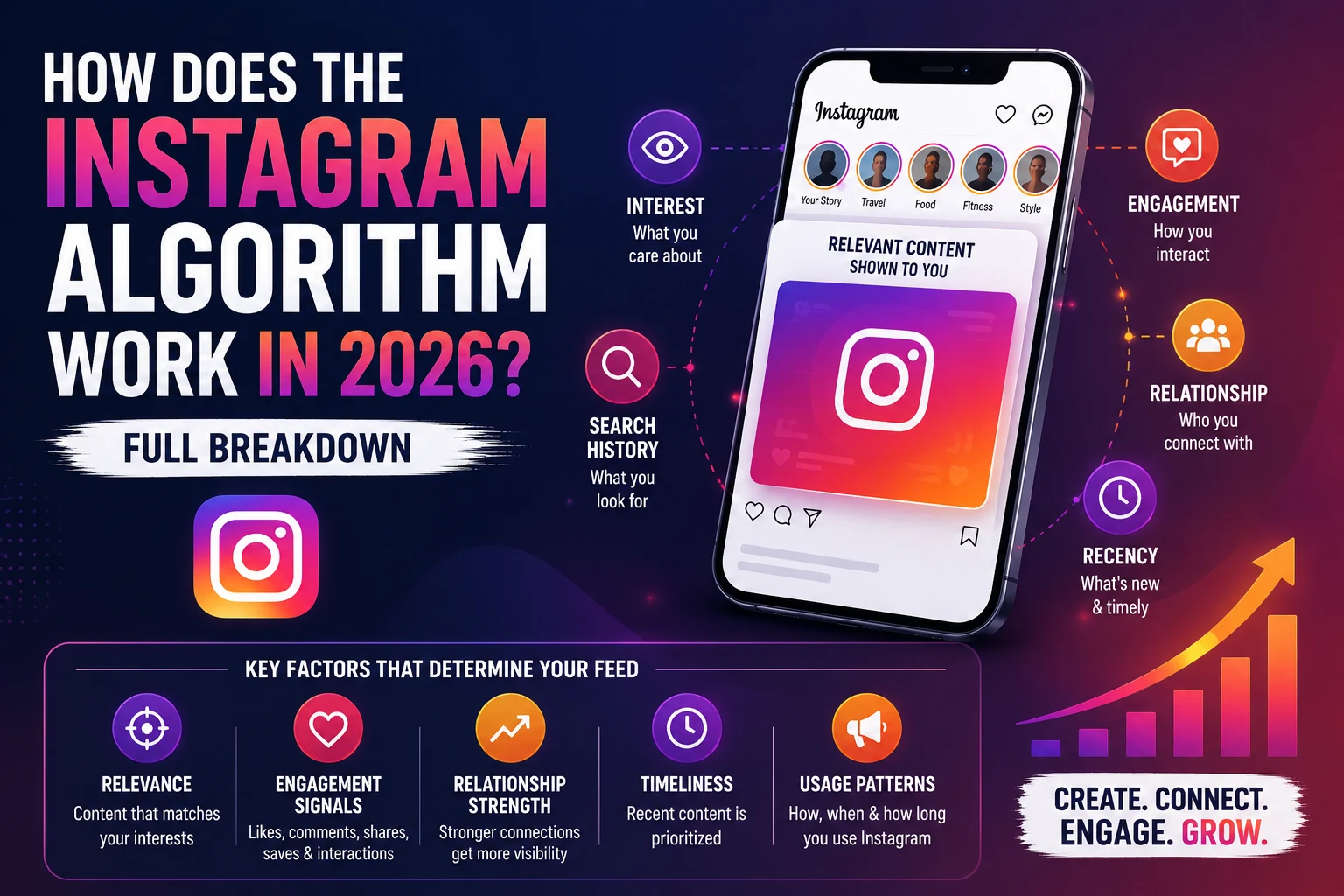
The honest answer to how does the Instagram algorithm work in 2026 is this: it is not one algorithm. It is several distinct AI ranking systems – one for Feed, one for Reels, one for Stories, one for Explore – and each one is scoring your content against a different question. Most advice fails because it treats Instagram as a single system with one set of rules, when the platform itself has confirmed it operates nothing like that.
At Search Savvy, we manage social content strategy alongside SEO and paid media – and the businesses seeing real growth on Instagram in 2026 are the ones who stopped asking “how do I beat the algorithm” and started asking “what is each specific surface actually measuring?” This article gives you the complete, current breakdown – sourced directly from Instagram’s own confirmed signals – so you can stop guessing and start building content that the platform is structurally designed to reward.
How Does the Instagram Algorithm Work in 2026 – In Simple Terms?
How does the Instagram algorithm work in 2026 starts with a single confirmed fact from Instagram’s own head, Adam Mosseri: there is no single Instagram algorithm. There are several AI-driven ranking systems, each tuned for a different part of the app – Feed, Stories, Reels, and Explore – and each one prioritises different signals because people use each surface differently.
People tend to look for their closest friends in Stories, use Explore to discover new content and creators, and look to be entertained in Reels. That distinction is the entire foundation of how Instagram works in 2026. A piece of content that performs brilliantly in Stories (because it strengthens an existing relationship) can perform terribly in Explore (because Explore is optimised for discovering something completely new).
The technical process is consistent across all four surfaces, even though the specific signals differ:
- Candidate generation – Instagram pulls a pool of possible posts from accounts you follow, plus accounts and content it predicts you might be interested in.
- Signal scoring – Each post in that pool is scored based on predicted actions: will you watch it, save it, share it, comment, tap the profile, or scroll past?
- Filtering – Safety, quality, originality, and account status checks run before any content is shown.
- Placement – The content appears in the position the score earns it – Feed, Reels, Explore, or wherever the system determines is the best fit.
How does the Instagram algorithm work in practice for a business posting content? Instagram is not asking “did you post today?” It is asking “will this specific viewer watch, save, share, reply, tap the profile, or keep scrolling?” – and it asks that question separately, with different weighting, on every surface of the app.
People Also Ask: Is there only one Instagram algorithm in 2026? Short Answer: No. Instagram uses multiple distinct AI ranking systems – separate algorithms for Feed, Reels, Stories, and Explore – each scoring content against different signals based on how people use that specific surface. This has been confirmed directly by Instagram’s head, Adam Mosseri. Content strategy needs to account for each surface separately rather than treating Instagram as a single unified system.
How Does the Instagram Feed Algorithm Work in 2026?
How does the Instagram algorithm work for your main Feed specifically? The Feed algorithm pulls posts from accounts you follow plus recommended accounts, then orders them by predicting how likely you are to spend ten or more seconds on a post, comment on it, or reshare it via DM.
The Home Feed prioritises content from accounts you interact with frequently, weighing factors like how recently you engaged with a creator and the strength of your relationship history. The ranking signals for Feed, in order of confirmed importance:
- What you engage with – Posts a specific user likes, shares, saves, or comments on, used to predict similar future interest
- Information about the post – How popular it is (measured by likes, comments, re-shares, and time spent), the relevance of the content, and when it was posted
- History of interactions with the poster – Whether you regularly comment on or DM that specific account
- Likelihood of interest – Predicted based on similar past behaviour, even with accounts you have not engaged with before
How does the Instagram algorithm work for a Feed post specifically in 2026 in terms of penalties? Reposted or recycled content is one of the clearest signals to avoid. Original content receives 40–60% more distribution than reposts, and accounts posting 10 or more reposts within a 30-day period get excluded from recommendations entirely. This is a direct, confirmed penalty – not a theory.
People Also Ask: Does posting frequency affect Instagram Feed ranking in 2026? Short Answer: Posting frequency alone is not a primary ranking signal. The Feed algorithm prioritises engagement quality (likes, comments, shares, saves, dwell time) and relationship strength with the poster over how often an account posts. Consistent posting helps maintain audience habit and gives the algorithm more opportunities to learn what resonates, but posting more frequently with weak engagement signals will not outperform posting less frequently with strong ones.
How Does the Instagram Reels Algorithm Work in 2026?
How does the Instagram algorithm work for Reels – the format most businesses are betting their growth strategy on? The signals here are different from Feed, and one specific change has reshaped Reels strategy entirely in 2026.
Adam Mosseri has directly confirmed the three most important Reels ranking signals: watch time (how long viewers stay with your content – the most important signal across all surfaces), sends per reach (DM shares – confirmed to be 3–5x more valuable than likes for reaching new, non-follower audiences), and likes per reach (still relevant, but carrying meaningfully less weight than watch time or sends).
How does the Instagram algorithm work for new Reels specifically? Through what is effectively an audition system. Instagram tests a Reel with a small sample of non-followers first. Early performance with that test group – not your existing follower count – determines whether the Reel gets pushed to a broader audience or quietly throttled. The first two to three seconds of the video are the single most decisive factor in that audition: if viewers do not stay past that opening window, the test sample’s data tells Instagram to stop distributing it further.
Two structural changes define Reels in 2026 specifically:
- Maximum length extended to 20 minutes. Instagram has confirmed that longer storytelling content – tutorials, behind-the-scenes series, mini-documentaries – is now actively recommended in the Explore feed, provided it holds attention throughout. This is a direct move to capture creators who were previously building long-form content exclusively on YouTube.
- Trial Reels let creators test content with non-followers before deciding whether to push it to their existing audience – giving more control over the audition process described above.
People Also Ask: What is the most important ranking signal for Instagram Reels in 2026? Short Answer: Watch time is the single most important confirmed signal across all Instagram surfaces, according to Adam Mosseri. For Reels specifically, sends per reach (DM shares) is the second most powerful signal – confirmed to be 3 to 5 times more valuable than likes for reaching non-follower audiences. The first 2–3 seconds of a Reel determine whether it survives Instagram’s initial test with a small non-follower sample, which decides whether the Reel gets pushed further.
How Does the Instagram Stories Algorithm Work in 2026?
How does the Instagram algorithm work for Stories – and why does it behave so differently from Feed and Reels? Stories only ever surfaces content from accounts you already follow, so the algorithm’s entire job is measuring closeness, not discovery.
Stories you’ve viewed or engaged with in the past is the primary input – but the specific weighting goes further. Whose Stories you consistently watch, reply to, or react to get pushed to the front of your Story tray. Direct message frequency is also a confirmed signal: if you message a specific account regularly through Instagram, the algorithm treats that relationship as part of your “inner circle” and prioritises their Stories accordingly.
How does the Instagram algorithm work for a business trying to build Stories visibility? Posting Stories consistently keeps you visible to your warmest existing audience, regardless of how your Feed posts are performing independently. Because Stories operates entirely on relationship strength rather than discovery, it is the surface least affected by Instagram’s broader algorithmic shifts – but also the surface with the lowest ceiling for reaching anyone outside your existing follower base.
People Also Ask: Can Stories help me reach new followers on Instagram in 2026? Short Answer: Not directly. The Stories algorithm only surfaces content from accounts a user already follows – it is built entirely around relationship strength (watch history, reply frequency, DM frequency) rather than content discovery. Stories is the right surface for deepening engagement with an existing audience, not for reaching new people. Reels and Explore are the surfaces designed for non-follower discovery.
How Does the Instagram Explore Algorithm Work in 2026?
How does the Instagram algorithm work for Explore – the surface specifically built to introduce you to accounts you have never interacted with? Explore surfaces new content based on interests and similar user behaviour, using your activity in Explore (likes, comments, and shares) combined with information about the specific post and poster.
This is the surface most directly responsible for reaching people who have never heard of your brand. Explore is where you reach people who have never heard of you – the algorithm uses pattern matching from similar accounts and content categories to decide who might be interested, rather than relying on any existing relationship signal.
How does the Instagram algorithm work for Explore in terms of recent format changes? The extension of Reels to 20 minutes directly affects Explore distribution – longer storytelling content is now eligible for recommendation here, provided the content holds attention from a cold, unfamiliar audience throughout its full runtime. This represents a meaningful shift: Explore in 2026 is not exclusively a short-form discovery feed anymore.
People Also Ask: What is the difference between Instagram Explore and Reels for discovery? Short Answer: Reels prioritises entertainment value through a fast audition process testing short-form content with non-followers first. Explore surfaces content (including longer-form video, photos, and carousels) based on interest and behaviour pattern matching with similar users – it is less format-restrictive than Reels and increasingly accommodates longer storytelling content as of 2026. Both surfaces are built for non-follower discovery, but they evaluate content using different signal weightings.
What Has Changed About the Instagram Algorithm in 2026?
How does the Instagram algorithm work differently in 2026 compared to the prior two years? Four confirmed shifts define the current landscape – and each one requires a meaningful content strategy adjustment.
Shares Are Now a Top-Tier Ranking Signal
One major 2026 shift: shares are now a top-ranking signal across multiple surfaces. Instagram has confirmed that content people send to friends carries significant weight in determining what gets distributed more broadly. This aligns directly with Mosseri’s confirmation that sends per reach is 3–5x more valuable than likes – the platform has structurally shifted toward rewarding content that triggers private, one-to-one distribution over public, passive engagement.
Original Content Is Explicitly Rewarded – and Reposting Is Explicitly Penalised
How does the Instagram algorithm work for accounts that rely heavily on reposted or curated content? Significantly worse than it used to. Original content receives 40–60% more distribution than reposts, and accounts posting 10 or more reposts within 30 days get excluded from Explore and Reels recommendations entirely. This is a hard penalty, not a soft de-prioritisation – meaning content curation strategies that worked in 2022 are now actively counterproductive.
Keywords Now Outperform Hashtags for Discoverability
How does the Instagram algorithm work for search and keyword discovery in 2026? SEO principles now matter more than hashtag strategy. Keywords in captions and profiles are now more effective for discovery than hashtags, which no longer support follows. This is a structural shift away from the hashtag-stuffing strategies of previous years toward genuinely descriptive, search-relevant captions and bios – the same principles that drive traditional SEO now apply directly to Instagram’s internal search and recommendation systems.
Longer-Form Reels Now Reach Non-Followers Through Recommendations
How does the Instagram algorithm work for content length preferences in 2026? Longer Reels – up to 3 minutes for standard recommendation distribution, and up to 20 minutes for Explore-eligible long-form storytelling – now get recommended to non-followers in ways that were previously reserved for short-form content only. This opens genuine strategic opportunity for businesses producing tutorials, case studies, or behind-the-scenes content that requires more than 30 seconds to deliver value.
People Also Ask: Do hashtags still matter on Instagram in 2026? Short Answer: Hashtags have significantly reduced value for discoverability in 2026. Keywords in captions and profiles are now more effective for discovery than hashtags, which no longer support follows. The recommended strategy shift is treating Instagram captions and bios as searchable text – similar to traditional SEO – rather than relying on hashtag volume or trending tag strategies that drove reach in previous years.
How Should You Adjust Your Content Strategy for Each Instagram Surface?
How does the Instagram algorithm work in a way that should change your actual content calendar? Each surface should receive a content type with a distinct, deliberate purpose – not the same content reposted across all four.
The practical framework that aligns with confirmed 2026 signals:
- Use Feed for trust – Save-worthy, share-worthy content that strengthens relationships with people who already follow you. Carousels and original posts consistently outperform single images and reshared content here.
- Use Stories for relationship – Frequent, low-production content that maintains visibility with your warmest existing audience. Consistency matters more than polish on this surface.
- Use Reels for discovery – Short, fast-paced video with a strong first 2–3 seconds, optimised for the non-follower audition system. Treat the opening frame as the single highest-leverage creative decision you make.
- Use Explore for interest matching – Content (increasingly including longer-form video) that holds attention from a genuinely cold audience with no prior relationship to your brand.
- Use Search for intentional discovery – Keyword-rich captions and a complete, descriptive profile bio that surfaces when someone actively searches for what you offer.
According to Search Savvy’s insights from managing Instagram strategy for clients across multiple industries, the single most common mistake businesses make is posting the exact same content format to every surface and measuring all of it against the same metrics. A Reel optimised for the non-follower audition system and a Story designed to deepen an existing relationship are not the same content – and measuring them with the same success criteria produces consistently misleading conclusions about what is actually working.
People Also Ask: How do I know which Instagram surface my content should target? Short Answer: Identify your content’s primary goal first. If the goal is reaching people who do not yet follow you, prioritise Reels (short-form, strong hook) or Explore (longer-form acceptable). If the goal is deepening relationships with existing followers, prioritise Feed (save-worthy, shareable content) or Stories (frequent, relationship-building updates). Matching content format and goal to the correct surface, rather than cross-posting identical content everywhere, is the most consistently effective strategy adjustment for 2026.
How Do You Measure Whether Your Content Is Working With the Algorithm?
How does the Instagram algorithm work in terms of giving creators visibility into their own performance? Instagram Insights provides the data needed to diagnose performance by surface – but only if you are checking the right metrics for the right format.
For each post, Instagram Insights allows comparison of reach from followers versus non-followers, profile visits generated, and shares specifically – the metric now confirmed as a top-tier ranking signal. The metrics worth tracking by surface:
- Reels – Watch time percentage, shares (sends), and the follower-to-non-follower reach ratio (a high non-follower ratio indicates the audition system is pushing your content further)
- Feed – Saves, comments, and dwell time (time spent on the specific post)
- Stories – Reply rate and completion rate (whether viewers watch through to the end of your Story sequence)
- Explore – Non-follower reach specifically, since any Explore-driven reach is by definition coming from outside your existing audience
At Search Savvy, we recommend reviewing these metrics weekly, by surface, rather than relying on a single blended engagement rate across all content. A blended metric obscures exactly the kind of surface-specific signal that explains why one Reel reached 50,000 non-followers while a Feed post with similar production value reached only existing followers.
FAQ: How Does the Instagram Algorithm Work in 2026 – Your Questions Answered
Q1: How does the Instagram algorithm work for new accounts with no existing followers? New accounts are evaluated primarily through the Reels audition system and Explore’s interest-matching, since neither relies on an existing follower relationship. Posting original, well-hooked Reels content gives a new account its best opportunity to be tested against non-follower audiences. Reposted content is particularly damaging for new accounts because it both fails to build the original content signal and risks the 10-repost exclusion penalty before the account has established any baseline credibility with the algorithm.
Q2: Does Instagram’s algorithm favour video over photos and carousels in 2026? Not universally – it depends on the surface and the specific goal. Reels and longer-form Explore content favour video formats, particularly for non-follower discovery. However, carousels and original posts consistently outperform single images and reshared content in Feed specifically, where save and share behaviour (not just watch time) drives ranking. The accurate conclusion is that video dominates discovery-focused surfaces (Reels, Explore), while carousels remain highly effective for relationship-focused surfaces (Feed) where saves and shares matter more than watch time.
Q3: How long should an Instagram Reel be in 2026 to maximise reach? There is no single optimal length – it depends on your audience and goal. Short Reels (15–30 seconds) remain the standard for the non-follower audition system, where the first 2–3 seconds determine whether the content survives initial testing. However, Instagram now recommends longer Reels (up to 3 minutes) to non-followers through standard recommendations, and Explore-eligible long-form content can run up to 20 minutes if it holds attention throughout. The strategic decision should be based on whether your content genuinely sustains viewer interest for its full runtime – a 3-minute Reel that loses 80% of viewers by the 30-second mark performs worse than a focused 20-second Reel.
Q4: Can I reset or change what Instagram recommends to me as a user? Yes. Instagram has introduced a Reset suggested content feature within Content preferences, allowing users to clear their algorithmic recommendation history and start fresh. This is primarily a user-facing feature for personal account management, but it is worth understanding as a business – it confirms that Instagram’s recommendation engine is built on accumulated behavioural history that can be deliberately reset, reinforcing how heavily personalised the Explore and Feed recommendation systems are for each individual user.
Q5: Does Instagram penalise businesses for using third-party scheduling tools? No – there is no confirmed penalty for using scheduling tools like Later, Buffer, Hootsuite, or similar platforms that publish through Instagram’s official API. The algorithm evaluates the content and the resulting engagement signals (watch time, shares, saves, comments), not the tool used to publish it. The practical value of scheduling tools is consistency and the ability to post at times when your specific audience is most active – which supports stronger early engagement signals, particularly important for the Reels audition system’s reliance on early performance data.
Q6: How is the Instagram algorithm different from the TikTok algorithm in 2026? Instagram operates multiple distinct algorithms (Feed, Reels, Stories, Explore) with different signal weighting for each surface, reflecting Instagram’s broader mix of relationship-based and discovery-based content. TikTok’s algorithm is more unified around a single For You feed optimised almost entirely for watch time and completion rate, with less emphasis on the relationship-based signals that drive Instagram’s Feed and Stories. For businesses running content across both platforms, this means a video optimised for TikTok’s completion-rate-driven algorithm often needs format adjustments – particularly around length and pacing – before it performs equally well on Instagram Reels.
Want a content strategy built around how each Instagram surface actually ranks content – instead of guessing what the algorithm wants? Visit Search Savvy for a social media audit that maps your current content to the confirmed 2026 ranking signals, and a clear plan to grow reach where it actually counts.