

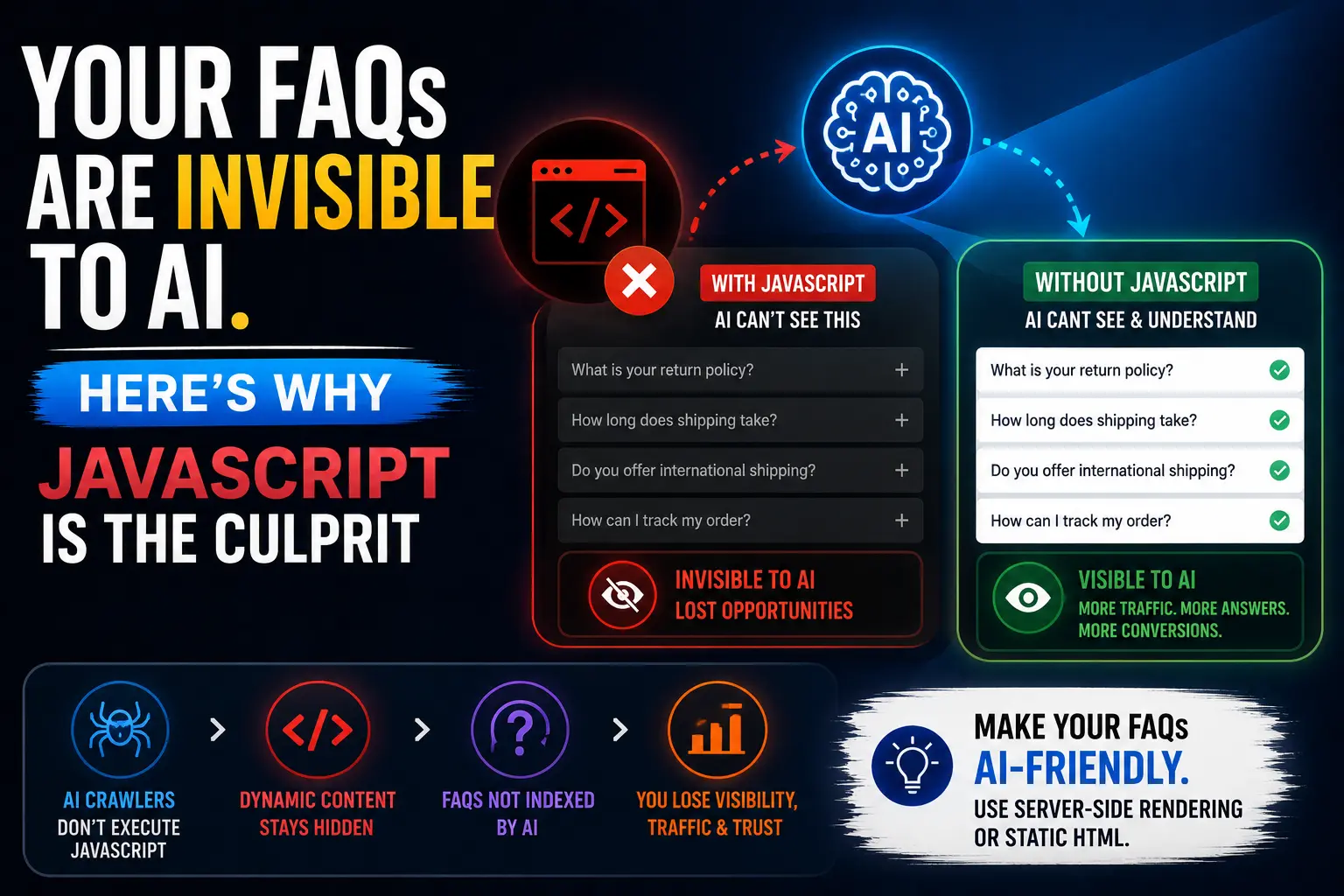

The JavaScript FAQ SEO problem is one of the most expensive invisible mistakes in technical SEO today – and most teams building FAQ sections have no idea they are making it. You write genuinely useful questions and answers, add FAQPage schema markup, publish the page, and check “FAQ optimised” off your list. What you don’t realise is that every AI crawler visiting your page – GPTBot (ChatGPT), PerplexityBot, ClaudeBot – fetched your raw HTML, found the accordion component, saw the questions and answers locked behind a click-to-reveal JavaScript interaction, and moved on without reading a single word of your content.
The FAQ section your users see when they click “Show Answer” is content that exists only after JavaScript executes in a browser. AI crawlers don’t execute JavaScript. They never execute JavaScript. They download the initial HTML response from your server and leave.
This is not a minor crawling nuance. An analysis of over 500 million GPTBot fetches found zero evidence of JavaScript execution. Not some of the time. Not on low-priority pages. Zero. Your product descriptions, pricing tables, and FAQ answers that exist only after JavaScript fires are completely invisible to the AI systems that power ChatGPT, Perplexity, and Google AI Overviews.
At Search Savvy, this is one of the most consistent gaps we find in technical audits for sites with strong content strategies and weak AI visibility: perfectly written FAQ content, locked inside a JavaScript accordion, invisible to the platforms that would cite it.
This post explains exactly how this happens, why it matters more in 2026 than ever before, and what to do about it.
What Is the JavaScript FAQ SEO Problem and How Does It Work?
The JavaScript FAQ SEO problem arises from a fundamental mismatch between how FAQ content is typically displayed on modern websites and how AI crawlers access web content.
Most FAQ sections built after 2018 use an accordion UI pattern – collapsed questions that expand to reveal answers when a user clicks them. Accordion components are built with JavaScript (React, Vue, Angular, or even simple vanilla JS) because they require interactive behaviour: the show/hide animation, the state management for which section is open, the smooth transition.
Here is the critical problem: the content inside that accordion – the actual text of your answers – often exists in the DOM only after JavaScript executes and the component mounts. In its pre-JavaScript state, the page’s raw HTML might contain the question headings but deliver empty <div> containers where the answers should be.
What a user sees: A polished, interactive FAQ section with expandable answers.
What GPTBot, PerplexityBot, and ClaudeBot see: Question headings with no answers.
Virtually all major AI crawlers – GPTBot, ClaudeBot, PerplexityBot – do not render JavaScript. Sites relying on client-side rendering are effectively invisible to a growing share of AI-powered search.
Even Googlebot – which does render JavaScript – has its own version of this problem. Google’s rendering happens asynchronously in a queue, with a delay of hours to weeks between the initial HTML fetch and the JavaScript rendering phase. Research from Onely found Googlebot took approximately 52 hours to follow a JavaScript-injected link versus 25 hours for a plain HTML link. Your competitor’s static HTML FAQ gets indexed the same day. Your JavaScript-rendered FAQ answers wait in a queue for days – if they get rendered at all for low-priority pages.
Why Is This Problem So Much Worse for AI Visibility in 2026?
The JavaScript FAQ SEO problem was always a suboptimal technical pattern. In 2026, it has become a genuine AI visibility crisis – because the stakes of AI crawler invisibility are higher than they have ever been.
ChatGPT, Claude, and Perplexity together represent over 70% of AI chatbot usage as of April 2026. Google AI Overviews appear in approximately 48% of all searches. If AI crawlers cannot read your FAQ content, your citations disappear from all of these surfaces simultaneously – not just one.
The data on what is at stake from getting this right is striking:
- Pages with FAQPage schema are 3.2x more likely to appear in Google AI Overviews than pages without
- Updating to FAQPage schema delivered a median 22% citation lift in AI-generated search results across 50 B2B and e-commerce domains studied by Relixir
- AI search visibility is growing at 527% year-on-year – against a backdrop where only 12.4% of sites currently use structured data
- Microsoft confirmed at SMX 2025 that schema markup directly helps its LLMs understand and cite content
The paradox is this: the businesses that most need AI Overview citations – the ones with specific, helpful FAQ content – are precisely the ones most likely to have their answers locked inside a JavaScript accordion where no AI crawler can find them.
Hidden content behind tabs, accordions, or modals that require a click to reveal is invisible to AI crawlers – and this is described as the single most common AEO (Answer Engine Optimisation) problem in 2026 technical audits.
How Does Googlebot Handle JavaScript FAQ Content vs AI Crawlers?
Understanding the JavaScript FAQ SEO problem requires understanding the two-wave crawling process that makes Googlebot different from every AI crawler – while still disadvantaging JavaScript-dependent content.
Googlebot’s two-phase crawling process:
Phase 1 (HTML fetch – immediate): Googlebot requests your URL and downloads the raw HTML. It scans for links, meta tags, canonical URLs, and any content already in the markup. For static HTML FAQ sections, this single fetch is sufficient – all content is visible and indexable immediately.
Phase 2 (JavaScript rendering – delayed): Pages with client-side JavaScript enter a rendering queue powered by headless Chromium (Google’s Web Rendering Service). Google’s Martin Splitt has stated the median rendering time is around five seconds – but medians hide outliers. For lower-priority pages, the rendering delay can stretch to days or weeks. During that window, JavaScript-dependent FAQ answers are missing from Google’s index.
How AI crawlers work (all of them, without exception):
GPTBot, PerplexityBot, ClaudeBot, Bytespider, and Meta-ExternalAgent are all Phase 1 only. They fetch raw HTML and stop. No rendering. No JavaScript execution. No second pass. Unlike Googlebot, most LLMs cannot render JavaScript – they rely on static HTML and plain-text visibility.
The practical implication:
| Content Type | Googlebot | GPTBot / PerplexityBot / ClaudeBot |
| FAQ in static HTML | Indexed immediately | Fully visible |
| FAQ in server-rendered HTML (SSR) | Indexed immediately | Fully visible |
| FAQ in JavaScript accordion (CSR) | Indexed with delay | Completely invisible |
| FAQPage JSON-LD in <head> | Read in Phase 1 | Read in Phase 1 |
This table reveals the specific failure mode: JSON-LD schema in the <head> is readable by all crawlers – it is part of the initial HTML. The text content inside a JavaScript accordion is not. This creates a situation where a page may have correct FAQPage schema telling AI systems “here are my questions and answers” while the actual answer text is inaccessible.
Google’s updated guidance states: ensure Q&As are visible on the page – not hidden in tabs or injected only via code. Marking up content that differs from the on-page text – or content that is not accessible to crawlers – violates Google’s structured data policies and can result in manual actions.
What Are the Specific JavaScript FAQ Patterns That Cause Invisibility?
The JavaScript FAQ SEO problem manifests through several specific implementation patterns. Understanding which category your FAQ falls into tells you exactly what needs to be fixed.
Pattern 1: Client-Side Rendered Accordion (Worst Case)
The answer text is stored in JavaScript state or fetched via API and injected into the DOM after the component mounts. The raw HTML contains the accordion structure but empty answer containers.
What crawlers see: Questions with no answers.
How to identify it: Right-click your FAQ page → View Page Source (not Inspect). If the answer text is not visible in the source code, it is client-side rendered.
Pattern 2: CSS-Visibility Toggle Without JS Content Loading
The FAQ answers are present in the HTML but hidden with display: none or visibility: hidden using CSS. JavaScript toggles the visibility class on click.
What crawlers see: Depends on the crawler. Googlebot typically reads display: none content but has historically treated it with lower weight. AI crawlers will read the raw HTML and find the hidden text – but Google’s quality guidelines actively discourage relying on this pattern for primary content.
The risk: Google’s March 2026 Spam Policies explicitly address hidden content used for SEO purposes. Even if AI crawlers can technically read hidden text, it sits in a quality grey area that creates risk for manual action.
Pattern 3: Correct Static HTML With FAQPage Schema – The Gold Standard
Answer text is in the page’s static HTML from the server response. FAQPage JSON-LD schema in the <head> maps the visible questions and answers to structured data. Both content and schema are accessible in Phase 1 of any crawl.
What crawlers see: Everything. Immediately.
How Do You Fix the JavaScript FAQ SEO Problem?
The JavaScript FAQ SEO problem has a clear, testable fix – and the correct solution depends on your site’s technology stack.
The Diagnosis Step (Do This First)
Before implementing any fix, you need to confirm you actually have the problem:
Test 1: View Page Source Right-click your FAQ page → “View Page Source.” Search for one of your FAQ answer texts using Ctrl+F. If you cannot find the text in the source code, the content is client-side rendered and invisible to AI crawlers.
Test 2: Use an AI Crawler Simulation In Screaming Frog, set the user agent to GPTBot or PerplexityBot and crawl your FAQ pages. The tool will show you exactly what these crawlers see – without any JavaScript rendering. Anything missing from this view is invisible to those AI platforms.
Test 3: Google Search Console → URL Inspection Use the URL Inspection tool in Google Search Console and click “Test Live URL.” The rendered HTML shows what Googlebot ultimately sees after JavaScript rendering – but also note when the page was last crawled. A significant gap between crawl date and current date suggests low rendering priority.
The Fix: Server-Side Rendering Your FAQ Content
The correct 2026 fix is ensuring FAQ answer text is present in the initial HTML response – not loaded after JavaScript executes. The implementation depends on your stack:
For Next.js sites: Use getServerSideProps or getStaticProps to ensure FAQ content is in the server-rendered HTML. The export const runtime = ‘edge’ pattern discussed in edge deployment runs your rendering at edge nodes globally – delivering static HTML with full FAQ content to every crawler at low latency.
For WordPress sites: Most WordPress FAQ plugins (including the popular Ultimate FAQ and Yoast FAQ blocks) render accordion content in the server-side HTML by default. The issue arises when custom JavaScript-heavy themes or page builders override this with client-side rendering. Verify using the View Page Source test. If answers are not in the source, switch to a plugin that renders FAQ content in static HTML.
For React/Vue/Angular SPAs: Migrate FAQ content to server-side rendering (SSR) or static site generation (SSG). For SPAs where full SSR migration is not immediately feasible, implement dynamic rendering – a server middleware that detects AI crawler user agents and serves a pre-rendered HTML version while continuing to serve the JavaScript application to regular users. Tools like Prerender.io or Cloudflare Workers can implement this without requiring framework migration.
For any site – the FAQPage JSON-LD minimum: If immediate SSR migration is not possible, ensure at minimum that your FAQPage JSON-LD schema in the <head> contains the complete question and answer text. JSON-LD is read from the raw HTML by all crawlers – it is not affected by JavaScript rendering delays. This provides AI crawlers with structured access to your FAQ content even when the visible HTML accordion is inaccessible.
At Search Savvy, this is the fix sequence we apply in technical audits: JSON-LD as the immediate solution, SSR as the durable one. Both together deliver the best AI citation performance.
What Should a Correctly Implemented FAQ Look Like in 2026?
The JavaScript FAQ SEO problem is fully resolved when your implementation meets all three criteria:
Criterion 1: Answer text in static HTML The complete text of every FAQ answer is present in the page’s server-rendered HTML response. Verify with View Page Source.
Criterion 2: FAQPage JSON-LD in the <head> Correct FAQPage schema markup – with the full question and answer text in the mainEntity array – is present in a <script type=”application/ld+json”> block in the page <head>. Validate with Google’s Rich Results Test.
Criterion 3: Schema and visible content match The questions and answers in your JSON-LD must match the content visible on the page. Structuring schema that differs from page content violates Google’s structured data policies and creates manual action risk.
Meeting all three criteria means:
- AI crawlers can read your FAQ content from the initial HTML
- Google can read and process your structured data in Phase 1
- Your content is a candidate for AI Overview citation, featured snippets, and PAA (People Also Ask) appearances
- The 3.2x AI Overview eligibility multiplier from FAQPage schema applies to your pages
FAQ: JavaScript FAQ SEO Problem in 2026
Q1: Can AI crawlers like GPTBot read JavaScript content? No – and this is absolute, not situational. An analysis of over 500 million GPTBot fetches found zero evidence of JavaScript execution. GPTBot, PerplexityBot, ClaudeBot, and all major AI crawlers download the initial HTML response from your server and stop. They do not execute JavaScript, do not wait for components to mount, and do not process content that requires a browser interaction (like clicking an accordion) to reveal. FAQ content that exists only after JavaScript executes is completely invisible to these crawlers.
Q2: Does Googlebot render JavaScript for FAQ accordions? Googlebot does render JavaScript – but through an asynchronous two-phase process. The initial HTML fetch is immediate; the rendering phase is queued and may take hours to weeks, especially for lower-priority pages. During that window, JavaScript-rendered FAQ answers are absent from Google’s index. FAQ content in static HTML is indexed the same day. Additionally, Google’s own documentation and structured data policies state that FAQ content should be visible on the page, not hidden behind interactions.
Q3: Is FAQPage schema still worth implementing after Google removed FAQ rich results in May 2026? Yes – strongly. Google removed FAQ rich results (the expandable accordion in search listings) on May 7, 2026, but FAQPage schema itself is not deprecated and continues to be actively parsed by AI crawlers including GPTBot, PerplexityBot, and Google’s AI Overview system. Pages with FAQPage schema are 3.2x more likely to appear in AI Overviews. FAQPage schema delivers a median 22% citation lift in AI-generated search results. The visual display feature in Google Search is gone; the backend AI citation value is higher than ever.
Q4: How do I test if my FAQ content is visible to AI crawlers? The fastest test: right-click your FAQ page and select “View Page Source” (not Inspect). Press Ctrl+F and search for the text of one of your FAQ answers. If the text appears in the source code, it is in the initial HTML and visible to AI crawlers. If it doesn’t appear, it is client-side rendered and invisible. For a more thorough audit, use Screaming Frog with the GPTBot user agent setting – it will show you exactly what AI crawlers see on every page of your site.
Q5: What is the difference between CSS-hidden FAQ content and JavaScript-rendered FAQ content for SEO? CSS-hidden content (display: none) is in the initial HTML and is technically readable by both Googlebot and AI crawlers. However, Google’s quality guidelines actively discourage primary content hidden with CSS, as it sits in a grey area of the spam policies – particularly if the hidden content exists primarily for SEO purposes rather than user experience. JavaScript-rendered content that doesn’t exist in the raw HTML at all is a clear, total visibility failure for AI crawlers. CSS hiding is a risk; JS rendering is an absolute block.
Q6: What is the fastest fix for a site with JavaScript-rendered FAQ content? The immediate fix is adding FAQPage JSON-LD schema in the page <head> with complete question and answer text. JSON-LD lives in the raw HTML – it is not affected by JavaScript rendering delays and is readable by all crawlers in Phase 1. This provides AI crawlers with structured access to your FAQ content even when the visible HTML is inaccessible. The durable fix is migrating FAQ content to server-side rendered HTML so both the visible content and the schema are available in the initial response.
The Bottom Line
The JavaScript FAQ SEO problem is a technical decision made once – usually by a developer building an accordion UI that looks great in a browser – that silently destroys AI visibility for every page it appears on. Your FAQ content is doing exactly what it was designed to do for human users. It is doing nothing for the AI systems that would otherwise cite it.
In 2026, with AI Overviews appearing in nearly half of all searches and GPTBot, Perplexity, and Claude driving increasing referral traffic, FAQ content that only a browser can access is FAQ content that does not exist in AI search.
The fix is a technical one, not a content one. Your questions are good. Your answers are genuine. The problem is where they live in your HTML. Move the answer text to the server-rendered response, add correct FAQPage JSON-LD schema that matches your visible content, validate both, and you transform an invisible asset into one of the most consistent AI citation generators available.
At Search Savvy, the JavaScript FAQ audit is now a standard component of every technical SEO review – because the pattern is that common and the fix is that straightforward once you know what to look for. If you want to know how many of your pages have this problem and what it would take to fix them, get in touch with the Search Savvy team.