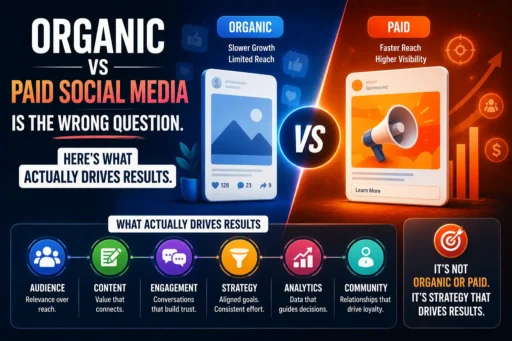
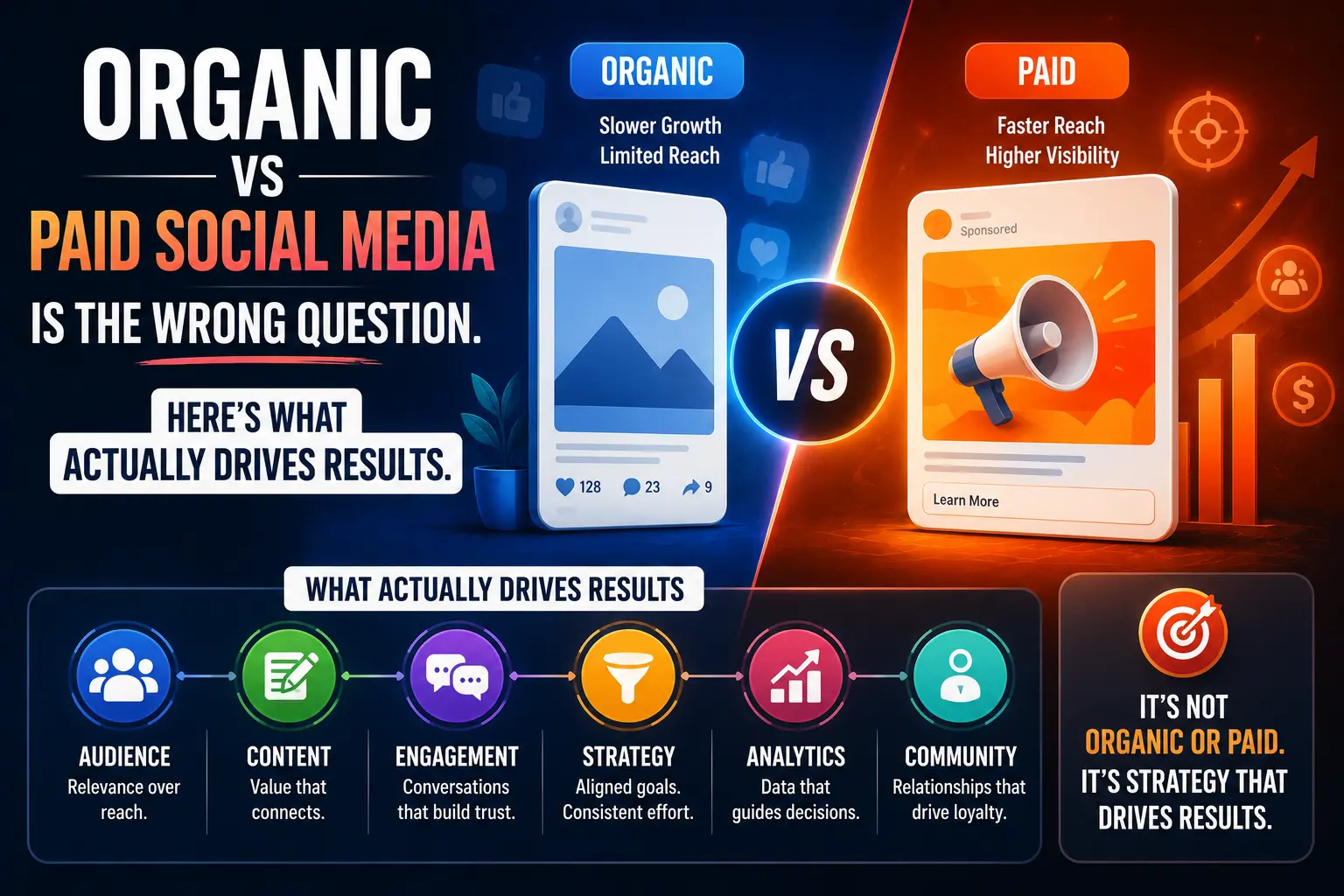

Organic vs paid social media is the question that fills every marketing strategy meeting, splits every social media budget conversation, and generates more confident-but-contradictory advice than almost any other topic in digital. Pick a side and someone will show you data that proves you wrong. Double down on organic and your reach stagnates. Pour everything into paid and your results evaporate the moment the budget does.
Here is the honest answer: the question itself is the problem.
In 2026, the brands generating the strongest measurable returns from social media are not the ones who chose organic or paid. They are the ones who stopped treating the two as competitors and started treating them as components of a single integrated system – each doing the specific job it does best, each making the other more effective.
At Search Savvy, we see the consequences of the either/or framing constantly. Brands that went all-in on organic watch their reach decline with every algorithm update. Brands that went all-in on paid watch their cost-per-acquisition creep upward every quarter – and have nothing to show for the spend the moment the card stops getting charged. Neither camp is winning. The brands building sustainable social media performance are the ones who figured out the architecture that connects both.
This post gives you that architecture – grounded in 2026 data, not marketing mythology.
What Is the Real Difference Between Organic and Paid Social Media in 2026?
Organic vs paid social media each serves a fundamentally different business function – and that is the most important thing to understand before any budget or time allocation decision.
Organic social media is unpaid content published through your brand’s channels. In 2026, its primary value is brand equity and community trust. Organic content creates familiarity. It signals that your brand has a genuine voice, a consistent presence, and a perspective worth following. When audiences encounter your paid campaigns – whether they recognise your brand or not – prior organic exposure dramatically lowers resistance and improves conversion rates.
The hard reality of organic in 2026:
- Facebook business Page organic reach averages 1–6% of followers per post
- Instagram organic reach for small accounts averages 3.5% – slightly better but declining
- LinkedIn organic reach is the most resilient of the major platforms, particularly for professional, text-forward content
- 86% of social media marketers now combine paid and organic tactics – because organic alone cannot scale reach predictably
Paid social media is content promoted through the platform’s advertising system to audiences beyond your existing followers. Its primary value is scale, speed, and precision targeting. Paid social reaches exactly who you define, when you choose, with creative you control. The data feedback loop is immediate. The scalability is limited only by budget and creative supply.
The hard reality of paid in 2026:
- Social media marketing delivers an average ROI of $5.20 for every $1 spent across industries
- Paid ROAS ranges from 2:1 to 10:1 depending on platform, industry, and campaign quality
- Retargeting campaigns convert 2–3x better than cold audience campaigns
- But the moment you stop spending, results stop – there is no compounding value, no accumulated asset, no brand equity built for the next campaign
Neither description sounds like a complete strategy on its own – because neither one is.
Why Is the Organic vs Paid Social Media Debate the Wrong Framing in 2026?
Organic vs paid social media keeps being framed as a competition because it produces a clean answer to a genuinely complicated question. Marketing teams want to know where to focus. Finance wants to know what to cut. The “organic vs paid” framing forces a choice that feels decisive but is actually counterproductive.
The platforms themselves have made this clear through how they are built. Every major social platform in 2026 is designed around a feedback loop that connects organic and paid performance:
On Meta (Facebook and Instagram): Your paid campaign quality scores are partially influenced by how your organic content performs. Ads that use creative aligned with your organic brand voice consistently outperform ads that feel disconnected from your organic presence. Warm audiences – people who have already engaged with your organic content – cost 30–50% less per conversion to retarget than fully cold audiences.
On LinkedIn: Organic posts that perform well among your first-degree connections are the most efficient way to test messaging before investing paid budget. High-performing organic posts become the basis for Sponsored Content campaigns – eliminating the creative risk of launching paid campaigns with untested messaging.
On Instagram: As confirmed in Instagram’s January 2026 algorithm update, DM shares are the single most powerful organic reach signal. That same signal – content being shared privately – is also one of the strongest predictors of paid creative performance. Content that earns organic DM shares almost always outperforms content that doesn’t when boosted with paid.
The data makes the architecture unavoidable: organic content is your creative testing lab. Paid distribution is your amplification layer. Separating them – or choosing between them – breaks the feedback loop that makes both work.
What Does the Integrated Strategy Actually Look Like in Practice?
Organic vs paid social media stops being a debate the moment you assign each a specific, non-competing role. At Search Savvy, the framework we apply when building social media strategies for clients operates on four principles:
Principle 1: Organic Earns Trust, Paid Earns Attention
Organic content does its best work when it is building the brand equity that paid campaigns later monetise. Organic LinkedIn posts from named experts build thought leadership. Organic Instagram content establishes visual identity and voice. Organic Facebook Group activity creates community belonging. None of these outcomes are efficiently purchased with paid budget – they require time and consistency.
Paid content does its best work when it is driving a specific action from a defined audience – conversions, lead form submissions, website traffic, event sign-ups. Trying to build brand trust primarily through paid content is expensive and ineffective. Trying to drive conversions primarily through organic content is slow and unpredictable.
Principle 2: Use Organic to Qualify Your Paid Creative
The most common and most costly paid social mistake is launching campaigns with creative that has never been tested. A static image that nobody engages with organically will not suddenly perform when paid budget is placed behind it. The reverse is also true: organic posts that generate strong saves, shares, and comments are telling you something about which messages, formats, and angles resonate with your audience.
The proven allocation for SMBs: 60% paid and 40% organic (in time and resources) for established brands focused on conversion performance. For brands in earlier stages building community, a 50/50 or even 60% organic split is more effective. The correct balance shifts as your business stage evolves.
The practical workflow:
- Publish organic content across your chosen platforms consistently for 30 days
- Identify the top 3–5 posts by saves, shares, or DM interactions – these are your creative signals
- Build paid campaigns using the formats, messages, and creative approaches of your best organic performers
- Use paid to reach cold audiences; use organic to nurture warm ones
Principle 3: Paid Builds the Audience That Organic Converts
Organic social content has its strongest conversion rates among warm audiences – people who already know your brand, have engaged with your content, or have visited your website. Building that warm audience organically alone is slow. Paid social – specifically top-of-funnel awareness and reach campaigns – can accelerate warm audience building significantly.
A brand that runs consistent paid reach campaigns to targeted cold audiences, then nurtures those newly-warm users with strong organic content, will see its organic engagement rates rise over time. The organic content does not work harder – it works smarter, because the audience receiving it is better qualified.
Principle 4: Measure Each Channel Against Its Actual Job
Organic vs paid social media produces misleading conclusions when you measure both against the same metric. Measuring organic content by direct conversion rate sets it up to fail. Measuring paid social by brand affinity score sets it up to fail.
Assign each channel its correct primary KPI:
| Channel | Primary Job | Primary KPI |
| Organic Instagram | Brand voice, community | Saves, DM shares, follower quality |
| Organic LinkedIn | Thought leadership, trust | Profile views, connection requests, DM inquiries |
| Organic Facebook Group | Community retention | Member engagement rate, post reach |
| Paid Meta (cold) | New audience reach | CPM, frequency, video completion rate |
| Paid Meta (warm retargeting) | Conversion | ROAS, CPA, conversion rate |
| Paid LinkedIn | B2B lead generation | Cost-per-lead, lead quality score |
Different platforms contribute to ROI in different ways. A channel that excels at discovery may not be the same one that closes leads. A content format that generates organic reach may not produce direct conversions – and that is not a failure. It is a feature.
How Does Platform Choice Affect the Organic vs Paid Social Media Decision?
Organic vs paid social media plays out differently on each platform – and choosing the wrong mix on the wrong platform is one of the most common ways brands waste both time and budget.
Facebook’s organic reach has declined most severely – averaging just 2–5% for business Pages in 2026. For organic, Facebook’s highest-return channel is now Facebook Groups, where posts routinely reach 20–40% of members. For paid, Facebook remains the top conversion channel for consumer purchases: 39% of consumers turn to Facebook first when ready to buy on social media.
Optimal mix: Low organic Page investment, high organic Group investment, paid ads for retargeting and conversion.
Instagram organic reach averages 3.5% for small accounts – better than Facebook Pages but declining. Organic Reels still earn the widest non-follower distribution. Paid Instagram performs strongest for visual products, D2C brands, and brands with established creative identity. Video ads deliver 48% higher engagement than static image ads – a finding that applies equally to organic and paid formats.
Optimal mix: Consistent organic Reels and carousels for brand building; paid for product launches, seasonal campaigns, and retargeting warm audiences.
LinkedIn remains the most resilient organic platform for B2B and professional services. Organic LinkedIn posts from real people – not brand Pages – earn significantly higher reach and trust. Named expert content, first-person insights, and specific industry commentary perform best organically. Paid LinkedIn is expensive (cost-per-lead averages $30–$75) but delivers the highest-quality B2B leads when targeting is precise.
Optimal mix: High organic investment in personal profile content from team members; paid used selectively for account-based marketing and lead generation campaigns with clear conversion intent.
Short-Form Video (Reels, TikTok-style formats)
Short-form video is the format that delivers the strongest combined organic and paid performance in 2026. Organic short-form video earns algorithmic distribution to non-followers on both Instagram and Facebook. The same video formats that perform organically can be run as paid ads with minimal adaptation. The creative investment produces double duty – organic reach building and paid ad creative – making short-form video the highest-efficiency format investment available.
What Is the Right Budget Split for Indian SMBs and Growing Brands?
Organic vs paid social media budget decisions look different depending on business stage, category, and available resources.
Based on 2026 data and client experience across Indian D2C brands, service businesses, and agencies, here is the stage-based framework:
Stage 1 – Brand new or less than 12 months old: Focus 60–70% of social media time on organic community building and content development. Use 30–40% of paid budget for audience reach expansion and page/profile follower building. The goal is building the warm audience base that makes future paid campaigns efficient.
Stage 2 – Established brand with existing audience: Shift to 60% paid for conversion-focused campaigns, 40% organic for brand voice and community maintenance. Identify your highest-performing organic content and build your paid creative strategy around it.
Stage 3 – Scaling brand with proven conversion funnels: Invest in paid amplification of your top-performing organic creative. Run always-on retargeting campaigns to warm audiences. Use organic primarily for brand equity, community management, and creative testing.
A consistent finding across SMB social media strategy in 2026: the highest total ROI is achieved by boosting organic content that already performs well with paid budget – rather than creating separate paid campaigns with untested creative. The organic performance signal reduces creative risk and typically produces lower CPMs and higher quality scores when promoted.
FAQ: Organic vs Paid Social Media in 2026
Q1: Which is better – organic or paid social media? Neither is universally better. In 2026, organic social media builds brand trust, community, and long-term equity – but its reach is limited, averaging 1–6% on Facebook and 3.5% on Instagram. Paid social media delivers scale, speed, and measurable conversions – but stops the moment budgets do. The highest ROI is achieved by integrating both: using organic to build and test, paid to amplify and convert. 86% of social media marketers in 2026 combine both approaches for exactly this reason.
Q2: What is a good ROI for paid social media campaigns in 2026? Across industries, a 3:1 return is considered the standard baseline for social media marketing. A 5:1 return is a strong benchmark for paid campaigns. Average ROAS ranges from 2:1 to 10:1 depending on platform, industry, and campaign quality. Social media marketing delivers an average of $5.20 for every $1 spent across industries. Retargeting campaigns – targeting warm audiences who have already engaged organically – typically convert 2–3x better than cold audience campaigns.
Q3: How much should a small business spend on paid social vs organic in 2026? The recommended split for established SMBs is 60% paid and 40% organic (in time and resources). For newer businesses still building community, 50/50 or even 60% organic is more effective. The correct ratio depends on your stage: in the awareness phase, invest more in paid reach; in the loyalty and retention phase, shift toward organic community building. Measure results monthly and adjust allocation toward what is producing measurable impact for your specific business.
Q4: Does organic social media still work in 2026? Yes – but its role has fundamentally changed. Organic social media in 2026 is not a reach channel (average reach of 1–6% on most platforms makes that unreliable). It is a trust and equity channel. Consistent, high-quality organic content builds brand familiarity, reduces conversion friction for paid campaigns, and provides the creative signal data that makes paid campaigns more efficient. Organic Facebook Groups are the exception – posts routinely reach 20–40% of Group members, making Groups the most effective organic reach channel available in 2026.
Q5: What is the biggest mistake brands make with paid social media? Launching paid campaigns with creative that has never been tested organically. Ads using untested creative, messaging the brand hasn’t validated, or formats that haven’t earned engagement organically consistently underperform compared to boosted organic content. The most cost-efficient approach is to publish content organically, identify what generates strong saves, shares, and comments, and use that organic performance data to guide paid creative investment.
Q6: Which social platform delivers the best ROI for Indian brands in 2026? Facebook delivers the strongest purchase conversion rates – 39% of consumers turn to Facebook first when ready to buy on social media, and its retargeting infrastructure is the most developed of any platform. Instagram delivers the highest creative impact for visual and D2C brands, with video ads generating 48% higher engagement than static formats. LinkedIn delivers the highest-quality B2B leads at higher cost. The correct platform mix depends on your business model: B2C conversion-focused brands should prioritise Meta (Facebook + Instagram); B2B and professional service brands should prioritise LinkedIn with organic personal profile investment.
The Bottom Line
Organic vs paid social media is the wrong debate not because one is clearly better, but because treating them as a choice forces you into a false trade-off that undermines both.
The organic vs paid question sounds strategic. It produces an answer that sounds decisive. But the brands generating the strongest, most sustainable social media ROI in 2026 are not the ones who chose correctly between the two. They are the ones who stopped choosing, assigned each channel its correct role, and built the feedback loop that connects organic trust-building to paid conversion-driving.
Organic builds the audience. Paid scales the reach. Organic tests the creative. Paid amplifies the winners. Organic retains the community. Paid acquires the next one.
That is the architecture. And once you see it that way, the question stops being “organic or paid?” and becomes: “Am I using both to their full potential?”
According to Search Savvy’s social media strategy practice, the answer for most brands is no – and the gap between where they are and where a properly integrated strategy would take them is measurable, closeable, and often achievable within a single quarter with the right framework in place. If you want to know exactly where your current social media strategy is leaving results behind, get in touch with Search Savvy.