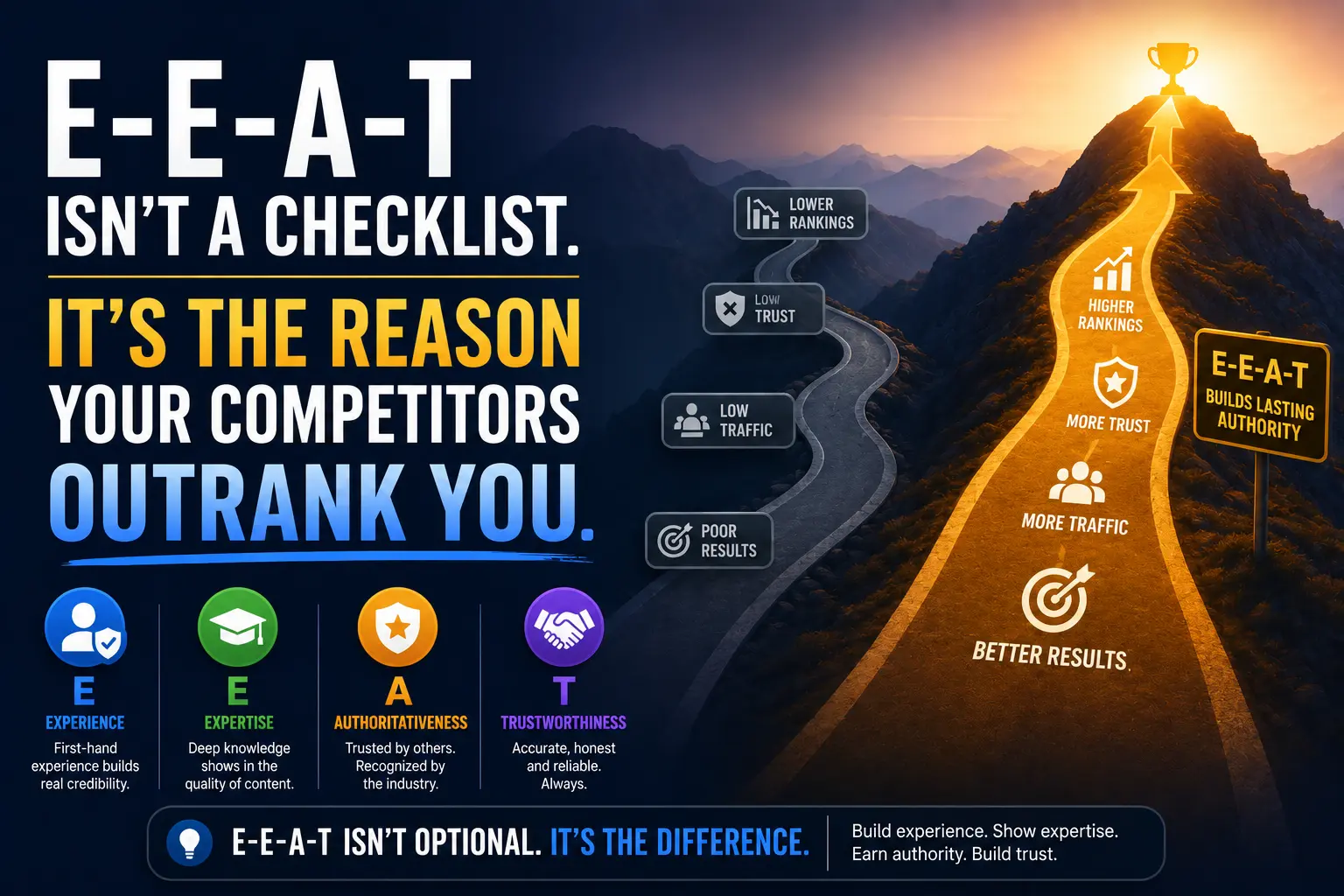

E-E-A-T SEO is the framework most brands think they understand – and most get completely wrong. They treat it like a to-do list: add an author bio, get a few backlinks, sprinkle in some credentials, done. But while they’re ticking boxes, their competitors are building something fundamentally different: a reputation that Google’s algorithm, its quality raters, and every major AI system can verify. That gap is why you’re losing rankings you should be winning.
At Search Savvy, we’ve seen this pattern repeatedly. A brand publishes excellent content. Technically clean site. Decent backlinks. And yet a competitor with half the domain authority consistently outranks them – and earns AI Overview citations they never see. The reason, almost every time, comes back to E-E-A-T signals that are either missing, weak, or impossible for a machine to independently confirm.
This post will show you exactly what E-E-A-T SEO looks like in 2026, why the March 2026 Core Update permanently raised the bar, and what you need to do differently starting today.
What Is E-E-A-T SEO and Why Does It Matter More Than Ever in 2026?
E-E-A-T SEO refers to the practice of building and signalling the four qualities Google uses to evaluate content credibility: Experience, Expertise, Authoritativeness, and Trustworthiness. Originally introduced as E-A-T in Google’s Search Quality Rater Guidelines in 2014, the extra “E” for Experience was added in late 2022 – and in 2026, it has become the most scrutinised quality signal for most content types.
Here is something critical that most SEO guides get wrong: E-E-A-T is not a ranking factor. There is no E-E-A-T score in Google’s algorithm. What it actually is: a framework that describes the qualities Google’s systems are designed to reward. Google’s human quality raters evaluate pages against E-E-A-T criteria, their assessments train the algorithm, and the algorithm replicates those quality judgements at scale across billions of pages.
The practical implication? You cannot “optimise for E-E-A-T” the way you optimise a title tag. You have to become the kind of source that genuinely deserves to rank – and then make sure Google can verify it.
In 2026, the stakes are higher than ever. The March 2026 Core Update – one of the most volatile updates ever measured – moved 79.5% of Top-3 positions, according to SE Ranking. Sites with original data gained +22% visibility post-update, while AI-paraphrased content with no genuine expertise lost up to 71% of its traffic.
How Does Each E-E-A-T Signal Actually Affect Your Rankings?
E-E-A-T SEO operates across four distinct dimensions, and Google evaluates each one differently. Understanding what each pillar means in practice – not in theory – is where most brands fall short.
What Does “Experience” Mean in SEO in 2026?
E-E-A-T SEO’s first pillar – Experience – asks a deceptively simple question: did the person who wrote this actually do the thing?
A post on “how to run a Google Ads campaign for e-commerce” written by someone who has managed ₹50 lakh in ad spend reads fundamentally differently from one written by someone who read a few industry articles. Google’s systems are increasingly capable of detecting that difference through signals like:
- First-person accounts of outcomes, decisions, and mistakes
- Original screenshots, data, and case-specific details
- Content that reflects practical knowledge rather than information synthesis
Experience is the pillar that AI-generated content cannot fake. It is the “moat” that separates genuine subject-matter sources from content farms, and Google is increasingly using it as a primary differentiator.
What Does “Expertise” Mean for Google Rankings?
E-E-A-T SEO’s expertise dimension is about credentials, depth, and demonstrated knowledge. Expertise signals include:
- Author qualifications – relevant degrees, certifications, professional roles
- Topical depth – does your content cluster cover a subject comprehensively, or does it skim the surface of popular queries?
- Sourcing quality – do you cite primary sources, original research, and authoritative references?
For YMYL (Your Money or Your Life) topics – health, finance, legal, safety – expertise requirements are especially strict. An article about investment strategies written by an anonymous author with no verifiable background has almost no chance of ranking in 2026, regardless of how well-written it is.
How Does Authoritativeness Work as a Ranking Signal?
E-E-A-T SEO’s authority dimension is largely external – it is not something you can self-assert. Google determines authority by looking at what the rest of the web says about you.
Key authority signals in 2026:
- Quality backlinks from contextually relevant, trusted sources
- Brand mentions – even unlinked mentions near relevant keywords contribute to entity recognition
- Digital PR – being quoted in trade publications, cited by journalists, and referenced by industry peers
- Knowledge Graph presence – does Google recognise your brand as a known entity in your field?
According to research published in early 2026, domain authority (DA) as a standalone metric has dramatically declined in importance, now showing only an r = 0.18 correlation with rankings – down from 0.23 in 2024. What matters now is contextual authority: are the right sources, in your specific niche, vouching for you?
Why Is Trustworthiness the Foundation That Everything Else Rests On?
E-E-A-T SEO ultimately lives or dies on trust – and in 2026, trust is multi-layered. Google’s own Quality Rater Guidelines describe Trustworthiness as the central pillar of the E-E-A-T model. A trust failure overrides any amount of Experience, Expertise, or Authority.
Trust signals that matter in 2026:
- HTTPS with a clean security record
- Transparent business information – physical address, named editorial leadership, contact details
- Clear author attribution on every page that makes quality claims
- Accurate, well-sourced content with clear correction policies
- Privacy policy, About page, and disclosure pages that are genuine, not boilerplate
At Search Savvy, we consistently find that trust failures are the most common and most damaging E-E-A-T weakness in client audits – and often the easiest to fix once identified.
Why Did the March 2026 Core Update Make E-E-A-T SEO Non-Negotiable?
E-E-A-T SEO moved from “important” to “essential” in the wake of Google’s March 2026 Core Update. The update launched just two days after a spam update completed – a deliberate two-phase sweep that first cleared manipulative link schemes, then re-evaluated content quality with those spam signals removed.
Sites that relied on questionable tactics were hit from both directions simultaneously. But the deeper impact was on sites with genuinely good intentions and weak E-E-A-T signals. Google’s systems, now powered by more sophisticated AI models, became significantly better at distinguishing between content that claims authority and content that can prove it.
The data tells the story clearly:
- Sites with original research and first-hand data gained +22% visibility
- Sites with AI-paraphrased content and no genuine expertise lost up to 71% of traffic
- 96% of AI Overview citations now come from sources with verified E-E-A-T signals
- E-E-A-T verification became 27% stricter in 2025, a trend that has continued into 2026
The update also reinforced topical authority as a key differentiator. A website with 50 SEO-related articles covering a subject in depth consistently outranks a site with one high-quality SEO article – because topical depth is itself an E-E-A-T signal.
How Does E-E-A-T SEO Determine Who Gets Cited in AI Overviews?
E-E-A-T SEO is now directly tied to AI Overview and AI citation eligibility – not just traditional search rankings. This is one of the most important strategic shifts of 2026.
When Google’s AI generates an Overview, it doesn’t just pull from the top-ranked pages. It filters for the most verifiable, credible, and machine-parseable sources. The correlation between strong E-E-A-T signals and AI Overview citations stands at an extraordinary r = 0.81 – making it the single strongest predictor of AI citation performance.
What this means in practice:
- A page ranked #5 with strong E-E-A-T signals can be cited in an AI Overview above the #1 result with weak trust signals
- Author entity verification – Person schema, LinkedIn SameAs links, Knowledge Graph presence – dramatically increases AI citation eligibility
- Pages with structured, definition-style content that clearly demonstrates authority are prioritised for AI extraction
AI Overviews now appear for approximately 20% of keywords, and the competition for those citations is won or lost on E-E-A-T, not keyword density.
What Are the Most Common E-E-A-T Mistakes Brands Make?
E-E-A-T SEO fails in predictable ways. According to Search Savvy’s client audit experience, these are the mistakes we see most consistently:
1. Anonymous or thin author bios Listing “Admin” or “Staff Writer” as the author of your expert content is one of the fastest ways to signal low trust. Every piece of content that makes quality claims needs a named, credible author with a verifiable background.
2. No external entity validation Claiming expertise on your own website carries almost no weight. You need third-party sources – backlinks, brand mentions, press coverage, directory listings – that independently confirm your authority.
3. Outdated content without visible revision dates Google’s systems check dateModified signals. Content that hasn’t been updated in 18+ months on fast-moving topics signals neglect, not authority.
4. Missing trust-layer pages No About page. No editorial policy. No clear business address or contact information. These are small omissions that create large trust deficits.
5. Schema without substance Deploying Organization and Person schema without the underlying content and external links to back them up. Schema signals authority to crawlers – but only when the rest of the web agrees.
How to Build E-E-A-T SEO Signals That Google Can Actually Verify
E-E-a-T SEO improvement is a 90-day minimum commitment, not a one-afternoon task. Here is a prioritised action plan:
Week 1–2: Trust foundations
- Add a transparent About page with named leadership and company history
- Ensure every piece of expert content has a named author with a full bio
- Link author bios to LinkedIn profiles and any relevant external publications
- Implement Person schema with sameAs links for all key authors
- Verify HTTPS, privacy policy, and contact information are complete
Week 3–4: Experience and expertise signals
- Audit your top 20 pages – does each one reflect first-hand knowledge or information synthesis?
- Add original data, case studies, screenshots, and outcomes where possible
- Build topical content clusters so Google sees depth, not breadth
Month 2–3: Authority building
- Launch a digital PR campaign targeting relevant trade publications and industry blogs
- Pursue strategic backlinks from contextually relevant, trusted sources
- Contribute guest articles, podcast appearances, and expert quotes to build external recognition
- Refresh outdated high-performing pages with updated data and clear dateModified timestamps
FAQ: E-E-A-T SEO in 2026
Q1: Is E-E-A-T a direct Google ranking factor? No. E-E-A-T is not a ranking signal Google’s algorithm directly scores. It is a quality framework described in Google’s Search Quality Rater Guidelines. Human raters evaluate pages against E-E-A-T criteria; their assessments train the algorithm to replicate those quality judgements at scale. The practical effect is the same – pages with strong E-E-A-T signals consistently rank higher and earn more AI citations.
Q2: How long does it take to see ranking improvements from improving E-E-A-T? Most brands see measurable ranking movement within 60–90 days of implementing strong trust and expertise signals, though the timeline varies by niche competitiveness and how significant the current E-E-A-T deficit is. Author entity signals and trust-layer pages tend to produce the fastest results.
Q3: Does E-E-A-T matter for small businesses and local brands? Yes, especially for local service businesses. Google applies E-E-A-T evaluation to local and YMYL content just as rigorously. For small businesses, the most impactful signals are transparent business information, genuine reviews, and visible named ownership – all of which are achievable without a large content team.
Q4: How does AI-generated content affect E-E-A-T? AI-generated content without genuine expert oversight is one of the biggest E-E-A-T liabilities in 2026. Sites relying on AI-paraphrased content with no first-hand expertise lost up to 71% of their traffic in the March 2026 Core Update. AI tools can support content production, but the Experience and Expertise signals must come from a real human with verifiable credentials.
Q5: What is the fastest single change I can make to improve E-E-A-T? Add detailed, credentialed author bios to your top pages and link them to verifiable external profiles (LinkedIn, published work, professional associations). Author entity clarity is consistently the highest-leverage quick win in E-E-A-T audits – and case studies have shown trust signals rebounding within three months of this change alone.
Q6: How is E-E-A-T connected to AI Overview citations? E-E-A-T signals have an r = 0.81 correlation with AI Overview citation rates – the strongest single predictor measured. AI systems filter for verifiable, credible sources before generating answers. Strong E-E-A-T means your pages pass that filter; weak E-E-A-T means they don’t, regardless of ranking position.
The Bottom Line
E-E-A-T SEO is not a checklist your content team ticks off before hitting publish. It is the cumulative reputation your brand builds across every piece of content you produce, every author you feature, every external source that validates your expertise, and every trust signal a machine can independently verify.
Your competitors are not outranking you because they found a clever technical trick. They are outranking you because Google and every major AI system can look at their content and say, with high confidence: this source is credible, this author is real, this information can be trusted.
That is what E-E-A-T SEO actually is in 2026. And closing that gap is entirely achievable – if you stop treating it like a checklist and start treating it like the brand-building exercise it truly is.
Need an E-E-A-T audit for your website? Get in touch with the Search Savvy team – we’ll tell you exactly where your trust signals are leaking and how to fix them.