

Somewhere in Bengaluru, a startup is paying ₹40,000 per month for a dedicated server that sits at 8% CPU utilisation for 23 hours a day. Once a week, a product launch email goes out, traffic spikes, the server struggles, and the team scrambles. The rest of the time, they are paying for capacity they are not using.
Somewhere in Gurugram, an e-commerce brand is planning a Diwali campaign that will generate 10× their normal traffic for 72 hours. The options the dev team has presented are: upgrade to a ₹2 lakh per month server tier they can sustain for only three months, or risk the existing infrastructure failing at peak.
Both problems have the same solution – one that a significant proportion of global engineering teams has already adopted, but that remains dramatically underutilised among Indian brands outside the top-tier tech companies. That solution is serverless web development.
Serverless web development is not a new concept. It has been commercially mature since 2014 when AWS Lambda launched. But the gap between global adoption velocity and Indian brand adoption remains wide enough to represent a genuine competitive opportunity – for any Indian brand that moves before its sector peers do.
At Search Savvy, we work across digital strategy, web performance, and technical infrastructure – and serverless architecture is one of the recommendations we make most consistently to growing Indian brands that are hitting the ceiling of traditional hosting models. This article makes the case, with the 2026 data to support it.
What Is Serverless Web Development – and What Does It Actually Mean?
Serverless web development is the practice of building applications and websites where the cloud provider – AWS, Google Cloud, Microsoft Azure – automatically handles all server provisioning, scaling, maintenance, and management. You write the code. The provider handles everything that runs it.
The term “serverless” is slightly misleading – servers are still involved, but they are abstracted entirely from the developer’s responsibility. Serverless computing shifts responsibility from infrastructure management to code execution. Developers deploy functions instead of servers. Cloud providers handle scaling and availability.
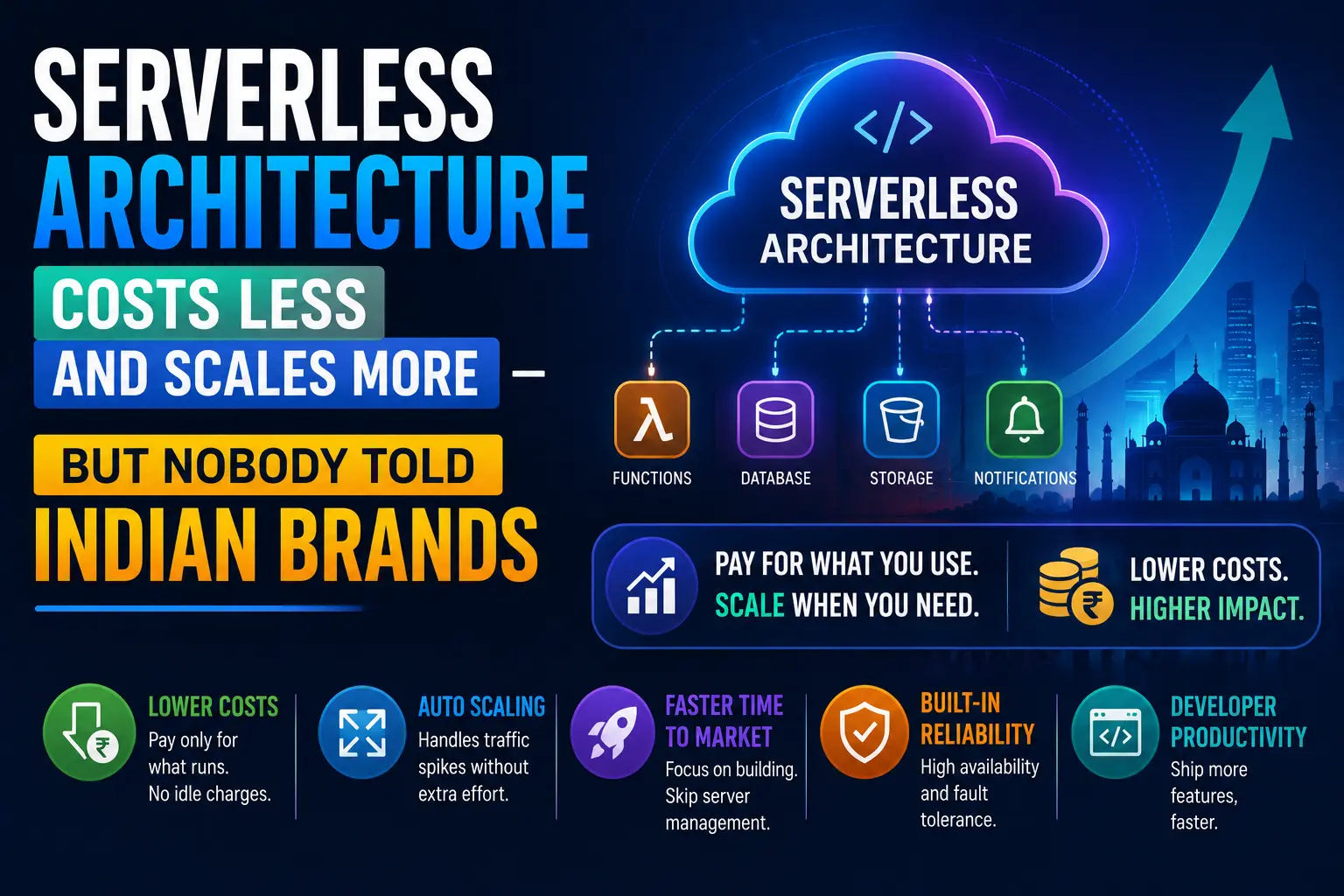
The technical model that makes this work is Function-as-a-Service (FaaS) – the core of serverless web development. Rather than deploying an always-running application on a persistent server, you deploy individual functions that execute only when triggered by a specific event: an HTTP request, a database change, a scheduled timer, an API call. When the function completes, the execution environment disappears. When another request arrives, a new execution starts.
The practical implications for a web application:
- A product page loads because a serverless function fetches the product data, renders it, and responds – then stops. No server is running in between requests.
- A payment is processed because a serverless function handles the Razorpay webhook, updates the database, and sends a confirmation email – then stops.
- A traffic spike during a sale is handled because the cloud provider spins up hundreds of function instances simultaneously – automatically, with no human intervention, no server resizing, no downtime.
The key platforms delivering serverless web development in 2026 include: AWS Lambda (the market leader, with 1.5 million customers invoking it each month), Google Cloud Run (the Google equivalent with strong containerised function support), Microsoft Azure Functions (dominant in enterprise and regulated industry contexts), Vercel and Netlify (developer-friendly platforms with zero-config serverless deployment for frontend-heavy applications), and Cloudflare Workers (edge-deployed serverless with global low-latency distribution).
People Also Ask: What is serverless web development in simple terms? Short Answer: Serverless web development means building a website or application where your cloud provider – AWS, Google, or Azure – automatically runs your code and manages all the server infrastructure. You pay only for the actual time your code runs, not for servers sitting idle. When traffic spikes, the provider scales automatically. When traffic is low, you pay almost nothing. The “serverless” part means you never configure, manage, or pay for server capacity directly.
Why Is Serverless Web Development So Important in 2026?
Serverless web development has reached the inflection point where it is no longer an advanced option for tech-native companies – it is the standard architecture choice for any team that wants to build fast, scale reliably, and control infrastructure costs precisely.
The market data confirms this definitively. The serverless computing market in 2026 is estimated at USD 32.59 billion, growing from USD 26.51 billion in 2025 – a 22.94% CAGR that is projected to carry the market to USD 91.56 billion by 2031. Demand is rising because development teams want to write code without managing infrastructure, and hyperscale clouds now bundle robust observability, security and integration capabilities.
Three converging trends in 2026 make serverless particularly relevant for Indian brands right now:
The cost equation has become undeniable. Gartner reports that serverless platforms reduce infrastructure costs by 20–30% for web applications. For most small and mid-sized Indian brands paying flat-rate hosting fees regardless of actual usage, the shift to pay-per-execution pricing represents a direct, measurable cost reduction – not a speculative one.
Traffic volatility is increasing. India’s internet economy is characterised by extreme traffic concentration: Diwali, Republic Day sales, cricket finals, budget announcements, IPL. Traditional server architectures require provisioning for peak capacity and paying for it year-round. Serverless architectures scale to peak automatically and charge only for actual execution time – making them structurally better suited to India’s traffic patterns than anywhere else.
The development tools have matured dramatically. January 2026 brought AWS Lambda Managed Instances, combining the flexibility of EC2 with fully managed serverless operations. October 2025 brought Lambda response streaming up to 200 MB, significantly improving latency-sensitive applications. IDC predicts that 50% of new web applications will use edge computing – a core serverless capability – by 2026. The infrastructure is now sophisticated enough for any use case a growing Indian brand is likely to have.
People Also Ask: How much does serverless architecture reduce infrastructure costs? Short Answer: Gartner reports that serverless platforms reduce infrastructure costs by 20–30% for web applications. The actual saving depends heavily on traffic patterns – the less predictably consistent your traffic is, the greater the saving. Brands with variable, spike-prone traffic – the pattern of most Indian consumer-facing brands – typically see the largest cost reductions because traditional hosting requires provisioning for peak capacity permanently, while serverless charges only for actual usage.
How Does Serverless Web Development Actually Save Money?
Serverless web development’s cost model is the opposite of traditional hosting – and understanding the difference reveals why it is specifically advantageous for the traffic patterns of Indian brands.
Traditional hosting cost model: You pay for a fixed amount of server capacity – CPU, memory, storage – regardless of whether traffic is using it. A ₹30,000/month VPS is ₹30,000/month whether you have 100 visitors or 100,000. If you need to handle a traffic spike, you upgrade to a larger tier – paying the higher amount permanently even when the spike is over.
Serverless cost model: You pay only for the time your code actually executes, measured in milliseconds. AWS Lambda, for example, charges per request (approximately $0.20 per million requests) and per GB-second of compute time ($0.0000166667 per GB-second). A function that processes 1,000,000 requests per month at 100ms average execution time would cost approximately $4–5 – for what might cost ₹15,000–30,000 per month on a traditional server capable of handling that volume reliably.
The saving appears most dramatically in three scenarios common to Indian brands:
Startup and pre-product-market-fit stage. A startup’s web application might serve 500 requests per day. On a traditional server, they pay ₹5,000–15,000 per month for capacity they barely use. On AWS Lambda, 500 daily requests (15,000 monthly) is essentially free – well within Lambda’s 1 million free requests per month on the free tier. The startup pays nothing for hosting until they reach meaningful scale.
Seasonal e-commerce. During Diwali, traffic might spike 20× for 72 hours, return to normal, then spike again for Christmas and Republic Day sales. A traditional architecture requires provisioning for 20× capacity year-round, or paying for emergency upgrades at peak. A serverless architecture handles the 20× spike automatically, costs 20× as much during those 72 hours, and costs normal amounts for the remaining 360 days. Net cost: significantly lower.
B2B SaaS with business hours traffic. Many B2B applications have near-zero traffic at night and on weekends, with concentrated load during 10 a.m.–6 p.m. weekday hours. Serverless pays for exactly those hours of execution. Traditional servers run through the night at full cost.
The break-even point where traditional hosting becomes cheaper than serverless is at sustained, continuously high traffic volumes – typically above 5–10 million requests per month with long execution times. Below that threshold, serverless is almost always cheaper. Above that threshold, hybrid architectures become relevant.
What Are the Real-World Benefits of Serverless Web Development Beyond Cost?
Serverless web development offers three additional advantages that matter as much as – or more than – the cost saving for Indian brands building digital products:
Automatic Scaling to Any Traffic Volume
Serverless web development handles traffic spikes that would crash a traditional server – without any manual intervention, server resizing, or advance planning. When an IPL final happens and your sports platform gets 50× normal traffic in 45 minutes, the serverless platform spins up as many function instances as needed automatically. When the match ends, it scales back down. You do not need a DevOps engineer on call at 10 p.m. managing server capacity.
This is the structural advantage that matters most for Indian consumer brands. The cultural concentration of traffic – around festivals, sports events, political announcements, product launches – is more extreme in India than in most other markets. The infrastructure that handles those spikes most reliably and most affordably is serverless.
Zero Server Management Overhead
Serverless web development eliminates an entire category of operational responsibility. No security patches, no OS updates, no server monitoring, no capacity planning, no database cluster management. The cloud provider handles all of this. Developers focus on writing the code that creates business value – not on the infrastructure that runs it.
For Indian SMBs and startups that cannot afford a dedicated DevOps team, this is particularly significant. The hidden cost of traditional hosting is not just the monthly fee – it is the hours of engineering time spent on server administration that could be spent on product development.
Faster Time to Market
Serverless web development enables teams to ship features significantly faster because the deployment pathway is radically simpler. No server provisioning, no environment configuration, no capacity estimation. Write the function, deploy to the platform, it runs. Vercel and Netlify have reduced the deployment cycle for frontend applications to seconds – a commit to a repository triggers an automatic build and deployment that is globally available within minutes.
For Indian brands in competitive markets, faster shipping is a meaningful commercial advantage. The team that ships features weekly beats the team that ships monthly, and serverless architecture enables that cadence without the infrastructure complexity that slows traditional deployment.
People Also Ask: Does serverless architecture handle traffic spikes automatically? Short Answer: Yes – automatic scaling is one of the primary advantages of serverless web development. When traffic spikes, the cloud provider automatically creates additional function instances to handle the load in parallel. There is no manual server resizing, no downtime, and no advance capacity planning required. AWS Lambda, Google Cloud Run, and Azure Functions all scale to thousands of simultaneous instances within seconds of a traffic surge – handling the kind of festival and sale traffic that crashes traditional servers.
What Are the Limitations of Serverless Web Development?
Serverless web development is not the right architecture for every situation – and being honest about its limitations prevents expensive mistakes.
Cold starts are the most commonly cited limitation. When a serverless function has not been invoked recently, the first request after an idle period takes longer to respond because the cloud provider needs to initialise a new execution environment. Cold start latency typically ranges from 100ms to several seconds depending on the platform, runtime, and function size. For applications where sub-100ms response time is critical for every request, this is a real problem. AWS Lambda Managed Instances (January 2026) addresses cold starts for high-volume workloads by maintaining pre-warmed execution environments – but this option reduces the cost advantage for consistently high-traffic scenarios.
Vendor lock-in is a significant architectural consideration. Serverless functions written for AWS Lambda use AWS-specific APIs and event models. Migrating to Google Cloud Run later requires rewriting. The mitigation is using framework abstractions like the Serverless Framework or AWS SAM that provide some portability across providers.
Long-running processes are not well-suited to serverless. Functions are designed for short, stateless execution. AWS Lambda has a maximum execution timeout of 15 minutes. Workloads that require persistent connections, long-running computation, or stateful sessions need either traditional servers or specialised serverless patterns (step functions, queues) that add architectural complexity.
Debugging and observability are harder in serverless environments than in traditional server architectures. Distributed function execution across many instances makes tracing errors and understanding performance more complex. Key barriers to wider serverless adoption include debugging and observability gaps in micro-functions. Tools like AWS CloudWatch, Datadog, and Lumigo address this – but they add cost and require configuration investment.
The conclusion for Indian brands: serverless is the right default architecture for new web applications, APIs, event-driven processing, and applications with variable traffic. Traditional or containerised architectures remain appropriate for long-running processes, applications requiring consistent sub-10ms latency, or workloads with sustained, predictable high traffic volumes that make pay-per-execution more expensive than reserved capacity.
Which Serverless Platform Should Indian Brands Choose in 2026?
Serverless web development platform selection depends on your team’s existing skills, your application’s requirements, and the budget model that fits your traffic pattern.
For Indian startups and SMBs: Vercel or Netlify are the lowest-friction entry points. Zero-config deployment, automatic serverless function generation, global CDN, and strong free tiers. Vercel specifically is optimised for Next.js, React, and modern JavaScript frameworks – the most commonly used frontend stack in Indian product companies. The Vercel free tier supports up to 100GB bandwidth and unlimited deployments, making it practically free for early-stage applications.
For applications requiring complex backend logic: AWS Lambda remains the market leader with the deepest integration ecosystem, the most available documentation, and the widest talent pool. AWS, Microsoft Azure, and Google Cloud collectively account for more than 60% of serverless computing spend. Node.js and Python dominate Lambda functions, covering more than 50% of all Lambda workloads – both skills widely available in India’s developer talent pool.
For global low-latency requirements: Cloudflare Workers runs at the edge – on Cloudflare’s network of over 300 global data centres, including multiple Indian edge locations. Code executes in the data centre closest to the user, reducing round-trip latency to near zero. For Indian brands serving both metro and Tier 2/3 audiences with different connectivity profiles, edge-deployed serverless is particularly effective.
For enterprises with existing Microsoft infrastructure: Azure Functions integrates seamlessly with Active Directory, Office 365, and enterprise compliance frameworks – the dominant choice for regulated industries like banking, healthcare, and insurance.
How Do You Migrate a Traditional Website to Serverless Architecture?
Serverless web development migration does not have to be a full rebuild – the most practical approach for most Indian brands is an incremental migration that serverlessifies high-value components while leaving stable ones in place.
The recommended migration sequence:
Phase 1 – Front-end and CDN: Move your static assets (HTML, CSS, JavaScript, images) to a CDN-delivered serverless host like Vercel, Netlify, or Cloudflare Pages. This alone eliminates server costs for static content, improves global load speed, and is typically achievable in a few days without touching application logic.
Phase 2 – API endpoints: Convert your most frequently called API endpoints to serverless functions. Start with the endpoints that have the most variable traffic – product catalog, search, user authentication – because these benefit most from auto-scaling. Leave internal, batch-processing endpoints for later phases.
Phase 3 – Event-driven processing: Move background jobs, email sending, webhook processing, and queue consumers to serverless functions. These are ideal serverless candidates – event-triggered, stateless, and often the source of significant idle server cost.
Phase 4 – Database layer: Evaluate serverless database options. PlanetScale, Supabase, and Neon’s serverless Postgres platform (acquired by Databricks in 2025) offer serverless database scaling that matches the serverless compute layer. Traditional databases on dedicated servers are the most common point of friction in serverless migrations.
According to Search Savvy’s insights from advising Indian brands on technical infrastructure, the most consistent finding is that the migration effort is smaller than most teams expect – and the cost reduction is larger. The mental model shift from “server that runs my code” to “platform that runs my functions” is the primary adjustment required. Once that shift is made, the operational and financial advantages become immediately apparent.
People Also Ask: How hard is it to migrate a website to serverless architecture? Short Answer: For most web applications, serverless migration is achievable incrementally – not as a full rebuild. The typical starting point is moving static assets to a CDN serverless host (Vercel, Netlify, Cloudflare Pages), then converting API endpoints to serverless functions one at a time. A complete migration of a medium-complexity web application typically takes 4–12 weeks for an experienced development team. Starting with front-end static hosting alone is achievable in 1–3 days and immediately reduces infrastructure costs without touching application logic.
FAQ: Serverless Web Development – Your Questions Answered
Q1: Is serverless web development suitable for Indian e-commerce websites? Yes – and it is particularly well-suited to Indian e-commerce due to India’s festival-concentrated traffic patterns. A serverless e-commerce architecture handles Diwali traffic spikes automatically without server upgrades, returns to baseline cost immediately after, and processes the high volume of concurrent checkout requests without the session management overhead of traditional server architectures. The main consideration is payment gateway integration – Indian gateways like Razorpay, PayU, and PayTM all provide API-based integration that works natively with serverless functions. For large product catalogs, a serverless-compatible database (PlanetScale, Supabase) should be part of the architecture from the start.
Q2: What programming languages work with serverless web development in 2026? Node.js and Python are the dominant serverless languages, comprising more than 50% of AWS Lambda functions in Datadog’s 2026 dataset. Both are skills widely available in India’s developer community. AWS Lambda also supports Java, Go, Ruby, C#, and custom runtimes. Google Cloud Run supports any language packaged in a container. Vercel and Netlify primarily support JavaScript and TypeScript through their serverless function primitives. For most Indian web development teams working with React, Next.js, or Node.js backends, the language transition to serverless requires no change at all.
Q3: How does serverless web development affect website loading speed and Core Web Vitals? Serverless architecture can improve Core Web Vitals – particularly LCP (Largest Contentful Paint) – when combined with edge deployment and CDN delivery. Static assets served from a global CDN load faster than assets served from a single-region server. Serverless functions executing at the edge location nearest to the user reduce API response latency. Cold starts are the primary risk – a serverless function that has not been recently invoked adds 100ms–several seconds of initial latency. Mitigations include keeping functions warm through scheduled invocations, using edge runtime (Vercel Edge, Cloudflare Workers) which has near-zero cold starts, and splitting applications so the critical rendering path avoids cold-start-prone functions.
Q4: What is the real cost difference between serverless and traditional hosting for a medium-sized Indian startup? For a startup serving 50,000–500,000 monthly active users with standard web application traffic patterns, serverless is typically 30–60% cheaper than equivalent traditional hosting once you factor in idle capacity cost. A ₹25,000/month VPS that is needed for traffic spikes but averages 15% CPU utilisation can often be replaced by ₹8,000–12,000/month of AWS Lambda, RDS Serverless, and Vercel hosting covering the same load with better reliability. The economics improve further for applications with predictable daily patterns (business hours B2B, event-driven consumer apps) where idle-time server costs are highest relative to actual usage.
Q5: Are there Indian cloud providers offering serverless infrastructure? Yes. Tata Communications and CtrlS offer managed cloud services with serverless-adjacent capabilities for Indian enterprises requiring data sovereignty compliance. For most Indian startups and SMBs, AWS (with Mumbai and Hyderabad regions), Google Cloud (with Mumbai and Delhi NCR regions), and Microsoft Azure (with Pune, Chennai, and Mumbai regions) are the primary serverless infrastructure choices – all providing Indian edge locations that keep data in-country for regulatory purposes and reduce latency for Indian users. AWS Lambda and Google Cloud Run are both deployable to Indian regions with full serverless capabilities.
Q6: What is the biggest mistake Indian brands make when adopting serverless architecture? The most common mistake is treating serverless as a drop-in replacement for a traditional server without redesigning the application architecture for stateless, event-driven execution. Serverless functions must be stateless – they cannot rely on in-memory state persisting between requests. Applications designed for persistent server processes (database connection pools, in-memory caches, background workers that maintain state) break in serverless environments unless refactored. At Search Savvy, we recommend starting with greenfield components (new APIs, new microservices, event processors) rather than directly migrating established monolithic applications, and building the team’s serverless architectural intuition before tackling the most complex migration targets.
Building a new web application or facing infrastructure scaling challenges as your Indian brand grows? Visit Search Savvy for a digital infrastructure advisory – and an honest assessment of whether serverless architecture is the right next step for your specific traffic patterns, development team, and cost requirements.