
Schema markup for AI search is no longer an optional technical nicety – in 2026, it is the single most important signal that determines whether an AI crawler cites your content or skips it entirely. If you’ve been treating structured data as a “nice to have,” this post will change your perspective. At Search Savvy, we work with brands every day who are invisible to AI systems not because their content is weak, but because their pages lack the structured signals AI needs to understand and trust them.
This guide breaks down exactly what AI crawlers read, which schema types matter most in 2026, and how to implement structured data that earns citations across Google AI Overviews, ChatGPT, Perplexity, and Bing Copilot.
What Is Schema Markup and Why Does It Matter in 2026?
Schema markup for AI search is structured data added to a webpage that helps AI systems and search engines classify content, understand entity relationships, and surface it in AI-generated answers. Think of it as a translation layer – your content speaks human, and schema speaks machine.
In 2026, structured data has become the primary technical layer determining AI Overview citation eligibility. Without it, even well-written, authoritative content gets passed over because AI systems cannot confidently classify what your page is about, who wrote it, or whether it can be trusted.
Here is what makes 2026 different from previous years:
- AI search crawlers like OAI-SearchBot (ChatGPT), PerplexityBot, and Google’s AI crawler process your schema at crawl time – often before they fully parse your HTML.
- 65% of AI-cited pages include structured data, according to research published in early 2026.
- Pages with clean, complete JSON-LD schema are easier for AI to extract facts from, making them significantly more likely to be cited in AI Overviews and AI-generated responses.
How Does Schema Markup for AI Search Actually Work?
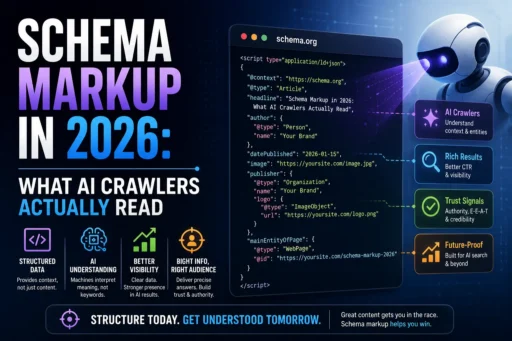
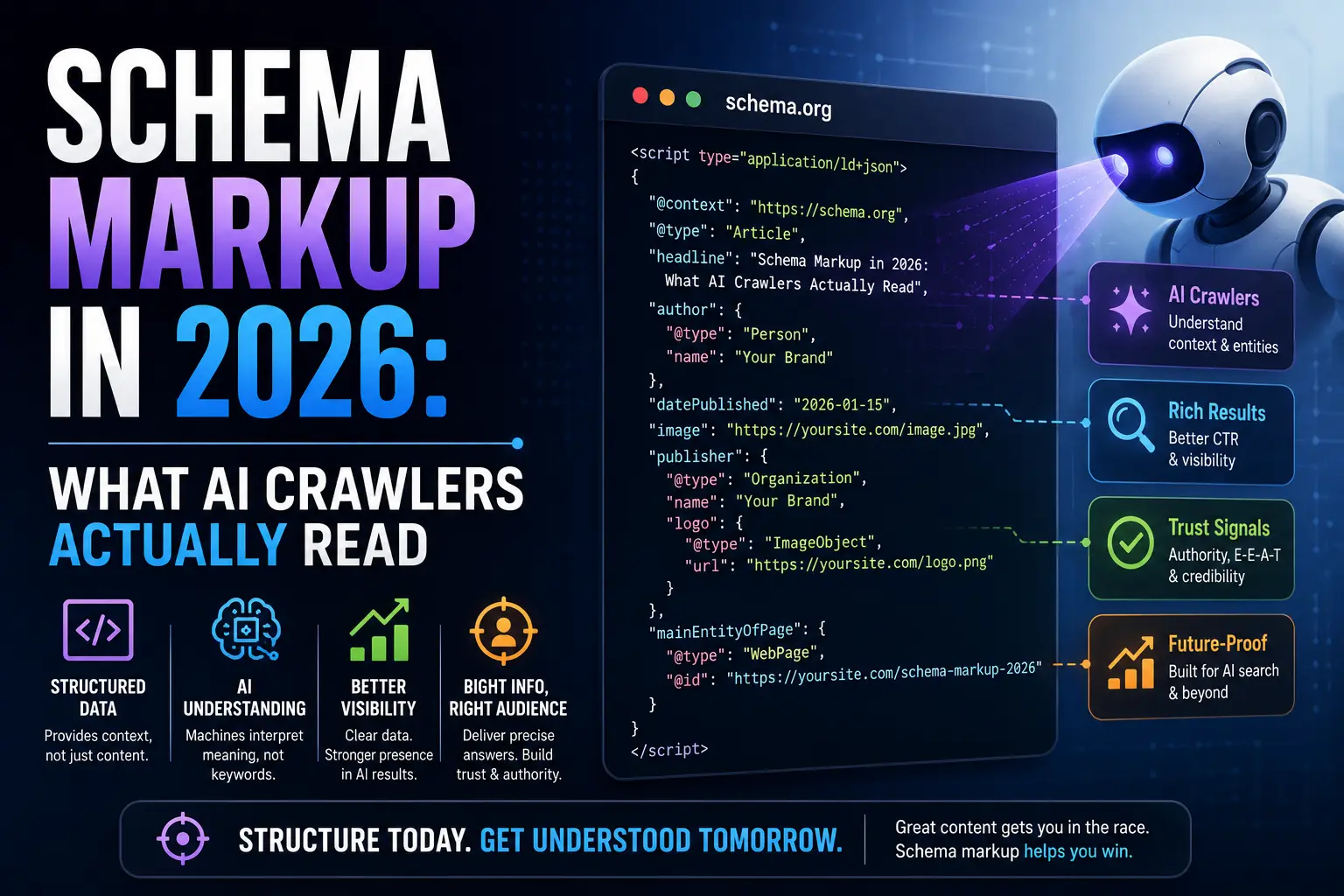
Schema markup for AI search works by embedding a machine-readable description of your page’s content directly in your HTML – typically as a <script type=”application/ld+json”> block in the <head> of your page. This block uses the Schema.org vocabulary, an open standard maintained by Google, Microsoft, Yahoo, and Yandex.
When an AI crawler visits your page, here is what happens:
- The crawler identifies the JSON-LD block – researchers have observed bots like OAI-SearchBot and PerplexityBot crawling JSON data more heavily than standard HTML.
- It extracts structured facts – business type, product details, author identity, FAQ answers, and more.
- It maps those facts to a knowledge graph – connecting your content to verified entities (people, places, organisations, concepts).
- It assigns a confidence score – pages with clean, complete schema receive higher confidence scores, increasing citation likelihood.
The key insight: your JSON-LD block may be the primary data source AI crawlers extract from your pages, not your body copy. This is a fundamental shift from traditional SEO, where on-page content was king.
JSON-LD remains Google’s recommended format after the March 2026 core update. Microdata and RDFa embed schema inside HTML tags, creating parsing conflicts when AI engines process rich text. JSON-LD lives in a dedicated script block – giving AI systems a clean, unambiguous signal layer.
Which Schema Types Do AI Crawlers Prioritise in 2026?
Schema markup for AI search performs differently depending on the schema type. Not all structured data carries equal weight. Based on current crawler behaviour and AI citation patterns, here are the types that matter most:
1. Organization Schema
Schema markup for AI search begins with brand identity. Organization schema – especially with SameAs properties pointing to Wikidata, LinkedIn, and Crunchbase – dramatically improves Knowledge Graph entity recognition. AI systems cite sources they can confidently identify. If your brand is an unresolved entity in an AI’s knowledge graph, your citation rate will be low regardless of content quality.
Essential properties to include:
- name, url, logo, description
- sameAs (link to Wikipedia, Wikidata, LinkedIn, Crunchbase)
- knowsAbout (your areas of expertise)
- contactPoint
2. Article / BlogPosting Schema
Schema markup for AI search on editorial content relies on Article and BlogPosting types. These build editorial credibility and verifiable E-E-A-T signals. Always include author (with a linked Person entity), datePublished, dateModified, and publisher.
A critical mistake: deploying Article schema without an author property. An Article without an author is treated as lower-trust content by AI citation systems.
3. FAQPage Schema
Schema markup for AI search on Q&A content still benefits significantly from FAQPage schema – even after Google removed FAQPage rich results from search on 7 May 2026. The schema type itself remains valid JSON-LD. Bingbot, PerplexityBot, voice-assistant indexers, and RAG crawlers continue to parse FAQPage as machine-readable structured content. At Search Savvy, we still recommend FAQPage implementation for AI visibility – just don’t expect the old accordion-style rich snippet in Google Search.
4. Product Schema (E-commerce)
Schema markup for AI search is transforming e-commerce visibility. The emergence of AI shopping agents – which compare products, check availability, and pre-fill carts – makes Product schema essential. Already, 24% of shoppers are comfortable with AI agents buying on their behalf, rising to 32% among Gen Z. Your Product schema must include name, description, sku, offers (with price, priceCurrency, availability), aggregateRating, and image.
5. HowTo Schema
Schema markup for AI search on process-based content benefits from HowTo schema. Note that Google deprecated HowTo rich results in February 2026, but – like FAQPage – the schema type continues to be read by AI crawlers as a strong signal that your page contains a structured, step-by-step process.
6. Person Schema
Schema markup for AI search increasingly depends on author credibility. Person schema tied to your authors – with sameAs links to their LinkedIn profiles, author pages, and academic/professional profiles – builds the kind of verifiable expertise that AI systems need to trust a source.
What Changed After Google’s March 2026 Core Update?
Schema markup for AI search underwent a significant shift in March 2026. Google’s core update – which completed on March 12 – produced the most significant structural data strategy change since rich snippets were introduced.
The key change: schema must now match the primary content topic of the page, not peripheral or supplementary content. Google penalises “schema stuffing” – deploying multiple schema types that are not directly supported by the page’s main content.
What this means practically:
- A product page should have Product schema. Adding Article or FAQPage schema to a product page where those types are not genuinely represented in the content is now a liability, not an asset.
- Entity disambiguation has become the highest-leverage implementation. SameAs, knowsAbout, and Organization schema pointing to authoritative external identifiers now dramatically improves Knowledge Graph recognition.
- The @graph array is now recommended for pages with multiple related schema types – nest them in a single JSON-LD block rather than using separate <script> tags.
How Do Different AI Platforms Read Your Schema?
Schema markup for AI search is not one-size-fits-all. Each AI platform processes structured data differently:
| Platform | Crawler | Schema Emphasis |
| Google AI Overviews | Googlebot | Organization, Article, FAQPage, Product |
| ChatGPT Search | OAI-SearchBot | Organization, Article, SameAs entity signals |
| Perplexity | PerplexityBot | FAQPage, Article, HowTo, structured Q&A |
| Bing Copilot | Bingbot | Full Schema.org coverage, strong FAQPage support |
According to Search Savvy’s analysis of AI citation patterns, ChatGPT and Perplexity place particularly high weight on entity resolution – meaning Organization and Person schema with SameAs links to trusted external sources.
Why Is Validation More Critical Than Ever in 2026?
Schema markup for AI search only delivers value when it is implemented correctly. Invalid schema does not just fail to help – it can actively harm your AI visibility.
Common errors that quietly kill schema effectiveness:
- FAQPage with an empty mainEntity array
- VideoObject missing thumbnailUrl
- Article without an author property
- Schema types deployed for content that isn’t actually on the page
The 2026 validation workflow requires two distinct checks:
- Google’s Rich Results Test – confirms error-free markup and rich result eligibility: search.google.com/test/rich-results
- Schema.org Validator – checks structural validity beyond Google’s scope: validator.schema.org
Sites that validate schema monthly see 25% fewer Search Console errors, and the ripple effect on AI citation rates is measurable within 4–8 weeks of implementation.
How to Implement Schema Markup for AI Search: A Quick-Start Checklist
Schema markup for AI search can be implemented efficiently with the right workflow. Here is what Search Savvy recommends as a starting point for most brands:
Technical foundations:
- Implement all schema as JSON-LD in the <head> of each page
- Use the @graph array for pages with multiple schema types
- Never deploy schema for content that isn’t genuinely on the page
- Validate every implementation before publishing
Brand entity setup (do this first):
- Organization schema on every page (via site-wide header/footer)
- SameAs links to Wikidata, LinkedIn, Crunchbase, Wikipedia (if applicable)
- Person schema for all key authors
Content-specific schema:
- Article / BlogPosting on all editorial content (always include author)
- FAQPage on Q&A and support content
- Product with full offers, aggregateRating, and image on product pages
- HowTo on step-by-step guides and tutorials
Monitoring:
- Track schema health monthly via Google Search Console’s Enhancements report
- Monitor AI Overview appearances for schema-optimised pages
- Allow 4–8 weeks for AI system re-indexing after implementation
FAQ: Schema Markup for AI Search in 2026
Q1: Is schema markup still worth implementing after Google removed FAQ and HowTo rich results? Yes, absolutely. Google removed the rich result display for FAQPage (May 2026) and HowTo (February 2026), but both schema types are still actively read by AI crawlers including PerplexityBot, OAI-SearchBot, and Bingbot. The value has shifted from visual rich snippets to AI citation signals.
Q2: What is the single most important schema type for AI search visibility? Organization schema with strong SameAs entity links is the most universally impactful. It establishes your brand as a resolved, trustworthy entity in AI knowledge graphs – which underpins citation decisions across all AI platforms.
Q3: Does schema markup guarantee my content will appear in AI Overviews? No. Schema markup significantly increases your eligibility for AI citations by making your content machine-parseable and trustworthy, but content quality, topical authority, and E-E-A-T signals all play a role. Think of schema as a prerequisite – necessary but not sufficient.
Q4: Should I use JSON-LD, Microdata, or RDFa? JSON-LD, always. Google explicitly recommends it, and AI crawlers parse it more cleanly than Microdata or RDFa because it lives in a dedicated script block separate from your page’s HTML structure. This is especially important post-March 2026.
Q5: How long does it take for schema changes to affect AI visibility? Typically 4–8 weeks. AI systems need to re-crawl and re-index your pages before schema changes are reflected in citation behaviour. Schema effects on traditional rich results in Google Search can appear faster, often within 2–4 weeks.
Q6: Can I use schema markup to appear in voice search results? Yes. Voice assistants including Google Assistant and Siri pull from structured data – particularly FAQPage, HowTo, and Organization schema – to generate spoken answers. Concise, factual answers in your FAQPage schema are especially effective for voice search optimisation.
The Bottom Line
Schema markup for AI search is not a 2024 tactic that has aged out – it is the foundation of AI visibility in 2026. As search shifts from a list of ten blue links to AI-generated answers that cite specific sources, the brands with clean, complete, validated structured data will consistently earn citations. The brands without it will be invisible, regardless of how good their content is.
At Search Savvy, we believe that technical SEO and AI optimisation are not separate disciplines – they are the same discipline, viewed through an updated lens. Start with your Organization schema, get your SameAs entities in order, then work through content-specific types page by page.
If you’d like a structured data audit for your website, contact the Search Savvy team – we’ll tell you exactly what AI crawlers are reading (and what they’re missing) on your site today.