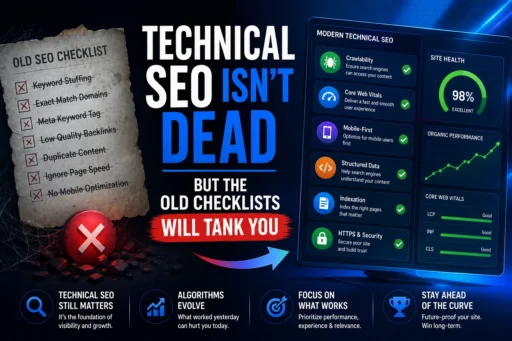
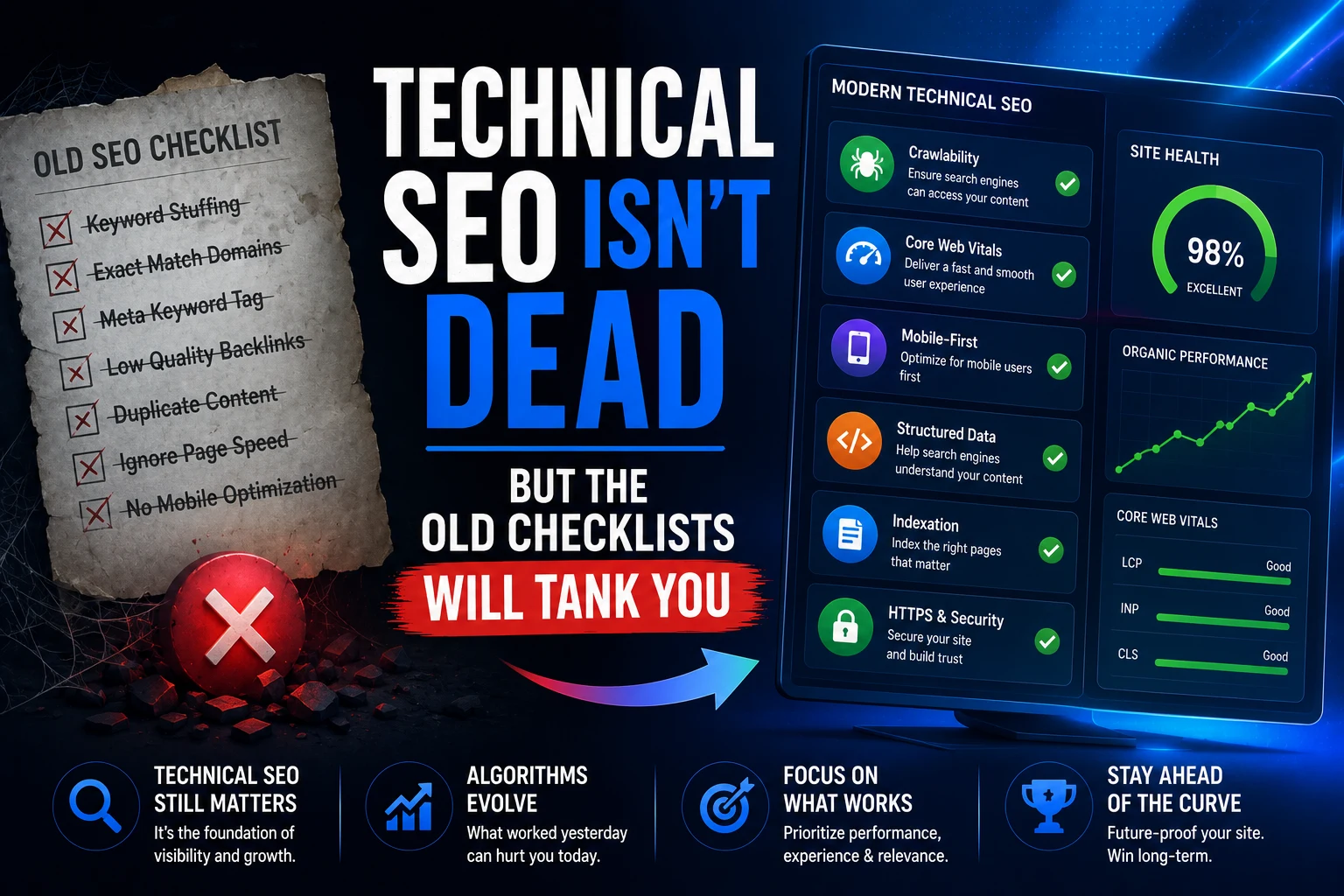

There is a technical SEO checklist circulating in agency decks, freelancer proposals, and blog posts everywhere – and it was probably written in 2020.
It covers the basics. SSL certificate. XML sitemap. Canonical tags. Image alt text. Mobile responsiveness. Redirect chains. It looks thorough. It looks professional. And if you run through it, tick every box, and call your site technically healthy – you may be walking straight into a rankings plateau you cannot explain.
Technical SEO in 2026 is not dead. If anything, it is more important than it has ever been. But the discipline has evolved dramatically in the last 24 months, and the gap between what the old checklists cover and what Google’s current systems actually evaluate has become wide enough to cost you significant ranking equity.
At Search Savvy, we audit websites regularly – and the pattern is consistent. Sites that have been “technically optimised” using legacy frameworks are often missing the signals that matter most in a search environment shaped by AI indexing, real-time rendering, and AI Overviews. This article explains what changed, what the old checklist misses, and what a modern technical SEO checklist actually needs to include in 2026.
Why Is Technical SEO More Important Than Ever in 2026?
A technical SEO checklist used to be about ensuring search engines could find your pages. In 2026, it is about ensuring search engines – and AI systems – can understand, trust, and cite them.
Google’s crawler is now context-aware, adapting its rendering pipeline using MUM (Multitask Unified Model) and Gemini AI to parse UX patterns, design structures, and performance heuristics in real time. It is not just reading your HTML. It is scoring your site on speed, stability, and usefulness with every crawl.
At the same time, AI-powered search experiences have added an entirely new layer of technical requirement. AI-generated search experiences, including Google’s AI Overviews, depend on technically clean, well-structured websites. If your pages have inconsistent markup, slow performance, or unclear hierarchy, AI systems are less likely to reference or summarise them. And in 2026, visibility in AI-powered answers is often more valuable than traditional rankings.
There is also a new pressure most technical audits have not yet caught up with: AI bots – GPTBot, ClaudeBot, PerplexityBot – are aggressive crawlers. Even mid-sized sites are seeing server strain from the combined load of multiple AI bots hitting the same pages simultaneously. Your robots.txt, server configuration, and crawl management now need to account for an entirely new class of visitor.
People Also Ask: Is technical SEO still important in 2026? Short Answer: More important than ever. In 2026, Google uses AI systems to crawl, render, and evaluate sites in real time. Technical SEO now determines not only whether your pages rank, but whether AI systems like Google AI Overviews and Perplexity cite your content. A technically weak site is disadvantaged in both traditional and AI-driven search simultaneously.
What Does the Old Technical SEO Checklist Get Wrong in 2026?
A technical SEO checklist built before 2024 typically misses four critical areas that now determine whether a site competes or stagnates.
1. It Treats Schema Markup as Optional or Surface-Level
A technical SEO checklist from 2020 might note: “Add schema markup where relevant.” That instruction is no longer sufficient.
The old checklist approach was to add schema markup and leave it. The 2026 approach treats schema as living infrastructure:
- Article / BlogPosting schema must include author as a named Person entity with a URL – not just a name string
- Organisation schema on your homepage must include sameAs links to your Wikipedia, Wikidata, LinkedIn, and Crunchbase profiles to reinforce entity recognition
- FAQPage schema may no longer trigger rich results in traditional SERPs, but it remains high-value for AI search citation eligibility
- Outdated schema is actively harmful. If your FAQ page has changed but the schema still reflects old questions, Google may flag it as misleading. Stale structured data confuses crawlers and reduces your eligibility for AI summaries
Every content page should have Article or BlogPosting markup. Product pages need Product schema with price, availability, and reviews. Local businesses need LocalBusiness schema with verified NAP data. All schema should be implemented in JSON-LD format – Google’s preferred method – in the <head> tag.
2. It Treats Crawl Budget as an Enterprise Problem
A technical SEO checklist from three years ago would say crawl budget management is only relevant for sites with millions of pages. That assumption is no longer safe.
The December 2025 rendering shift also clarified that pages returning non-200 status codes – 4xx or 5xx errors – may now be excluded from Google’s rendering queue entirely. Pages excluded from rendering cannot be ranked. This means broken pages are no longer just a user experience problem – they are a ranking eligibility problem.
Your robots.txt in 2026 also needs to differentiate between beneficial retrieval agents (Googlebot, GPTBot, PerplexityBot) and non-beneficial training scrapers. Blocking the wrong bots removes your content from citation consideration across AI platforms. Blocking the right ones prevents server strain without sacrificing visibility.
3. It Uses FID Instead of INP for Responsiveness
A technical SEO checklist that still references First Input Delay (FID) as a Core Web Vitals metric is outdated by over two years. FID was replaced by Interaction to Next Paint (INP) in March 2024, and INP is significantly stricter – it measures every interaction on a page, not just the first one.
The current 2026 Core Web Vitals thresholds are:
| Metric | What It Measures | Good Threshold |
| LCP | Largest content element load time | Under 2.5 seconds |
| INP | Page responsiveness to all interactions | Under 200 milliseconds |
| CLS | Visual stability during loading | Under 0.1 |
Most ranking issues in 2026 trace back to crawlability or indexation – but Core Web Vitals, particularly INP, are the next most common technical barrier to competitive rankings. Sites still optimising for FID are not measuring what Google is actually evaluating.
4. It Treats Indexing as Binary – Indexed or Not
A technical SEO checklist that only checks whether pages are indexed misses the deeper problem of index quality – and in 2026, index quality is arguably more important than raw index coverage.
The strategy of “indexing everything” is often less effective in 2026 than strategic pruning. Most e-commerce sites in particular now suffer from Index Budget issues – too many low-value pages consuming crawl attention that should be directed toward high-value content.
Pages that should typically be removed from the index or consolidated:
- Thin category pages with fewer than 5 products
- Faceted navigation URLs (colour + size + price filter combinations creating thousands of low-value URLs)
- Duplicate or near-duplicate content pages without clear canonical signals
- Auto-generated tag pages and archive pages with no unique content
- Paginated pages beyond page 3–4 that carry no unique value
People Also Ask: What are the most common technical SEO mistakes in 2026? Short Answer: The most costly technical SEO mistakes in 2026 are: stale or missing schema markup, blocking AI crawlers like GPTBot in robots.txt, unresolved INP performance issues, low-quality page indexation diluting crawl budget, and accidental noindex tags left from development environments. Most of these are invisible in basic audits and require log file analysis and structured data validation to surface.
What Should a Modern Technical SEO Checklist Include in 2026?
A technical SEO checklist for 2026 must address four priority layers in order – because fixing a higher layer without addressing a foundational one produces no results.
Layer 1: Crawlability and Index Health (Foundation)
A technical SEO checklist starts here because nothing else works if Googlebot and AI crawlers cannot access your pages.
Must-check items:
- Crawl error audit – Use Google Search Console‘s Coverage report to identify 4xx and 5xx errors. Every broken page is a crawl budget waste and a potential rendering exclusion in 2026.
- Robots.txt validation – Confirm you are not blocking CSS, JavaScript, or rendering resources. Differentiate between AI retrieval bots you want to allow and training scrapers you want to block.
- XML sitemap hygiene – Your sitemap should only contain canonically valid, indexable, 200-status pages. Include only pages you actively want Google to index and prioritise.
- Canonical tag audit – Every page with potential duplicate variants (HTTPS/HTTP, www/non-www, trailing slash/no slash, pagination, URL parameters) needs a consistent canonical signal.
- Log file analysis – Server logs reveal which URLs Googlebot actually crawls, not just what sitemaps claim exists. Pages heavily crawled but not ranking represent wasted crawl budget. This is a senior audit step most basic checklists omit entirely.
Layer 2: Core Web Vitals and Page Experience
A technical SEO checklist that does not benchmark against current INP thresholds is using yesterday’s measuring stick.
Must-check items:
- LCP under 2.5 seconds – Preload the LCP image, serve images in WebP, implement a CDN
- INP under 200ms – Audit JavaScript execution patterns, defer non-critical scripts, reduce third-party script load
- CLS under 0.1 – Set explicit width and height dimensions on all images and embeds; avoid injecting content above existing elements
- TTFB under 800ms – A slow server response time undermines LCP regardless of front-end optimisation
- Mobile-specific testing – Run all Core Web Vitals checks via Google PageSpeed Insights specifically on mobile, not just desktop
Test in Google Search Console‘s Core Web Vitals report for real-user field data – not just lab results from PageSpeed Insights, which reflect simulated conditions rather than actual visitor experience.
Layer 3: Structured Data and Entity Clarity
A technical SEO checklist for 2026 must treat schema markup as infrastructure – not an afterthought.
Must-check items:
- Organisation schema on homepage – Include official name, logo, founding date, sameAs links to all major external profiles, and contact information
- Article/BlogPosting schema on all content pages – Include author as a Person entity with a URL, datePublished, dateModified, headline, and publisher
- Product schema on product/service pages – Include price, availability, aggregate rating, and SKU
- FAQPage schema on FAQ sections – Even without SERP rich result eligibility, this improves AI Overview citation eligibility
- BreadcrumbList schema – Helps Google and AI systems understand site hierarchy and page relationships
- Validate with Google’s Rich Results Test – Check for errors, not just warnings, after every schema deployment
- Audit schema against live content – Schema that no longer matches visible page content is worse than no schema
Layer 4: Site Architecture and Internal Linking
A technical SEO checklist for 2026 must address how PageRank flows through your site – because Google’s ability to discover and rank your best content depends on it.
Must-check items:
- Click depth – Pages more than 3–4 clicks from the homepage are crawled less frequently and accumulate less internal PageRank. Priority pages – service pages, key blog content, product categories – must be reachable within 3 clicks.
- Orphan pages – Pages with no internal links pointing to them are invisible to Googlebot in practical terms. Every published page needs at least one internally linked entry point.
- Anchor text distribution – Internal links should use descriptive, keyword-relevant anchor text that helps Google understand the topic relationship between pages.
- Heading hierarchy – One H1 per page, H2s for primary sections, H3s for subsections. Never skip heading levels. A clear heading hierarchy helps both users and search engines understand the structure and topic of your page.
According to Search Savvy’s insights from running technical audits across businesses in India and internationally, the majority of ranking issues that cannot be explained by content or backlink gaps trace back to one of these four layers – most commonly to schema markup gaps or index quality problems that legacy checklists did not surface.
People Also Ask: How often should I run a technical SEO audit in 2026? Short Answer: Established sites should run a full technical audit at least once per quarter. New sites should audit every few weeks until the foundation is solid. Any major site change – redesign, platform migration, significant content addition – should trigger an immediate technical audit. Quarterly auditing catches regressions before they erode traffic; waiting until rankings drop means you are already behind.
How Does Technical SEO Support AI Search Visibility in 2026?
A technical SEO checklist in 2026 must account for a new kind of search performance: AI citation eligibility.
Google’s indexing priorities in 2026 reflect a broader transition from ranking-based visibility to retrieval-based discovery. AI-driven search experiences rely on structured, relevant content that can be processed quickly and accurately. Ranking highly is no longer sufficient. Content must also be understandable and extractable by AI systems during indexing.
Sites with poor technical foundations – inconsistent markup, slow performance, unclear hierarchy – are less likely to be cited in AI Overviews regardless of content quality. Your technical health is the prerequisite for AI visibility in the same way it is the prerequisite for traditional ranking.
The practical additions to a modern technical SEO checklist for AI search eligibility:
- BLUF formatting (Bottom Line Up Front) – Structure key content to answer the primary question in the first paragraph. AI systems extract answers from the top of content, not the middle.
- Clean HTML rendering – AI crawlers prefer clean, parsable text without JavaScript dependency. Ensure your core content renders in HTML without requiring JavaScript execution.
- Allow beneficial AI crawlers – GPTBot (ChatGPT), PerplexityBot, ClaudeBot, and Google’s AI Overview crawler should all be permitted in your robots.txt unless you have a specific reason to exclude them.
- Entity reinforcement – Your brand name, category, and key facts should appear consistently across your homepage, About page, structured data, and third-party sources to build the entity model AI systems rely on for citation.
At Search Savvy, we have updated our full technical audit framework to include AI visibility checks as a distinct layer alongside traditional crawl, performance, and structure audits. The businesses that will rank and be cited in 2026 are the ones treating technical SEO as a living system – not a one-time checklist.
People Also Ask: Does technical SEO affect AI Overview citations? Short Answer: Directly, yes. AI Overviews and AI search tools like Perplexity preferentially cite content from pages that are fast, structurally clean, and schema-rich. A technically weak page – slow load time, inconsistent structured data, JavaScript-dependent rendering – is significantly less likely to be selected for AI citation, regardless of how authoritative the content is.
FAQ: Technical SEO Checklist 2026 – Your Questions Answered
Q1: What is the single most important item on a technical SEO checklist in 2026? Crawlability and indexability remain the foundational layer – if Google and AI crawlers cannot access your pages, no other optimisation matters. After confirming crawl health, schema markup has become the single most impactful technical SEO element for both traditional rich results and AI citation eligibility. The combination of clean crawlability plus comprehensive, accurate structured data represents the highest-leverage technical investment in 2026.
Q2: How do I check if AI crawlers can access my website? Review your robots.txt file and confirm that user agents GPTBot, PerplexityBot, ClaudeBot, and Google’s crawler are not blocked. Then run a log file analysis – your server logs will show exactly which bots are visiting your site, how frequently, and which pages they are accessing. Google Search Console shows Googlebot’s crawl behaviour, but third-party AI bots require log file access to monitor directly.
Q3: Is HTTPS still a ranking factor in 2026? Yes – HTTPS remains a confirmed ranking signal. Websites still running on HTTP are at a direct competitive disadvantage. More importantly in 2026, HTTPS is a trust signal for AI systems evaluating whether to cite a source. An insecure site is not just a ranking liability – it is an authority liability that makes AI citation significantly less likely.
Q4: Should I use a third-party SEO audit tool or Google’s own tools for technical audits? Both serve different purposes and should be used in combination. Google Search Console provides real-user data: actual crawl errors Google has encountered, real Core Web Vitals field data from Chrome users, and coverage and indexing reports that reflect Google’s actual processing of your site. Third-party tools like Screaming Frog, Ahrefs, or Semrush provide site-wide crawl simulation, broken link identification, and schema validation. For log file analysis, dedicated tools like JetOctopus or Splunk are necessary. A complete technical audit uses all three.
Q5: How does site architecture affect technical SEO in 2026? Significantly. Pages beyond 3–4 clicks from the homepage receive less frequent crawling and accumulate less internal PageRank, which directly limits their ranking potential. For large sites, ensuring that priority pages are accessible within 3 clicks and receive strong internal linking is a critical technical requirement – not just a best practice. Poor site architecture means Google may never efficiently discover or rank your most commercially important pages, regardless of how well they are optimised individually.
Q6: What is the difference between a technical SEO audit and an SEO audit? A technical SEO audit focuses specifically on the infrastructure layer: crawlability, indexation, site speed, Core Web Vitals, structured data, URL architecture, and rendering behaviour. An SEO audit is broader, covering technical health alongside content quality, keyword alignment, backlink profile, and competitive positioning. In 2026, a complete SEO audit should always begin with a technical layer – because content and authority issues are impossible to diagnose accurately when the technical foundation has unresolved problems. At Search Savvy, we treat the technical layer as the mandatory first step in every SEO engagement, regardless of the client’s primary objectives.
Running an outdated technical SEO checklist and wondering why rankings are not moving? Visit Search Savvy for a modern technical audit built for how Google and AI search systems actually work in 2026.