
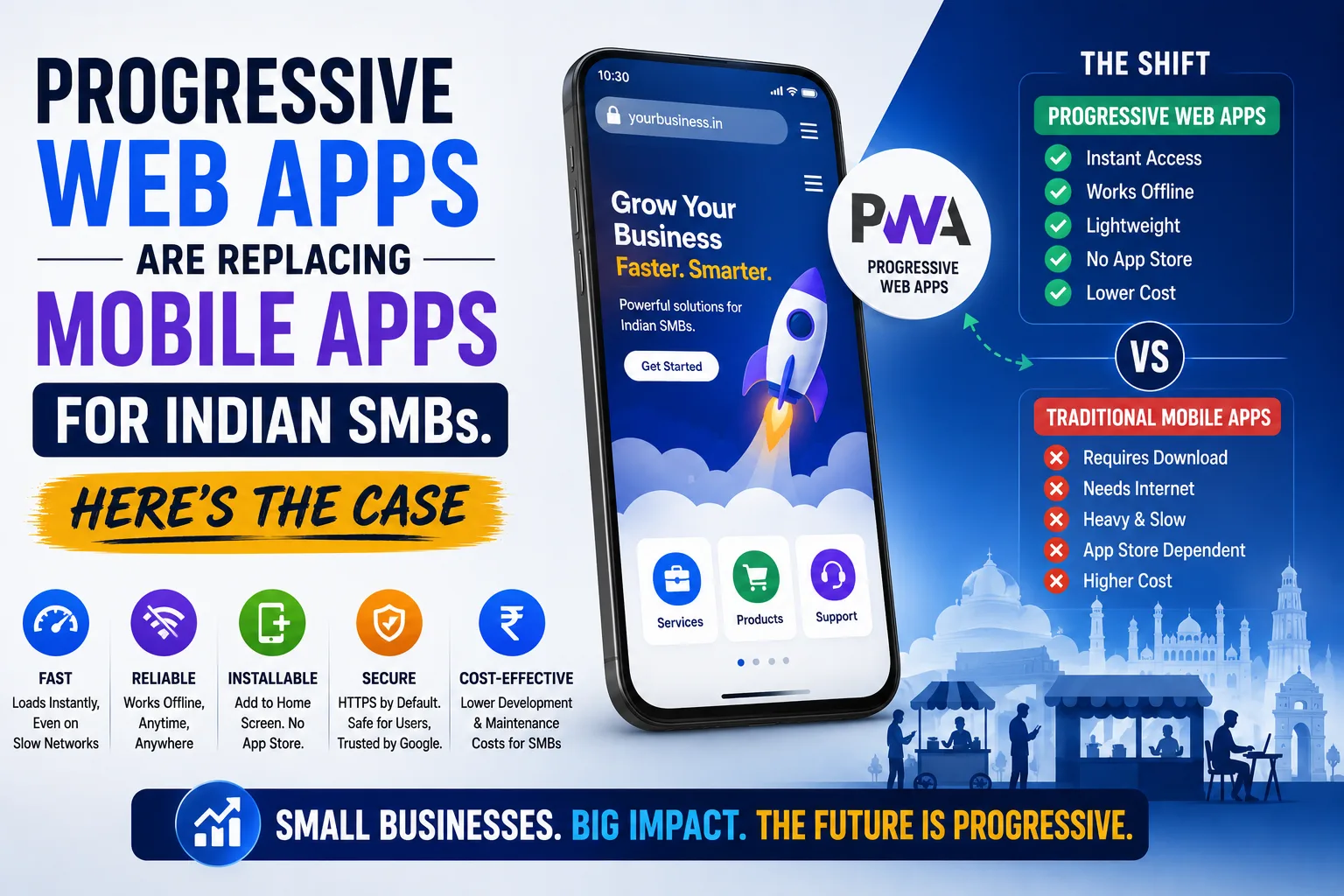

A restaurant owner in Nagpur needed a mobile ordering app. His agency quoted ₹8,00,000 for iOS and Android native apps – separate codebases, separate submissions, separate App Store and Play Store approvals, and a ₹40,000 monthly maintenance retainer.
He built a Progressive Web App instead. It cost ₹1,20,000, launched in three weeks, works on every device without any store approval, sends push notifications for order updates, and functions in low-connectivity areas. His customers add it to their home screen exactly like a native app – without visiting a store.
This is not an unusual story in 2026. Progressive web apps have evolved from experimental technology into enterprise-grade platforms that companies once dismissed as “glorified mobile websites” are now deploying as their primary applications. The gap between what PWAs can do and what native apps can do has narrowed to the point where, for the vast majority of Indian SMB use cases, PWAs are no longer the compromise option. They are the smarter choice.
At Search Savvy, we work at the intersection of web strategy and digital performance – and the businesses we advise on digital product decisions are increasingly reaching the same conclusion: the case for native app development only makes sense in specific, well-defined circumstances. For everyone else, progressive web apps offer a combination of cost efficiency, speed to market, SEO advantage, and cross-platform reach that native development cannot match.
This article makes that case, with the 2026 data to support it.
What Are Progressive Web Apps – and How Do They Work?
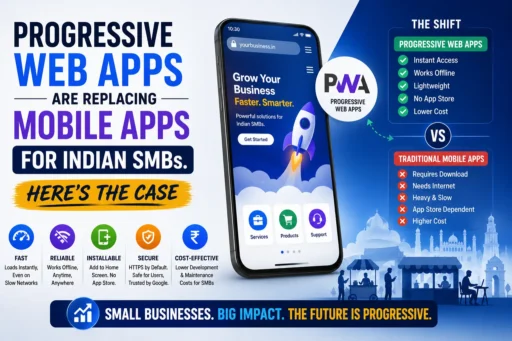
Progressive web apps are web applications built with modern browser capabilities that deliver an app-like experience – installable from the browser, offline-capable, push-notification-enabled, and fast-loading – without requiring distribution through the App Store or Google Play.
The “progressive” in the name means they work for everyone – on any browser, any device – but progressively enhance the experience for users whose browsers support advanced features. A PWA on the latest Android Chrome delivers a near-native experience. The same PWA on an older device delivers a fast, responsive website. Nobody is excluded.
The three technical foundations that make PWAs work:
Service Workers – Background scripts that cache assets and data, enabling offline functionality and background sync. A service worker is what allows a PWA to work without connectivity – it intercepts network requests and serves cached responses when the network is unavailable. A restaurant menu PWA can display the full menu without connectivity because the service worker has already cached the required data.
Web App Manifest – A JSON file that tells browsers how your PWA should behave when installed on a device: the app name, icon, theme colour, display mode (full-screen or browser chrome), and start URL. This is what enables the home screen installation prompt and the app-like appearance when launched.
HTTPS – The security foundation. Service workers and many modern browser APIs require HTTPS, making a secure connection a prerequisite for PWA capability.
In 2026, PWAs can reliably deliver: push notifications on Android and – since iOS 17+ – on iPhone and iPad with proper Safari support; offline functionality and background sync; home screen installation without an app store; camera and microphone access; geolocation; biometric authentication; and near-native performance for the vast majority of business application use cases.
People Also Ask: What can progressive web apps do in 2026 that they could not do before? Short Answer: The most significant capability additions for PWAs in 2026 are iOS push notifications (available since iOS 17+ in Safari), broader background sync support, and improved offline functionality through advanced service worker patterns. WebAssembly and WebGPU have also narrowed the performance gap for compute-intensive use cases. The capabilities that remain native-only are complex hardware integrations (NFC, Bluetooth, ARKit/ARCore, advanced camera controls) and App Store presence – everything else has effectively converged.
Why Are Progressive Web Apps So Important for Indian SMBs in 2026?
Progressive web apps address the specific constraints that make mobile app development inaccessible for most Indian SMBs – and they do so at exactly the moment when mobile digital presence has become commercially essential.
The Indian context is distinct in three ways that make PWAs particularly well-suited to the market:
Smartphone penetration without consistent connectivity. India has over 800 million smartphone users, but mobile internet connectivity remains variable – particularly in Tier 2 and Tier 3 cities and in rural areas. Progressive web apps, with their offline-capable service worker architecture, perform reliably in low-connectivity environments that would cause native apps with server-dependent functionality to fail. A native food delivery app that requires 4G connectivity to display a menu is functionally useless in areas where coverage drops. A PWA with cached content is not.
App store friction and the download barrier. The average Indian user abandons a journey that requires a Play Store or App Store download when they are discovering a brand for the first time. PWAs eliminate this barrier entirely – a customer who lands on your PWA from a Google search, WhatsApp link, or Facebook ad experiences the full app functionality immediately, without a download. Conversion rates increase 36% when users install PWAs compared to mobile web. The “Add to Home Screen” prompt feels frictionless compared to “Open the Play Store, find the app, wait for download, agree to permissions.”
The SMB development budget reality. Progressive web apps generally cost 50–70% less to develop than native apps, since they use a single codebase for all platforms, reducing development and maintenance overhead compared to building separate native iOS and Android apps. A medium-scope PWA costs $25,000 to $70,000 in global estimates – proportionally ₹50,000 to ₹3,50,000 in the Indian market depending on complexity. Dual-platform native projects commonly start above $70,000 globally ($70,000+). For most Indian SMBs, this differential is not a marginal saving – it is the difference between an accessible investment and an inaccessible one.
People Also Ask: Are progressive web apps better than native apps for Indian businesses? Short Answer: For the majority of Indian SMB use cases – e-commerce, restaurant ordering, service booking, B2B portals, lead generation, content delivery – yes. Progressive web apps cost 50–70% less to build and maintain, work in low-connectivity environments, eliminate the App Store download barrier, and are fully indexed by Google for SEO. Native apps remain superior for specific use cases requiring deep hardware integration (AR, NFC, Bluetooth), performance-critical gaming, or established App Store brand presence.
What Has Changed About Progressive Web Apps in 2026?
Progressive web apps in 2026 are not the technology they were in 2020 – and the outdated assumptions that kept many Indian businesses from considering them have been systematically invalidated.
The most consequential capability changes in 2026:
iOS Push Notifications Are Now a Reality
Progressive web apps were long limited by Apple’s historical refusal to support push notifications in Safari. iOS 17+ changed this. Push notifications now work on Android and have finally arrived on iOS with proper support. You can send re-engagement messages, order updates, and promotional alerts. The implementation uses the Web Push API and requires user permission – just like native apps.
For Indian businesses where iPhone ownership is concentrated in the highest-value customer segments (urban, high-income), this was the last major capability gap between PWA and native for consumer-facing applications. It is now closed.
Performance Has Converged for Business Use Cases
Progressive web apps in 2026 deliver near-native performance through WebAssembly and WebGPU advances that have dramatically narrowed the processing speed gap. For applications that rely on complex animations, video processing, real-time communication, or augmented reality, native remains the superior choice. However, for the vast majority of business applications – marketplaces, SaaS dashboards, content platforms, and e-commerce storefronts – the performance gap between a well-optimised PWA and a native app is increasingly imperceptible to end users.
Companies that dismissed PWAs in 2023 as “glorified mobile websites” are now deploying them as primary applications, achieving 40–70% cost savings compared to native development while reaching users across mobile, desktop, and tablet with a single codebase.
Offline Functionality Has Matured
Progressive web apps now handle offline scenarios that previously required native development. Service workers cache assets and data with sophisticated strategies – cache-first for static content, network-first with fallback for dynamic content, background sync for form submissions made while offline. A field sales agent’s order entry PWA can collect orders without connectivity and sync them automatically when the connection is restored. This was a native-only capability three years ago.
Trusted Web Activity – PWA in the Play Store
Progressive web apps can now be wrapped as Trusted Web Activities (TWA) for Play Store distribution. This is a significant development for Indian businesses where Play Store presence still matters for discovery. A TWA packages your PWA as a Play Store submission – users download a native shell that loads your PWA – giving you App Store presence, home screen icons with Play Store branding, and the discoverability benefit of store listings, while maintaining the single-codebase and instant-update advantages of a PWA.
People Also Ask: Can progressive web apps send push notifications in 2026? Short Answer: Yes, on both Android and iOS. Android support via Chrome has been mature since 2020. iOS push notification support arrived with iOS 17+ via Safari, closing the final major capability gap between PWAs and native apps for most consumer and business use cases. Push notifications require user permission, use the Web Push API, and work identically to native app push notifications from the user’s perspective.
What Are the Real Cost Differences Between Progressive Web Apps and Native Apps?
Progressive web apps make the strongest initial impression on any Indian SMB budget analysis – and the cost difference compounds significantly over the product lifecycle.
Initial Development:
| Project Scope | PWA Cost (Estimate) | Native iOS + Android (Estimate) |
| Simple (service listing, menu, bookings) | ₹50,000–₹1,50,000 | ₹2,50,000–₹5,00,000 |
| Medium (e-commerce, portal, marketplace) | ₹1,50,000–₹5,00,000 | ₹5,00,000–₹15,00,000 |
| Complex (real-time features, heavy integrations) | ₹5,00,000–₹15,00,000 | ₹15,00,000–₹50,00,000+ |
Ongoing Maintenance – The Hidden Cost:
Native apps require separate iOS and Android maintenance cycles, separate submissions for each update, App Store review delays (typically 1–3 days for iOS, 2–7 days for Android), and separate bug fixes for platform-specific issues. Each major iOS or Android OS update requires compatibility testing and often code changes.
PWAs deploy instantly – security patches and feature updates reach users via the browser immediately. No Play Store review delays, no coordinating iOS and Android release schedules. This is not a small operational difference for Indian SMBs where development capacity is limited and response time to market feedback is a competitive advantage.
The Platform Tax:
Apple’s App Store takes 15–30% of in-app purchase revenue. Google Play takes 15%. For any Indian SMB with in-app commerce or subscriptions, this commission applies to every transaction processed through a native app. PWAs process payments through standard web payment gateways (Razorpay, PayU, PayTM) with no platform commission applied.
For a business with ₹10 lakh/month in digital transactions, the platform commission saving alone from switching from native to PWA can offset the entire PWA development cost within a year.
People Also Ask: How much cheaper are progressive web apps than native apps in 2026? Short Answer: Progressive web apps generally cost 50–70% less to develop than native apps, using a single codebase for all platforms. Development time is 2–3x faster. For Indian SMBs, a simple PWA might cost ₹50,000–₹1,50,000 versus ₹2,50,000–₹5,00,000 for equivalent native apps. The ongoing cost advantage compounds through instant deployments (no app store review delays), single-codebase maintenance, and no platform commission on in-app transactions.
How Do Progressive Web Apps Help SEO – and Why Does That Matter for SMBs?
Progressive web apps deliver a competitive advantage that native apps cannot match on any dimension: they are fully indexed by Google.
Unlike walled-garden native apps, PWAs are fully indexable by Google, allowing you to turn search traffic directly into installed users. A native app’s content is invisible to Google’s organic search crawler – the only way users discover it organically is through the App Store and Play Store search, which has its own separate and competitive discovery ecosystem.
A PWA is a website – a fast, installable, capable website that Google can crawl, index, and rank exactly like any other web page. Every product page, service listing, blog post, and location page on your PWA is discoverable through Google Search. When someone searches “best dry cleaning near me in Pune” and your PWA service page ranks in the organic results, they click through to a page that immediately prompts them to “Add to Home Screen” – converting an organic search visitor into an installed app user.
This is the distribution funnel that native apps cannot replicate. You need a user to discover your native app, navigate to the store, download it, and open it – four steps of friction. A PWA converts a Google click into an app user in a single step.
PWA SEO also benefits from Core Web Vitals performance. Well-built PWAs typically achieve excellent LCP, INP, and CLS scores due to their performance-first architecture – which directly improves organic search rankings alongside the discoverability advantage.
According to Search Savvy’s insights from advising Indian digital businesses, the SEO-to-installed-user conversion funnel is one of the most underappreciated commercial advantages of PWAs for Indian SMBs. The ability to grow your installed user base through organic search – without an app store marketing budget – fundamentally changes the economics of digital customer acquisition.
When Should an Indian SMB Choose Native Over a Progressive Web App?
Progressive web apps are not the right choice for every scenario – and making an honest assessment of your specific requirements prevents a costly mismatch.
Choose native when:
- Your app requires deep hardware integration. NFC payments, Bluetooth device pairing, advanced AR (ARKit/ARCore), background location tracking, or complex camera controls (scanning, image processing, video production) still require native APIs that PWAs cannot reliably access.
- App Store presence is a genuine marketing strategy. If your target audience specifically discovers apps through Play Store or App Store search – gaming, utility tools, apps with established store presence – native distribution provides the discoverability that PWA’s web-based distribution cannot replicate.
- Performance is the primary product experience. Real-time multiplayer gaming, intensive video processing, augmented reality, or financial trading platforms where millisecond response time determines product quality require native performance that PWAs currently cannot match.
- You need full iOS ecosystem integration. Apple Pay, HealthKit, Siri Shortcuts, Apple Watch companion apps – these integrations remain native-only territory.
For most Indian SMBs – restaurants, retail, service businesses, logistics, education, healthcare appointment booking, B2B portals, content platforms, SaaS tools – none of these requirements apply. The specific use cases where native wins are well-defined and narrow. The vast majority of Indian SMB digital product requirements fall squarely in PWA territory.
At Search Savvy, we recommend the following decision framework: start with a PWA to validate demand quickly, control cost, and reach users fast. Then expand with native capabilities when performance, integrations, and scale justify the investment. The businesses that build native apps before validating product-market fit spend the most on the path to discovering they need to rebuild anyway.
What Are the Best Examples of Progressive Web Apps Working for SMBs?
Progressive web apps have produced documented commercial results across multiple Indian and global SMB contexts in 2026:
E-commerce – Conversion Uplift: Conversion rates increase 36% when users install PWAs compared to mobile web. For Indian D2C brands targeting mobile-first audiences, the “Add to Home Screen” conversion represents a fundamentally different customer relationship – installed users have higher repeat purchase rates, higher LTV, and more consistent engagement than mobile web visitors.
Restaurants and Food Service: Zomato and Swiggy’s web experiences are PWA-based – fast-loading, offline-capable, installable. For independent restaurants in Tier 2 cities, a PWA ordering system costs a fraction of a native app while delivering the same core customer experience: menu browsing, ordering, and payment without connectivity requirements.
Service Businesses and Booking Platforms: Service worker caching makes booking platforms resilient to connectivity drops during the booking flow – the most critical conversion moment. A dropped connection during a native-app booking that requires a server roundtrip loses the booking. A PWA with cached form data completes the booking when connectivity is restored.
Field Sales and B2B Portals: Offline data entry with background sync is the field sales use case where PWAs most dramatically outperform mobile web and approach native parity. Sales representatives in areas with variable connectivity can enter orders, update customer data, and sync when they reach connectivity – with no native app development investment.
People Also Ask: Which Indian businesses benefit most from progressive web apps? Short Answer: Indian businesses benefiting most from PWAs in 2026 are: e-commerce and D2C brands targeting mobile-first audiences (36% higher conversion from installed users), restaurants and food service (offline menus, ordering, low-connectivity resilience), service businesses needing booking systems (low-friction discovery via Google Search), field sales and B2B portals (offline data entry with background sync), and content and media businesses (fast loading, SEO-discoverable content with app-like experience).
FAQ: Progressive Web Apps – Your Questions Answered
Q1: Will a progressive web app appear in Google Play Store search results? Not by default – but it can with Trusted Web Activity (TWA) packaging. A TWA wraps your PWA in a native shell that can be submitted to the Play Store, giving you Play Store presence and discoverability while maintaining the single-codebase, instant-update advantages of a PWA. Your PWA’s web content is still what users experience – the native wrapper simply provides the Play Store distribution channel. For most Indian SMBs, TWA packaging is worth considering if Play Store presence is commercially important for your specific audience.
Q2: Do progressive web apps work on iPhones in 2026? Yes, with the caveat that iOS support lags Android Chrome in some areas. Push notifications are supported on iOS 17+ via Safari. Home screen installation works. Offline functionality via service workers works. The main gaps remaining on iOS are background sync (limited compared to Android) and some payment APIs. For most SMB use cases – menus, booking, e-commerce, content – iOS Safari delivers a full PWA experience in 2026. Safari on iOS is the browser to test against for PWA compatibility in India’s iOS user base.
Q3: How long does it take to build a progressive web app for an Indian SMB? Development time is 2–3x faster than native apps, primarily because you build once rather than maintaining separate iOS and Android codebases. A simple PWA (5–15 pages, basic offline support, push notifications) can be built in 4–8 weeks. A medium-complexity PWA (e-commerce, booking system, real-time features) typically requires 8–16 weeks. Compare this to native app development timelines of 4–6 months for both iOS and Android. The instant deployment advantage – no App Store review process – also means fixes and improvements reach users immediately rather than after a 1–3 week review cycle.
Q4: Can a progressive web app handle payments in India? Yes, and often more efficiently than native apps for Indian payment contexts. PWAs can integrate all major Indian payment gateways – Razorpay, PayU, PayTM, CCAvenue – through standard web payment APIs. UPI deeplinks work in PWAs. EMI and BNPL integrations work through the same payment gateway SDKs used in websites. The advantage over native apps: no 15–30% platform commission on transactions, and faster integration cycles without App Store payment policy compliance requirements. For Indian SMBs processing digital transactions, the platform commission saving can be substantial.
Q5: My website is on WordPress. Can I turn it into a progressive web app? Yes – and this is one of the fastest paths to PWA capability for Indian SMBs already running WordPress sites. Plugins like PWA for WP & AMP add service worker caching, offline capability, and home screen installation to existing WordPress installations with minimal configuration. For WooCommerce-based stores, dedicated PWA plugins provide cart persistence and checkout offline resilience. The result is not a fully custom PWA – but for many Indian SMBs, the plugin-based approach delivers 80% of the PWA benefit at a fraction of the custom development cost.
Q6: How do I know if my business needs a PWA or just a better mobile website? The key distinction is whether repeat, offline-capable, push-notification-driven engagement creates meaningful business value for your customers. If your customers visit once for a specific transaction and do not need to return regularly – a single-purpose lookup or reference – a fast mobile website is sufficient. If your customers benefit from: regular re-engagement (orders, bookings, updates), offline access to content or functionality, a persistent home screen presence that competes with native apps, or conversion from Google search directly to installed user status – a PWA is the right investment. At Search Savvy, we evaluate this through the lens of customer journey frequency and the offline use case relevance. Most Indian SMBs with recurring customer relationships benefit significantly from PWA investment over simple mobile website optimisation.
Exploring whether a progressive web app is the right investment for your business – or wondering how to make the case to a business partner or investor? Visit Search Savvy for a digital product strategy consultation that maps your specific use case, audience, and budget to the right technology choice in 2026.