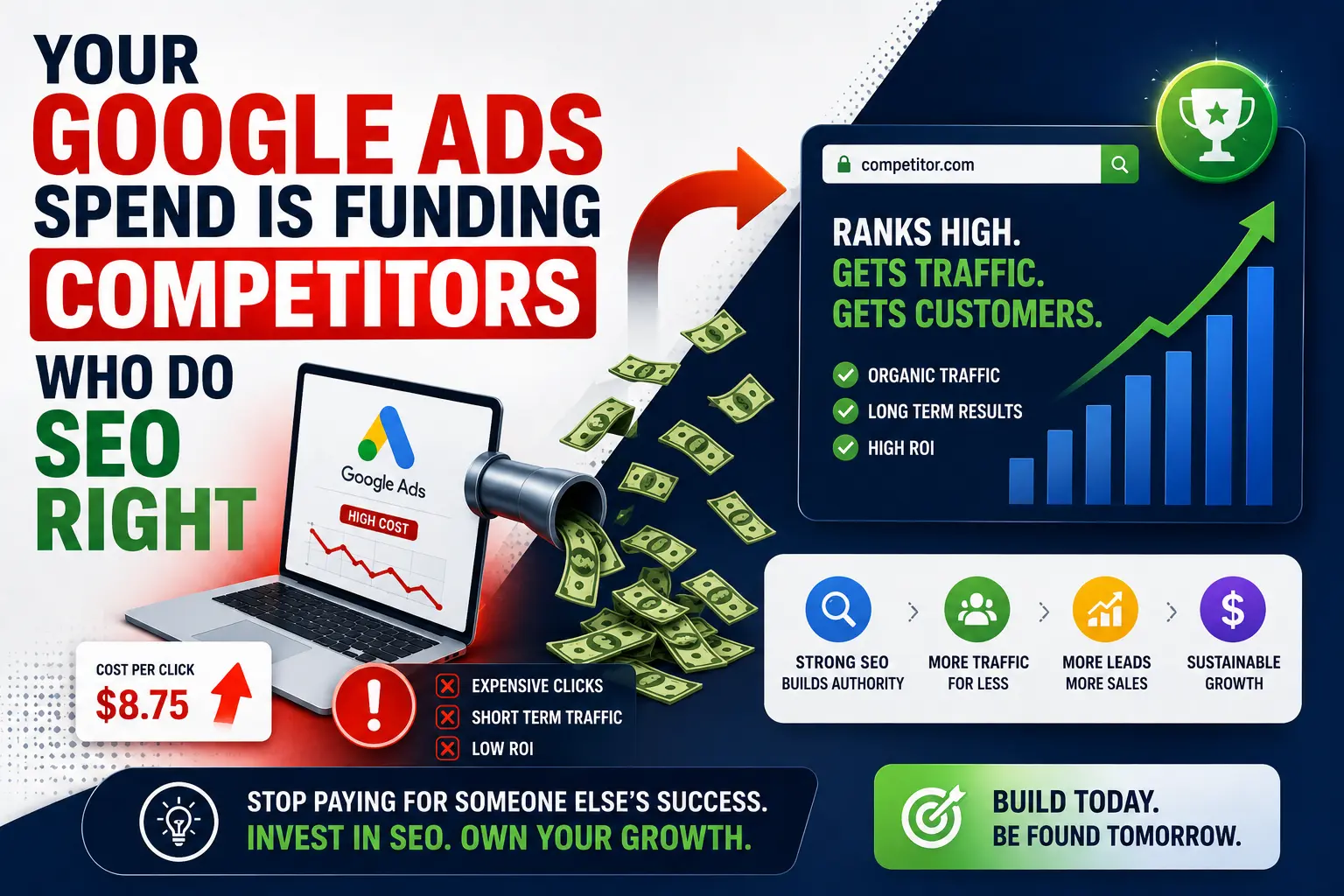

Right now, your competitor is getting free clicks.
Not free as in “zero effort” – they put in the work months ago. They published the content, built the authority, earned the backlinks, and optimised the pages. And now, every day, Google sends them a steady stream of high-intent visitors who searched for exactly what both of you sell – and those visitors cost your competitor nothing per click.
Meanwhile, you are paying for every single one of yours.
SEO vs Google Ads is one of the most consequential strategic decisions in digital marketing – and most businesses in India are getting it dangerously wrong. Organic search generates 53% of all website traffic globally, while paid ads account for just 15%. Yet the same data shows most businesses allocate 72% of their marketing budget to paid advertising. The math does not work in their favour.
At Search Savvy, we work with businesses that have been running Google Ads for years – often profitably – but have never built the organic foundation that would give them real, lasting competitive leverage. This article is the honest conversation most agencies are too polite to have: about where your ad spend is actually going, why your competitors who invested in SEO are pulling further ahead every month, and what you can do about it.
What Is the Core Difference Between SEO vs Google Ads in 2026?
SEO vs Google Ads comes down to a single, fundamental distinction that changes everything about your long-term economics:
Google Ads is renting visibility. SEO is owning it.
When you run Google Ads, you pay for every click. The moment your budget runs out, your ad disappears. Your visibility is directly proportional to your spend – nothing more. If you stop Google Ads, your traffic stops the same day.
SEO works on the opposite principle. The investment goes in upfront – content creation, technical optimisation, link building – but the returns compound over time. Once a page ranks, it keeps attracting traffic without paying per click. Every month you hold that ranking, the ROI of the original investment improves.
Here is what the numbers say about each channel in 2026:
| Metric | Google Ads | SEO (Organic) |
| Share of all web traffic | 15% | 53% |
| Click share on search results | ~14% of all clicks | ~86% of all clicks |
| Average ROI | 200% ($2 per $1 spent) | 748% ($7.48 per $1 spent) |
| Lead close rate | 1.7% | 14.6% |
| Traffic when you stop investing | Stops immediately | Continues |
| Time to see results | Immediate | 6–12 months |
| Long-term cost per acquisition | Rising | Declining |
Organic results receive approximately 86% of all clicks on the search results page, versus roughly 14% for paid ads. The majority of searchers – particularly for informational and research-stage queries – actively scroll past the ads and click on the organic results they trust.
People Also Ask: Which has a better ROI – SEO or Google Ads? Short Answer: Over a 12-month or longer timeframe, SEO consistently delivers higher ROI. SEO averages a 748% ROI compared to Google Ads’ 200%. SEO leads also close at 14.6% versus 1.7% for outbound paid leads. Google Ads is more effective for immediate, time-sensitive results – but for long-term growth, organic search compounds in a way paid advertising never can.
Why Is Over-Relying on Google Ads a Dangerous Strategy in 2026?
SEO vs Google Ads becomes an urgent conversation when you understand what is happening to Google Ads costs in 2026 – and who ultimately benefits from the bidding war you are participating in every day.
Global search advertising spending reached $159 billion in 2024 and is projected to hit $192 billion by 2027. More advertisers entering the auction means more competition for the same keywords. More competition means higher CPCs. And higher CPCs mean you are paying more for the same clicks you were paying less for last year.
In India specifically, Google Ads CPCs range from ₹5 to ₹600+ per click depending on industry, with the most competitive verticals seeing dramatic increases year-on-year:
- Real estate: ₹40–120 per click
- Education: ₹15–45 per click
- Healthcare CPL: ₹300–800 per lead
- Legal and financial services: ₹150–500+ per click
- Advertisers who have not recalibrated budgets in 12 months are likely overspending 15–25% per acquisition
Here is the mechanism nobody talks about openly: every rupee you spend bidding on a keyword is a signal to Google that the keyword is commercially valuable. That signal helps your well-funded competitors justify paying even more for the same term. And as they push the price up, your cost-per-acquisition rises – often without any improvement in lead quality or conversion rate.
You are not just competing for customers. You are collectively inflating the price of every click, every month, for every advertiser in your category.
Meanwhile, the competitor who invested in SEO 18 months ago is getting those same clicks for free.
People Also Ask: Why are my Google Ads costs increasing every year? Short Answer: Google Ads operate in a real-time auction where more advertisers bidding on the same keywords directly increases costs. As digital ad budgets grow globally (projected to reach $192 billion in search advertising by 2027), CPCs rise across virtually all industries. New campaigns also typically see 20–30% higher CPCs in the first 2–3 months as Google’s algorithm calibrates. The only sustainable answer is reducing paid dependency by building organic search equity in parallel.
How Does SEO Build Compounding Value That Google Ads Never Can?
SEO vs Google Ads is really a debate about business assets versus business expenses. Every pound or rupee spent on Google Ads is gone the moment the click happens – it produces no lasting asset for your business. Every pound or rupee invested in SEO builds something that continues to pay returns long after the initial spend.
SEO delivers an average ROI of 748%, meaning for every dollar invested, you get an average of $7.48 back. That figure improves over time, because once a page ranks, it continues attracting traffic without additional cost per click.
The compounding mechanism works through three reinforcing dynamics:
1. Topical Authority Accumulates
SEO rewards consistency. A brand that publishes 30 well-structured articles on a specific topic builds a content library that Google’s algorithm treats as a specialist resource. Each new article adds to the authority of the entire cluster. B2B websites with strong organic strategies see organic traffic averaging 64% of all sessions – the result of topical authority built over months and years.
This authority does not disappear when you reduce content spend for a quarter. It persists, continues ranking, and continues sending traffic.
2. Backlinks Accumulate
Every external site that links to your content is a vote of credibility that Google counts in your favour – now and indefinitely. A well-researched article that earns 20 backlinks over two years keeps those backlinks working for you regardless of whether you publish anything new. Your Google Ads spend, by contrast, earns nothing after the campaign ends.
3. Cost Per Acquisition Declines Over Time
After 12–18 months, SEO often produces significantly lower acquisition costs per lead compared to paid ads. The initial investment in content and technical SEO is amortised across an ever-growing volume of organic traffic. Your Google Ads CPA, in contrast, tends to rise as auction competition increases and your Quality Score requires continuous optimisation to maintain.
According to Search Savvy’s insights from working with Indian businesses across industries, the crossover point – where SEO’s monthly cost per acquisition drops below Google Ads’ – typically arrives between 9 and 18 months after a structured SEO programme begins. After that point, every additional month of organic investment widens the advantage.
People Also Ask: How long does it take for SEO to start beating Google Ads on ROI? Short Answer: Most well-executed SEO programmes begin generating meaningful organic traffic within 3–6 months and typically surpass Google Ads on a per-acquisition cost basis between 9–18 months. After the 12-month mark, SEO’s ROI advantage over paid ads becomes increasingly significant as traffic compounds and the original investment is amortised across a growing volume of free clicks.
Are Google Ads Ever the Right Choice Over SEO in 2026?
SEO vs Google Ads is not a zero-sum debate – and a nuanced answer matters here. Google Ads still serves critical functions that SEO cannot replicate, and the smartest brands use both strategically.
Google Ads is the right tool when:
- You need immediate results. A new product launch, a seasonal promotion, or a business that has not yet built organic authority needs traffic now, not in 12 months. Ads deliver that.
- You are testing new markets or messaging. Google Ads provides fast, measurable feedback on which keywords convert, which headlines resonate, and which landing pages perform. This data directly informs your SEO strategy.
- Your target keyword has strong commercial intent with limited organic competition. Some transactional queries are genuinely better served by ads where strong organic competition makes ranking difficult in the short term.
- You want to capture bottom-of-funnel demand while your organic content builds. A hybrid approach – ads for high-intent commercial terms, SEO for informational and mid-funnel content – is a defensible short-term strategy.
The problem is not using Google Ads. The problem is using Google Ads as a substitute for SEO instead of a complement to it – because that is the structural choice that puts you permanently at the mercy of an ever-rising auction.
What Happens When a Competitor Who Did SEO Right Enters Your Market?
SEO vs Google Ads becomes viscerally real when you watch a competitor who invested in organic search begin to dominate the keywords you have been paying for.
Here is what the competitive dynamic looks like in practice:
A brand in your space publishes comprehensive, well-structured content. They earn backlinks. They build topical authority. After 12–18 months, they rank organically for the same high-intent keywords you have been bidding on. They now receive those clicks for free.
Meanwhile, your Google Ads costs for those keywords just got more expensive – because one fewer major competitor bidding on them means the auction dynamics shifted, or because you are now competing harder for the impression share they are taking organically.
Studies consistently show that organic results get more clicks than paid ads for informational and research-stage queries. And as AI Overviews increasingly absorb informational searches before users click on anything, brands without organic authority are losing visibility at the top of the funnel in ways that paid ads cannot compensate for.
The competitor who did SEO right has built a moat. They have brand recognition from consistent organic presence. Their content ranks across dozens of related keywords. Their cost per customer is declining. And they are reinvesting what they are saving on clicks into building more content, earning more backlinks, and widening the gap further.
At Search Savvy, the businesses we work with who feel most strategically secure are the ones who made the decision to build organic equity early – not the ones running the largest ad budgets. Budget can always be outspent. A well-built authority position is significantly harder to displace.
How Do You Build an SEO Strategy That Reduces Your Google Ads Dependency?
SEO vs Google Ads does not need to be a sudden switch – it should be a deliberate transition over 12–24 months that systematically reduces your paid dependency as organic authority grows.
Here is the framework Search Savvy uses with clients making this transition:
Phase 1 (Months 1–3): Foundation Fix technical SEO issues. Ensure your site loads in under 3 seconds on mobile. Implement Core Web Vitals improvements. Set up Google Search Console and baseline your current organic performance. Conduct a keyword gap analysis to identify where competitors are ranking organically that you are currently paying for.
Phase 2 (Months 3–9): Content Authority Build your first topic cluster. Publish a pillar page covering your primary commercial topic at depth, supported by 15–20 cluster articles covering related subtopics. Use data from your Google Ads campaigns – specifically your highest-converting search terms – as your SEO keyword roadmap. Your best-performing paid keywords tell you exactly what content your audience is searching for.
Phase 3 (Months 9–18): Authority Amplification Earn backlinks through digital PR, industry publications, and original data. As organic rankings begin to produce traffic and leads, begin reallocating a portion of your paid budget to SEO investment. Track your organic CPA and compare it directly against your Google Ads CPA. When the crossover point arrives, you have the data to justify the reallocation.
Phase 4 (Month 18+): Paid as Amplifier Use Google Ads selectively – for product launches, promotions, and testing – while organic traffic handles the consistent, compounding volume. Your ad budget goes further because you are not using it as a primary acquisition channel.
People Also Ask: Should I stop Google Ads to invest in SEO? Short Answer: Not abruptly – a gradual transition is safer and more strategic. Continue running Google Ads while building your organic foundation. Use your paid search data (converting keywords, best-performing landing pages) to directly inform your SEO content strategy. As organic rankings mature and your cost per organic lead declines, reduce paid dependency systematically rather than stopping abruptly. The goal is a portfolio – not a replacement.
FAQ: SEO vs Google Ads – Your Questions Answered
Q1: How much should an Indian business invest in SEO vs Google Ads in 2026? There is no universal ratio, but a useful starting framework is 60–70% of digital marketing budget toward Google Ads for businesses under 12 months old with no organic foundation, transitioning toward 50:50 by month 12–18 as organic rankings begin contributing leads. For businesses with an established organic presence, a 40:60 split favouring SEO often produces better long-term ROI. The specific allocation should be driven by your organic CPA versus paid CPA data – not a fixed rule of thumb.
Q2: Can small businesses in India afford SEO given the timeline to results? Yes – and small businesses often benefit more from SEO than large ones, because they cannot out-spend enterprise competitors in Google Ads auctions. A structured SEO programme for a small Indian business focusing on one topic cluster typically requires 3–6 months to produce initial rankings and 9–12 months to produce consistent organic leads. The investment is significantly lower per lead than Google Ads CPLs of ₹300–800 in competitive categories once organic traffic compounds.
Q3: Does running Google Ads help or hurt your SEO rankings? Google Ads spend has no direct impact on organic rankings – Google’s systems treat them completely separately. However, running ads provides valuable keyword and conversion data that can sharpen your SEO strategy significantly. Knowing which paid search terms convert at the highest rate tells you exactly which keywords to target with organic content. In this way, ads can indirectly accelerate your SEO programme.
Q4: What is the biggest mistake businesses make with Google Ads in 2026? The most common and costly mistake is treating Google Ads as a permanent acquisition strategy rather than a bridge to organic authority. Advertisers who have not recalibrated their budgets in 12 months are typically overspending 15–25% per acquisition. The second most common mistake is not using paid search data to inform SEO – running both channels in siloes means you miss the direct feedback loop that makes both more effective.
Q5: How do I measure SEO ROI compared to Google Ads ROI? Use the same formula for both: (Revenue Generated – Cost of Investment) ÷ Cost of Investment × 100. For Google Ads, your cost is ad spend plus management fees. For SEO, your cost is content creation, technical work, tools, and agency or staff time. Track both in Google Analytics 4 by assigning revenue or lead value to organic and paid channels separately. After 12 months, compare monthly organic CPA against monthly paid CPA to determine your actual crossover point.
Q6: Will AI Overviews and ChatGPT make both SEO and Google Ads less effective in 2026? AI Overviews affect both channels differently. For Google Ads, AI Overviews appear above the ads in many queries, potentially reducing paid ad impression share on informational searches. For SEO, AI Overviews cite organic content from authoritative sources – meaning strong SEO directly contributes to AI visibility in ways paid ads cannot. Brands with deep topical authority are cited more frequently in AI-generated answers. This makes the case for SEO investment even stronger in 2026: organic authority now drives visibility not just in traditional rankings but across AI search tools too.
Spending on Google Ads but not building the organic foundation that makes them optional? Visit Search Savvy for a strategic SEO and paid search audit – and a clear, data-backed plan to build the organic equity your competitors are quietly compounding right now.