You’re Running Facebook Ads Wrong. Here’s the Step-by-Step That Actually Works in 2026
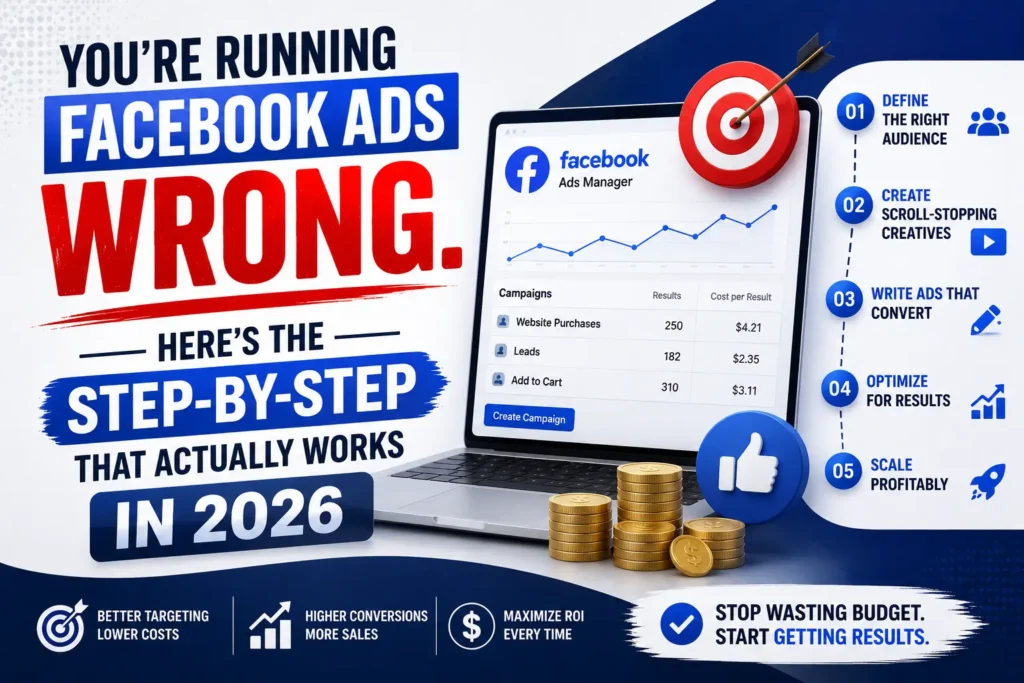

Facebook Ads are still one of the most powerful paid advertising platforms on the planet. Meta reaches over 3.2 billion daily active users across Facebook, Instagram, Messenger, and the Audience Network. The targeting is unmatched. The creative formats are diverse. And for businesses that get it right, the returns are transformational.
In this article15 sections
Yet most businesses are running Facebook Ads in 2026 the same way they ran them in 2022 – and paying for it.
They are stacking ad sets on top of each other. They are obsessing over interest targeting while Meta’s AI is quietly begging for creative variety. They are judging campaigns at day three and killing anything that is not immediately printing money. They are optimising for clicks when they should be optimising for conversions. And they are wondering why every rupee they spend seems to evaporate.
At Search Savvy, we manage Meta ad accounts for businesses across India and internationally – and the mistakes we see are consistent, fixable, and costing brands enormously. This step-by-step guide is built on what is actually working in 2026, using Meta’s current platform architecture, the latest benchmark data, and the strategies that are driving measurable returns right now.
Why Are Most Facebook Ads Campaigns Failing in 2026?#
Facebook Ads underperform in 2026 not because the platform has stopped working – it is because the platform has fundamentally changed, and most advertisers have not caught up.
Meta has undergone the most significant structural overhaul of its advertising platform in years. The manual versus Advantage+ toggle is gone. Complex multi-audience ad set structures that worked in 2021 now actively hurt performance. And the Andromeda algorithm – Meta’s AI creative ranking system – now treats your creative as your targeting. Running ten similar ad sets with similar visuals and different audiences is not a strategy anymore. It is an inefficiency the algorithm penalises.
Here is what the current benchmark data looks like in 2026:
| Metric | Global Average | India Average |
| Average CTR (all industries) | 0.9–2.19% (above 1.2% = good) | Comparable to global |
| Average CPC | $1.72 | ₹8–18 |
| Average CPM | $13.48 | ₹50–90 |
| Average conversion rate | 9.21% | Varies by vertical |
| Median ROAS (e-commerce) | 1.93x (top performers: 8x+) | 3–5x achievable |
| Average CPL (lead gen) | $27.66 globally | ₹150–400 |
Without proper tracking, businesses waste 35–40% of their ad budget on underperforming campaigns. The businesses hitting 8x+ ROAS are not spending more – they are structured differently.
People Also Ask: Are Facebook Ads still worth running in 2026? Short Answer: Absolutely. Meta Ads remain one of the most cost-effective paid channels for both B2C and B2B marketers, particularly in India where CPCs of ₹8–18 compare favourably to other paid platforms. The question is not whether to run Facebook Ads – it is whether your current strategy matches how the platform actually works in 2026.
How Do Facebook Ads Work Differently in 2026?#
Facebook Ads in 2026 are powered by three AI systems working simultaneously beneath the surface – and understanding them is the foundation of any strategy that wins.
Advantage+ Automation#
Facebook Ads now run through Meta’s Advantage+ system by default. Advantage+ uses machine learning to automatically optimise targeting, creative placement, and bidding. The old manual versus automated toggle is gone. When you combine broad targeting, optimised placements, campaign-level budgets, and a purchase or conversion event, Advantage+ activates automatically – confirmed by a green “Advantage+ On” label in Ads Manager.
AI-powered bidding strategies deliver 27% higher ROAS than manual management in 2026. Resistance to this automation – continuing to manually micromanage bid strategies – is now one of the most expensive mistakes an advertiser can make.
Andromeda: Creative Is Your Targeting#
Facebook Ads in 2026 are dominated by Andromeda, Meta’s creative ranking and delivery system. Meta’s Creative Similarity metric now penalises repetitive ads with higher CPMs. Two ads with different scripts but similar visual styles may be treated as the same ad – receiving reduced delivery and higher costs.
The practical implication is significant: your creative diversity is now your audience targeting. The algorithm needs volume – not 3 or 5 ad variations, but 10–20 genuinely different creative concepts per campaign, with different hooks, formats, and visual styles.
GEM: Conversion Optimisation Behind the Scenes#
Facebook Ads are also enhanced by Meta’s GEM (Generalised Engagement Model), which quietly boosts conversions by predicting which users are most likely to take your target action. GEM operates in the background, and the best way to feed it accurately is through clean conversion tracking via the Meta Pixel and the Conversions API (CAPI) running in parallel.
People Also Ask: What is Meta Advantage+ and how does it affect my Facebook Ads? Short Answer: Meta Advantage+ is the AI automation layer now built into all Meta campaigns. It automatically optimises targeting, placement, budget allocation, and bidding. Advertisers using Advantage+ Sales Campaigns see lower cost per acquisition compared to traditional manual campaign structures. It is the default mode for most campaigns in 2026.
Step-by-Step: How to Run Facebook Ads That Actually Work in 2026#
Facebook Ads that produce consistent, scalable results follow a specific sequence. Here is the complete framework, built for how Meta’s platform operates today.
Step 1 – Install Tracking Correctly Before Spending a Single Rupee#
Facebook Ads cannot optimise toward results they cannot measure. Before building any campaign, your tracking foundation must be solid.
- Meta Pixel – Install it on every page of your website: homepage, landing pages, product pages, and the thank-you/confirmation page after a purchase or lead form submission.
- Conversions API (CAPI) – Run CAPI alongside the Pixel. Browser-based tracking is increasingly affected by iOS privacy restrictions and ad blockers. CAPI sends conversion data directly from your server to Meta, ensuring events are captured that the Pixel would miss. Without CAPI, you are likely under-reporting conversions by 20–40%.
- UTM parameters – Add UTM tracking to every ad URL so you can verify Meta-reported results against your Google Analytics or GA4 data independently.
Do not run a single ad without this in place. The algorithm is only as smart as the data it receives.
Step 2 – Choose One Objective and One Primary KPI#
Facebook Ads with split focus produce split results. Each campaign must serve exactly one objective – awareness, traffic, leads, or sales – and your entire optimisation strategy flows from that single choice.
Aligning on a single primary KPI lets you use Ads Manager’s Columns, Breakdowns, and Reports with purpose. When you try to optimise for everything, the algorithm optimises for nothing.
For most businesses in 2026, the right objective hierarchy is:
- Sales or Purchase conversions – For e-commerce businesses with a working product page and at least 50 conversions per week in your pixel data
- Leads – For service businesses, coaches, or SaaS products where the purchase happens off-platform
- Traffic – For newer accounts or campaigns where conversion data is thin, since traffic campaigns increasingly deliver stronger ROI than lead generation in 2026 when pixel data is limited
Step 3 – Consolidate Your Campaign Structure#
Facebook Ads in 2026 demand a simpler structure than most advertisers are running. Meta is pushing advertisers firmly toward consolidating ad sets. Here is why: when you spread your daily budget across 4 ad sets at ₹500 each, the algorithm in each ad set receives too little data to learn effectively. Consolidate that into a single ad set at ₹2,000, and the algorithm learns four times faster.
The recommended structure for most campaigns in 2026:
- 1 campaign per objective
- 1–3 ad sets per campaign (not 8–12 as was common in 2021)
- 5–10 ad variations per ad set, testing genuinely different creative concepts
- Campaign Budget Optimisation (CBO) enabled – let Meta allocate budget between ad sets based on real-time performance signals
Budget optimisation tools provide 30% ROI improvements when properly implemented. The days of manually managing ad set budgets to protect “safe” audiences are over.
Step 4 – Build Creative That Stops the Scroll#
Facebook Ads live or die on creative quality. In 2026, with Andromeda treating creative as targeting, your ad content is the most important variable in your entire campaign – more important than audience selection, bidding strategy, or budget.
Video-first formats – Reels and Stories – consistently outperform static placements in 2026. Video Views campaigns remain the most cost-efficient objective for top-of-funnel awareness at $6.83 CPM. But format alone is not enough.
Every high-performing Facebook ad in 2026 shares three structural elements:
1. A pattern-interrupt hook in the first 3 seconds. Users scroll at speed. If your first frame does not arrest that movement, nothing else matters. Your hook must be visually distinctive, immediately relevant to the viewer’s pain or desire, and direct.
2. A single, clear value proposition. What does your product or service do, for whom, and why does it matter? One message communicated with clarity beats three messages communicated with noise.
3. A frictionless, specific call to action. “Learn More” is the weakest CTA in the library. “Get Your Free Quote,” “See This Week’s Offer,” or “Book a Free Audit” are specific, low-friction, and conversion-intent aligned.
For volume, produce 10–20 genuinely different creative concepts per campaign – not 10 versions of the same concept with different text overlays. Different hooks, different formats (Reels, carousels, static), different emotional angles, different presenters. The algorithm needs real variety to find your best performers.
Step 5 – Target Broadly and Let Advantage+ Do Its Job#
Facebook Ads targeting in 2026 is counterintuitive for most advertisers who learned the platform when hyper-specific interest stacking was the winning approach.
That era is over. Advantage+ audience targeting works best with broad parameters. Give Meta your geography, age range, and language – then step back. The algorithm uses behavioural and conversion data to find your buyers far more accurately than manually layered interest segments can.
The highest-value targeting inputs in 2026 are:
- Custom Audiences – Upload your existing customer list (emails, phone numbers) and website visitor data. These seed the algorithm with your best real-world buyer signals.
- Lookalike Audiences – Build 1–3% Lookalikes from your highest-value customer custom audience. These remain one of the most efficient prospecting tools on the platform.
- Retargeting audiences – Segment website visitors by behaviour: product page viewers, add-to-cart without purchase, video viewers at 50%+. Each segment needs a different message aligned to where they are in the buying journey.
Step 6 – Give Campaigns Time to Learn Before Optimising#
Facebook Ads in 2026 have a Learning Phase – a period during which Meta’s algorithm tests delivery across audiences, placements, and times to understand who converts for your objective. This phase typically requires 50 conversion events per week per ad set to exit.
The single most common mistake new advertisers make is turning off campaigns during the Learning Phase because early results look weak. Making significant edits – changing budget by more than 20%, swapping creatives, adjusting targeting – resets the Learning Phase and wastes the data already accumulated.
The rule: Set your campaign, fund it appropriately for at least 7–14 days, and do not make significant changes until you have enough conversion data to make statistically meaningful decisions.
Step 7 – Measure the Right Metrics and Scale What Works#
Facebook Ads success is measured with a specific set of metrics – and conflating them leads to bad decisions.
According to Search Savvy’s insights from managing campaigns across e-commerce, service businesses, and lead generation clients, the metrics that matter most are:
- ROAS (Return on Ad Spend) – Revenue generated per rupee spent. Industry median is 1.93x, but profitable e-commerce businesses target 3–5x minimum.
- CPA (Cost Per Acquisition/Action) – What you pay for each conversion. Median globally is $38.17 / ~₹3,200. Your acceptable CPA depends entirely on your average order value and margins.
- CTR (Link Click-Through Rate) – Most industries in 2026 see Facebook CTRs between 2% and 3%. Below 1% is a creative problem. Above 3% with a low CVR is a landing page problem.
- Frequency – How many times the same person has seen your ad. Above 4–5 in a short window signals audience fatigue and requires fresh creative.
When you find a winning ad – one delivering above-benchmark ROAS with stable CPAs – scale it gradually. Increase budgets by no more than 20% every 48–72 hours to avoid triggering the Learning Phase reset. Fast scaling breaks what the algorithm has already learned.
Why Is Creative Testing So Important for Facebook Ads in 2026?#
Facebook Ads performance is increasingly a creative problem, not a targeting problem. Meta’s ads ranking improvements drove a 3.5% lift in ad clicks on Facebook and a 3% increase in conversion rates across Instagram Feed, Stories, and Reels in Q4 2025 – not because advertisers found better audiences, but because Meta’s delivery became smarter about matching creative to the right viewer.
This means the advertiser’s job in 2026 is to provide the algorithm with enough creative variety to work with. A static campaign with two or three similar ads gives the algorithm very little to optimise. A campaign with 10–15 genuinely diverse creative concepts gives it the raw material to find your best performers, suppress underperformers, and consistently lower your CPAs over time.
At Search Savvy, we run structured creative testing frameworks for every Meta account we manage: a minimum of five new creative concepts introduced every two weeks, a clear hypothesis for each variant, and a 7-day evaluation window before drawing conclusions. The winning concepts get scaled. The losers get analysed for insights. Nothing gets emotion-driven decisions made at day two.
People Also Ask: How many ad creatives should I test in a Facebook Ads campaign? Short Answer: In 2026, aim for 10–20 genuinely different creative concepts per campaign – not minor variations of the same concept. Meta’s Andromeda algorithm needs creative volume to optimise effectively. Different hooks, formats (Reels, carousels, static), and emotional angles give the algorithm the diversity it needs to find your best performers and reduce CPMs over time.
FAQ: Facebook Ads in 2026 – Your Questions Answered#
Q1: How much should I spend on Facebook Ads in India to see results? There is no universal minimum, but Meta’s algorithm needs sufficient spend to generate the conversion data required to exit the Learning Phase. For a conversion-optimised campaign targeting purchases, a daily budget of ₹1,000–2,000 per ad set gives the algorithm enough room to learn within a reasonable time frame. For lead generation, ₹500–1,000 daily can be sufficient given India’s lower CPLs of ₹150–400. Start conservatively, validate that your tracking is working, and scale once you have a proven campaign structure.
Q2: Why is my Facebook Ads ROAS so low even with a good product? Low ROAS despite a strong product almost always traces to one of three causes: tracking is incomplete (conversions are under-reported, so the algorithm is optimising blind), creative is not connecting with the audience (the hook is not stopping the scroll or the offer is not clear), or the landing page is losing conversions after the click (slow load time, weak copy, or a mismatch between ad promise and page content). Audit all three before adjusting your campaign structure.
Q3: Should I use broad targeting or specific interest targeting in 2026? Broad targeting with Advantage+ activated is almost always the right approach in 2026 for campaigns with sufficient pixel data. Meta’s AI finds your buyers more accurately than manually stacked interest segments. The exception is very new accounts with no pixel history – in that case, building initial custom audiences and seeding the algorithm with customer lists first will accelerate the learning process significantly.
Q4: What is the difference between Facebook Ads and Advantage+ Sales Campaigns? Traditional Facebook Ads campaigns give advertisers manual control over targeting, placements, and bidding. Advantage+ Sales Campaigns hand more of these decisions to Meta’s AI, which automatically tests and optimises across a broader range of variables. Advantage+ Shopping – now renamed Advantage+ Sales – was expanded in early 2025 to support lead generation and app installs beyond e-commerce. For accounts with strong conversion history, Advantage+ Sales consistently outperforms manual structures on CPA and ROAS.
Q5: How long should I run a Facebook Ads campaign before judging performance? Give every new campaign a minimum of 7 days before making conclusions, and ideally 14 days for purchase-optimised campaigns. The Learning Phase typically requires 50 conversion events per ad set per week to stabilise. Judging performance before that data threshold is met leads to premature campaign kills and budget waste. The exception is a campaign where CPA is dramatically above your target from day one – that indicates a structural or creative problem, not a learning phase issue.
Q6: What Facebook Ads metrics should I check every week? Your weekly review should cover six core metrics: ROAS (revenue efficiency), CPA (acquisition cost), CTR link clicks (creative resonance), CPM (auction cost – rising CPM indicates audience fatigue), frequency (how often the same person sees your ad – above 4–5 signals creative refresh needed), and purchase conversion rate (landing page effectiveness). Check these at the ad set and individual ad level, not just campaign level – a campaign averaging 3x ROAS can hide one ad set at 6x and another losing money at 1.2x.Running Facebook Ads but not seeing the results your budget deserves? Visit Search Savvy for a professional Meta Ads audit and a clear, step-by-step strategy built for how the platform works in 2026.