
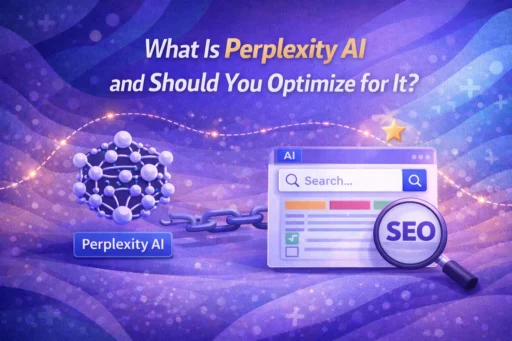

Perplexity AI is no longer a niche tool for academic researchers and tech insiders – it has become one of the fastest-growing search platforms on the planet, and its implications for how your business gets discovered online are impossible to ignore. With 45 million monthly active users, an $18–20 billion valuation, and an estimated 1.2–1.5 billion monthly queries by mid-2026, Perplexity AI is reshaping what it means to appear at the top of search results. At Search Savvy, we’ve been closely tracking AI search platforms and their impact on content visibility – and Perplexity deserves a dedicated spot in your optimisation strategy.
The platform processes more than 780 million queries per month (as of 2025, with rapid growth projections through 2026), answers in real-time with cited sources, and is actively being integrated into Snapchat, Android devices, and enterprise workflows globally. The question for every business and content creator in 2026 is not whether Perplexity AI matters – it’s whether you’re doing anything to appear in its answers.
This guide covers exactly what Perplexity AI is, how it selects sources, and the specific steps you need to take to optimise for it.
What Is Perplexity AI and How Does It Work?
Perplexity AI is an AI-powered answer engine founded in 2022 that combines large language models (LLMs) with real-time web search to deliver concise, sourced, conversational answers to user queries. Unlike traditional search engines that return a list of links, and unlike pure AI chatbots that generate answers from training data alone, Perplexity does something distinct: it retrieves live web content, synthesises it into a structured answer, and cites its sources inline – in virtually 92% of its responses.
The technical pipeline behind Perplexity AI works like this:
- A user submits a query – typically longer and more research-oriented than a Google search
- Perplexity fans the query out into multiple sub-searches, retrieving live content from the web
- Its retrieval-augmented generation (RAG) pipeline reads, scores, and ranks the retrieved content by quality, recency, and relevance
- The LLM synthesises a direct, structured answer – citing the top 3–6 sources used
That citation model is what makes Perplexity AI uniquely important for SEO in 2026. Every time Perplexity answers a question in your topic area, it selects a small group of sources to cite. Getting your content into that group is the optimisation objective.
What Makes Perplexity Different From Google and ChatGPT?
Perplexity AI sits in a distinct category from both Google and ChatGPT:
- vs Google – Google shows 10 ranked links. Perplexity synthesises a single answer and cites 3–6 sources. The visibility model is fundamentally different.
- vs ChatGPT – ChatGPT primarily draws from training data (unless Browse is enabled). Perplexity retrieves live content for every query, meaning freshness and crawlability matter far more.
- vs Both – A critical finding from theStacc’s 2026 research shows that 80% of Perplexity’s top-cited sources do not rank in Google’s top 10. This means you can earn Perplexity citations without dominating traditional search – and vice versa.
Why Is Perplexity AI Important for SEO in 2026?
Perplexity AI’s growth curve makes it impossible to treat as a secondary platform. Here are the 2026 numbers that demand attention:
- 45 million monthly active users – up from 10 million in January 2024, representing over 100% year-over-year growth
- 800% overall year-on-year growth across user base metrics
- 780 million+ monthly queries processed as of 2025, with mid-2026 estimates reaching 1.2–1.5 billion monthly queries
- $20 billion valuation backed by NVIDIA, SoftBank, Jeff Bezos, and other major investors
- 170 million global website visitors per month
- 80.5 million lifetime app downloads, with millions more every month
- A target of $656 million ARR in 2026, up from $148 million in 2025
The user profile matters as much as the volume. 80% of Perplexity’s audience holds graduate-level education, 30% are senior company leaders, and 65% are high-income white-collar professionals. These are not casual browsers – these are the decision-makers, researchers, buyers, and professionals who will act on what Perplexity tells them.
For businesses in tech, finance, consulting, healthcare, law, and education – the sectors where Perplexity AI adoption is fastest – appearing in Perplexity answers is increasingly as important as appearing on Google’s first page.
According to Search Savvy’s AI visibility research, referral traffic from Perplexity AI to cited websites is already measurable in Google Analytics 4 for businesses in knowledge-intensive sectors. If you’re not tracking chatgpt.com and perplexity.ai as referral sources in your Google Analytics 4 reports, start today.
How Does Perplexity AI Select Which Sources to Cite?
Perplexity AI uses a quality reranking pipeline that scores and selects sources based on a distinct set of signals. Understanding these signals is the foundation of Perplexity AI optimisation.
Signal 1: Answer Speed – Answers Within the First 100 Words
An LLMClicks 30-query study found that 90% of Perplexity’s top-cited sources answer the core question within the first 100 words. Google rewards depth and dwell time. Perplexity rewards immediacy. If your content buries the answer three paragraphs in, it will consistently lose citation slots to pages that lead with the direct answer.
Signal 2: Verifiable, Cited Statistics
Perplexity AI’s quality reranker assigns higher scores to content containing specific, measurable, attributable claims. A sentence like “many businesses struggle with SEO” scores low. A sentence like “96% of web pages receive zero organic traffic from Google (Ahrefs, 2024)” scores high – because the claim is specific, citable, and verifiable. Perplexity cross-references claims against multiple sources. Fabricated or vague statistics are filtered out.
Signal 3: Content Freshness
Perplexity AI applies a stronger recency bias than Google for most query types. Pages with a dateModified schema value within the past 90 days receive priority for time-sensitive and research-intensive queries. A 2025 guide competes poorly against a March 2026 update of the same topic. Refreshing your cornerstone content with current data and a visible “Last Updated” timestamp is one of the highest-ROI optimisation steps for Perplexity AI visibility.
Signal 4: PerplexityBot Accessibility
Perplexity AI uses its own crawler – PerplexityBot – to index web content. If your robots.txt file blocks PerplexityBot, your content will never be retrieved or cited, regardless of how well-optimised it is. Check your robots.txt immediately to confirm PerplexityBot is not blocked. The directive to check for is:
User-agent: PerplexityBot
Disallow: /
If this rule exists, remove it. To explicitly allow PerplexityBot, you can add:
User-agent: PerplexityBot
Allow: /
Signal 5: Structured Content Format
Perplexity AI processes text hierarchically. Content with clear semantic structure – question-based H2/H3 headings, bullet points, numbered lists, and short paragraphs – is far easier for its pipeline to parse and cite accurately. Unstructured walls of text are consistently deprioritised, even when the information quality is high.
Signal 6: Multi-Platform Brand Presence
Perplexity AI doesn’t only crawl your website. It retrieves content from across the open web – including Reddit, LinkedIn, Wikipedia, G2, Trustpilot, and industry publications. Brands that are actively discussed and mentioned across authoritative third-party platforms are cited more frequently than brands that only publish on their own domain.
How Do You Optimise Content for Perplexity AI? (Step by Step)
Perplexity AI optimisation shares DNA with traditional SEO but requires specific additional actions. Here is a prioritised implementation checklist:
1. Check and allow PerplexityBot in your robots.txt This is the pre-condition for everything else. No access = no citation, full stop.
2. Lead every page with a direct answer in the first 100 words Restructure your top content pages so the primary question the page addresses is answered directly and completely in the opening paragraph – before any preamble, context, or background.
3. Embed verifiable statistics with inline citations Every factual claim should reference its source explicitly. Format: “According to [Source Name], [specific statistic] (Year).” This mirrors how Perplexity itself structures its answers, and signals source reliability to its quality reranker.
4. Update your schema with current dateModified values Add or update Article/BlogPosting Schema on all key pages. Include both datePublished and dateModified. Refresh cornerstone pages at least every 90 days with new data or updated sections.
5. Restructure headings as direct questions Perplexity generates an average of 21.87 citations per answer (Qwairy study). Competition for those slots is intense. Pages whose H2 and H3 headings precisely match the sub-queries Perplexity fans out are significantly more likely to be retrieved and cited for those specific questions.
6. Build multi-platform brand coverage Participate in relevant Reddit discussions. Publish thought leadership on LinkedIn. Ensure your brand is listed and reviewed on G2 and Trustpilot. Seek editorial mentions in industry publications. Perplexity actively mines these platforms – brand presence beyond your own domain is a genuine citation signal.
7. Submit your sitemap via Bing Webmaster Tools Perplexity’s web index overlaps significantly with Bing’s. Submitting your sitemap to Bing Webmaster Tools ensures your content is crawled and indexed by the infrastructure Perplexity uses for real-time retrieval.
People Also Ask: Perplexity AI Questions
Does Perplexity AI use Google’s search index?
No. Perplexity AI uses its own crawler (PerplexityBot) and its own real-time retrieval pipeline. It does not rely on Google’s search index. This is why 80% of Perplexity’s top-cited sources do not rank in Google’s top 10 – the two platforms evaluate and select sources independently.
Is Perplexity AI accurate?
Perplexity AI ranks among the lowest hallucination rates of any major AI search engine, with independent evaluations placing accuracy between 3–8% hallucination rate depending on the domain. The platform scores 93.9% accuracy on the SimpleQA benchmark and handles short queries in an average of 0.8 seconds, making it one of the fastest and most accurate AI answer engines available in 2026.
Who uses Perplexity AI the most?
Perplexity AI’s user base skews heavily toward educated professionals. 80% are graduates, 30% are senior company leaders, and 65% are high-income white-collar workers. The platform is most heavily used in technology, finance, consulting, and education – industries where research-grade answers with verifiable sources are the primary need. 41% of Perplexity users work in knowledge-based industries like technology and finance.
Is Perplexity AI Worth Optimising For in 2026?
Perplexity AI is not yet competing with Google for raw search volume – Google processes approximately 14 billion queries per day versus Perplexity’s 35–45 million. But that comparison misses the strategic point.
Perplexity is not capturing the same type of query as Google. Its users are asking longer, more complex, research-intensive questions – and making professional and purchasing decisions based on the answers. A single Perplexity citation in the right answer can drive a higher-quality conversion than dozens of Google clicks from informational queries.
At Search Savvy, we recommend treating Perplexity AI optimisation as a high-ROI complement to your existing SEO strategy – not a replacement. The overlap between the two is significant enough that most GEO-focused content improvements (direct answers, fresh schema, structured headings, verifiable data) simultaneously improve your Google rankings and your Perplexity citation rate.
The question isn’t whether Perplexity AI is big enough to deserve your attention. With 45 million users, 170 million monthly visitors, and an audience of senior professionals who act on what they find – it already is.
Frequently Asked Questions (FAQ)
Q1: What is Perplexity AI in simple terms?
Perplexity AI is a real-time AI answer engine that retrieves live web content, synthesises it into a structured response, and cites its sources inline. Unlike ChatGPT (which uses training data), Perplexity searches the web for every query – making it more like a next-generation search engine than a chatbot.
Q2: How is Perplexity AI different from Google Search?
Google shows a ranked list of 10 links per page. Perplexity synthesises a single direct answer and cites 3–6 sources. Google rewards authority and keyword relevance. Perplexity rewards content that answers questions immediately, includes verifiable data, and is structured for machine extraction. 80% of Perplexity’s top-cited sources don’t rank in Google’s top 10.
Q3: How do I check if PerplexityBot can crawl my website?
Open your website’s robots.txt file (accessible at yourdomain.com/robots.txt) and check whether PerplexityBot has a Disallow: / directive. If it does, remove it. You can then verify access by searching Bing Webmaster Tools for your site’s crawl status, as Perplexity’s index overlaps significantly with Bing’s.
Q4: Does Perplexity AI send referral traffic to cited websites?
Yes. Perplexity AI includes clickable inline citations in its answers and shows a “Sources” panel with links to cited pages. Websites cited by Perplexity receive referral traffic that is trackable in Google Analytics 4 as a referral from perplexity.ai. Monitoring this traffic source is a practical way to measure your Perplexity citation performance.
Q5: How many citations does Perplexity AI include per answer?
A Qwairy study found that Perplexity generates an average of 21.87 citations per answer – however, only 3–6 are typically shown prominently inline. The competition for those visible citation slots is intense, and is won by content that answers questions directly in the first 100 words, includes verifiable data, and uses structured question-based headings.
Q6: Should small businesses optimise for Perplexity AI?
Yes – especially for businesses in knowledge-intensive sectors. Perplexity’s user base is dominated by senior professionals and high-income decision-makers. A single citation in a relevant Perplexity answer can deliver higher-quality leads than much larger volumes of casual search traffic. The optimisation techniques for Perplexity (direct answers, fresh content, schema markup, structured headings) are also best practices for SEO – meaning the investment serves multiple channels simultaneously.
Final Thoughts
Perplexity AI has grown from 3,000 daily queries in 2022 to an estimated 35–45 million daily queries in 2026 – one of the fastest adoption curves in the history of search technology. Its combination of real-time web retrieval, systematic source citation, and a premium professional user base makes it a uniquely valuable discovery channel for businesses whose content is built on verifiable expertise and clear, structured answers.
The brands that are earning Perplexity citations today are building an advantage that compounds with every new user the platform acquires. Search Savvy helps businesses audit their Perplexity AI accessibility, restructure content for extractability, and build the multi-platform brand presence that AI search engines use as credibility signals.