
In today’s digital landscape, social media has evolved from a simple communication tool into a powerful marketing engine that drives billions in revenue. With over 5.2 billion active users worldwide and social media advertising spending projected to reach $276.7 billion in 2026, understanding the difference between organic and paid social strategies has never been more critical. At Search Savvy, we’ve watched this evolution unfold, and we’re here to guide you through the essential knowledge you need to maximize your social media investment.
Whether you’re a small business owner questioning where to allocate your limited budget or a marketing professional seeking to optimize your strategy, the organic vs paid social media debate remains one of the most important conversations in digital marketing. The truth is, both approaches serve distinct purposes, and Search Savvy has found that the most successful brands strategically leverage both to create a comprehensive social presence that builds trust while driving measurable results.
This comprehensive guide will walk you through everything you need to know about organic vs paid social media in 2026, from understanding how each strategy works to discovering when to use them for maximum impact.
What Is Organic Social Media and How Does It Work?
Organic social media refers to the free content you publish on your social platforms without any paid promotion. This includes regular posts, photos, videos, Stories, Reels, and engagement activities like responding to comments and messages. When you post organically, your content reaches a percentage of your followers based on platform algorithms-what’s commonly referred to as “organic reach.”
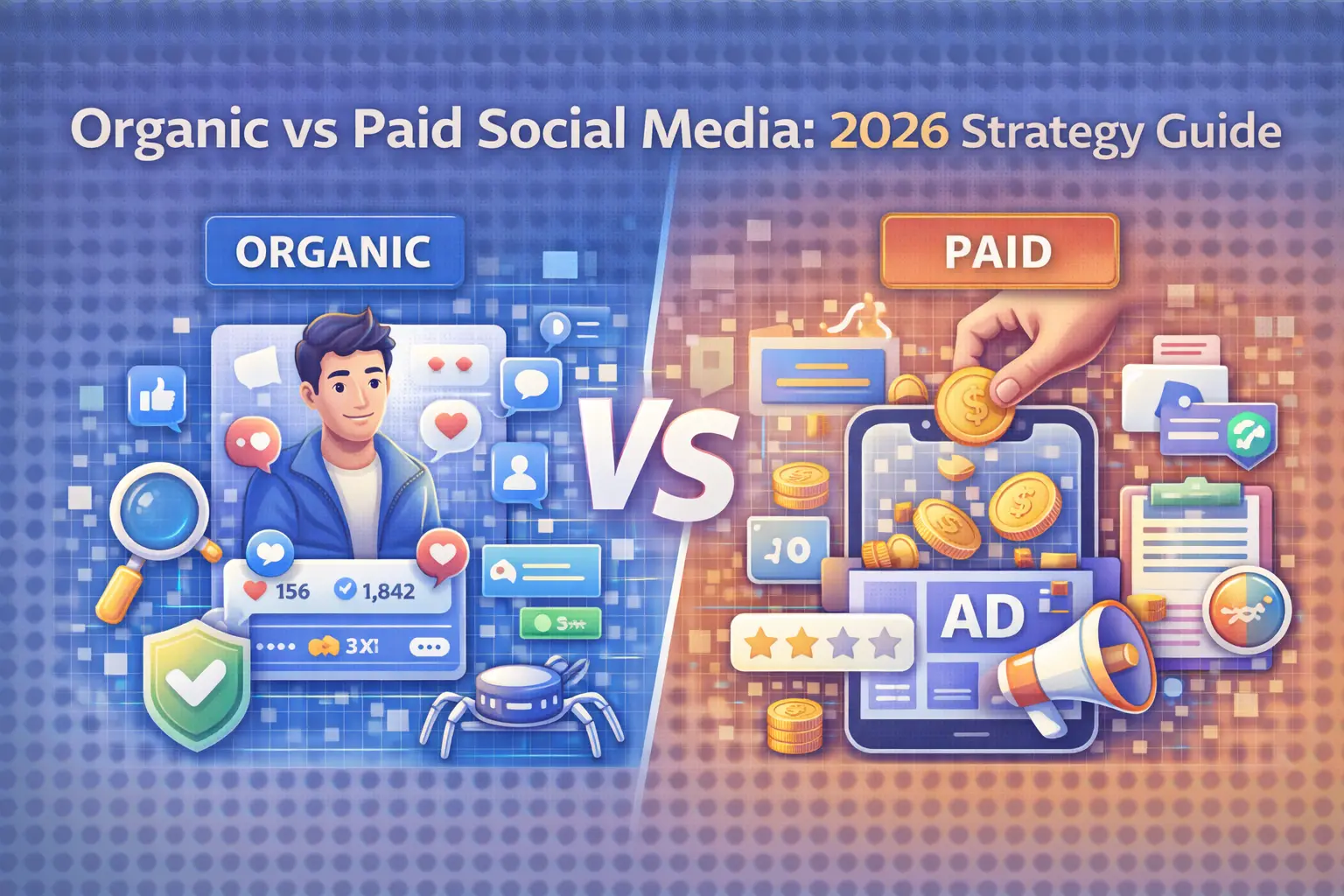
Organic vs paid social media strategies differ fundamentally in how content gets distributed. With organic posting, you’re relying on authentic engagement, shareability, and algorithmic favor to expand your reach. The goal isn’t immediate sales but rather building genuine relationships with your audience over time. According to recent research, prospects exposed to both a company’s paid and organic content are 61% more likely to convert, highlighting the power of consistent organic presence.
At Search Savvy, we emphasize that organic social media serves as your brand’s digital storefront. When potential customers discover your business, they visit your social profiles to assess credibility, understand your values, and determine if you’re actively engaged with your community. A dormant or inconsistent profile can immediately undermine trust, regardless of how strong your paid advertising might be.
The beauty of organic vs paid social media lies in their complementary nature. While paid campaigns deliver immediate visibility, organic content provides the foundation of authenticity that modern consumers demand. User-generated content (UGC), for instance, heavily featured in organic strategies, influences 79% of respondents’ purchasing decisions, far outperforming branded content at 13% and influencer posts at 8%.
Why Is Organic Reach Declining in 2026?
Organic vs paid social media has shifted dramatically over the past few years, with organic reach experiencing significant decline across all major platforms. If you’ve noticed your business posts receiving fewer likes, comments, and impressions, you’re not imagining things-the data confirms a troubling trend for unpaid content.
Between 2020 and 2023, average organic reach dropped by approximately 62% across social platforms. By 2026, Facebook brands reach only 1.65% of their followers organically, while Instagram hovers around 3.50%. This means if your business has 2,000 followers, only 30-70 people will likely see your organic posts without paid promotion.
Several factors contribute to this decline in organic vs paid social media effectiveness:
Algorithm Changes: Platforms now prioritize content from friends and family over business pages. In January 2018, Meta announced a major News Feed overhaul emphasizing “meaningful interactions,” which fundamentally reduced business content visibility.
Pay-to-Play Model: Social platforms generate revenue through advertising. To incentivize businesses to purchase ads, they must limit organic reach. This business model means that companies investing in paid promotion receive preferential algorithmic treatment.
Content Saturation: With millions of businesses competing for attention alongside personal content from users’ networks, the sheer volume of content makes organic visibility increasingly challenging. You’re not just competing with other brands-you’re competing with users’ family photos and friends’ updates.
Mobile-First Design: As 92.4% of all social media ad clicks now occur on mobile devices, platforms have optimized for paid content that delivers better mobile user experiences and generates platform revenue.
Search Savvy recommends acknowledging these realities rather than fighting them. The question isn’t whether organic reach has declined-it’s how to adapt your strategy to succeed despite these constraints.
What Is Paid Social Media and How Does It Differ?
Organic vs paid social media becomes clearer when you understand what paid strategies entail. Paid social media involves investing budget to promote your content to specific audiences beyond your organic followers. This includes sponsored posts, display ads, carousel ads, video ads, and Story placements across platforms like Facebook, Instagram, LinkedIn, TikTok, and X (formerly Twitter).
The primary advantage of organic vs paid social media from a paid perspective is precision targeting. Paid campaigns allow you to define audiences by demographics, interests, behaviors, job titles, income levels, and even specific actions they’ve taken (like visiting your website or engaging with previous content). This granular targeting ensures your message reaches exactly the right people at the right time.
In 2026, the numbers speak for themselves. Social media advertising delivers an average ROI of $5.28 for every $1 spent, with video-based campaigns generating 34% higher conversion rates than static ads. For B2B companies, LinkedIn lead-gen ads average a 6.1% conversion rate, while Facebook ads convert at an impressive 9.2% for direct-response campaigns.
Organic vs paid social media strategies serve different functions in your marketing ecosystem. While organic builds relationships and credibility, paid delivers immediate visibility, drives specific actions, and scales your reach exponentially. At Search Savvy, we’ve seen firsthand how paid campaigns can amplify great organic content-taking a testimonial video that might reach hundreds organically and showing it to tens of thousands through paid promotion.
The cost-per-acquisition varies significantly by platform, with marketers spending an average of $46.47 per user to reach social audiences. However, with strategic targeting and compelling creative, these investments consistently deliver measurable returns that far exceed traditional advertising channels.
How Can You Build Trust Through Organic Social Media?
Organic vs paid social media reveals one undeniable truth: organic content builds trust in ways paid advertising cannot replicate. When audiences consistently see your brand showing up without aggressive calls-to-action, it creates what marketing experts call “emotional residue”-a lasting impression that money simply can’t buy.
According to industry research, 84% of organizations now have a documented content marketing strategy, recognizing that authentic, value-driven content forms the foundation of customer relationships. This is where organic social media excels: showcasing your brand’s personality, values, and commitment to your community without constantly pushing for sales.
Several trust-building elements distinguish organic vs paid social media approaches:
Authenticity: Organic posts feel genuine rather than commercial. Behind-the-scenes content, employee spotlights, and company culture posts humanize your brand and demonstrate transparency. When customers see the real people behind your business, trust naturally develops.
Consistent Engagement: Responding promptly to comments, messages, and mentions shows you’re listening and care about customer experience. This two-way communication cannot be replicated through paid ads and signals that your brand values relationships over transactions.
Value-First Content: Educational posts, helpful tips, industry insights, and entertaining content that requires nothing in return build goodwill. When you consistently provide value without asking for anything, audiences develop loyalty that translates to business results over time.
Community Building: Organic social media fosters genuine communities around shared interests or values. These communities become brand advocates who voluntarily promote your products to their networks-creating exponential reach without advertising spend.
At Search Savvy, we emphasize that organic vs paid social media isn’t an either-or proposition when it comes to trust. However, attempting to maintain visibility solely through paid ads without an organic foundation means you’re essentially talking to an empty room. The moment your ad budget runs out, your brand disappears entirely.
When Should You Invest in Paid Social Media Advertising?
Organic vs paid social media decisions often hinge on specific business objectives and timelines. While organic content builds the foundation, certain scenarios demand the immediate visibility and precision that only paid campaigns can provide.
New Product Launches: When introducing new offerings, paid social media ensures your announcement reaches beyond your existing followers. With 59.02% of users believing social media ads are at least sometimes accurate, well-crafted paid campaigns can generate immediate awareness and drive early adoption.
Time-Sensitive Promotions: Limited-time offers, seasonal sales, and flash deals require rapid audience reach that organic posting cannot guarantee. Paid campaigns can be scheduled to run during specific windows, ensuring maximum exposure when it matters most.
Entering New Markets: Expanding to new geographic regions or targeting different demographics requires reaching audiences who don’t yet follow your brand. Paid social media’s targeting capabilities allow you to precisely define and reach these new customer segments.
Scaling Proven Organic Content: When organic posts demonstrate strong engagement, paid promotion amplifies their impact exponentially. This hybrid approach in organic vs paid social media maximizes your content investment by showing high-performing posts to larger, targeted audiences.
Lead Generation Campaigns: When you need measurable results quickly, paid social media excels. B2B companies using LinkedIn ads achieve an average cost per lead of $42.75 with 6.1% conversion rates, making it a reliable channel for generating qualified prospects.
Event Promotion: Whether hosting webinars, conferences, or local events, paid social media ensures your event reaches relevant audiences within your desired timeline, driving registrations and attendance.
Search Savvy consistently advises clients that paid social media works best when supporting a strong organic foundation. Brands that master organic vs paid social media integration see 3.3x higher ROI from cross-platform retargeting campaigns compared to single-platform strategies. The data clearly shows that investment in paid amplification delivers strongest results when audiences already have some familiarity with your brand through organic touchpoints.
What Are the Key Benefits of Combining Both Strategies?
Organic vs paid social media doesn’t require choosing one over the other-in fact, the most successful brands strategically combine both approaches to maximize their social media ROI. At Search Savvy, we’ve consistently observed that integrated strategies outperform siloed approaches across every industry and business size.
Comprehensive Audience Coverage: Organic content maintains visibility with your existing community while paid campaigns expand reach to new prospects. This dual approach ensures you’re nurturing current relationships while simultaneously building new ones.
Cost Efficiency: By building a loyal organic following first, your paid campaigns become more effective. Retargeting audiences who’ve engaged with your organic content costs less and converts better than cold targeting. This synergy in organic vs paid social media creates compounding returns over time.
Testing Ground: Organic posts serve as an invaluable testing mechanism for paid campaigns. By analyzing which organic content generates strongest engagement, you can identify winning messages, visuals, and formats before investing ad budget. This data-driven approach minimizes wasted spend and maximizes campaign effectiveness.
Sustained Visibility: Paid campaigns deliver results only while budget flows, but organic content continues generating engagement long after posting. Combining both ensures consistent brand presence regardless of budget fluctuations-organic maintains the baseline while paid provides surge capacity when needed.
Enhanced Credibility: When prospects see both organic presence and paid ads, they perceive greater legitimacy and stability. A brand actively posting valuable content alongside professional advertising campaigns appears more established and trustworthy than one relying exclusively on either approach.
Platform Algorithm Favor: Platforms reward accounts that invest in both organic engagement and paid promotion. Businesses using this integrated organic vs paid social media strategy often benefit from improved algorithmic treatment of their organic content as well.
According to recent data, only 27% of marketers rely exclusively on organic social activities, while the remaining 73% recognize that paid promotion is essential for maintaining competitive visibility. However, those achieving strongest results maintain robust organic strategies alongside their paid investments.
The numbers support this integrated approach: brands leveraging both organic and paid social media achieve 61% higher conversion rates than those using either strategy in isolation. At Search Savvy, we’ve developed frameworks that help businesses determine optimal budget allocation between organic content creation and paid promotion based on their specific goals, industry, and stage of growth.
How Do You Measure Success in Organic vs Paid Social Media?
Organic vs paid social media requires different measurement frameworks because each strategy serves distinct purposes within your overall marketing ecosystem. Understanding the appropriate metrics for each approach prevents misguided decisions based on incomplete or irrelevant data.
Organic Social Media Metrics:
- Engagement Rate: Measures how actively your audience interacts with content (likes, comments, shares, saves)
- Follower Growth: Tracks the rate at which your community expands over time
- Reach and Impressions: Shows how many people see your content, both followers and non-followers
- Website Traffic: Monitors visitors arriving from organic social posts
- Brand Sentiment: Evaluates the tone and quality of conversations about your brand
- Content Performance: Identifies which posts, formats, and topics resonate most strongly
Paid Social Media Metrics:
- Return on Ad Spend (ROAS): Calculates revenue generated for every dollar invested in ads
- Cost Per Acquisition (CPA): Measures the expense required to acquire each customer
- Click-Through Rate (CTR): Shows the percentage of people who click your ads after seeing them
- Conversion Rate: Tracks the percentage of clicks that result in desired actions
- Cost Per Click (CPC): Determines how much you pay for each ad click
- Lifetime Value to CAC Ratio: Compares customer lifetime value against acquisition cost
At Search Savvy, we emphasize that organic vs paid social media success metrics should align with your specific campaign objectives. Organic campaigns focused on awareness should prioritize reach and engagement, while those aimed at lead generation should track website traffic and conversion rates. Similarly, paid campaigns designed for brand awareness require different metrics than direct-response campaigns optimizing for immediate sales.
Advanced marketers in 2026 use attribution modeling to understand how organic and paid touchpoints work together throughout the customer journey. This holistic view reveals that prospects typically interact with both organic content and paid ads before converting-making it essential to measure the combined impact rather than evaluating channels in isolation.
Cross-platform measurement tools have become increasingly sophisticated, allowing businesses to track user behavior across multiple social networks and connect social media activities directly to revenue. When evaluating organic vs paid social media performance, look for tools that provide unified dashboards showing the complete picture of your social media investment returns.
Modern analytics platforms now track time saved on content scheduling, growth in engagement, and lead generation improvements, helping justify social media management platform investments. With brands reporting that 82% of marketers say AI tools have improved their ad targeting accuracy, leveraging technology for measurement has become non-negotiable for competitive performance.
What Does the Future Hold for Social Media Marketing?
Organic vs paid social media will continue evolving throughout 2026 and beyond, with several emerging trends reshaping how businesses approach social platforms. Understanding these shifts helps future-proof your strategy and maintain competitive advantage.
Video Content Dominance: Short-form video content now drives the highest engagement rates across all platforms. With 93% of marketers planning to maintain or increase video marketing investment in 2026, and short-form videos under 30 seconds converting 3× better than longer formats, visual storytelling has become non-negotiable.
Social Commerce Explosion: Direct in-app purchasing is transforming social platforms into shopping destinations. 50% of Gen Z users have made purchases directly within social media apps, while shoppable content delivers 1.7 times more conversions than non-shoppable posts. This trend blurs the lines between organic vs paid social media as product discovery increasingly happens within social feeds.
AI-Powered Optimization: Artificial intelligence now influences every aspect of social media marketing, from content creation to audience targeting. 82% of marketers report that AI tools have improved their ad targeting accuracy, while advertisers using AI-optimized bidding strategies achieve 14% higher conversion rates on average.
Authenticity Over Polish: Audiences increasingly favor authentic, behind-the-scenes content over highly produced advertising. This shift benefits organic strategies, as consumers seek genuine connections with brands rather than slick marketing messages. The most successful organic vs paid social media strategies in 2026 maintain authentic voices across both channels.
Platform Fragmentation: Rather than dominating a single platform, successful brands now maintain presence across multiple networks to reach different audience segments. The average person uses 6.83 different social networks per month, requiring businesses to develop platform-specific strategies while maintaining consistent brand messaging.
Search Savvy predicts that the most successful businesses in 2026 and beyond will be those that master the complementary nature of organic vs paid social media. While ad costs continue rising and organic reach remains constrained, brands that build authentic communities through consistent organic engagement while strategically investing in paid amplification will capture disproportionate market share.
Conclusion
Organic vs paid social media represents one of the most critical strategic decisions facing businesses in 2026. With social media advertising spending reaching $276.7 billion and over 5.2 billion active users worldwide, the platforms offer unprecedented opportunity to reach and engage customers-but only for those who understand how to leverage both organic and paid approaches strategically.
At Search Savvy, we’ve consistently observed that the most successful brands don’t choose between organic and paid social media-they master both. Organic content builds trust, showcases authenticity, and creates lasting community connections that paid advertising alone cannot replicate. Meanwhile, paid campaigns deliver the immediate visibility, precise targeting, and scalability necessary to achieve ambitious growth goals within compressed timelines.
The data throughout this guide demonstrates that integrated strategies deliver superior results: 61% higher conversion rates for brands using both approaches, $5.28 ROI for every dollar spent on social media advertising, and substantially lower customer acquisition costs when paid campaigns retarget engaged organic audiences.
As you develop your social media strategy for 2026, remember that organic vs paid social media isn’t a binary choice-it’s a dynamic balance that should evolve with your business objectives, competitive landscape, and available resources. Whether you’re just beginning your social media journey or optimizing existing campaigns, the insights shared here provide a roadmap for success in an increasingly complex digital ecosystem.
The future belongs to brands that build authentic communities through consistent organic engagement while strategically amplifying their best content through paid promotion. By understanding the unique strengths of each approach and how they complement one another, you’ll position your business to thrive in the ever-evolving world of social media marketing.
Frequently Asked Questions
Q: What is the main difference between organic and paid social media?
A: Organic social media refers to free content posted on your social profiles that reaches audiences through natural engagement and algorithmic distribution. Paid social media involves investing budget to promote content to specific targeted audiences beyond your organic followers. The key difference lies in cost, reach, targeting precision, and speed of results-organic builds relationships over time while paid delivers immediate, scalable visibility.
Q: How much should I budget for paid social media advertising in 2026?
A: Budget allocation depends on your business size, industry, and objectives. Small businesses typically allocate 5-10% of revenue to digital marketing, while larger companies may invest up to 14%. With average costs of $46.47 per user reached and an average ROI of $5.28 per dollar spent, start with a test budget of $500-1,000 monthly to gather performance data, then scale based on results. At Search Savvy, we recommend balancing paid investment with consistent organic content creation for optimal results.
Q: Can I succeed with only organic social media in 2026?
A: While organic-only strategies can work, they require exceptional content quality, consistency, and patience. With organic reach at just 1.65% on Facebook and 3.50% on Instagram, growing through organic content alone is increasingly challenging. Most successful brands combine both approaches-using organic to build community and trust while leveraging paid promotion for launches, promotions, and reaching new audiences. Only 27% of marketers rely exclusively on organic activities.
Q: Which social media platform offers the best ROI for paid advertising?
A: Platform ROI varies by business type and objectives. Facebook delivers the highest direct-response conversion rates at 9.2%, making it excellent for e-commerce and lead generation. LinkedIn produces superior B2B results with 6.1% conversion rates on lead-gen ads. Instagram leads for B2C brands with 78% of marketers reporting positive returns. TikTok generates the highest engagement rates at 5.7% and drives 28% higher engagement-to-conversion rates than Instagram Reels. Choose platforms based on where your target audience actively engages.
Q: How often should I post organic content on social media?
A: Posting frequency depends on your platform, resources, and audience preferences. Research suggests brands should post 48-72 times per week across all platforms combined to maintain optimal visibility. However, quality matters more than quantity-inconsistent high-quality content outperforms frequent low-quality posts. Start with 3-5 posts weekly per platform, analyze engagement patterns, and adjust based on performance data rather than arbitrary scheduling rules.
Q: Do I need different content for organic vs paid social media?
A: While you can use the same content for both organic and paid distribution, optimal performance requires some differentiation. Organic content should prioritize relationship-building, entertainment, education, and authentic engagement without aggressive sales messaging. Paid content can be more promotional but performs best when it still provides value and doesn’t feel overtly commercial. The most successful strategy involves testing content organically first, then promoting your highest-performing posts with a paid budget to maximize ROI.
Looking to optimize your social media strategy for 2026? Contact Search Savvy today to discover how our integrated organic and paid social media services can help your business achieve measurable results while building lasting customer relationships.