
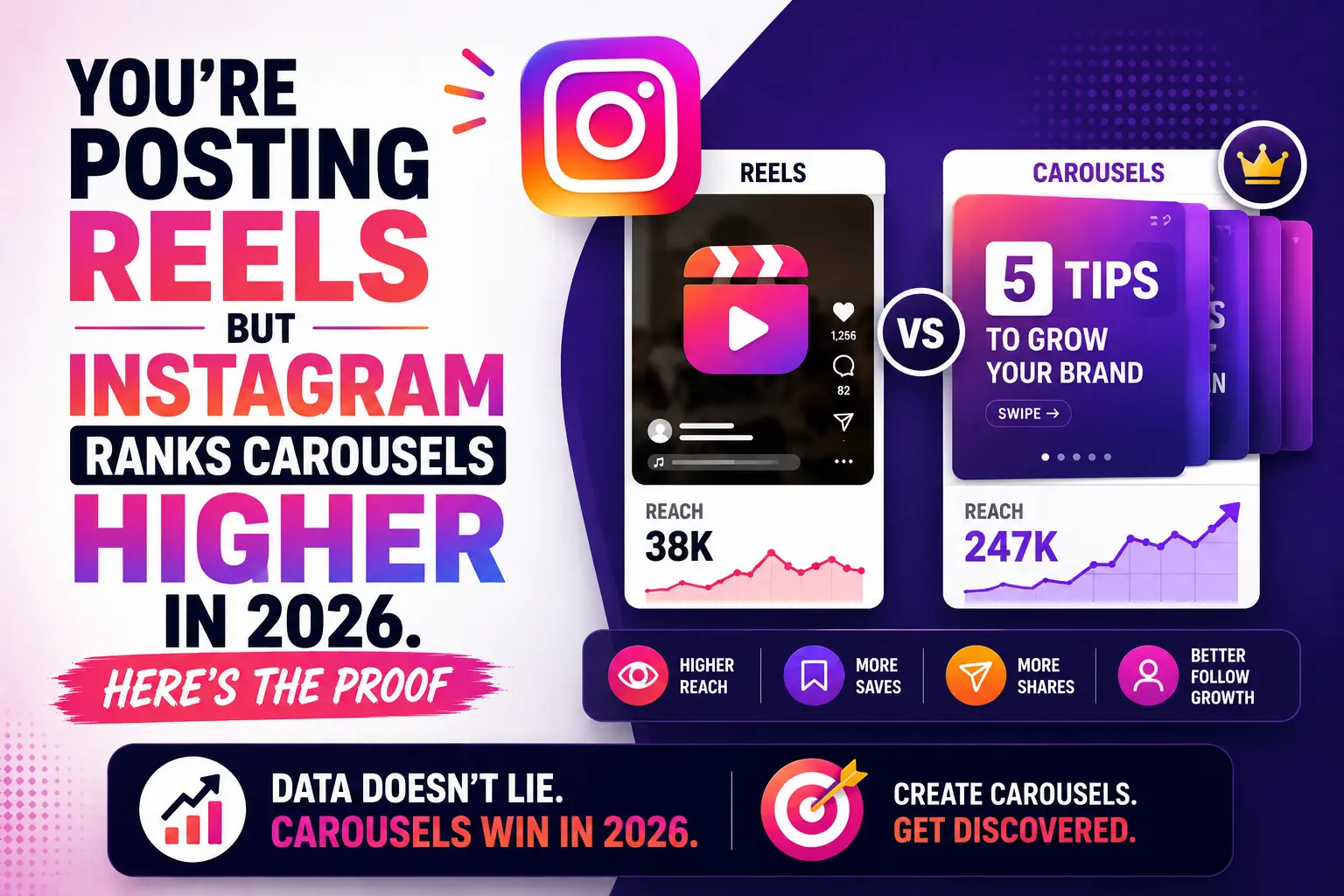

The Instagram carousels vs Reels algorithm debate has a definitive answer in 2026 – and it is not the one that most brands are acting on. If you opened your content calendar this morning and it shows wall-to-wall Reels with a few static images scattered in, you are running a strategy built for 2023. The platform has shifted. The algorithm has shifted. And the engagement data across every major 2026 benchmark study says the same thing: carousels are outperforming Reels on every metric that actually drives account growth and conversion.
The numbers are not subtle. Carousels achieve an average engagement rate of 10.15% in 2026. Reels average 6%. That is not a marginal difference – it is a 70% higher engagement rate from a format that most brand accounts are underinvesting in while they spend their production budget on video content that reaches more people but converts fewer of them.
At Search Savvy, we talk to brands every week who are exhausted from Reels production cycles and confused about why their accounts are not growing the way they expected. The Reels strategy made sense when Instagram was pushing video to every non-follower in 2022. In 2026, the algorithm’s priorities have changed, and the winning format is the one that generates the engagement signals the platform is now weighing most heavily.
This post breaks down the actual data, explains exactly how the Instagram carousels vs Reels algorithm works differently for each format, and tells you what to post – and when – based on your account’s specific goals.
What Does the 2026 Data Actually Show About Instagram Carousels vs Reels?
The Instagram carousels vs Reels algorithm comparison looks different depending on which metric you measure – and this is where most brands get confused. Reels win on raw reach. Carousels win on engagement, saves, conversion, and sustained distribution. Understanding which metric matters for your goal is the strategic decision that determines which format deserves your production investment.
Here is the 2026 data from multiple independent benchmark studies:
Engagement Rate:
- Carousels: 10–10.15% average engagement rate
- Reels: 6–7% average engagement rate
- Single images: 5–7% average engagement rate
Carousels generate 114% more engagement than single images and 12% more than Reels – making them the highest-engagement format on the platform by a clear margin.
Reach:
- Reels: 3–5x more reach than carousels per post (Explore page and Reels tab distribution)
- Carousels: 3x more reach than single images; 1.4x wider reach than single-image posts
- Reels have a 33% reach rate to non-followers – the highest of any Instagram format
Saves:
- Carousels: 2–3x more saves than Reels
- Saves drive long-term algorithmic distribution – the algorithm interprets a save as a high-value quality signal and re-serves saved content to additional users
DM Shares:
- DM shares are the single most powerful ranking signal on Instagram in 2026 – weighted 3–5x heavier than likes
- Carousels and Reels both generate DM shares, but educational carousel content (step-by-step guides, frameworks, comparison content) generates shares at higher rates per impression than most Reel content
Distribution Window:
- Reels: Spike in the first 24–48 hours, then fade
- Carousels: Continue generating engagement for days to weeks after posting via Instagram’s re-serve mechanism – the algorithm re-distributes high-performing carousels to new audiences 24–48 hours after initial posting
The headline summary: Reels = reach. Carousels = depth, conversion, and longevity. Neither wins everything. Both serve different strategic functions. The error is not posting Reels – it is not posting carousels.
How Does the Instagram Carousels vs Reels Algorithm Work Differently for Each Format?
The Instagram carousels vs Reels algorithm is not a single system – it is multiple separate ranking systems, one for each surface (Feed, Reels tab, Explore page, Stories). Each surface optimises for different user behaviours, which is why carousel and Reel content performs so differently.
How Instagram’s Algorithm Evaluates Carousels
Instagram ranks carousels primarily on three engagement signals that are unique to the multi-slide format:
Signal 1: Swipe-Through Rate Instagram tracks how many users who see a carousel also swipe to slide 3 or beyond. This is the algorithm’s primary quality signal for carousel content. Carousels that clear the platform average for swipe-through rate for their account size enter a re-serve queue – the mechanism that gives carousels their extended distribution window. Your first two slides are not just hooks for human readers. They are the performance metric the algorithm uses to decide whether your post deserves a second distribution window 24–48 hours later.
Signal 2: Active Dwell Time Per Slide Instagram measures how long a user spends on each slide, not just total time with the post. High dwell time per slide signals that the content is being actively read and processed – a “meaningful interaction” signal that the platform weights heavily. Carousels with 8.7 seconds or more of average dwell time enter a higher distribution tier.
Signal 3: Carousel Completion Rate A carousel completion rate below 60% reduces the probability of Instagram re-serving the post to new audiences via Explore. The algorithm interprets low completion as a sign that the content lost relevance mid-sequence. Carousels with 7 or fewer slides tend to see lower completion rates; 8–10 slides in a well-structured sequence is typically the optimal range.
How Instagram’s Algorithm Evaluates Reels
Instagram ranks Reels primarily on watch time, completion rate, and DM shares – the same signals that determine distribution in the Reels tab and Explore page. Reels get priority distribution to non-followers because Instagram treats the Reels format as its primary user acquisition surface – the mechanism for growing the platform’s total active user base by surfacing content to people who don’t yet follow you.
The 3-second threshold is the first critical filter: Reels that lose viewers before three seconds see dramatically reduced distribution. After that threshold, Instagram evaluates completion rate (what percentage of viewers watch to the end), rewatch rate (a strong quality signal), DM shares, and saves.
The key algorithmic difference: Reels distribute to the Reels tab (non-follower reach), Explore page, and Feed. Carousels primarily distribute through the Feed and, when performance is strong, through Explore. This means Reels reach more strangers. Carousels reach your existing audience more deeply – and the depth of engagement with an existing audience generates the conversion and trust signals that turn followers into customers.
Why Are Carousels the Highest-Engagement Format for Most Brand Accounts in 2026?
The Instagram carousels vs Reels algorithm distributes Reels more broadly – but that distribution advantage does not automatically translate to business outcomes. The format-to-goal alignment is where most brand strategies break down.
Carousels win on the signals that drive account growth and commercial impact:
- Saves indicate intent. When someone saves a carousel, they are signalling: I want to return to this. A save is stronger evidence of genuine value than a passive view. A content library with a high save rate builds a re-visit relationship with the audience that a Reels-only strategy never creates.
- Educational content thrives in carousel format. Step-by-step guides, before-and-after comparisons, framework explanations, and multi-part announcements require enough space for the reader to absorb the information. Carousels provide that space. A 10-slide educational carousel delivers information in a format the user can control – pausing on slides they need to read more carefully, skipping content they know, referring back after leaving.
- Carousels perform better for larger accounts. For accounts with 500,000 to 1 million followers, carousels match Reels in reach while delivering superior engagement. For accounts with more than 1 million followers, carousels dominate across all metrics – including reach. Brand accounts in the 500K–1M follower range see carousels generating approximately 1,034 median likes compared to 807 for Reels. For accounts above 1 million, carousels deliver median reach of 217,668 views compared to 110,500 for Reels.
- Carousels have a longer content lifespan. Reels typically spike within the first 24–48 hours and fade. Carousels with strong swipe-through rates re-enter distribution cycles and continue accumulating engagement over days or weeks. A library of high-quality carousels becomes a self-compounding engagement asset in a way that a library of Reels rarely does.
When Should You Post Reels vs Carousels in 2026?
The Instagram carousels vs Reels algorithm makes both formats valuable – but for different, non-competing purposes. The strategic decision is about goal alignment, not format loyalty.
Post Reels when:
- Your primary objective is reaching new audiences who don’t follow you yet
- You are launching a new product, service, or campaign and want maximum cold-audience impressions
- You have trending audio to leverage – trending sounds give Reels an algorithmic boost with no equivalent mechanism for carousels
- Your content is inherently motion-dependent – demonstrations, tutorials, unboxings, or reaction content that requires video to be understood
- You are targeting the Reels tab discovery surface – the algorithm pushes short video more aggressively to non-followers than any other format
Post Carousels when:
- Your objective is engagement depth with your existing audience – building relationships with current followers, not just reaching new ones
- You are sharing educational content – frameworks, guides, step-by-step processes, comparisons, or multi-part explanations that benefit from a controlled-pace format
- You want to maximise saves – the algorithm treats saves as high-value quality signals, and educational carousels consistently generate the highest save rates on the platform
- You are building brand authority – carousels demonstrate expertise in a way that a 15-second video rarely achieves
- You are repurposing high-performing content – carousels are the most efficient format for repurposing blog content, email sequences, or long-form guides into Instagram-native posts
Post the Carousel Reels hybrid format when: The most significant 2026 format development is the Carousel Reel – a hybrid format combining carousel swiping with Reels distribution introduced in late 2025. Performance data from the Instagram Creator Coalition in January 2026 shows:
- Regular Reels: 6% engagement rate, 45K average reach
- Carousel Reels: 12% engagement rate, 89K average reach
- Result: 2x reach + 2x engagement = 4x overall performance
The Carousel Reel is currently the highest-performing hybrid format on the platform and represents the most efficient single format investment for accounts trying to optimise across both reach and engagement simultaneously.
What Makes a High-Performing Instagram Carousel in 2026?
According to Search Savvy’s Instagram content strategy framework, the six variables that separate high-performing carousels from posts that stall after 50 impressions are:
1. The First Two Slides Are a Performance Threshold, Not a Hook
The Instagram carousels vs Reels algorithm evaluates your carousel’s swipe-through rate from slide 2 to slide 3 as the primary quality signal. Your first slide must generate curiosity or utility strong enough that the user needs to swipe. Your second slide must deliver enough value that they continue to slide 3 – the point at which you enter the re-serve queue.
The first slide is a promise. The second slide is proof the promise is being kept. The carousel that earns the most from the algorithm is one where every slide creates a reason to see the next.
2. Minimum 7–10 Slides for Maximum Re-Serve Potential
Carousels with fewer than 7 slides tend to see lower reach because the algorithm has fewer swipe events to score. The optimal range for most educational and brand content is 8–10 slides – enough depth to deliver genuine value, enough swipe events for the algorithm to build a reliable distribution confidence score.
3. Save-Worthy Content Design
Save-worthy content has a simple test: would someone want to return to this after leaving? Checklists, reference guides, comparison frameworks, data summaries, and step-by-step processes all pass this test. Promotional content, generic inspiration, and content that makes a single point in ten slides do not.
High save rates compound algorithmically. Saved posts are re-served to additional users. Users who save one piece of your content are significantly more likely to save future posts. And accounts with consistently high save rates across their content library see algorithmically superior reach over time – independent of follower count.
4. Text That Can Be Read Without Audio
Unlike Reels, carousels are a silent format by default. Every slide must be fully comprehensible without sound. This is an advantage for brands creating educational and professional content – the carousel communicates its full value without requiring the user to enable audio or stop scrolling.
Clear, readable slide text with sufficient contrast, a legible font size for mobile screens (minimum 18–20pt for body text), and no overcrowding per slide are the minimum design standards.
5. A Strong Final Slide With an Explicit Action
The final slide of a carousel is its conversion surface. Users who reach the final slide have demonstrated the highest engagement level of any viewer – they swiped through your entire content sequence. That is a warm audience in a moment of high receptivity.
The final slide should contain: a save prompt (“Save this for later”), a follow suggestion, a specific CTA (link in bio, DM response, comment answer), or a question that invites comments. All four, if relevant. Ending a carousel without a final slide CTA leaves the highest-intent viewers with no direction – and loses the conversion that the rest of the post’s performance earned.
6. Consistent Visual Identity Across Slides
The Instagram carousels vs Reels algorithm’s visual recognition now reads aesthetic consistency as a classification signal. A carousel with a consistent colour palette, typography, and layout structure trains the algorithm’s content profile for your account. Users who recognise your visual style from the thumbnail – before they swipe – are more likely to engage, because recognition precedes trust.
FAQ: Instagram Carousels vs Reels Algorithm in 2026
Q1: Do carousels or Reels get more engagement on Instagram in 2026? Carousels get significantly more engagement. In 2026, carousels achieve an average engagement rate of 10–10.15% compared to 6–7% for Reels. Carousels also generate 2–3x more saves than Reels and continue accumulating engagement over days via Instagram’s re-serve mechanism, while Reels typically spike in the first 24–48 hours and decline. However, Reels reach 3–5x more non-followers per post, making them more effective for raw audience discovery.
Q2: Why does Instagram favour carousels over Reels for engagement in 2026? Instagram’s algorithm evaluates carousels on swipe-through rate, dwell time per slide, and carousel completion rate – signals that are unique to multi-slide content and highly indicative of genuine user interest. High-swipe-rate carousels enter a re-serve queue that gives them a second distribution window 24–48 hours after posting. This extended distribution window, combined with the higher save rates that educational carousel content generates, creates a compounding engagement advantage that single-frame Reels cannot replicate.
Q3: Should I stop posting Reels and only post carousels? No – the optimal 2026 Instagram strategy uses both formats for different purposes. Reels are Instagram’s primary discovery surface – use them when your goal is reaching non-followers, launching new campaigns, or capitalising on trending audio. Carousels are the highest-engagement format for depth, saves, and conversion – use them for educational content, authority building, and engaging your existing audience. The highest-performing 2026 format is the Carousel Reel hybrid, which combines carousel swiping with Reels distribution at 2x both reach and engagement.
Q4: How many slides should an Instagram carousel have in 2026? Research consistently shows that carousels with fewer than 7 slides see lower reach because the algorithm has fewer swipe events to score. The optimal range is 8–10 slides for educational and brand content – enough depth to deliver genuine value while maintaining a completion rate above 60% (the threshold below which Instagram reduces re-serve probability). For promotional or announcement carousels, 5–7 slides can work when each slide is visually strong and clearly purposeful.
Q5: What is a Carousel Reel and how does it perform? Carousel Reels is a hybrid format introduced in late 2025 that combines the multi-slide swiping mechanics of a carousel with the Reels distribution infrastructure. According to Instagram Creator Coalition data from January 2026, Carousel Reels achieve a 12% engagement rate and 89K average reach – compared to 6% and 45K for standard Reels. The 2x reach and 2x engagement combination produces roughly 4x overall performance, making Carousel Reels the single highest-performing format available on Instagram in 2026.
Q6: What content works best in Instagram carousels vs Reels? Carousels perform best for educational content (step-by-step guides, frameworks, how-to sequences), comparison and reference content (tables, checklists, before-and-after formats), multi-part announcements, and authority-building content that requires more than a few seconds to absorb. Reels perform best for motion-dependent demonstrations, trending audio content, product launches targeting cold audiences, and content designed for viral DM sharing. The save metric is the best guide for carousel content suitability: if someone would want to return to the content after leaving, it belongs in a carousel.
The Bottom Line
The Instagram carousels vs Reels algorithm in 2026 has delivered a clear verdict: carousels are not the outdated format you were told to move away from when Reels launched. They are the highest-engagement, highest-save, longest-lasting format on the platform – and the brands still treating them as an afterthought are leaving measurable engagement and conversion on the table.
The strategy is not to abandon Reels. It is to stop treating carousels as filler content between video posts. Use Reels to reach new audiences. Use carousels to convert those audiences into engaged followers, savers, and customers. Use the Carousel Reel hybrid when you want both.
According to Search Savvy’s content calendar analysis for 2026, the accounts generating the strongest sustained organic growth on Instagram are posting a mix of approximately 40% carousels, 40% Reels, and 20% single images – with carousels carrying the educational and authority-building content that earns saves, and Reels carrying the growth and reach objectives. That ratio is not fixed – it is a starting point that the data from your own account will refine over time.
If you want a content format audit that shows exactly how your current Instagram posting mix compares to what the 2026 algorithm rewards, get in touch with the Search Savvy team.