Facebook Groups Are the Only Organic Reach Left. Here’s Why You’re Ignoring Them.
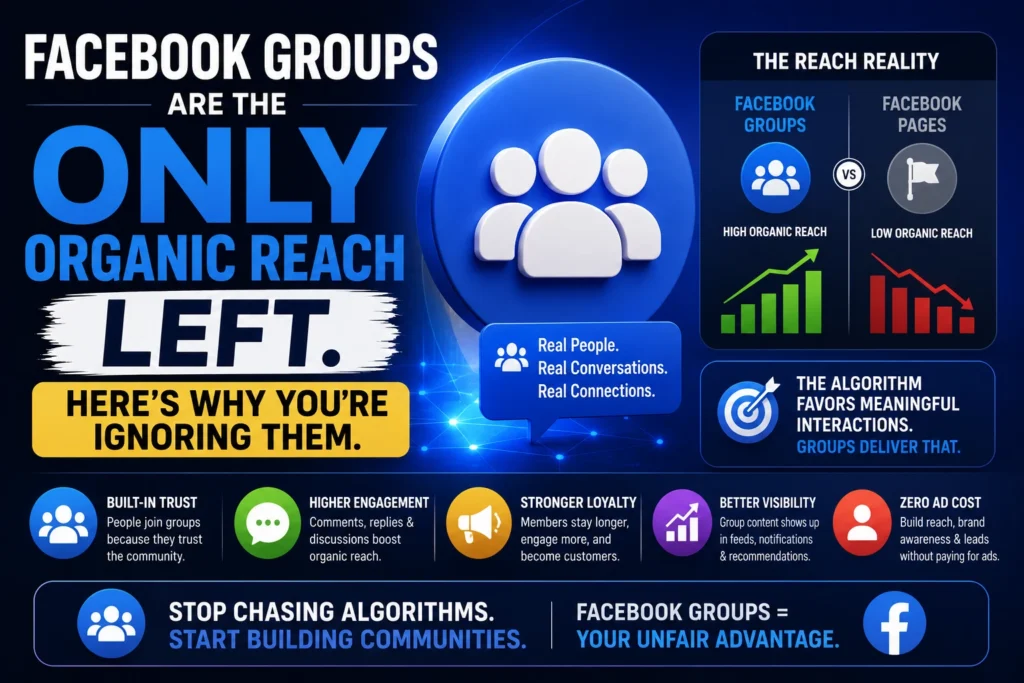

Facebook Groups organic reach is one of the most significant, most measurable, and most consistently ignored opportunities in social media marketing right now. If your brand is still putting the bulk of its organic Facebook effort into your business Page, you are working ten times harder for a fraction of the results – and handing a substantial competitive advantage to the brands that figured this out two years ago.
In this article12 sections
The numbers tell a story that should change your strategy today. Facebook Page organic reach in 2026 averages just 1–6% of followers per post. A Page with 10,000 followers can expect approximately 200–600 people to see any given organic post. A Group with 10,000 members? A typical post reaches 2,000–4,000 members. A high-quality post reaches 5,000 or more. That is a 10–15x reach multiplier on identical content – for free.
At Search Savvy, we talk to brand managers and digital marketers who are spending hours crafting Page posts that reach almost nobody, while a well-run Facebook Group covering the same audience could deliver more organic visibility in a week than their Page has in a year. This post explains why that gap exists, why it’s growing, and exactly how to close it.
What Is Facebook Groups Organic Reach and Why Does It Matter in 2026?#
Facebook Groups organic reach refers to the number of Group members who see a post in their news feed or notifications without any paid promotion. Unlike Page posts, which are distributed by an algorithm that strongly favours paid content and penalises even large Pages for their scale, Group posts are surfaced to members as part of Facebook’s deliberate push toward community-first content.
Facebook’s strategic intent is clear and has been confirmed through platform behaviour: Groups are positioned as the future of community-building on the platform. Meta CEO Mark Zuckerberg has referred to Groups as “the social fabric of Facebook” multiple times, and the product investment in Group features – live sessions, polls, guides, subgroups, admin tools, and member management – has been consistent and accelerating.
The macro context in 2026 makes this even more compelling:
- Facebook has 3.07 billion monthly active users, making it the world’s largest social platform
- 1.8 billion people engage with Facebook Groups every month – more than half of all monthly active users
- Facebook Groups drive 30% higher organic engagement than Pages
- Posts in Facebook Groups generate 3.7x more engagement than equivalent posts on brand Pages
- Thriving Facebook Groups can reach engagement rates of 200% to 400% – compared to the 0.06% average engagement rate on standard business Pages
The contrast is not marginal. It is structural. And it is the direct result of how Facebook’s algorithm treats community content versus brand content.
Why Did Facebook Page Organic Reach Collapse While Groups Thrive?#
Facebook Groups organic reach has held strong precisely because Facebook Pages organic reach has not. Understanding why the divergence happened explains why the gap will not close.
Facebook Page organic reach has been declining since 2014 – from over 15% per post twelve years ago to its current 1.4–5.9% average in 2026. The cause is not a secret. Facebook openly confirmed in 2018 that it was deprioritising Page content in favour of content from friends and family. The business model is straightforward: Pages are the gateway to Facebook Ads. Facebook wants brands to pay for reach, not earn it for free.
Groups operate on a fundamentally different principle. Facebook’s algorithm treats Group content as community content – the equivalent of friends-and-family interactions – because it is. Group members have explicitly opted in. They are not passive followers; they are participants who have chosen to be part of a specific community. That intent signal is treated very differently by the algorithm.
What the algorithm rewards in Groups:
- Member-initiated discussions – questions, polls, shared experiences
- Comments and conversation threads – especially exchanges between multiple members
- Early engagement signals – posts that receive comments within the first 30–60 minutes get significantly wider distribution
- Admin and frequent contributor activity – members who post regularly earn higher baseline distribution
What it suppresses on Pages:
- Promotional content – the algorithm detects and limits posts that look like advertising
- Low-engagement posts – Pages with recent low-performing posts get their new posts suppressed further
- Large Page scale – Facebook’s algorithm actually penalises large Pages, prioritising smaller, more specialised Pages as more relevant
Facebook’s average engagement rate on Pages currently stands at just 0.15% (Socialinsider, Q1 2026 data). Groups are operating in a different universe – one where the platform’s incentives align with brands, not against them.
How Does the Facebook Algorithm Treat Groups Differently in 2026?#
Facebook Groups organic reach benefits from a specific set of algorithmic signals that Pages simply cannot access. Understanding these signals is what separates brands that get consistent reach from those that don’t.
In January 2026, Meta launched the User True Interest Survey (UTIS) model for content recommendations – a system that goes beyond engagement metrics and directly surveys users in-feed about whether content matches their interests. The results from A/B testing with over 10 million users showed a 5.4% increase in high survey ratings and a 5.2% boost in total engagement.
This matters for Groups because Group content is inherently interest-matched. People join Groups around specific topics they care about. When the algorithm evaluates whether Group content is relevant to a member, the fact that the member chose to join a community around that exact topic is one of the strongest relevance signals available.
Key algorithmic advantages Groups hold in 2026:
Notification preference: Members can choose to receive notifications for all Group posts, new posts only, or highlights – meaning Group content has a direct notification pathway that Pages only access through paid promotion.
Feed prioritisation: Facebook’s Feed algorithm actively surfaces Group content from communities a member engages with, treating it similarly to friends’ content rather than brand Page content.
Content indexing: Facebook Group posts are now indexed in Google Search for public Groups, creating an SEO dimension that Page posts do not benefit from at the same scale.
Meaningful interaction signals: Comments, replies, polls, and shared discussions in Groups generate the “meaningful interaction” signals that Facebook’s algorithm explicitly rewards with wider distribution.
What Types of Facebook Groups Drive the Most Organic Reach for Brands?#
Facebook Groups organic reach varies significantly depending on how a Group is structured and what purpose it serves. At Search Savvy, we categorise brand Facebook Group strategies into three models, each with different reach and conversion dynamics:
1. The Community of Interest Model#
A Group built around a topic, problem, or interest that your target audience cares about – where your brand is the host, not the focus. This is the highest-reach model because it attracts the largest membership and generates the most member-initiated content.
Example: A digital marketing agency running a Group for “Indian D2C Founders: Marketing & Growth” – covering topics relevant to its ideal client base without making the Group primarily about its own services.
This model works because members join for the community value, not the brand. Organic reach is high because engagement is genuine. The brand builds authority and trust as the community host, which converts into business conversations over time.
2. The Customer Success Model#
A Group for existing customers or clients – a private, members-only space for onboarding, support, peer discussion, and exclusive content. This model has lower total reach (smaller membership) but extremely high engagement and retention value.
Example: A SaaS company with a private Group for paying subscribers – sharing tutorials, feature updates, collecting feedback, and enabling peer-to-peer support.
The business value here is not reach – it is retention, churn reduction, and upsell opportunity. Members who are active in a brand’s customer Group have significantly higher lifetime value than those who are not.
3. The Brand Community Model#
A Group explicitly built around a brand – for fans, customers, and prospects. This works best for brands with genuine communities already forming organically (D2C products, fitness brands, food brands, lifestyle companies).
Example: A camphor products D2C brand running a Group for “Natural Home & Wellness: Tips, Rituals & Recipes” – where the product is part of a broader lifestyle the audience lives.
All three models benefit from Facebook Groups organic reach advantages over Pages. The choice depends on your business model, audience size, and whether you have content to sustain a community beyond direct product promotion.
How Do You Build a Facebook Group That Actually Grows in 2026?#
Facebook Groups organic reach compounds over time – but only if the Group is structured correctly from the start. A Group that launches and stagnates within 90 days is worse than not having one, because it creates a visible dead community that signals neglect to potential members.
Here is the framework that consistently produces results:
Before you launch:
- Define the community’s purpose in a single sentence – not “a Group for [Brand Name] customers” but “a space for [specific people] to [achieve specific outcome]”
- Set up clear Group rules that establish tone, prohibit spam, and reward valuable contributions
- Prepare your first 30 days of content – questions, polls, conversation starters, expert posts – before inviting the first member
- Decide on your moderation capacity honestly – an unmoderated Group degrades fast
In the first 30 days:
- Seed the Group with your most engaged existing customers, advocates, or community members – invite personally, not via broadcast
- Post every day – questions and polls outperform promotional posts in early-stage Groups
- Comment on every post and reply to every comment – algorithm rewards this heavily in new Groups
- Set up a welcome post that establishes the community’s value proposition and invites introductions
For ongoing growth:
- Post 3–5 times per week at minimum – consistency matters more than volume
- Use the 80/20 rule: 80% community-serving content (tips, questions, discussions, member spotlights), 20% brand or product content
- Run regular polls – they consistently generate the highest engagement-to-effort ratio
- Feature member contributions prominently – reposting a member’s insight or question signals that the community is for them, not just for you
- Cross-promote across channels – email subscribers, LinkedIn, WhatsApp broadcasts, and your website are all valid membership funnels
Why Are Most Brands Still Ignoring Facebook Groups Organic Reach?#
The reasons brands underinvest in Facebook Groups organic reach despite the clear data are predictable – and worth naming, because recognising them is the first step to fixing them.
“It takes too long to build.” This is true and it is also the point. A Facebook Group that takes 12 months to reach 2,000 genuinely engaged members is a more defensible asset than a paid campaign that stops the moment you turn off the budget. The brands that started 12 months ago are already benefiting from reach that their competitors are still paying for.
“We don’t have the content.” This is the wrong framing. A thriving Group needs questions and conversations more than polished content. The community creates the content – your role is to facilitate and moderate.
“We can’t control what gets posted.” Moderation tools in 2026 are comprehensive. Admin approval for posts, member request screening, and automated keyword filtering give brands significant control over Group quality without requiring round-the-clock monitoring.
“Our team doesn’t have capacity.” According to Search Savvy’s community strategy practice, a single dedicated community manager spending 30–45 minutes per day can sustain a mid-sized Facebook Group effectively. That is considerably less time than the average brand spends on Page content that reaches 2% of followers.
What Content Generates the Highest Organic Reach in Facebook Groups?#
Facebook Groups organic reach responds to specific content signals. Based on 2026 platform data and community management best practices, the content formats that consistently generate the highest reach and engagement in Groups are:
Polls – the highest engagement-to-effort ratio of any Facebook Group content type. Simple, relevant questions with 2–4 options generate immediate responses and trigger algorithmic distribution.
Open questions – especially specific, opinionated questions that invite personal experience: “What’s the one marketing tool you couldn’t run your business without?” outperforms “What are your thoughts on digital marketing?”
Timely commentary – responding to a news event, platform update, or industry development within 24 hours of it breaking. Timeliness is a strong reach signal in Groups.
Member spotlights – featuring a member’s achievement, question, or contribution builds belonging and encourages others to contribute, creating a positive engagement loop.
Behind-the-scenes and honest content – original insights, real failures, process documentation, and genuine brand voice consistently outperform polished marketing copy in community settings.
User-generated content performs 3x better than brand-generated posts on Facebook in terms of organic engagement. In Groups, the goal is to make your members the content.
FAQ: Facebook Groups Organic Reach in 2026#
Q1: What is the organic reach of a Facebook Group compared to a Facebook Page?
Facebook Group posts reach 20–40% of members per post, compared to just 1–6% of followers for Facebook Pages in 2026. A Group with 10,000 members can expect 2,000–4,000 members to see a typical post – versus 200–600 for a Page of identical size. This 10–15x reach difference is structural, resulting from Facebook’s algorithmic preference for community content over brand Page content.
Q2: How many people use Facebook Groups in 2026?
Over 1.8 billion people engage with Facebook Groups every month as of 2026 – more than half of Facebook’s total 3.07 billion monthly active users. This makes Facebook Groups one of the largest active community ecosystems in the world, and one of the few places on social media where organic reach remains genuinely competitive.
Q3: Are Facebook Groups better than Facebook Pages for businesses?
For organic reach and community building, yes – significantly. Facebook Groups generate 3.7x more engagement than equivalent brand Pages and drive 30% higher organic engagement overall. However, Pages still hold advantages for paid advertising (pixel integration, custom audiences, ad targeting tools). The most effective Facebook strategy in 2026 uses Groups for organic community-building and Pages for paid campaigns – not one or the other.
Q4: How often should a brand post in their Facebook Group?
A minimum of 3–5 times per week is recommended for consistent algorithmic distribution. Consistency matters more than volume – a Group that posts every day for three months then goes quiet will see dramatically suppressed reach when activity resumes. For new Groups in the first 90 days, daily posting (or even twice daily) accelerates the algorithmic learning that drives member notification and distribution.
Q5: What type of Facebook Group content gets the most organic reach?
Polls generate the highest engagement-to-effort ratio and consistently earn wide algorithmic distribution. Open questions that invite personal experience, timely commentary on industry news, and member spotlights also perform strongly. The underlying principle: content that generates comments and conversations earns significantly more reach than content that generates only likes or reactions, because comments signal “meaningful interaction” – the specific behaviour Facebook’s algorithm is designed to reward.
Q6: Can I use a Facebook Group to generate business leads organically?
Yes – and it is one of the most effective organic lead generation channels available in 2026, particularly for service businesses, consultants, agencies, and D2C brands. The conversion mechanism is indirect: you build trust and authority as the community host over time, and members who need your product or service think of you first. Direct sales pitching in Groups suppresses reach and damages community trust. The most effective approach is consistent value delivery, with clear pathways (bio links, pinned posts, occasional announcements) for members who want to learn more about working with you.
The Bottom Line#
Facebook Groups organic reach is not a hidden secret or a new idea. The data has been clear for years. The gap between what Groups deliver and what most brands invest in them reflects a widespread strategic blind spot – a preference for channels that feel easier or more modern over channels that actually produce free, compounding reach.
In a social media landscape where organic Page reach averages 2%, paid costs are rising every quarter, and every major platform is becoming more pay-to-play, a channel delivering 20–40% organic reach to an opted-in, interest-qualified community is extraordinary. It is the closest thing to a free audience that exists in digital marketing right now.
The brands that are building Facebook Group communities today will hold organic reach advantages that their competitors will struggle to replicate – because community trust compounds over time in a way that ad spend does not.
If you want help designing a Facebook Group strategy that fits your business model, audience, and content capacity, the Search Savvy team can build you a community roadmap that turns organic reach into measurable business outcomes.