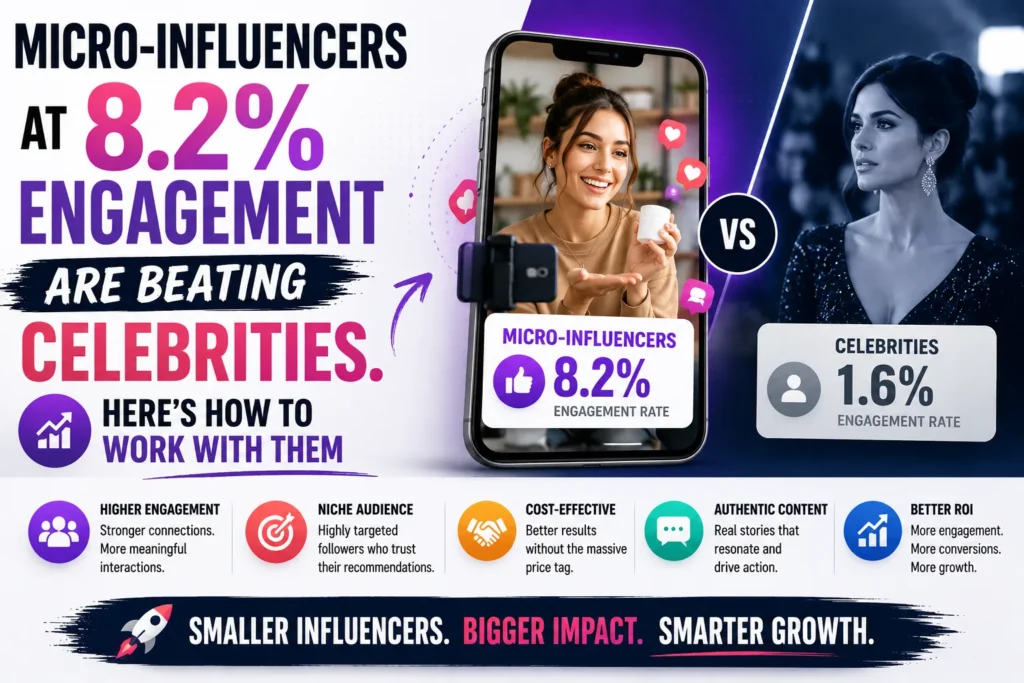
Micro-Influencers at 8.2% Engagement Are Beating Celebrities. Here’s How to Work With Them

The brand deal with 5 million followers did not move the needle. The celebrity post got impressions but generated almost no clicks, no conversions, and a cost-per-result that made the finance team quietly horrified.
In this article10 sections
Meanwhile, a skincare brand in Pune worked with 12 creators – each with between 15,000 and 80,000 followers – and sold out their launch product in 11 days.
This is not an anecdote. It is the industry-wide shift that the 2026 data is now confirming at scale. Micro-influencer marketing strategy has stopped being the scrappy alternative to celebrity deals and become the primary, data-backed choice for brands that care about ROI over reach metrics.
Micro-influencers consistently generate engagement rates between 7% and 20%. TikTok micro-influencers average 8.7%. Instagram micro-influencers in fashion average 8–12% at the nano tier. Celebrity-level creators, by contrast, often see engagement rates under 2%. The math is not even close.
83% of marketing professionals explicitly state that micro-influencers drive better commercial results than traditional celebrities. 70% of marketers now prioritise micro-influencers over big names. And 40% of all dedicated influencer budgets are now directed specifically at micro-influencer tiers.
At Search Savvy, we work on digital strategy alongside content and social media – and the businesses we see extracting the most value from their marketing spend in 2026 are the ones who have built systematic micro-influencer marketing strategies rather than one-off celebrity aspirations. This article explains exactly why micro-influencers win, how to find the right ones for your brand, and the step-by-step process to run campaigns that produce measurable results.
What Is a Micro-Influencer – and Why Do Their Numbers Beat Celebrities?#
A micro-influencer marketing strategy typically targets creators with between 10,000 and 100,000 followers – the tier that sits above nano-influencers (under 10K) and below mid-tier or macro-influencers (100K–1M+).
The engagement rate hierarchy in 2026 tells the story clearly:
| Influencer Tier | Follower Range | Average Engagement Rate |
| Nano | 1K–10K | 10.3% (TikTok), 5%+ (Instagram) |
| Micro | 10K–100K | 8.7% (TikTok), 3.5–8.5% (Instagram) |
| Mid-tier | 100K–1M | 2–4% |
| Macro/Celebrity | 1M+ | 0.8–2.5% |
TikTok nano-influencers achieve 10.3% engagement rates, while micro-influencers hit 8.7% – both substantially outperforming macro and mega-influencers on the platform.
The reasons behind the performance gap are structural, not random. Micro-influencers tend to cultivate tight-knit, highly interested communities. Their content is often more relatable and dialogue-driven. Followers see them as genuine peers or experts in a specific niche – whether it’s eco-friendly beauty or gourmet baking.
When someone follows a creator with 40,000 followers, they almost certainly discovered that creator through a shared interest. The recommendation that creator makes carries the weight of a trusted peer – not an advertisement. 92% of consumers trust recommendations from influencers more than traditional advertisements or celebrity endorsements.
And then there is the commercial efficiency argument. Micro-influencers consistently generate 3–5x higher ROI on campaign spend compared to traditional advertising. The same budget that pays for a single celebrity post can fund 15–30 micro-influencer campaigns – each reaching a tightly relevant audience, each producing authentic content, and each generating measurable, attributable results.
People Also Ask: Why do micro-influencers have better engagement than celebrities? Short Answer: Micro-influencers maintain closer relationships with their audiences because their communities are small enough to enable genuine interaction. Followers view micro-influencers as peers rather than celebrities, creating trust that translates to higher engagement. Platform algorithms also favour content from accounts that generate strong relative engagement – amplifying micro-influencer reach to non-followers. The result is 7–20% engagement rates versus celebrities’ 0.8–2.5%.
Why Is Micro-Influencer Marketing Strategy So Important in 2026?#
Micro-influencer marketing strategy has become essential in 2026 for three compounding reasons: the influencer marketing industry is growing rapidly, budgets are concentrating in this tier specifically, and AI tools have removed the operational barrier that previously made micro-influencer programmes too complex to run at scale.
The scale of the opportunity is confirmed by the latest market data. The influencer marketing industry is expected to grow at a CAGR of 32.4% from 2021 to 2026. Aspire’s 2026 State of Influencer Marketing report indicates that 74% of marketers plan to actively increase their influencer marketing budgets this year. Global influencer spending reached an estimated $32.55 billion in 2025 – and the allocation within that budget is shifting decisively toward smaller creators.
According to Digital Web Solutions, 40% of dedicated influencer funds are spent specifically on micro-influencers – signalling a strategic prioritisation of targeted engagement over broad celebrity reach.
And the operational excuse for avoiding micro-influencer programmes has disappeared. AI-powered platforms now handle most of the work of finding, vetting, contracting, briefing, and paying 50 creators – making a 50 creator campaign as easy to run as a single celebrity deal.
For Indian brands specifically, the micro-influencer opportunity is even more acute. 75.9% of Instagram’s influencer base consists of nano-influencers, and 73% of brands now prefer smaller creator partnerships – meaning the creator supply to support micro-influencer strategy is deep, the competition for creator relationships is not yet saturated, and the cost-per-result advantage over celebrity deals is especially pronounced in the Indian market where follower counts are large but authentic engagement is the more valuable metric.
People Also Ask: Is micro-influencer marketing more cost-effective than celebrity influencer marketing? Short Answer: Consistently, yes. Micro-influencers deliver 3–5x higher ROI on campaign spend compared to traditional celebrity advertising. A single celebrity post costing ₹5–10 lakh can be replaced by 20–40 micro-influencer posts at the same total cost, each reaching a more targeted, higher-trust audience with 4–8x the engagement rate. The budget that funds one celebrity deal typically supports an entire systematic micro-influencer programme with measurable results.
How Do You Find the Right Micro-Influencers for Your Brand?#
A micro-influencer marketing strategy lives or dies at the discovery and vetting stage. Finding creators with large enough engagement to matter and genuine enough audiences to convert is where most first-time programmes go wrong – not in the brief or the creative.
Where to Find Micro-Influencers#
Finding the right micro-influencers is the top challenge cited by 48% of marketers, making creator discovery tools essential for scaling programmes. The methods that work best:
Platform-native search. On Instagram, search niche-specific hashtags relevant to your product category – #MumbaiFitness, #IndianSkincare, #TechReviewsIndia – and look for accounts in the 10K–100K range that are posting consistently, receiving genuine comments (not just emoji reactions), and covering topics closely aligned with your brand. Repeat this on TikTok and YouTube for a multi-platform picture.
Audience-first discovery. Instead of starting with creators, start with where your customers are. If you know your target audience reads specific subreddits, follows specific hashtags, or engages with specific community accounts – the influencers those people follow are your warmest leads.
AI-powered discovery tools. Tools like HypeAuditor and Heepsy automate the discovery and initial vetting process, providing engagement rate verification, audience demographics, and fake follower detection at scale.
Your own customer base. Your most authentic micro-influencer leads are often already following you. Influencer compensation is shifting from simple per-post fees toward performance-based models that tie payment to actual results. Starting with customers who already believe in your product means the advocacy is genuine from day one – and the content reflects real experience rather than a paid performance.
How to Vet Micro-Influencers Before Committing#
Don’t just look at follower counts. Some creators buy fake followers or use engagement pods. Check audience authenticity before partnering. The vetting checklist before any partnership:
- Engagement rate – Cross-check using Social Blade or HypeAuditor. A micro-influencer with 50K followers should have at least 3–5% Instagram engagement or 7–10% TikTok engagement.
- Comment quality – Read the actual comments. Genuine comments ask questions, share experiences, or reference specific content. Generic comments like “Love this!” or emoji-only responses are signs of inauthentic engagement.
- Audience demographics – Does their audience match your ICP? Age range, location, income bracket, and interest alignment matter more than follower volume.
- Content consistency – Are they posting at least weekly? Do the last 30 posts reflect a consistent niche focus, or is the account scattered across topics with no clear theme?
- Brand safety – Review the last 90 days of content. Any posts that conflict with your brand values, product safety standards, or reputational requirements should disqualify the creator – regardless of their engagement metrics.
People Also Ask: How do I check if a micro-influencer’s followers are real? Short Answer: Use tools like HypeAuditor or Social Blade to audit follower quality. Look for audience credibility scores, follower growth pattern analysis (sudden spikes indicate purchased followers), and engagement authenticity metrics that flag engagement pods. Manually review comment quality – genuine communities leave specific, contextual comments. Read the comment section of their last five posts before any engagement rate analysis.
How Do You Brief a Micro-Influencer for Maximum Creative Output?#
A micro-influencer marketing strategy produces its best creative – and its best results – when the brand brief provides strategic clarity without creative restriction.
Your brief should include: campaign goals, main messages, what content is needed, when to post, and how to show it is sponsored. Leave room for creators to be creative. The best micro-influencer marketing strategies balance what the brand needs with the creator’s real voice.
The elements every micro-influencer brief must contain:
Campaign objective – Be specific. “Drive awareness” is not a brief. “Drive 500 clicks to our product landing page in 14 days” is. The objective determines the content format, the call to action, and the metrics you will use to evaluate success.
Key message – The single most important thing you want the audience to understand about your product after watching or reading. Not three things. One.
Mandatory disclosures – In India, sponsored content must comply with the Advertising Standards Council of India (ASCI) guidelines, which require all paid posts to be clearly labelled as “Ad” or “Paid Partnership.” Non-disclosure carries regulatory and reputational risk for both the brand and the creator.
Deliverables and timeline – Exactly what content is expected (Reel, static post, Story, YouTube Short), how many pieces, when to post, and when to submit drafts for review.
Creative freedom zone – After specifying the above, explicitly state what the creator can decide for themselves. Hook, storytelling format, setting, production style – this is where their authenticity lives, and restricting it undermines the reason you chose a micro-influencer over a branded content studio.
Single-post influencer collaborations are tactical. Multi-post narrative campaigns that unfold over weeks or months are where micro-influencer relationships build genuine brand equity. A creator who documents their experience with a product over time – purchase, first use, thirty-day update, three-month reflection – produces a content arc that tracks authentic behaviour.
How Do You Structure Compensation for Micro-Influencers in 2026?#
Micro-influencer marketing strategy in 2026 uses multiple compensation models – and the right choice depends on your campaign objective, your product category, and your relationship stage with each creator.
The four compensation models in current use:
Flat fee per deliverable – The most straightforward structure. A flat fee of $500 to $1,500 works for most micro-influencers globally. In India, rates vary significantly by platform, niche, and follower count. For an Indian micro-influencer with 30K–80K followers: ₹8,000–₹40,000 per Instagram Reel or TikTok post is a reasonable range in 2026, with significant variation by niche and engagement quality.
Performance-based / hybrid – A base fee combined with commission for sales driven via a unique tracking link or promo code. The most advanced marketers use hybrid compensation models that balance consistency with performance – a base fee to guarantee creator time and quality, paired with affiliate commissions that reward influencers directly for driving sales, and bonus triggers that align their upside with hitting CPA or ROAS benchmarks.
Product gifting / seeding – Sending product in exchange for an organic, unsponsored post. Gifted collaborations outperform paid partnerships – brands using gifted influencer collaborations achieve 12.9% higher engagement rates (2.19% vs 1.94%) compared to paid sponsorships. This model works best with nano and micro-influencers who are genuinely aligned with the product category and most reliably when the product quality speaks for itself.
Long-term retainer – A monthly fee in exchange for regular, ongoing content over a 3–6 month period. 69% of marketers consider long-term influencer relationships to be the most effective strategy. Retainer relationships allow the creator’s audience to see sustained, repeated endorsement – which is significantly more persuasive than a single sponsored post.
Start with ₹15,000–25,000 for 2–4 nano influencers. Test, measure ROI, scale what works. For micro-influencers with 10K–100K followers, budget ₹50,000–₹3,00,000 for an initial campaign across 5–10 creators, depending on the deliverable scope and compensation model.
How Do You Track and Measure a Micro-Influencer Campaign?#
Micro-influencer marketing strategy delivers measurable ROI only when tracking is built in before the campaign launches – not added as an afterthought during the debrief.
Define KPIs by funnel stage: CPM for awareness, CPE for engagement, CPA for conversions, and blended ROAS for overall return. Every campaign should have a primary KPI established before creator briefing begins – because the measurement framework determines which creator instructions, which content formats, and which compensation structures are appropriate.
The tracking infrastructure every campaign needs:
- Unique UTM links for every creator – allowing you to attribute traffic, sessions, and conversions by individual influencer in Google Analytics 4. Each creator gets a URL with their unique UTM_source parameter.
- Creator-specific promo codes – for direct sales attribution in your e-commerce platform. Codes like CREATOR20 allow precise conversion tracking and double as an incentive for the creator’s audience.
- Story swipe-up and link-in-bio click tracking – using Bitly or platform-native analytics to measure click volume from Stories and profile bio links.
Metrics to review at campaign close:
- Engagement rate – Were the posts performing above or below the creator’s historical average?
- Click-through rate – Of viewers who saw the post, what percentage took the next step?
- Cost per engagement (CPE) – Total spend divided by total engagements across all creator posts
- Cost per acquisition (CPA) – Total spend divided by total conversions attributed via UTM or promo code
- Content rights value – Can the content be repurposed in paid social ads, email campaigns, or website assets?
87% of micro-influencer content requested by brands is short-form video (TikToks and Instagram Reels), with optimal performance from 20–40 second clips. If you are not acquiring usage rights to repurpose this content across paid channels, you are leaving significant additional value on the table. The creator content that performs best organically is often the most effective creative for paid social amplification – and negotiating usage rights upfront costs a fraction of producing equivalent studio content.
According to Search Savvy’s insights from advising brands on influencer ROI measurement, the most common mistake in micro-influencer tracking is measuring campaign performance on the day the post goes live. Most sales conversions from influencer content happen 3–14 days after the post, as audiences revisit content, discuss it in comments, or are reminded by algorithmic redistribution. Set a 14-day attribution window before drawing any conclusions about campaign ROAS.
People Also Ask: What metrics should I track for a micro-influencer campaign? Short Answer: The core metrics are: engagement rate (likes + comments + shares + saves ÷ followers × 100), click-through rate (via UTM tracking links), cost per engagement (total spend ÷ total engagements), cost per acquisition (total spend ÷ tracked conversions), and ROAS (revenue attributed via promo codes ÷ campaign cost). Track each creator separately before comparing aggregate performance. Use a 14-day attribution window for sales-focused campaigns to capture delayed conversion behaviour.
What Platforms Work Best for Micro-Influencer Marketing in 2026?#
Micro-influencer marketing strategy looks different on each major platform – and the platform choice should follow your audience, not default to Instagram because it is the most familiar.
Instagram remains the most popular platform for influencer marketing. 89% of marketers use Instagram for influencer campaigns. Instagram Reels get 67% higher engagement than static feed posts. Micro-influencers with 10K–100K followers on Instagram average 3.5–8.5% engagement. Product discovery, beauty, lifestyle, fashion, and food are the strongest categories.
TikTok produces the highest engagement rates. TikTok micro-influencers average 8.7% – the strongest platform-specific benchmark for this tier. Short-form video between 20–40 seconds performs best. TikTok Shop integration has created direct e-commerce conversion potential that was unavailable 12 months ago. However, TikTok’s US regulatory challenges created a 17.2% drop in marketer investment intentions, accelerating the shift toward portfolio approaches – meaning multi-platform diversification is now standard strategy.
YouTube works best for long-form product reviews, tutorials, and comparison content. Micro-influencer YouTube channels produce content with longer shelf life than Instagram or TikTok – a YouTube review published today may continue driving traffic and conversions 18 months from now.
LinkedIn for B2B micro-influencer strategy is an underutilised opportunity in 2026. B2B micro-influencers with 5K–50K LinkedIn followers in specific professional niches – HR, finance, sales, marketing technology – can deliver extraordinarily targeted professional audience reach that no other platform matches.
At Search Savvy, we recommend building a platform-diversified creator portfolio rather than concentrating entirely on one platform. A creator who posts across Instagram and YouTube provides both immediate engagement and long-form content that compounds in search value over time – delivering SEO benefit alongside social reach.
People Also Ask: Which platform is best for micro-influencer marketing in 2026? Short Answer: TikTok delivers the highest engagement rates for micro-influencers at 8.7% average, making it best for awareness and product discovery campaigns. Instagram has the largest influencer base and the most established brand infrastructure for discovery and conversion. YouTube provides the longest content shelf life and strongest SEO-adjacent value. For B2B, LinkedIn is significantly underused and offers exceptional professional audience precision. The best strategy is a portfolio approach across two or three platforms rather than single-platform dependency.
FAQ: Micro-Influencer Marketing Strategy – Your Questions Answered#
Q1: How many micro-influencers should I work with for my first campaign? Start with 5–10 creators for your initial micro-influencer marketing strategy test. This gives you enough data points to compare performance across creator styles, content formats, and audience types – without the operational complexity of managing 50 simultaneous relationships. Start with ₹15,000–25,000 for 2–4 nano influencers, test, measure ROI, scale what works. For a micro-influencer tier, budget ₹75,000–₹1,50,000 for a 5-creator initial campaign and evaluate CPA and engagement data before scaling. The creators who outperform in round one become the foundation of your long-term partner roster.
Q2: Should I work with micro-influencers in my exact city or can they be anywhere in India? It depends entirely on your business model. For a local service business – a restaurant, a gym, a clinic, a real estate developer – city or neighbourhood-specific creators are essential because the audience’s geographic relevance directly determines conversion potential. For a D2C e-commerce brand that ships nationally, city of residence matters less than niche alignment and audience quality. Review each creator’s audience location breakdown (available in most creator media kits or through HypeAuditor) before committing – a Mumbai-based creator with 60% Mumbai audience is a very different prospect from the same creator with 40% international audience.
Q3: Do I need a legal contract for every micro-influencer collaboration? Yes – for any paid partnership, a written agreement is non-negotiable. The contract should specify: deliverables and deadlines, compensation amount and payment timeline, revision rights (how many rounds of review), content approval process, ASCI disclosure requirements, content usage rights (can you repurpose their content for paid ads?), exclusivity terms (can they work with direct competitors during the campaign period?), and consequences for non-delivery. For product-seeding (gifted) collaborations where no payment changes hands, a short written brief confirming expectations is sufficient – though ASCI disclosure requirements still apply if any consideration (product, discount, experience) is given in exchange for coverage.
Q4: How do I handle a micro-influencer who posts content I did not approve? Address it immediately and directly. Contact the creator via your agreed communication channel, explain the specific issue, and request either amendment or removal depending on the severity. For minor deviations from the brief – wrong hashtag, slightly off messaging – a polite correction request is appropriate. For material brand safety violations, escalate to a removal request and review your contract terms for remediation. Prevention is more effective than remedy: a thorough brief with clear content guidelines, a draft approval step before publishing, and an explicit content policy in your contract eliminate the majority of unapproved post situations before they occur.
Q5: What is the difference between a micro-influencer and a brand ambassador in 2026? A micro-influencer typically works with a brand on a campaign-specific, project-based basis – one or two posts per collaboration, with each engagement negotiated separately. A brand ambassador is a creator in a long-term, exclusive or semi-exclusive relationship with a brand – regularly featuring the brand across months or years, often as a visible face of the brand’s community. 69% of marketers consider long-term influencer relationships to be the most effective strategy, and 46% plan to increase their long-term influencer partnerships. Evolving your best-performing micro-influencer relationships into ambassador arrangements is the natural progression of a mature micro-influencer marketing strategy – the creator’s sustained advocacy becomes a compounding asset rather than a one-time campaign output.
Q6: How do I calculate ROI from a micro-influencer marketing campaign? Use this formula: (Projected revenue − Campaign cost) ÷ Campaign cost × 100 = ROI%. Revenue attribution uses the promo code or UTM-tracked conversions from each creator. For campaigns where direct conversion tracking is difficult (awareness or top-of-funnel campaigns), measure secondary KPIs: CPE (cost per engagement), CPM (cost per thousand impressions), and brand search volume lift in the days after the campaign. Compare your micro-influencer CPE and CPA against your baseline from paid social or Google Ads for the same audience segment. The average return on investment for influencer marketing is $5.78 for every $1 spent – but micro-influencer programmes consistently outperform this average, with well-run campaigns delivering 3–5x higher ROI than celebrity or macro-influencer equivalents.
Ready to build a micro-influencer marketing strategy that actually drives measurable ROI – not just impressions? Visit Search Savvy for a social content and influencer strategy review tailored to your brand, your audience, and your 2026 growth targets.