

Google AI Overview has fundamentally changed the search experience – and with it, the rules of organic visibility. If you have searched on Google recently, you have almost certainly seen it: a prominent AI-generated summary sitting above all traditional organic results, answering the query directly and citing a handful of sources beneath it. Those cited sources are where the new SEO battle is being fought in 2026.
At Search Savvy, we have been tracking Google AI Overview since its full rollout in May 2024, monitoring how it evolves, which sources it favours, and what signals consistently earn a citation. The landscape has shifted dramatically. Appearing in Google AI Overview is now one of the most coveted positions in search – not because it always drives the most clicks, but because it signals to users, to competitors, and to Google’s own systems that your content is among the most trusted and authoritative in your niche.
This guide explains exactly what Google AI Overview is, how it works, why it matters more than ever in 2026, and the specific, actionable strategies that Search Savvy recommends to maximise your chances of being featured. Whether you are an SEO professional, a content marketer, or a business owner, this is the definitive starting point for understanding and optimising for the most significant shift in search since the introduction of featured snippets.
What Is Google AI Overview?
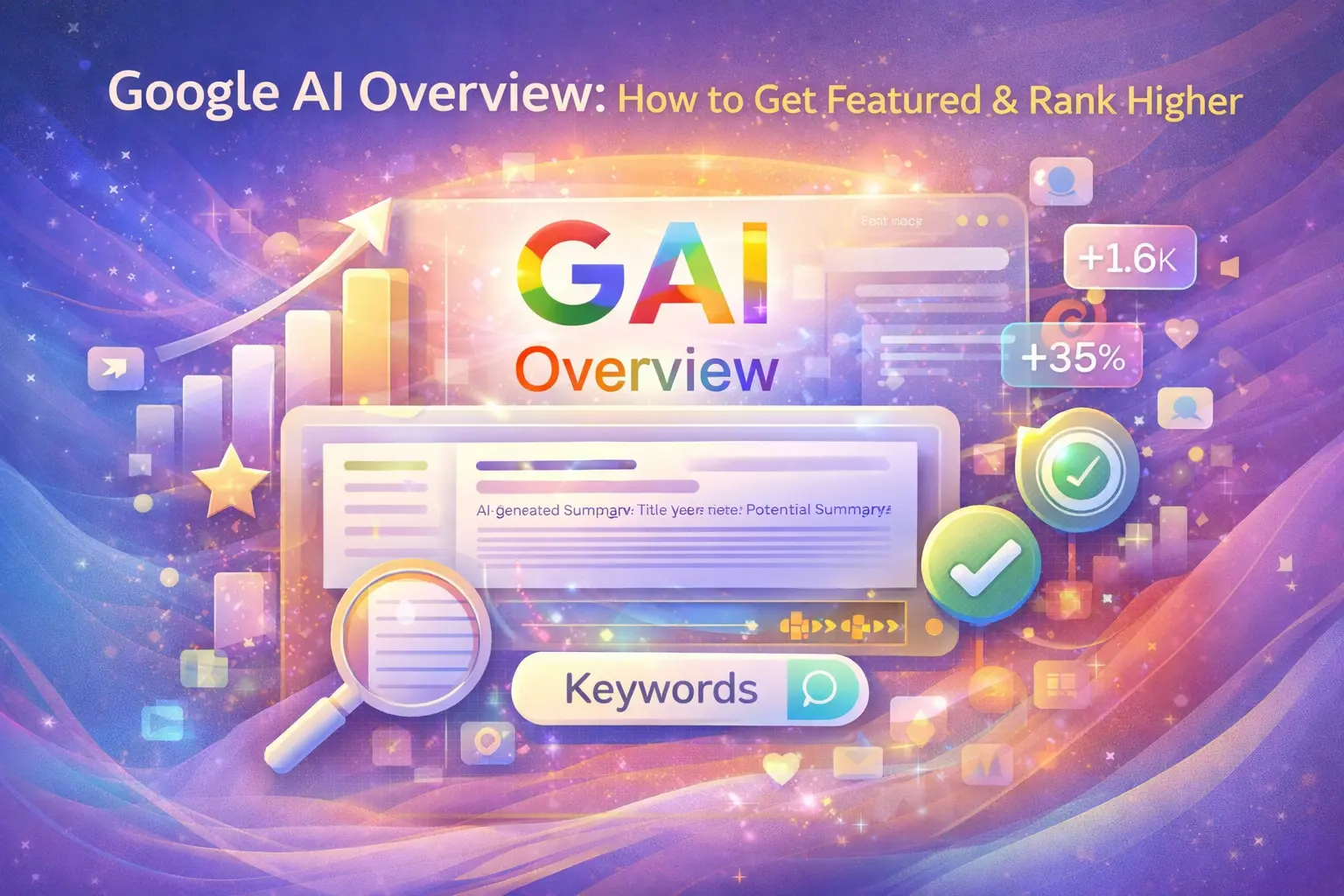
Google AI Overview is an AI-generated response that appears at the top of Google’s search results page for eligible queries, powered by Google’s Gemini large language model. It synthesises information from multiple web sources to produce a direct, conversational answer to the user’s search query – accompanied by expandable source citations that users can click to visit the underlying pages.
Google AI Overview was officially launched globally in May 2024, initially rolling out in the United States before expanding internationally throughout 2024 and into 2025. As of March 2026, AI Overviews appear across a wide range of query types in over 100 countries and in multiple languages, with Google confirming the feature now serves more than one billion users per month according to Google’s Search blog.
Google AI Overview is powered by a customised version of Gemini – Google’s most advanced multimodal AI model – specifically tuned for search tasks. It is not simply a chatbot response. The system retrieves, evaluates, and synthesises content from Google’s existing search index in real time, meaning the sources it cites are pages Google has already crawled, indexed, and assessed as high-quality.
Key characteristics of Google AI Overview in 2026:
- Appears above all traditional organic results for eligible queries
- Displays a synthesised answer typically two to five sentences to several paragraphs long
- Cites three to eight sources on average, shown as expandable cards beneath the summary
- Includes a “Show more” option to expand the full AI response
- Features a “Sources” section where cited pages are listed with title, URL, and a brief excerpt
- Does not appear for all queries – Google selects which searches trigger an AI Overview based on query complexity, user intent, and content availability
People Also Ask: Is Google AI Overview the same as SGE (Search Generative Experience)? Yes. Google AI Overview was previously called Search Generative Experience (SGE) during its experimental phase in Google Search Labs from May 2023 to May 2024. When Google officially launched the feature globally in May 2024, it was renamed AI Overview. The underlying technology is the same – a Gemini-powered AI system that generates synthesised answers to search queries – but the product has been significantly refined since the SGE testing period. In 2026, AI Overview is a permanent, widely deployed feature of Google Search.
How Does Google AI Overview Work?
Google AI Overview works by combining Google’s existing search index with the generative capabilities of the Gemini AI model. Understanding the mechanics is essential for any SEO strategy aimed at earning citations within it.
When a user submits a query that triggers an AI Overview, here is what happens:
- Query evaluation – Google’s systems assess the query to determine whether it is eligible for an AI Overview response. Complex, informational, and multi-part queries are most likely to trigger an Overview. Simple navigational queries (“Facebook login”) and purely transactional queries (“buy Nike Air Max”) are less likely to produce one.
- Source retrieval – Gemini queries Google’s search index to retrieve the most relevant, high-quality pages for the topic. This retrieval step is informed by the same ranking signals that determine traditional organic search rankings – E-E-A-T, relevance, authority, and content quality.
- Content synthesis – Gemini reads and synthesises the retrieved content, generating a coherent, conversational response that addresses the user’s query. It does not simply copy and paste – it interprets and restructures content from multiple sources.
- Citation selection – The system selects which source pages to cite beneath the AI-generated response. Citation is not guaranteed for all retrieved sources – Gemini chooses the pages whose content most directly supports specific claims or sections of its generated answer.
- Response display – The AI Overview is displayed at the top of the SERP, with expandable source citations visible to users who want to explore the underlying content further.
According to Search Engine Land’s AI Overview analysis, pages cited in Google AI Overview are not always the same pages ranking in the top 10 organic results below it. Google’s citation algorithm draws from a broader pool of pages it considers authoritative on the topic – meaning a page ranking at position 8 could be cited in the AI Overview while the page ranking at position 1 is not.
People Also Ask: Does appearing in Google AI Overview guarantee more traffic? Not necessarily. Research from Semrush and other SEO analytics platforms has found that AI Overviews sometimes reduce click-through rates for queries where the AI answer fully satisfies user intent without requiring a click. However, being cited as a source beneath the AI Overview generates brand exposure, credibility signals, and direct referral clicks from users who want to explore the topic further. For complex queries where the AI answer prompts further research, cited sources often see meaningful traffic lifts.
Why Does Google AI Overview Matter for SEO in 2026?
Google AI Overview has reshaped the search results page more significantly than any feature since the introduction of featured snippets – and its impact on organic visibility is still expanding. In 2026, understanding and optimising for AI Overview is no longer a forward-looking strategy. It is a present-day necessity.
Here is why Google AI Overview matters so profoundly for SEO right now:
It Occupies the Most Prominent Position on the SERP
Google AI Overview sits above everything – above paid ads in many configurations, above featured snippets, and above all traditional organic results. In terms of visual real estate, it commands more attention than any other SERP element. For users who find their answer in the AI Overview without scrolling, the traditional organic results below may receive significantly less engagement.
It Changes How Content Is Consumed
Google AI Overview changes the fundamental interaction model of search. Rather than presenting a list of links for users to choose from, it presents a synthesised answer and invites users to explore sources for more depth. This shift favours brands that are cited as trusted authorities – and disadvantages brands that rely purely on click-driven traffic without building broader authority signals.
It Expands the Visibility Opportunity Beyond Position 1
Google AI Overview creates a new visibility tier that is decoupled from traditional ranking positions. A page that ranks at position 6 organically can be cited in the AI Overview and receive more exposure than the page at position 1. This democratises visibility for high-quality, authoritative content regardless of domain authority – a significant opportunity for established niche sites that may not dominate traditional rankings.
It Is Google’s Primary Surface for AI-Driven Queries
As users increasingly phrase searches as conversational questions – a behaviour driven by voice search, AI assistant adoption, and the natural evolution of search habits – Google AI Overview is the primary mechanism Google uses to respond. Optimising for AI Overview is, in practical terms, optimising for the future of how people search.
According to Search Savvy’s insights, the brands that invested in AI Overview optimisation early in 2025 are now seeing compounding benefits in 2026 – appearing consistently as cited authorities across broad topic clusters, not just individual queries.
What Types of Queries Trigger Google AI Overview?
Google AI Overview does not appear for every search. Understanding which query types are most likely to generate an AI Overview helps you prioritise which content to optimise first.
Informational and Educational Queries
Google AI Overview appears most consistently for informational queries – questions that seek to explain, define, or educate. “What is canonical tag?”, “How does photosynthesis work?”, “Why is sleep important for health?” – these are the query formats most reliably answered by AI Overview in 2026.
Complex, Multi-Part Questions
Queries that require synthesising information from multiple angles – “What are the pros and cons of intermittent fasting for beginners?” or “How do Core Web Vitals affect mobile SEO rankings?” – are strong AI Overview triggers because they benefit from the synthesis capability Gemini provides.
How-To and Step-by-Step Queries
Process-based queries asking how to accomplish a task are frequent AI Overview triggers, particularly when the task involves multiple steps that benefit from a structured, sequential response.
Comparison Queries
“Noindex vs nofollow: what’s the difference?”, “WordPress vs Shopify for e-commerce” – comparison queries consistently trigger AI Overview because they benefit from structured, balanced synthesis across multiple perspectives.
Queries Less Likely to Trigger AI Overview
- Pure navigational queries (“Gmail login”)
- Very short, highly commercial transactional queries (“buy iPhone 16”)
- Breaking news queries where real-time recency is critical
- Queries Google determines are best served by a single authoritative source (e.g. government or medical institution)
How Do You Get Featured in Google AI Overview?
Getting featured in Google AI Overview requires a deliberate strategy built on the same foundations as traditional SEO – but with specific emphases that align with how Gemini evaluates and cites content. At Search Savvy, we have identified the following as the most consistently impactful strategies for earning and maintaining AI Overview citations.
Strategy 1: Build Unambiguous E-E-A-T Signals
Google AI Overview citations are heavily weighted towards sources that demonstrate strong Experience, Expertise, Authoritativeness, and Trustworthiness. Gemini is trained to identify and prefer authoritative sources – meaning your E-E-A-T signals are the foundation of any AI Overview strategy.
Prioritise:
- Named, credentialed authors on every piece of content with linked author bios
- First-hand experience signals – original research, case studies, and real-world results
- External validation – mentions and backlinks from industry publications, academic sources, and news outlets
- Transparent About pages, clear contact information, and verifiable business credentials
- Regular content updates with visible “last reviewed” dates
Strategy 2: Write Direct, Structured Answers to Specific Questions
Google AI Overview favours content that directly answers questions in clear, structured language. Gemini is designed to extract concise, accurate information – content that buries its answers in long, unstructured prose is harder for the system to parse and cite.
Apply these formatting principles:
- Open each section with a direct answer to the question posed in the heading – ideally within the first two to three sentences
- Use question-based H2 and H3 subheadings that mirror the natural language queries your audience types
- Keep paragraphs short – three to five sentences maximum
- Use bullet points and numbered lists for process-based or multi-point content
- Include a concise definition or summary at the start of any explanatory section
Strategy 3: Implement Structured Data Markup
Structured data – implemented via schema.org vocabulary – helps Google’s systems understand the content, context, and structure of your pages more precisely. Pages with appropriate structured data markup are better positioned for AI Overview citations because they provide explicit signals about content type, authorship, and topic relationships.
Most impactful schema types for AI Overview visibility:
- FAQPage schema – marks up question-and-answer content explicitly, making it directly parseable by Gemini
- Article schema – signals content type, author, publication date, and update date
- HowTo schema – structures step-by-step process content for AI extraction
- Organisation schema – establishes your brand identity, credentials, and trustworthiness signals at the entity level
Use Google’s Rich Results Test to validate your schema implementation before and after deployment.
Strategy 4: Build Topical Authority Across Your Content Ecosystem
Google AI Overview cites sources it recognises as authorities on a topic – not just individual pages that rank for a query. Building a comprehensive content ecosystem around your core topics signals to Gemini that your site is a reliable, deep resource worthy of citation across a broad query cluster.
Build topical authority by:
- Creating pillar pages that comprehensively cover broad topics
- Developing cluster content – detailed supporting articles addressing specific sub-topics within your niche
- Maintaining strong internal linking between related content to signal topical coherence
- Covering your niche consistently over time – content freshness and sustained publishing signal active expertise
Strategy 5: Earn High-Quality Backlinks and Brand Mentions
Google AI Overview’s source selection is influenced by the same authority signals that drive traditional rankings – and backlinks remain one of the strongest authority signals Google’s systems process. Pages cited in AI Overview consistently demonstrate stronger backlink profiles than non-cited pages at comparable ranking positions.
Focus on:
- Earning editorial backlinks from industry publications, academic institutions, and authoritative news sources
- Building brand mentions across press coverage, podcasts, and third-party platforms even where links are not present – Google’s entity recognition systems process unlinked mentions
- Creating original research, data studies, and free tools that naturally attract citations from other publishers
Strategy 6: Optimise for Conversational and Long-Tail Query Formats
Google AI Overview is disproportionately triggered by conversational, long-tail queries – the kind that mirror how users naturally phrase questions when speaking or using AI assistants. Targeting these query formats in your content strategy increases the pool of AI Overview opportunities available to your site.
Practical steps:
- Use tools like AnswerThePublic, AlsoAsked, and Google’s own People Also Ask boxes to identify the exact question formats your audience uses
- Create dedicated FAQ sections on key pages answering the most common related questions
- Build standalone blog posts and guides targeting specific long-tail questions as their primary keyword
- Ensure your content answers the question posed – not just mentions the keyword
Strategy 7: Maintain Technical SEO Foundations
Google AI Overview can only cite content it can access, crawl, and index. Technical barriers – crawl errors, slow page speed, poor Core Web Vitals, noindex tags on valuable pages – prevent your content from being considered as a citation source regardless of its quality.
Technical foundations to maintain:
- All target pages indexed and crawl-error free (verify in Google Search Console)
- Core Web Vitals passing – LCP under 2.5 seconds, CLS under 0.1, INP under 200ms
- HTTPS security across all pages
- Clean XML sitemap submitted and up to date in Search Console
- No accidental noindex tags on content you want cited
People Also Ask: How long does it take to get featured in Google AI Overview? There is no fixed timeline. Pages with strong existing authority and E-E-A-T signals that are already ranking in the top 10 for relevant queries can begin appearing in AI Overview citations relatively quickly after content optimisation – sometimes within weeks. For newer sites or pages without established authority, building the signals required for AI Overview citation is a multi-month process aligned with broader SEO growth. Consistent content quality, topical depth, and authoritative backlinks are the most reliable accelerants.
How Do You Measure Your Google AI Overview Performance?
Google AI Overview tracking is still an evolving discipline – Google does not yet provide direct AI Overview impression or citation data within Google Search Console. However, several approaches allow you to monitor your AI Overview presence:
- Manual SERP checks – search your target queries in an incognito browser and note whether your site is cited in the AI Overview. Document these findings in a tracking spreadsheet by query and date.
- Third-party rank tracking tools – platforms including Semrush, Ahrefs, and BrightEdge have introduced AI Overview tracking features that identify which of your pages are being cited and for which queries.
- Search Console CTR analysis – while Search Console doesn’t label AI Overview traffic separately, monitoring CTR and impression changes for informational queries after optimisation efforts can indicate AI Overview influence.
- Traffic pattern analysis – AI Overview citations for high-volume queries can produce distinctive traffic patterns in Google Analytics 4 – monitor organic traffic by landing page to identify pages with unexpectedly high visibility relative to their traditional ranking position.
Frequently Asked Questions About Google AI Overview
Q1. What is Google AI Overview in simple terms?
Google AI Overview is an AI-generated summary that appears at the top of Google’s search results for eligible queries. Powered by Google’s Gemini AI model, it synthesises information from multiple web sources to provide a direct answer to the user’s question, with expandable source citations shown beneath the summary. It was launched globally in May 2024 and serves over one billion users per month as of 2026.
Q2. Can I opt my website out of appearing in Google AI Overview?
Yes, partially. You can use the nosnippet meta tag (<meta name=”robots” content=”nosnippet”>) to prevent Google from using your content in AI-generated summaries, including AI Overview. However, this also prevents your content from appearing in featured snippets and other snippet-based SERP features. Google provides guidance on controlling how your content appears in search for site owners who wish to limit AI Overview usage of their content.
Q3. Do I need to rank in the top 10 to be cited in Google AI Overview?
Not necessarily. Research consistently shows that AI Overview citations are drawn from a broader pool than the traditional top 10 organic results. Pages ranking outside the top 10 – including pages at positions 11 to 20 – are regularly cited when their content is particularly well-structured, authoritative, and directly relevant to the query. Strong E-E-A-T signals and clear, structured answers can earn AI Overview citations even for pages that are not dominant traditional rankers for that query.
Q4. Does Google AI Overview hurt organic click-through rates?
The impact on CTR varies by query type. For simple informational queries where the AI Overview fully satisfies user intent, click-through rates to organic results below the Overview can decrease. For complex queries that prompt further exploration, being cited in the AI Overview can drive significant referral clicks. The overall impact on a site’s organic traffic depends on its query mix – sites heavily dependent on simple informational queries have seen larger CTR impacts than those focused on complex, commercial, or transactional content.
Q5. Is Google AI Overview available in all countries in 2026?
Google AI Overview is available in over 100 countries and multiple languages as of early 2026, having expanded significantly from its initial US-only launch. Availability varies by language and query type, with English-language queries in major markets receiving the most consistent AI Overview coverage. Check Google’s Search blog for the latest regional availability announcements.
Q6. What is the difference between Google AI Overview and Google’s featured snippets?
Featured snippets extract a single passage, list, or table from one source page and display it prominently in the SERP. Google AI Overview generates a synthesised response using Gemini AI, drawing on multiple source pages simultaneously and producing an answer that goes beyond any single source. Featured snippets cite one page; AI Overviews cite multiple. Featured snippets are a direct extraction; AI Overviews are a generated synthesis. Both appear above traditional organic results, but AI Overviews are typically more prominent, longer, and more conversational in format.