

E-E-A-T in SEO isn’t a buzzword – in 2026, it’s the single most important quality signal Google uses to decide which content deserves to rank. If your site isn’t demonstrating Experience, Expertise, Authoritativeness, and Trustworthiness, it’s leaving rankings – and revenue – on the table.
E-E-A-T in SEO has become the backbone of Google’s quality evaluation systems. With the March 2026 Core Update now rolling out and AI-powered search reshaping how results are surfaced, understanding and improving your E-E-A-T signals is no longer optional – it’s essential for survival in modern search.
At Search Savvy, we’ve watched E-E-A-T evolve from a behind-the-scenes guideline into a front-and-centre ranking framework. Whether you run a personal blog, an e-commerce store, or an enterprise website, this guide breaks down exactly what E-E-A-T means, why it matters more than ever in 2026, and the actionable steps you can take today to strengthen every pillar.
What is E-E-A-T in SEO? A Clear 2026 Definition
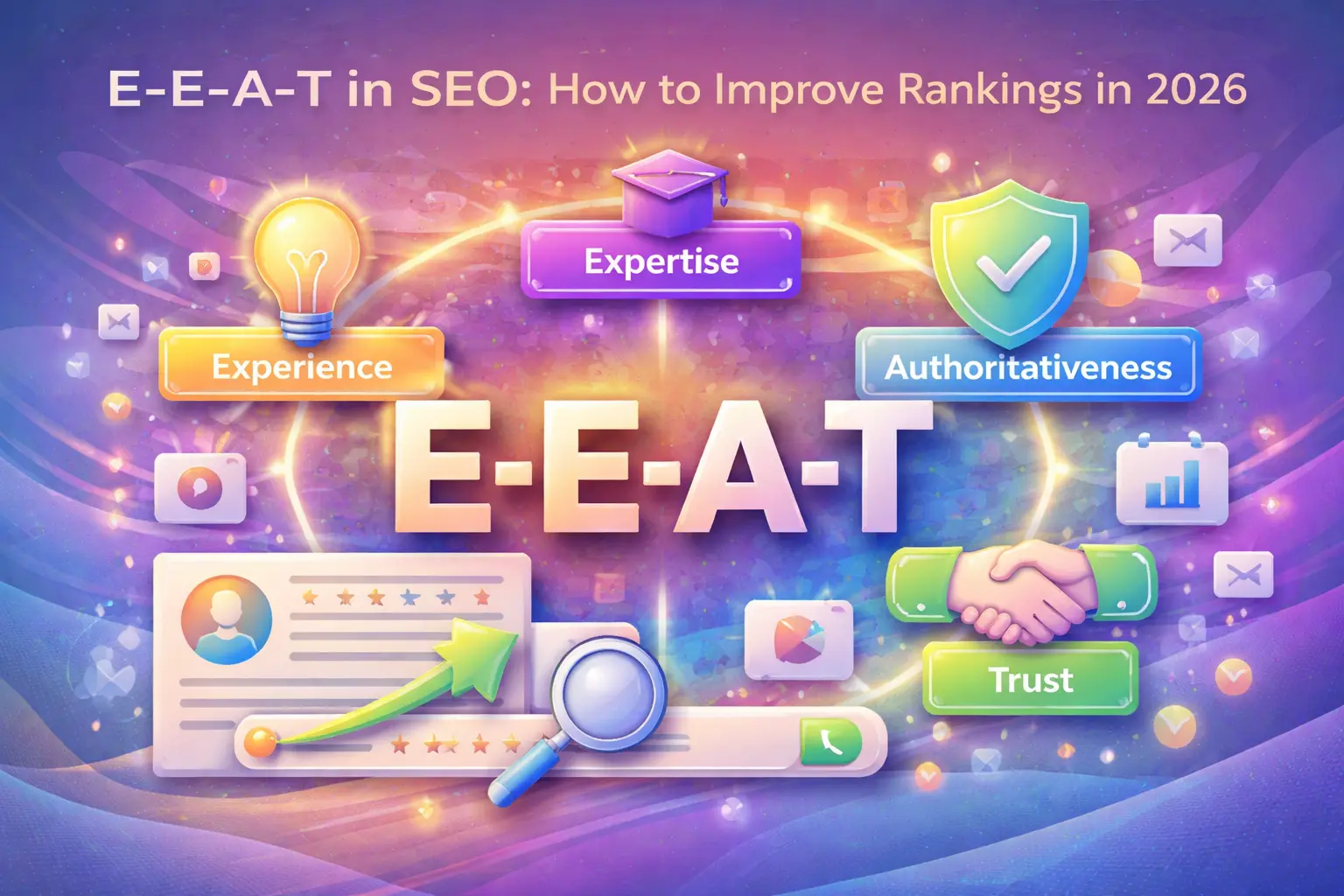
E-E-A-T in SEO stands for Experience, Expertise, Authoritativeness, and Trustworthiness. It’s a framework outlined in Google’s Search Quality Rater Guidelines – a document used by human raters to assess content quality and inform how Google’s algorithms rank pages.
Originally launched as E-A-T, the framework gained a fourth dimension in late 2022 when Google added “Experience” – recognising that real, first-hand interaction with a topic is something AI-generated content simply cannot replicate. That addition has become even more meaningful in 2026, as Google’s systems grow more precise at distinguishing genuine human insight from synthetic filler.
The four pillars explained:
- Experience – Has the author actually done this? First-hand interaction with a topic signals authenticity.
- Expertise – Does the author have deep knowledge? Credentials, training, and demonstrated skill matter.
- Authoritativeness – Is the site recognised as a go-to source? Backlinks, mentions, and niche dominance count.
- Trustworthiness – Can users trust your site? Accuracy, transparency, and security are the foundation of it all.
Is E-E-A-T a direct Google ranking factor?
E-E-A-T itself is not a single ranking signal, but Google uses a mix of factors – author bios, backlinks, site reputation, content accuracy – to evaluate content that aligns with E-E-A-T principles. As Google’s own documentation notes, E-E-A-T is especially weighted for YMYL (Your Money or Your Life) topics involving health, finance, and legal decisions.
Why is E-E-A-T in SEO More Important in 2026 Than Ever Before?
E-E-A-T in SEO has taken centre stage because the internet is drowning in AI-generated content. Google’s December 2025 Core Update, which completed on December 29, set the quality bar for 2026 – and the March 2026 Core Update has pushed it even higher. Both updates share one clear message: trust and genuine expertise outrank cleverly optimised text every time.
Here’s what’s changed in the search landscape that makes E-E-A-T so critical right now:
- AI Overviews are everywhere. Google’s AI-powered summaries (powered by Gemini) are now the first thing many users see. Only content that demonstrates strong E-E-A-T signals gets cited as a trusted source inside these overviews.
- Zero-click searches are rising. With users increasingly finding answers without clicking through, your brand must appear in AI outputs and featured snippets – which requires recognised authority.
- YMYL scrutiny is expanding. Finance, health, and legal content face the strictest E-E-A-T checks, but the scrutiny is spreading to virtually every niche.
- Niche authority beats broad publishing. Google now rewards sites with deep topical coverage over high-volume, general content mills.
According to Search Savvy’s insights, the brands winning in 2026 search aren’t necessarily the biggest publishers – they’re the most credible ones. Sites that invested in genuine author expertise and transparent sourcing before the March 2026 update saw visibility gains, while thin-content sites saw sharp declines.
How Does E-E-A-T Work Inside Google’s Algorithm?
E-E-A-T in SEO functions as an evaluation lens, not a single score. Google’s quality raters – real humans hired to assess search result quality – use the E-E-A-T framework to identify which pages are genuinely helpful. Their ratings feed into the training and calibration of Google’s AI-powered ranking systems.
In practice, Google’s systems look for dozens of signals that collectively indicate strong E-E-A-T:
Experience Signals
- Original photos, screenshots, or test results embedded in content
- “What We Tested” or “Our Experience” sections
- First-person accounts that include specific, verifiable details
- Product reviews that go beyond the manufacturer’s description
Expertise Signals
- Author bios listing credentials, qualifications, or professional background
- Detailed, technically accurate content that satisfies advanced queries
- Citations to peer-reviewed research, official sources, or primary data
- Named authors on every article (not anonymous “Editorial Team” by-lines)
Authoritativeness Signals
- High-quality backlinks from respected sites in your industry
- Brand mentions across press, podcasts, and third-party publications
- Strong internal linking and topical depth across your content ecosystem
- Consistent coverage of a defined niche – not scattershot publishing
Trustworthiness Signals
- HTTPS security and clear privacy policies
- Transparent About pages and verifiable contact information
- Positive, authentic user reviews and ratings
- Factually accurate, regularly updated content with visible “last updated” dates
Does E-E-A-T apply to all websites, or just YMYL sites?
While E-E-A-T in SEO is weighted most heavily for YMYL topics, Google applies E-E-A-T evaluation across all content categories in 2026. Even lifestyle blogs, recipe sites, and entertainment publications benefit from demonstrating genuine authorship and credibility.
How Can You Improve E-E-A-T in SEO in 2026? 10 Actionable Strategies
E-E-A-T in SEO can absolutely be improved – but it requires genuine effort, not shortcuts. At Search Savvy, we recommend treating these strategies as long-term investments rather than quick fixes.
1. Build Real Author Profiles
Every piece of content should be attributed to a named, credentialed author. Create dedicated author pages that link to their social profiles, published work, and professional credentials. Google explicitly looks for this when evaluating expertise.
2. Add First-Hand Experience to Your Content
Include original research, case studies, personal anecdotes, and real-world results. Test the products you review. Document the processes you explain. This first-hand experience is something AI-generated content structurally cannot replicate – use it as your competitive advantage.
3. Earn High-Quality Backlinks – Not Just Any Links
Authority grows through external recognition. Focus on earning mentions from industry publications, academic sources, news outlets, and respected niche websites. Google’s guidance on links is clear: relevance and quality far outweigh quantity.
4. Cite Your Sources Consistently
Link out to authoritative, primary sources – government websites, academic journals, official industry bodies. This signals that your content is grounded in verified information, not speculation.
5. Keep Content Fresh and Accurate
Display “last updated” dates on time-sensitive articles and revisit older content regularly. Outdated information is a trust-killer. A 2023 article still ranking in 2026 needs a 2026 review to maintain credibility.
6. Invest in Technical Trust Signals
- Ensure your site uses HTTPS across all pages
- Publish a detailed About page and a clear Privacy Policy
- Add structured data (Schema markup) for author, organisation, and article entities – use schema.org as your reference
- Display authentic customer reviews using platforms like Google Business Profile or Trustpilot
- Include a visible, working Contact page with a real address or phone number
7. Dominate a Niche Rather Than Spreading Thin
E-E-A-T in SEO rewards depth. Build a content ecosystem around a defined subject area – covering it comprehensively with pillar pages, cluster articles, FAQs, and multimedia. Google increasingly favours sites recognised as authoritative within a specific vertical.
8. Optimise for AI Overviews and Generative Engine Optimisation (GEO)
With Generative Engine Optimisation (GEO) now a mainstream discipline, E-E-A-T is your ticket into AI-generated answers. Structure content clearly, use question-based subheadings, provide concise direct answers, and mark up your content with appropriate Schema so AI systems can reliably identify and cite your brand as a trusted source.
9. Monitor and Respond to Reviews
Actively manage your online reputation. Respond professionally to negative reviews, encourage satisfied customers to leave honest feedback, and address factual inaccuracies in public mentions. Trustworthiness is visible – and Google’s systems read it.
10. Align Content With User Intent – Not Just Keywords
The March 2026 Core Update reinforced one truth above all: content must genuinely answer what the user came to find. Audit your key pages against the question “Does this actually solve the user’s problem?” If not, rewrite it before optimising it.
How long does it take to see E-E-A-T improvements reflected in rankings?
Most sites that make consistent, meaningful E-E-A-T investments – real author credentials, quality backlinks, fresh accurate content – begin to see measurable ranking improvements within 3 to 6 months, typically aligned with Google’s next core update cycle.
How Does E-E-A-T in SEO Apply to YMYL Content?
E-E-A-T in SEO carries its heaviest weight in YMYL – Your Money or Your Life – content. These are topics where inaccurate or misleading information could seriously harm a reader: medical advice, financial planning, legal guidance, news, and safety-critical instructions.
For YMYL publishers in 2026, the bar is not just higher – it’s categorically different. If you operate in health, finance, or legal content:
- All content should be reviewed or authored by verified professionals (doctors, lawyers, certified financial planners)
- Medical and financial claims must cite peer-reviewed sources or official regulatory bodies
- Disclaimers should be clear, honest, and legally appropriate
- Content should be reviewed at a minimum every six months for accuracy
At Search Savvy, we recommend that YMYL site owners treat E-E-A-T compliance not as an SEO tactic but as a professional standard – because the consequences of getting it wrong extend far beyond rankings.
Can AI-Generated Content Still Have Strong E-E-A-T in SEO?
E-E-A-T in SEO and AI content can coexist – but only under specific conditions. Google has made clear it does not penalise content simply for being AI-assisted. What it penalises is content that is automated, unoriginal, and devoid of genuine value.
If you use AI writing tools, the human layer is non-negotiable:
- Have a subject-matter expert review and edit every AI-drafted piece
- Add original data, personal insights, and real-world examples that the AI could not generate
- Clearly attribute content to a named human author, not to “AI” or an anonymous team
- Never publish AI output without substantive editorial oversight
- Use AI for research and structure – use human expertise for conclusions and recommendations
The March 2026 Core Update has introduced tighter checks for AI-generated content. Sites relying on mass-published, lightly edited AI articles are losing visibility fast. The solution isn’t to abandon AI – it’s to ensure every published piece carries unmistakable human expertise and genuine value.
Will Google penalise my site for using AI to write content?
Google does not penalise AI-assisted content outright. However, it does downgrade content that is automated, lacks originality, and fails to provide genuine value to users. Human editing, real-world experience, and clear authorship attribution are the key differentiators that allow AI-assisted content to maintain strong E-E-A-T signals in 2026.
Where Does E-E-A-T in SEO Go From Here?
E-E-A-T in SEO will only grow in importance as Google continues integrating AI deeper into search. With Gemini powering AI Overviews, with agentic AI assistants now retrieving and citing content autonomously, and with zero-click searches expanding, the brands that will win the search visibility battle are those recognised as genuinely credible sources – not just those with the most content.
The shift from traditional SEO to Generative Engine Optimisation (GEO) is already underway. Being cited in an AI Overview, appearing in a voice search answer, or being recommended by an AI assistant – all of these depend on the same underlying signals that E-E-A-T has always rewarded: real expertise, honest information, and content that genuinely helps people.
Search Savvy’s final recommendation? Stop thinking about E-E-A-T as an SEO checklist and start treating it as a reflection of who you actually are online. Build a site that earns trust from real people – and the search engines will follow.
Frequently Asked Questions About E-E-A-T in SEO
Q1. What does E-E-A-T stand for in SEO?
E-E-A-T stands for Experience, Expertise, Authoritativeness, and Trustworthiness. It is a framework from Google’s Search Quality Rater Guidelines that defines the qualities of high-quality, trustworthy content. The “Experience” component was added in late 2022 to recognise first-hand knowledge as a distinct quality marker, making it especially relevant in 2026 as a differentiator from AI-generated content.
Q2. How do I check my website’s E-E-A-T score?
There is no single “E-E-A-T score” – Google does not publish one. Instead, audit your site by reviewing the quality of your author bios, the strength of your backlink profile (using tools like Ahrefs or Moz), the accuracy and freshness of your content, and your site’s performance in Google Search Console. Consistent drops after core updates are often a signal that E-E-A-T improvements are needed.
Q3. Is E-E-A-T relevant for small businesses or local websites?
Absolutely. E-E-A-T in SEO applies to businesses of every size. For local businesses, a verified Google Business Profile, genuine customer reviews, a clear About page with real staff bios, and consistent NAP (Name, Address, Phone) data across directories all contribute to local E-E-A-T credibility.
Q4. How does E-E-A-T affect rankings after a Google Core Update?
Sites with strong E-E-A-T signals typically maintain or gain rankings after core updates, while sites with thin, unattributed, or inaccurate content often see declines. Recovery from a core update usually takes until the next update cycle to fully reflect in rankings.
Q5. What is the difference between E-A-T and E-E-A-T?
The original framework – E-A-T (Expertise, Authoritativeness, Trustworthiness) – was Google’s quality standard for years. In December 2022, Google added a second “E” for Experience, acknowledging that lived, first-hand experience with a topic is a distinct quality marker that pure academic expertise does not always cover.
Q6. Does social media presence help improve E-E-A-T in SEO?
Social media is not a direct ranking signal, but it supports E-E-A-T indirectly. A visible, professional presence on platforms like LinkedIn helps validate author identities, builds brand recognition, and can generate the kind of third-party brand mentions that contribute to authoritativeness. Linking your social profiles from author bios also helps Google connect your real-world identity to your content.