
Alt text has quietly become one of the most powerful yet overlooked elements of modern web design. At Search Savvy, we’ve witnessed firsthand how this simple addition can transform a website’s accessibility, search visibility, and user experience. Whether you’re a seasoned digital marketer or just starting your online journey, understanding alt text is no longer optional-it’s essential for success in 2026’s increasingly AI-driven search landscape.
Alternative text (commonly called alt text) serves as the written description of images on websites and digital platforms. While invisible to most users, alt text works behind the scenes to make visual content accessible to everyone, including the 2.2 billion people worldwide who have vision impairments. At Search Savvy, we recommend thinking of alt text as a bridge between visual content and the diverse ways people consume information online.
What Is Alt Text and Why Does It Exist?
Alt text originated from the Web Content Accessibility Guidelines (WCAG) 1.0 published in 1999, which established the principle that websites should “provide equivalent alternatives to auditory and visual content.” This guideline recognized a fundamental truth: not everyone experiences the web in the same way.
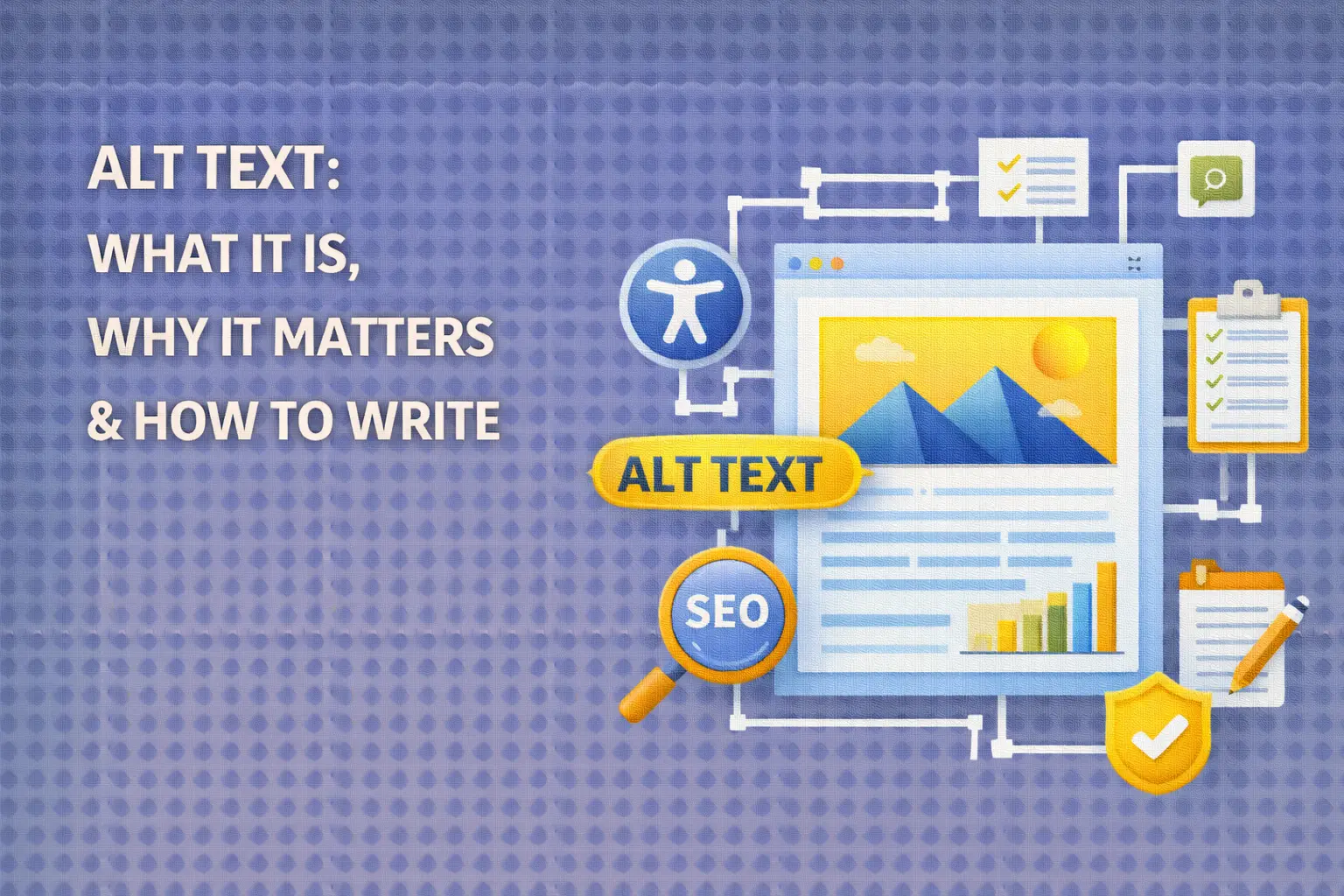
Alt text is descriptive text embedded in HTML code that explains what an image shows. It appears when images fail to load, helps search engines understand visual content, and-most importantly-allows screen readers to describe images to users with visual impairments. According to Search Savvy’s research and industry analysis, properly implemented alt text serves three critical functions: accessibility compliance, SEO optimization, and enhanced user experience.
How Does Alt Text Work in 2026?
Alt text operates through the HTML alt attribute within image tags. When a screen reader encounters an image, it reads the alt text aloud, allowing visually impaired users to understand what the image conveys. Similarly, when images fail to load due to slow connections or technical issues, browsers display the alt text in place of the broken image.
The technical implementation is straightforward:
<img src=”product-image.jpg” alt=”Silver laptop computer on wooden desk”>
In 2026, the importance of alt text has expanded beyond traditional accessibility. Google’s AI Overviews now influence search results significantly, and when these AI systems surface visuals, they rely heavily on alt text to understand image content. At Search Savvy, we’ve observed that websites with comprehensive alt text strategies consistently outperform competitors in both traditional and AI-powered search results.
Why Is Alt Text Important in 2026?
Alt text matters more in 2026 than ever before for several compelling reasons. First and foremost, accessibility remains the primary purpose-research shows that 81% of visually impaired adults use social media, yet they’re often excluded from visual content without proper alt text. The European Accessibility Act, which became enforceable on June 28, 2026, has made alt text compliance mandatory for businesses serving EU customers.
Beyond legal compliance, alt text delivers substantial SEO benefits. Recent statistics from SearchEngine Journal reveal that image search accounts for nearly 27% of all search queries across major platforms. This represents an enormous opportunity for websites that optimize their visual content properly. According to Search Savvy’s analysis, alt text doesn’t just help images rank-it contributes to how search engines understand your overall content and topical relevance.
The competitive advantage is clear. HubSpot increased their blog’s image traffic by 779% in less than a year by focusing more intently on optimizing image alt text, which resulted in 160,000 more organic views. These aren’t just theoretical benefits-they’re measurable business results that impact your bottom line.
What Are the WCAG 2.2 Requirements for Alt Text?
Alt text requirements under WCAG 2.2 maintain fundamental accessibility principles while clarifying implementation details for 2026. The core success criterion is 1.1.1 Non-text Content (Level A), which mandates that all images must have programmatically determinable text alternatives.
2026 compliance requirements specify that alt text must convey equivalent information to the image, decorative images must use empty alt=”” (not missing alt attribute), and complex images require both alt text and long descriptions. At Search Savvy, we emphasize that compliance isn’t just about avoiding legal issues-it’s about creating genuinely inclusive digital experiences.
Additional WCAG 2.2 guidelines relevant to images include Success Criterion 1.4.5 (Images of Text – Level AA), which advises avoiding images of text unless customizable or essential. The rationale is simple: when text is presented as an image, users cannot resize it, change colors, or adjust it to meet their accessibility needs.
How Do You Write Effective Alt Text?
Alt text should be descriptive yet concise, typically between 100-125 characters. Keep it short, usually 1-2 sentences, and consider key elements of why you chose this image, instead of describing every little detail. According to Search Savvy’s best practices, effective alt text answers one fundamental question: “What would someone need to know about this image if they couldn’t see it?”
Essential Alt Text Writing Rules:
- Be specific and descriptive: Instead of “dog,” write “golden retriever puppy playing with red ball in backyard”
- Provide context, not just appearance: Focus on what the image communicates within your content
- Skip redundant phrases: Don’t begin with “Image of…” because screen readers already tell users it’s an image
- Include text that appears in images: If your image contains words, include them in the alt text
- Avoid keyword stuffing: Use 1-2 relevant keywords naturally, never force them
Context-Based Examples:
For a product photo: “Black leather office chair with adjustable armrests and lumbar support” ✓ Not: “Image of chair” ✗
For a chart: “Bar graph of the number of courses taken in Q4 compared to Q3 showing a slight increase in numbers” ✓ Not: “Graph” ✗
For a linked logo: “Company name logo – Home” (describes both content and function) ✓
What About Decorative Images and Empty Alt Text?
Alt text isn’t always necessary. Purely decorative images that don’t convey information or serve a function should use empty alt attributes (alt=””) rather than being left blank entirely. When an image is used only for decorative purposes, it is best to remove the image from the page content and instead define it as a CSS background image.
At Search Savvy, we help clients identify which images are truly decorative. Ask yourself: “If this image were deleted, would important content be lost?” If the answer is no, and the image serves only aesthetic purposes like borders, dividers, or background patterns, use alt=””. However, logos are never decorative and always require descriptive alt text.
How Does Alt Text Impact SEO Performance?
Alt text serves as a critical ranking signal for both traditional and AI-powered search systems. Search engines cannot “see” images the way humans do, but they can read and understand alt text. By providing contextual information to search engine crawlers, alt text can potentially increase your visibility in search results.
Google’s algorithms are increasingly focused on understanding content in context, and when alt text aligns with your page’s primary keywords and subject matter, it sends a powerful signal that your content comprehensively addresses the topic. According to Search Savvy’s performance data from 2026, websites with optimized alt text see measurable improvements across multiple metrics:
- Higher rankings in Google Image Search
- Increased organic traffic from visual search queries
- Better overall page relevance scores
- Improved performance in AI-generated search results
In May 2026 alone, AI chatbots sent 37.9 million visits to YouTube, 10.9 million to Facebook, and 5.5 million to Instagram, demonstrating that AI-driven discovery is no longer theoretical-it’s driving real traffic.
What Are Common Alt Text Mistakes to Avoid?
Even experienced marketers make alt text mistakes that undermine accessibility and SEO performance. At Search Savvy, we’ve identified the most frequent errors:
1. Keyword Stuffing: Bad: “alt=’SEO services SEO agency best SEO company marketing SEO'” Good: “alt=’Digital marketing professional analyzing SEO performance metrics on computer screen'”
2. Overly Generic Descriptions: Bad: “alt=’photo'” or “alt=’image123.jpg'” Good: “alt=’Team meeting with diverse professionals collaborating around conference table'”
3. Too Much Detail: Bad: “A smiling woman with her hair up in a bun wearing a red dress standing by a blue table holding up a red bottle of disinfectant spray on a sunny afternoon” Good: “Woman demonstrating disinfectant spray bottle”
4. Duplicating Adjacent Text: If your caption already describes the image, don’t repeat that exact text in alt text-provide complementary information instead.
5. Missing Alt Text Entirely: 88% of websites are still not fully compliant with the latest web accessibility standards, with missing alt text being one of the most common issues.
How Can You Implement Alt Text Across Different Platforms?
Alt text implementation varies by platform, but the principles remain consistent. Most modern content management systems (CMS) like WordPress, Shopify, and Wix provide dedicated fields for adding alt text when uploading images. According to Search Savvy’s platform guides:
For Websites:
- WordPress: Use the “Alt Text” field in the media library
- Shopify: Edit product images to add alt text in the image settings
- HTML: Add the alt attribute directly in your <img> tags
For Social Media: All major social media platforms now include alt text functionality:
- Instagram: Tap “Advanced Settings” before posting to add alt text
- Twitter/X: Click “Add Description” when uploading images
- Facebook: Edit photo and select “Alternative Text”
- LinkedIn: Click the pencil icon on images to add alt text
At Search Savvy, we recommend developing an alt text workflow that becomes automatic with every image upload, whether for your website, blog posts, or social media content.
What Tools Can Help Automate Alt Text Creation?
While manual alt text creation ensures the highest quality, several tools can help streamline the process, especially for large image libraries. At Search Savvy, we’ve tested various solutions and found that AI-powered tools can provide a helpful starting point, though human review remains essential.
Available tools include:
- Built-in CMS features: Many platforms now offer AI-generated alt text suggestions
- Browser extensions: Tools like accessiBe can scan and suggest alt text
- SEO audit tools: Platforms like ClickRank identify missing alt text and provide optimization recommendations
- Accessibility checkers: WAVE and axe DevTools help evaluate your alt text quality
Remember: automated tools should supplement, not replace, thoughtful alt text creation. AI-generated descriptions often miss context and nuance that human writers naturally include.
Conclusion
Alt text represents the intersection of accessibility, SEO, and user experience-three pillars that define successful digital strategies in 2026. At Search Savvy, we believe that every image on your website is an opportunity to connect with a wider audience, improve search visibility, and demonstrate your commitment to inclusive design.
The investment required is minimal: a few extra seconds per image. The returns are substantial: improved rankings, increased traffic, legal compliance, and most importantly, an inclusive experience for all users. As AI-driven search continues to evolve, properly optimized alt text will only become more valuable.
Start today by auditing your existing images, implementing alt text best practices for new content, and making accessibility a natural part of your content creation workflow. Your users-and your search rankings-will thank you.
Frequently Asked Questions About Alt Text
Q: How long should alt text be?
Alt text should typically be between 100-125 characters, roughly 1-2 sentences. Many older screen readers won’t process more than 150 characters, so keeping descriptions concise ensures compatibility. Focus on essential information rather than exhaustive detail.
Q: Does alt text actually improve SEO rankings?
Yes, alt text contributes to SEO by helping search engines understand image content and page context. Image search accounts for nearly 27% of all search queries across major platforms, making optimized alt text crucial for visibility. However, it works best as part of a comprehensive SEO strategy, not as a standalone tactic.
Q: Should I use keywords in alt text?
Use keywords naturally when they accurately describe the image, but never force them. Include 1-2 relevant keywords if they fit the context, but prioritize accurate, helpful descriptions over SEO optimization. Keyword stuffing is easily detected by search engines and harms both accessibility and rankings.
Q: What’s the difference between alt text and image captions?
Alt text is a brief, functional description for screen readers (usually under 125 characters), while captions are longer text that appears below images for everyone. Alt text is hidden from visual users, captions are visible. Both serve different purposes and aren’t interchangeable.
Q: Do I need alt text for social media images?
Absolutely. 81% of visually impaired adults use social media, and adding alt text makes your content accessible to this significant audience. Most platforms now include built-in alt text fields, and using them improves both accessibility and your content’s discoverability.
Q: What should I write for decorative images?
For purely decorative images that don’t convey information (borders, spacers, background patterns), use an empty alt attribute: alt=””. Don’t skip the attribute entirely-using alt=”” explicitly tells screen readers to ignore the image, which is the desired behavior for decorative elements.
Ready to transform your website’s accessibility and search performance? At Search Savvy, we help businesses implement comprehensive alt text strategies that drive results. Contact us to learn how we can optimize your digital presence for both humans and AI-powered search engines.