

Featured snippets are one of the most powerful – and most misunderstood – opportunities in SEO today. If you’ve ever Googled a question and seen a highlighted answer box appear at the very top of the results page, before any traditional blue links, you’ve seen a featured snippet in action. That box is what every content creator and SEO strategist should be actively working to win.
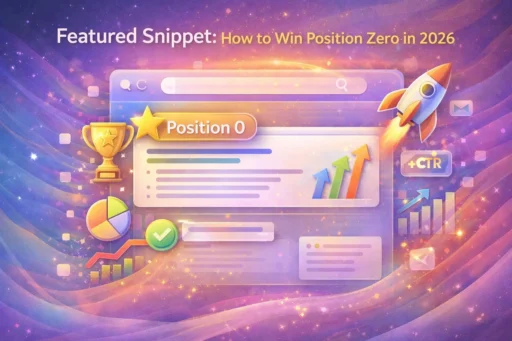
At Search Savvy, we consider featured snippets one of the highest-value targets in modern SEO. They place your content at “Position Zero” – above everything else on the page – driving significant click-through traffic, brand visibility, and voice search authority all at once.
In 2026, with Google’s AI Overviews now pulling from trusted sources and voice search queries increasing year on year, featured snippets have become even more strategically important. This guide covers exactly what a featured snippet is, how Google selects them, and the step-by-step strategies Search Savvy recommends to consistently win them.
What Is a Featured Snippet and Why Does It Matter in 2026?
A featured snippet is a selected search result that Google displays at the top of the search engine results page (SERP) in a special highlighted box. Unlike standard results, a featured snippet surfaces the answer directly on the page – pulling a relevant excerpt, definition, list, table, or video from a source that Google deems the most helpful and authoritative response to the query.
Featured snippets appear for question-based queries, comparison searches, how-to instructions, and definition requests. They are triggered by natural language queries – exactly the kind of searches that have exploded with the rise of voice assistants and conversational AI.
Why do they matter so much in 2026?
- Position Zero visibility: Featured snippets appear above all paid and organic results, commanding the most prominent real estate on the page.
- Voice search dominance: When users ask Google Assistant, Siri, or Alexa a question, the answer read aloud is almost always pulled from a featured snippet.
- AI Overview citations: Google’s Gemini-powered AI Overviews increasingly cite and link to featured snippet sources, compounding visibility further.
- Click-through impact: According to Search Engine Land, pages that hold a featured snippet see average click-through rates between 8% and 20% higher than the #1 organic result without a snippet.
- Brand authority: Appearing in a featured snippet signals to users – and to Google – that your content is the most trusted answer in your niche.
People Also Ask: Are featured snippets the same as Position Zero? Yes. “Position Zero” is the informal term used by SEOs to describe the featured snippet placement, because it sits above the standard first organic result – effectively at position zero in the ranking hierarchy. Not every search query triggers a featured snippet; Google estimates they appear for roughly 12–13% of all searches.
How Does Google Select a Featured Snippet?
Featured snippet selection is one of Google’s most discussed – and least officially documented – processes. What we know from Google’s own guidance and years of industry research is that Google’s systems automatically identify pages that best answer a specific query and extract the most relevant passage, list, or table.
Key things to understand about how selection works:
Google Pulls From Existing Ranked Pages
A featured snippet is almost always pulled from a page already ranking in the top 10 organic results for that query. You cannot win a featured snippet without first being indexed and ranking reasonably well. This means featured snippet optimisation and core ranking optimisation go hand in hand.
Content Format Matters Enormously
Google doesn’t just pick the most authoritative site – it picks the most usable answer. Content that is clearly structured, directly answers the question, and is formatted in a snippet-friendly way (a concise paragraph, a numbered list, a table) is far more likely to be selected than dense, unformatted prose.
Query Intent Drives Snippet Type
Different query types trigger different featured snippet formats:
- Paragraph snippets – triggered by “what is,” “who is,” and “why” questions. Typically 40–60 words.
- List snippets – triggered by “how to,” “steps to,” and “best X” queries. Numbered or bulleted.
- Table snippets – triggered by comparison, pricing, or data queries. Google extracts HTML tables.
- Video snippets – triggered by “how to” queries where a YouTube video is deemed the best answer.
User Engagement Signals Play a Role
Featured snippet selection is not static. Google continuously tests which result best satisfies users for a given query. Pages that hold snippets tend to have strong engagement signals – low bounce rates, high time-on-page, and clear content that delivers what the searcher came for.
People Also Ask: Can any website win a featured snippet, or only big brands? Any website can win a featured snippet – regardless of domain authority or brand size. Featured snippets are won through content formatting and relevance, not brand power alone. In fact, smaller, niche-focused sites frequently outcompete large brands for featured snippets when their content directly and clearly answers a specific question.
What Types of Featured Snippets Exist in 2026?
Featured snippets come in several formats, and knowing which type to target changes how you structure your content. At Search Savvy, we advise clients to identify the snippet format currently appearing for their target queries before writing a single word.
Paragraph Featured Snippets
The most common type. Featured snippet paragraph boxes typically contain 40–60 words answering a “what is” or “why” question. To win these, open your answer with a direct, concise definition or explanation immediately after the H2 heading – don’t bury the answer in the third paragraph.
Numbered List Featured Snippets
Featured snippet lists appear for process-based or ranked queries: “how to set up Google Search Console,” “steps to write a blog post,” “best ways to build backlinks.” Google numbers the steps automatically from your ordered list markup. Keep each list item concise – one clear action or point per line.
Bulleted List Featured Snippets
Similar to numbered lists but triggered by non-sequential queries like “types of featured snippets” or “benefits of SEO.” Use clean HTML unordered lists rather than dashes or symbols created in a text editor, as Google reads list markup more reliably.
Table Featured Snippets
Featured snippet tables appear when users are comparing options, looking up pricing tiers, or seeking structured data. If your content includes a comparison table built with proper HTML table tags, it becomes a strong candidate for this format.
Video Featured Snippets
Featured snippet video boxes are pulled primarily from YouTube. Google identifies the specific timestamp within the video that best answers the query. If you produce video content, optimising your video descriptions, chapters, and transcripts increases your chances of winning these placements.
People Also Ask: Which type of featured snippet is most common? Paragraph snippets are the most common featured snippet format, accounting for roughly 70% of all snippet appearances according to Semrush’s SERP research. List snippets are the second most common, particularly for how-to and step-based queries.
How Do You Win a Featured Snippet? A Step-by-Step Strategy
Winning a featured snippet is a deliberate process, not a lucky accident. According to Search Savvy’s insights, the sites that consistently capture and hold featured snippets follow a repeatable framework – regardless of niche or domain size.
Step 1: Find Featured Snippet Opportunities
Start by identifying queries in your niche that already trigger a featured snippet – and where your site has a realistic chance of competing.
- Use Semrush or Ahrefs to filter keyword research for “SERP Features: Featured Snippet”
- Prioritise keywords where you already rank between positions 2 and 10 – these are your lowest-hanging opportunities
- Focus on question-based, conversational queries: “what is,” “how does,” “why does,” “how to,” “what are the best”
- Check Google Search Console for queries driving impressions but low clicks – these often indicate a snippet opportunity you’re close to winning
Step 2: Match the Existing Snippet Format
Before rewriting your content, Google the target keyword and study what type of featured snippet currently appears. Then mirror that format in your content – if the current snippet is a numbered list, restructure your content as a numbered list. If it’s a paragraph definition, open with a direct 50-word definition.
Step 3: Put the Answer First
Featured snippet content must answer the question immediately. Don’t build up to the answer over three paragraphs – place a direct, complete answer in the first 50–60 words after your question-based heading. This is the passage Google is most likely to extract.
Step 4: Use Explicit Question-and-Answer Formatting
Structure your content so Google can easily identify the question and the answer as a discrete unit:
- Use an H2 or H3 heading phrased as the exact question (e.g. “What is a featured snippet?”)
- Follow immediately with a concise paragraph or list that directly answers it
- Avoid padding the opening answer with caveats, qualifications, or preamble
Step 5: Add Schema Markup Where Relevant
Use structured data markup from schema.org – particularly FAQ Schema, HowTo Schema, and Article Schema – to signal to Google that your content is structured, credible, and designed to answer specific queries. While Schema doesn’t guarantee a snippet, it strengthens your content’s eligibility.
Step 6: Build the Page’s Overall Authority
Featured snippets are drawn from ranking pages. If your page isn’t in the top 10, you won’t win the snippet no matter how well-formatted your answer is. Prioritise:
- Strong internal links pointing to the target page from high-authority pages on your site
- At least a handful of quality external backlinks
- Clear on-page optimisation: title tag, meta description, header structure, and page speed
- Compliance with Google’s helpful content guidelines
Step 7: Monitor and Protect Your Snippets
Winning a featured snippet is not permanent. Competitors can displace you, and Google regularly tests alternatives. Use Google Search Console and Semrush’s Position Tracking to monitor which snippets you hold and alert you to any changes. When a competitor wins a snippet you previously held, analyse what changed in their content and respond accordingly.
People Also Ask: How long does it take to win a featured snippet? There is no fixed timeline. Pages already ranking in the top 5 for a query can win a featured snippet within days of optimising their content format. For pages ranking further down the first page, it typically takes 4 to 12 weeks for Google to test and select the updated content for the snippet position.
Why Are Featured Snippets Critical for Voice Search and AI in 2026?
Featured snippets and voice search have always been closely linked – but in 2026, the relationship has deepened significantly. Google’s AI Overviews, powered by Gemini, now draw on featured snippet sources as trusted references when generating conversational answers to complex queries.
This means a featured snippet in 2026 isn’t just a box on a desktop search results page. It’s a citation in an AI-generated answer. It’s the response read aloud by a voice assistant to millions of users who never see a traditional SERP at all. It’s a signal to Google’s systems that your content is authoritative enough to be surfaced and recommended autonomously.
For voice search specifically, the connection is direct: Backlinko’s voice search research found that 40.7% of all voice search answers come directly from featured snippets. If voice search is part of your audience’s behaviour – and in 2026, it almost certainly is – winning featured snippets is not optional, it’s essential.
At Search Savvy, our approach to featured snippet optimisation is always built with voice and AI discovery in mind. Concise answers, question-based headings, and clean formatting don’t just win snippets – they position your brand as the authoritative source that AI platforms trust and cite.
Frequently Asked Questions About Featured Snippets
Q: What is a featured snippet in simple terms?
A: A featured snippet is a highlighted answer box that appears at the very top of Google’s search results page, above all other organic listings. Google automatically extracts a relevant passage, list, or table from a web page it considers the best answer to the search query. They appear most commonly for question-based and how-to searches.
Q: Do featured snippets always come from the #1 ranked page?
A: No. While the #1 ranked page wins the featured snippet more often than any other position, Google frequently pulls snippets from pages ranking at positions 2 through 10. This means that even if you’re not in first place, optimising your content for snippet formats can still win you the most visible placement on the page.
Q: Can I opt out of having my content appear as a featured snippet?
A: Yes. Google allows webmasters to opt out of featured snippet display using the nosnippet meta tag or by using data-nosnippet on specific HTML elements. You can read Google’s full guidance on controlling snippets. However, opting out is rarely advisable given the significant visibility and traffic benefits featured snippets provide.
Q: Does winning a featured snippet always increase traffic?
A: Generally yes, but it depends on the query. For informational queries, featured snippets can increase clicks significantly by establishing your brand as the top authority. For very simple queries – like “what is 2+2” – the answer is fully served in the snippet and users may not click through at all. Focus snippet optimisation efforts on queries where the answer leads to a natural next step that brings users to your site.
Q: Are featured snippets affected by Google Core Updates?
A: Yes. Google’s Core Updates – including the March 2026 Core Update – reassess which pages are the most helpful and authoritative for given queries. Sites that see featured snippet losses after a core update should review their content for E-E-A-T alignment, update accuracy, and formatting quality. Recovery is typically possible within one or two update cycles.
Q: How do I track whether my pages are winning featured snippets?
A: The most reliable method is Google Search Console, which shows queries where your pages appear with SERP features. For more granular tracking, tools like Semrush’s Position Tracking and Ahrefs’ Rank Tracker allow you to specifically monitor featured snippet wins and losses across your target keyword set.