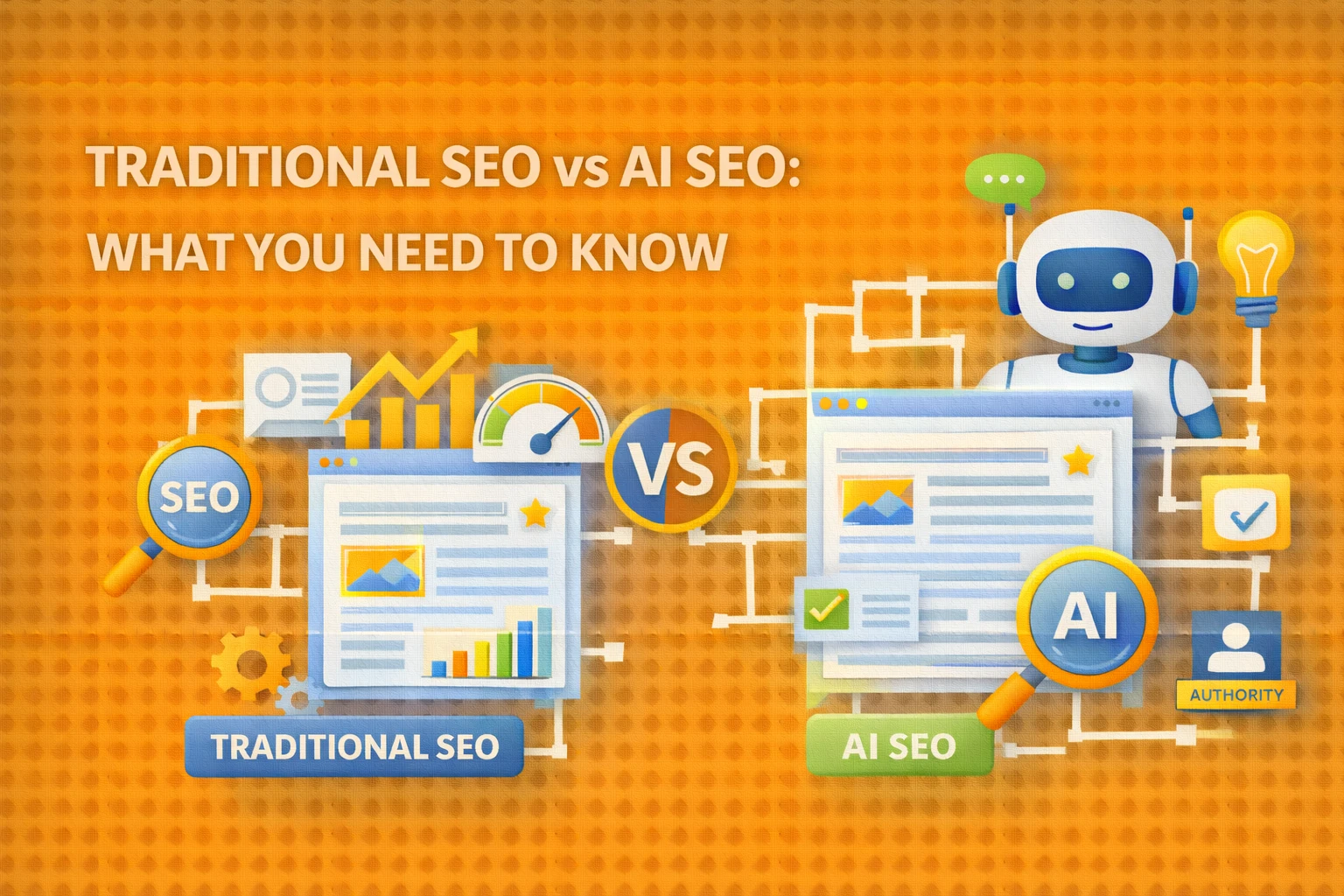

Traditional SEO vs AI SEO represents the most significant shift in digital marketing since the birth of search engines themselves. As we navigate through 2026, businesses face a critical decision: should they continue investing in time-tested SEO practices, or pivot entirely to AI-optimized strategies? At Search Savvy, we’ve analyzed the data, tracked the trends, and discovered that the answer isn’t either-or-it’s both.
The search landscape has fundamentally transformed. Google’s AI Overviews now serve 2 billion monthly users, while AI Overviews appear in over 11% of Google queries, a 22% increase since debuting last year. Meanwhile, ChatGPT ranks as the 5th most visited site globally, with nearly 5 billion visits per month. These numbers tell a clear story: AI-powered search isn’t coming-it’s already here.
Traditional SEO vs AI SEO isn’t about choosing sides. It’s about understanding how these approaches complement each other and leveraging both to maintain visibility across the entire search ecosystem. According to Search Savvy‘s latest analysis, brands that master both strategies will dominate the visibility battle in 2026 and beyond.
What Is Traditional SEO in 2026?
Traditional SEO focuses on optimizing websites to rank higher in search engine results pages (SERPs) on platforms like Google and Bing. Traditional SEO focuses on improving a website to be more visible in search engine results pages, using established techniques that have evolved over decades.
The core elements of traditional SEO include:
- Keyword research and targeting: Identifying specific search terms users enter and optimizing content around those exact phrases
- On-page optimization: Crafting meta titles, descriptions, header tags, and ensuring proper keyword density
- Technical SEO: Improving site speed, mobile responsiveness, structured data, and crawlability
- Link building: Acquiring backlinks from authoritative websites to build domain authority
- Content creation: Publishing high-quality, relevant content that satisfies user search intent
Traditional SEO mainly focuses on optimizing keyword density, alt tags, internal linking, meta tags, and schema. These tactics have driven results for years, but the landscape has shifted. These are all still important, but AI has shifted the dynamic. No longer can you only focus on those cosmetic details to gain an advantage.
Traditional SEO remains essential in 2026. SEO remains a critical part of digital marketing in 2026. Google is still the dominant search engine globally, and organic search continues to drive high-quality, high-intent traffic. The foundation you build with traditional SEO directly influences your success in AI-powered search environments.
How Does AI SEO Work?
Traditional SEO vs AI SEO differs primarily in focus and methodology. AI SEO focuses on improving content to appear in AI-generated answers from tools like ChatGPT, Gemini, and Google’s AI Overviews. Rather than optimizing for specific keywords to rank in the top 10 results, AI SEO optimizes for being cited, referenced, and featured in AI-generated responses.
AI SEO operates on different principles:
- Topical authority over keyword targeting: AI SEO involves mapping entire topic areas, rather than optimizing for one or more particular terms
- Trust signals and credibility: AI platforms evaluate your digital reputation similar to a credit score, assessing authority and trustworthiness
- Entity optimization: Building recognition as an authoritative source across the web, not just your own site
- Conversational content: Creating content that answers natural language queries and longer, more complex questions
- Cross-platform visibility: Ensuring brand mentions and citations appear in trusted third-party publications
AI-powered tools like machine learning technologies meticulously sift through extensive data sets to pinpoint SEO opportunities that might go unnoticed through traditional methods. These technologies identify patterns and trends, providing marketers with insights to refine strategies with unprecedented accuracy.
The data reveals a significant shift. Only 8% of visits with a Google AI summary resulted in clicks on traditional links, compared to 15% without a summary. This means AI Overviews are fundamentally changing user behavior, making visibility within these AI-generated responses more critical than ever.
Why Is Traditional SEO vs AI SEO Important in 2026?
Traditional SEO vs AI SEO matters because consumer search behavior is fracturing across multiple platforms. We’re in a paradigm shift of consumer search behavior, not an SEO extinction event. Users are no longer confined to traditional search engines-they’re asking questions in ChatGPT, seeking recommendations through Perplexity, and getting instant answers from Google’s AI Overviews.
The statistics are striking. 82% of respondents agree that “AI-powered search is more helpful than traditional search engines,” indicating how consumer expectations are evolving. Meanwhile, about one-in-five Google searches in March 2026 produced an AI summary, and that number continues climbing monthly.
At Search Savvy, we’ve observed that businesses focusing solely on traditional SEO miss opportunities for visibility in AI platforms, while those ignoring traditional SEO lack the foundational authority needed to be cited by AI systems. The winning strategy integrates both approaches.
Traditional SEO vs AI SEO represents a fundamental shift in how trust and authority are established online. AI search engines focus on authority and trust as the factors that mean the most, similar to how banking institutions evaluate creditworthiness based on account age, payment history, and credit utilization.
What Are the Key Differences Between Traditional SEO vs AI SEO?
Traditional SEO vs AI SEO diverges in several critical areas:
Keyword Strategy
Traditional SEO targets specific keywords with measurable search volume. Marketers optimize for exact phrases users type into search boxes, aiming for rankings in positions 1-10.
AI SEO focuses on comprehensive topic coverage. Due to the conversational nature of AI tools like ChatGPT and Claude, users may prompt them with what can seem like an infinite number of variations on your typical “keyword.” AI tools use query fan-out to perform numerous related searches at once.
Content Approach
Traditional SEO emphasizes keyword density, optimal word counts, and strategic placement of target phrases within titles, headers, and meta descriptions.
AI SEO prioritizes depth, expertise, and comprehensive coverage of topics. The best way to view AI search optimization is to think of it as a digital credit score, where AI search engines are figuring out whether a website’s content should be shown in its AI responses based on authority and trust.
Success Metrics
Traditional SEO measures success through rankings, organic traffic, click-through rates, and conversions from search engine results pages.
AI SEO tracks brand mentions in AI responses, citation frequency across AI platforms, and visibility in tools like ChatGPT, Perplexity, and Google’s AI Overviews.
Link Building
Traditional SEO focuses on acquiring backlinks to your website to build domain authority and improve rankings.
AI SEO requires building your web-wide brand presence. For AI Search Optimisation, building topical authority goes beyond your website. AI platforms like ChatGPT and Perplexity consider web-wide brand signals including brand mentions in trusted third-party publications, consistent quote contributions across platforms, and guest posts on authoritative websites.
Optimization Timeline
Traditional SEO requires patience, often taking 3-6 months to see ranking improvements for competitive keywords.
AI SEO demands consistent, long-term reputation building. It’s a long-term process of building your digital reputation. It may take time for ChatGPT and other AI search modules to take notice, but the rewards of being a trustworthy voice in your industry will pay out big time.
How Should Businesses Adapt Their Strategy for Traditional SEO vs AI SEO?
Traditional SEO vs AI SEO requires an integrated approach rather than choosing one over the other. It’s not AI Search Optimisation vs traditional SEO; it’s SEO and AI Search Optimisation working together. The brands that master both will win the visibility battle in 2026 and beyond.
Here’s how Search Savvy recommends businesses adapt:
Maintain Your Traditional SEO Foundation
Continue optimizing for search engines with proven tactics. A strong traditional SEO foundation remains essential for success in AI-driven search environments. This includes:
- Conducting thorough keyword research
- Optimizing technical SEO elements
- Building high-quality backlinks
- Creating valuable, user-focused content
- Ensuring excellent site performance and user experience
Expand to AI Search Optimization
Layer AI SEO strategies on top of your traditional foundation:
Enable AI Crawler Access: Update XML sitemaps to allow AI crawlers and change your robots.txt file to allow crawlers. If AI systems can’t access your content, you won’t appear in their responses.
Build Topical Authority: Create comprehensive content hubs that demonstrate expertise in your niche. Focus on depth over breadth, covering topics thoroughly rather than superficially.
Establish Web-Wide Presence: Pursue guest posting opportunities, contribute expert quotes to industry publications, and build your brand reputation across trusted platforms-not just your own website.
Optimize for Conversational Queries: Longer, complex queries have grown 49% in AIOs since May 2024. Create content that answers natural language questions and addresses long-tail queries.
Provide Actionable, Expert Content: Avoid giving theoretical advice; instead, provide actionable examples that people can implement. AI platforms favor practical, implementable information backed by expertise.
Monitor Performance Across Both Channels
Traditional SEO vs AI SEO requires tracking different metrics. Monitor your traditional rankings and traffic while also tracking:
- Brand mentions in AI-generated responses
- Citation frequency across AI platforms
- Visibility in ChatGPT, Perplexity, Claude, and Google’s AI tools
- Share of voice in AI answers for your industry topics
Only 22% of marketers have set up LLM brand visibility or traffic monitoring, with 53% saying they’re in the early stages of exploring how to monitor this emerging brand channel. Early adopters who establish monitoring systems now will gain a significant competitive advantage.
What Challenges Do Businesses Face With Traditional SEO vs AI SEO?
Traditional SEO vs AI SEO presents several challenges businesses must navigate:
Traffic Decline from AI Overviews
The data shows concerning trends for traditional organic traffic. Organic CTR fell by 34.5% when an AI Overview appeared, with CTR of the position 1 ranking site dropping from 7.3% to 2.6%. Even ranking first no longer guarantees traffic when AI summaries provide direct answers.
Just 8% of users who encountered an AI summary clicked on a traditional link-half the rate of those who did not. This shift creates financial pressure on publishers and content creators who’ve relied on organic search traffic for years.
Unpredictable AI Citation Patterns
80% of the sources featured in AI Overviews don’t rank organically for the query, meaning Google is pulling in sites beyond the usual top results. Even holding a top organic spot offers only an 8% chance of being cited within an AI Overview.
This unpredictability makes it challenging to guarantee visibility in AI responses, even with strong traditional SEO performance.
Resource Allocation
While AI is incredibly powerful, it’s not a panacea for all SEO challenges. Machines excel at processing vast amounts of data, identifying patterns, and automating tasks-but they lack the strategic vision, creative intuition, and emotional intelligence that only humans can provide.
Businesses must decide how to split resources between maintaining traditional SEO efforts and developing AI optimization strategies.
Content Quality vs. Scale
AI is automating 44.1% of key SEO tasks, including content creation and keyword research. However, AI-generated content can hallucinate facts, invent sources, or misattribute quotes, presenting search quality risk and reputation risk.
The challenge lies in using AI tools for efficiency while maintaining the human oversight necessary for accuracy and brand integrity.
How Can Small Businesses Compete in Traditional SEO vs AI SEO?
Traditional SEO vs AI SEO doesn’t favor large enterprises exclusively. Small businesses can compete effectively by focusing on specific strategies:
Focus on Niche Expertise
For small businesses and beginner bloggers, traditional SEO often provides the strongest foundation, allowing for a deeper understanding of their audience and building valuable skills that remain useful regardless of technological changes.
Establish yourself as the go-to expert in your specific niche. Deep, specialized content often performs better in both traditional search and AI citations than broad, generic content.
Build Authentic Authority
Small businesses can establish credibility through:
- Publishing case studies and real-world examples
- Sharing original research and unique data
- Contributing expert insights to industry discussions
- Building genuine relationships with other authorities in your space
Optimize for Long-Tail Queries
A query with eight words or more is 7x more likely to get an AI Overview in its results. Small businesses can target specific, detailed questions their audience asks, often facing less competition than for shorter, generic terms.
Leverage Local and Specialized Context
Small businesses serving local markets or specialized industries can provide context and insights that large competitors and AI systems might miss. Your unique perspective and local knowledge become competitive advantages.
What Does the Future Hold for Traditional SEO vs AI SEO?
Traditional SEO vs AI SEO will continue evolving, but several trends are already clear for the remainder of 2026 and beyond:
Continued Growth of AI Search
AI Overviews were triggered for 6.49% of queries in January, climbed to 7.64% in February (an 18% increase), and then up to 13.14% by March (72% growth from the previous month). This exponential growth shows no signs of slowing.
Total search impressions increased by over 49%, with Google experiencing substantial growth alongside the emergence of AI-driven discovery platforms. The search pie is expanding, not shrinking-but the distribution of attention is changing dramatically.
Shift to Multi-Platform Optimization
The global AI SEO software tool market is estimated to reach $4.97 billion by 2033 from $1.99 billion in 2024, indicating massive investment in tools and strategies for AI-powered search optimization.
Businesses will need to optimize for traditional search engines, AI platforms, social media discovery, and other emerging channels simultaneously.
Evolution, Not Replacement
Rather than being replaced, SEO is evolving alongside AI. The brands that recognise and adapt to this shift by combining strong SEO with AI Search Optimisation strategies will be best positioned to stay visible, competitive, and trusted in the years ahead.
Importance of Human Expertise
The most successful SEO campaigns in 2026 will be those that seamlessly integrate AI insights with human expertise. While AI tools provide speed and scale, human creativity, strategic thinking, and relationship-building remain irreplaceable.
Traditional SEO vs AI SEO represents a defining moment for digital marketing. At Search Savvy, we believe the future belongs to those who recognize this isn’t a binary choice. Success requires mastering both approaches-using traditional SEO to build a solid foundation while simultaneously optimizing for AI platforms that are reshaping how people discover information.
The search landscape will continue fragmenting across traditional engines, AI tools, social platforms, and technologies we haven’t yet imagined. Businesses that remain agile, data-driven, and committed to providing genuine value will thrive regardless of how search continues to evolve.
Frequently Asked Questions
Is traditional SEO still relevant in 2026?
Yes, traditional SEO remains critically important. SEO remains a critical part of digital marketing in 2026. Google is still the dominant search engine globally, and organic search continues to drive high-quality, high-intent traffic. Traditional SEO provides the foundation upon which AI SEO builds, and both are necessary for comprehensive search visibility.
What percentage of searches show AI Overviews in 2026?
Around one-in-five Google searches in March 2026 produced an AI summary, with 18% of all Google searches generating an AI summary. This percentage continues to grow monthly, with AI Overviews triggered for 13.14% of queries by March, showing 72% growth from the previous month.
Do I need to choose between traditional SEO and AI SEO?
No, you need both. You need both SEO and AI SEO to ensure your brand is visible to your target audience on traditional search engines and within AI systems. People still use traditional search engines like Google and Bing every day. A comprehensive strategy captures visibility across the entire search ecosystem.
How much traffic do websites lose to AI Overviews?
The impact varies, but data shows significant declines. Organic CTR fell by 34.5% when an AI Overview appeared, with the position 1 ranking site’s CTR dropping from 7.3% to 2.6%. Some publishers have reported traffic drops of 20-40% since AI Overviews launched, though overall search volume has increased.
What’s the most important factor for AI SEO success?
Authority and trustworthiness are paramount. AI search engines focus on authority and trust as the factors that mean the most, similar to a digital credit score where they’re figuring out whether a website’s content should be shown in its AI responses. Building genuine expertise and web-wide recognition as a trusted source in your industry determines AI SEO success.
Can AI tools replace human SEO professionals?
No, AI tools enhance rather than replace human expertise. Machines excel at processing vast amounts of data, identifying patterns, and automating tasks-but they lack the strategic vision, creative intuition, and emotional intelligence that only humans can provide. The most effective approach combines AI efficiency with human strategic thinking and creativity.