

The digital landscape is experiencing a profound transformation in 2026. Social media traffic has evolved from a supplementary marketing channel into a genuine search alternative, while AI-powered platforms are emerging as unexpected contenders in the traffic generation arena. At Search Savvy, we’ve analyzed the latest data to help you understand how these channels compare and what this means for your digital strategy.
How Is the Traffic Landscape Changing in 2026?
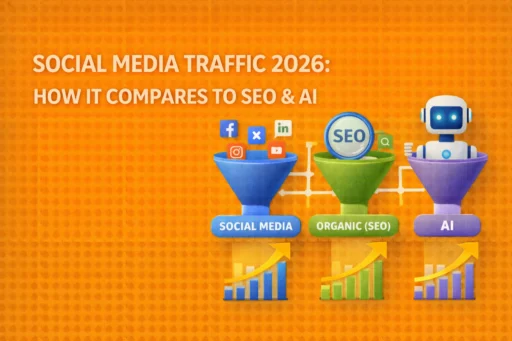
Organic traffic channels remain the dominant force in driving website visitors, but their grip is loosening. According to SE Ranking’s comprehensive analysis, organic search currently accounts for 46.98% of all global traffic, but this represents a decline from 49.15% at the beginning of 2026, dropping to 45.50% by August. This 3.65% decrease in just eight months signals a significant shift in how users discover content online.
Social media traffic, meanwhile, has grown to capture 10.12% of global website visits in 2026, as reported by the same research. This represents a steady alternative pathway for content discovery, particularly among younger demographics who increasingly turn to platforms like TikTok, Instagram, and Reddit for answers to their questions rather than traditional search engines.
The newest player in the traffic ecosystem is AI-powered search. AI traffic currently represents just 0.18% of global website visits, but this figure has nearly doubled from 0.11% in January to 0.21% in August 2026. While still tiny compared to other channels, Superprompt’s study shows a staggering 527% year-over-year growth rate, suggesting AI platforms could become a significant traffic source faster than many expect.
Why Does Social Media Traffic Matter More Than Ever in 2026?
Social media traffic isn’t just about clicks anymore-it’s about where search is actually happening. DataReportal’s Digital 2026 report reveals that 63.9% of the world’s population uses social media, with users spending an average of 2 hours and 21 minutes daily on these platforms. This massive time investment means billions of product discoveries, research queries, and purchase decisions now happen within social feeds rather than traditional search engines.
At Search Savvy, we’ve observed that social platforms have become integrated into the search ecosystem itself. Approximately 50.3% of all Google searches now include at least one social media platform among the top-10 organic results, with Reddit appearing in 37% of searches, YouTube in 19.8%, and Quora in 8%. This crossover demonstrates that Google itself recognizes the value of social content in answering user queries.
The quality of social media traffic varies significantly by region and platform. According to Sprout Social’s 2026 statistics, in the United States, social media accounts for 15.23% of website visits-well above the global average-while in the UK it represents just 6.14%. This regional variation highlights the importance of understanding your specific audience demographics when allocating resources across traffic channels.
How Do Organic Traffic Channels Perform in 2026?
Organic traffic channels continue to deliver the highest volume and most consistent results for most websites. Research from Fire Us Marketing shows that organic search is projected to account for 53% of all website traffic in 2026, with paid traffic contributing approximately 15%. For B2B companies specifically, the numbers are even more compelling, with over 75% of traffic coming from organic and paid search combined.
The click-through rate dynamics in organic search remain crucial for understanding traffic potential. According to AIOSEO’s research, the #1 organic search result captures 39.8% of all clicks, while position 2 receives only 18.7%. Moving from position 2 to position 1 generates a 74.5% increase in clicks, underscoring why top rankings remain so valuable despite the rise of alternative channels.
Mobile optimization has become non-negotiable for organic traffic success. Statista data shows that 63.31% of organic search engine visits now come from mobile devices, making mobile-friendly content and fast page speeds essential rather than optional. Search Savvy recommends prioritizing mobile experience as the foundation of any organic search strategy in 2026.
What Makes AI Traffic Channels Different in 2026?
AI traffic channels represent the most dramatic growth story of 2026, even if absolute numbers remain small. AI platforms account for just 0.15% of global internet traffic compared to 48.5% from organic search, but AI traffic has grown seven times since 2024. This exponential growth trajectory suggests we’re witnessing the early stages of a major shift in how users find information online.
ChatGPT dominates the AI traffic landscape with an overwhelming market share. SE Ranking’s analysis reveals that ChatGPT accounts for approximately 77.97% of all AI-driven website visits, with users spending close to 10 minutes per session on referred sites. This high engagement time indicates that AI platforms are sending qualified, interested visitors rather than casual browsers.
Perplexity has emerged as the second-largest AI traffic driver, particularly in the United States. Globally, Perplexity drives 15% of AI traffic, climbing to nearly 20% in the U.S., with users spending around 9 minutes per visit on referred sites. Search Engine Land’s research shows that for finance and legal industry websites, Perplexity has become particularly important, suggesting platform preferences vary by content type and user intent.
According to Search Savvy’s analysis, the conversion quality from AI traffic often exceeds traditional organic search. Adobe’s comprehensive study demonstrates that AI-referred visitors generate 12% more page views and spend 41% longer on sites compared to non-AI traffic. This deeper engagement suggests AI platforms are sending users further along in their decision-making journey.
How Should Businesses Allocate Resources Across Traffic Channels?
The data reveals that a balanced, multi-channel approach delivers the best results in 2026. According to Search Atlas, search dominates as the primary traffic source for ecommerce websites, with 68% of all trackable website traffic coming from a combination of organic and paid search channels. However, ignoring social media and emerging AI channels means missing out on increasingly valuable traffic sources.
Social media traffic deserves more strategic investment than many businesses currently provide. Sprout Social reports that social media advertising spend is projected to reach $276.7 billion in 2026, with 83% of that spend generated on mobile by 2030. The platforms have evolved beyond awareness-building into full-funnel marketing channels, with social commerce capabilities allowing users to discover, research, and purchase without ever leaving the platform.
For AI traffic channels, early adoption provides a significant competitive advantage. Superprompt’s data shows that early movers in AI optimization capture 60% more AI citations than late adopters, suggesting that establishing visibility in AI-generated responses now will pay dividends as these platforms grow. Search Savvy recommends beginning AI optimization efforts immediately, even though current traffic volumes remain modest.
Why Is Integration Between Channels More Important Than Ever?
The boundaries between traffic channels are blurring in 2026, creating new opportunities for businesses that understand how these channels work together. In Google’s AI Overviews, at least one social media site appeared for 20% of queries, while in AI Mode, that figure rose to 36%. The most cited platforms in AI responses include YouTube, Reddit, Quora, LinkedIn, and Medium-demonstrating that social media content directly influences AI-generated answers.
This interconnection means optimization for one channel often improves performance across others. High-quality content that ranks well in organic search frequently gets cited in AI responses and shared on social media. Building authoritative backlink profiles, creating original research, and maintaining fresh content all contribute to visibility across multiple channels simultaneously.
Search Savvy emphasizes that the most successful digital strategies in 2026 focus on creating genuinely valuable content rather than gaming individual algorithms. Content that serves user needs performs well regardless of whether traffic arrives via Google, TikTok, or ChatGPT. The fundamentals of quality, relevance, and user experience remain constant even as traffic sources evolve.
What Are the Key Takeaways for Your 2026 Traffic Strategy?
The traffic landscape in 2026 requires businesses to think beyond traditional SEO while maintaining strong organic search fundamentals. BrightEdge research confirms that SEO drives over 1,000% more traffic than organic social media, making it unwise to abandon proven strategies. However, the 123% growth in AI referral traffic and the steady rise of social media as a search alternative demand attention and resources.
Mobile optimization serves as the foundation for success across all channels. Mobile searches make up a large portion of organic traffic, and mobile traffic represents 63.31% of all website visits. Ensuring fast page speeds, responsive design, and mobile-friendly content layouts benefits performance in organic search, social media, and AI platforms simultaneously.
Measurement and adaptation should guide resource allocation decisions. Set up proper tracking for AI traffic sources, monitor social referrals by platform, and analyze engagement metrics beyond simple visit counts. Understanding which channels deliver the highest-quality traffic for your specific business allows for data-driven optimization rather than following industry averages.
How Can You Prepare for the Future of Traffic Channels?
The trajectory of traffic channels through the remainder of 2026 and beyond suggests continued fragmentation and specialization. Organic search will likely remain the largest single source, but its dominance will continue eroding as users embrace alternative discovery methods. Social media platforms are investing heavily in search functionality, while AI tools are integrating real-time web results to stay current.
Voice search and visual search represent additional emerging channels that intersect with existing traffic sources. LinkAssistant data shows that voice search technology will be used weekly by 1.1 billion mobile phone users worldwide, requiring content optimization for conversational queries and question-based formats. These queries often surface through AI assistants, social media voice features, and traditional search engines simultaneously.
Content freshness has become universally important across all channels. Research indicates that content updated within the last 30 days gets 3.2x more AI citations, and social algorithms similarly favor recent posts. Establishing systematic update schedules for evergreen content ensures continued visibility across channels as user behavior evolves.
At Search Savvy, we recommend viewing traffic channels as complementary rather than competitive. The businesses that thrive in 2026’s fragmented landscape will be those that create exceptional content, optimize for discoverability across multiple platforms, and remain agile as new channels emerge. The fundamentals of providing value to users remain unchanged, even as the paths users take to find that value continue evolving.
Frequently Asked Questions
What percentage of website traffic comes from social media in 2026?
Social media traffic accounts for 10.12% of global website visits in 2026, with significant regional variation. In the United States, social media generates 15.23% of website visits, while in the UK it represents just 6.14%. The majority of social referrals come from a limited set of platforms, with Facebook, YouTube, and Reddit leading the way according to DataReportal’s analysis.
How does organic search traffic compare to paid advertising in 2026?
Organic search remains dominant, accounting for approximately 53% of all website traffic in 2026, while paid search contributes about 15%. The top organic search result receives 39.8% of all clicks on average, demonstrating significantly higher engagement than paid results. For B2B companies specifically, over 75% of traffic comes from the combination of organic and paid search efforts.
Is AI traffic growing fast enough to matter for businesses in 2026?
While AI traffic currently represents just 0.18% of global website visits, it has experienced 527% year-over-year growth. Between January and August 2026, AI traffic nearly doubled from 0.11% to 0.21%. ChatGPT alone accounts for nearly 78% of all AI-driven website referrals, with users spending an average of 10 minutes per session. Early adopters of AI optimization strategies capture 60% more citations than late movers.
Which traffic channel provides the best ROI for small businesses?
Different channels excel for different business models, but organic search consistently delivers strong ROI across industries. 49% of marketers report that organic search has the best ROI of any marketing channel, and SEO leads have a 14.6% close rate. However, social media traffic in specific sectors (particularly retail and entertainment) can deliver comparable or superior results, especially for businesses with visual products or younger target demographics.
How should businesses track AI traffic in their analytics?
To properly track AI traffic, create custom channel groupings in Google Analytics 4 that identify visits from platforms like ChatGPT, Perplexity, Gemini, and Claude. Use regex patterns to capture these sources: .*chatgpt.*|.*perplexity.*|.*gemini.*|.*claude.*. Monitor not just visit counts but also engagement metrics like pages per session, conversion rates, and time on site, as AI traffic often shows 12% more page views and 41% longer sessions than traditional organic search.
What’s the most important trend affecting website traffic in 2026?
The most significant trend is the fragmentation of search behavior. Users no longer rely solely on Google for information discovery-they’re using social media platforms, AI assistants, and traditional search engines interchangeably depending on their needs. This means businesses must optimize for discoverability across multiple channels rather than focusing exclusively on traditional SEO. Content quality, mobile optimization, and fresh information have become universal requirements across all traffic channels, with mobile devices now accounting for 63.31% of all web traffic.