
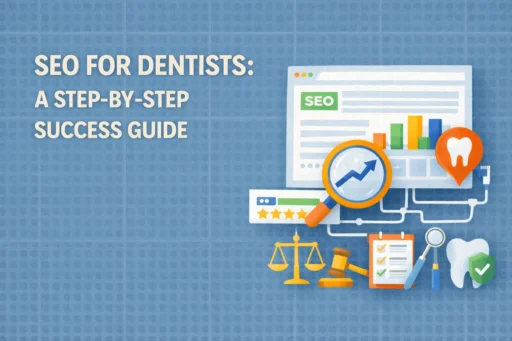

SEO for dentists has become more critical than ever in 2025, with over 89% of patients now researching dental services online before booking appointments. If you’re running a dental practice, your visibility in search results directly impacts your bottom line. At Search Savvy, we’ve witnessed firsthand how strategic search engine optimization transforms struggling practices into thriving patient magnets.
The digital landscape for dental practices has undergone massive changes. Google’s AI-powered features now dominate search results, patient behavior has shifted toward voice and mobile searches, and local SEO has become the cornerstone of practice growth. Whether you’re a cosmetic dentist, pediatric specialist, or general practitioner, understanding SEO for dentists isn’t optional anymore-it’s essential for survival in an increasingly competitive market.
This comprehensive guide will walk you through everything you need to know about dental SEO in 2025, from optimizing your Google Business Profile to creating content that ranks. According to Search Savvy’s insights, practices that implement these strategies see measurable growth within months, often attracting 5-10 new patients monthly through organic search alone.
How Does SEO for Dentists Work in 2025?
SEO for dentists is the practice of optimizing your dental website and online presence to appear prominently when potential patients search for dental services. Unlike general SEO, dental search engine optimization requires understanding patient search behavior, local market dynamics, and the unique challenges facing dental practices.
The fundamental shift in 2025 centers around Google’s AI Overviews, which now generate summary answers directly on search results pages. Rather than simply displaying links, Google uses artificial intelligence to curate answers for patients. If your practice isn’t featured in these AI-generated summaries, your visibility can take a significant hit-even if you previously ranked #1 in traditional search results.
At Search Savvy, we emphasize that modern dental SEO combines three critical elements: technical optimization (ensuring your website loads quickly and functions properly), content authority (creating valuable information that AI can understand and reference), and local signals (reviews, citations, and Google Business Profile optimization). Master these three pillars, and you’ll dominate your local market.
Understanding Patient Search Intent
Dental-related searches follow predictable patterns that smart dentists can leverage:
- Emergency searches like “toothache relief” or “emergency dentist open now” typically convert within hours
- Treatment research queries such as “dental implants cost” or “Invisalign reviews” indicate longer consideration periods but higher value
- Routine care searches including “dentist near me” or “dental cleaning” represent regular appointment bookings
- Specialist services like “orthodontist [city]” or “cosmetic dentist [location]” signal targeted, high-value searches
76% of patients who search for dental services online book an appointment within 24 hours, making immediate search visibility crucial for practice growth.
Why Is Local SEO Critical for Dentists in 2025?
SEO for dentists centers heavily on local optimization because dental services are inherently location-dependent. Patients don’t travel far for routine care-they want convenience, which is why over 70% of clicks to dental practices on Google go to practices in the Map Pack.
The Map Pack (also called the Local Pack) displays the top 3 dental practices for location-based searches. This prime real estate appears above both paid ads and organic results, making it the most valuable digital property for any dental practice. Getting listed here requires three critical factors: proximity (how close you are to the searcher), relevance (how well your profile matches their search), and prominence (your overall authority and reputation).
According to Search Savvy’s analysis, dental practices that secure a Map Pack position see dramatic increases in patient inquiries. The difference between position #3 and #4 can mean 30-40 additional patient calls per month in competitive markets.
The Power of Google Business Profile
Your Google Business Profile (formerly Google My Business) has become more important than your website itself for attracting local patients. Search impressions are up 49% year-over-year, but click-through rates are down 30% due to AI Overviews answering questions directly. This makes optimizing your GBP absolutely critical.
A complete Google Business Profile includes:
- Accurate business name, address, and phone number (NAP)
- Primary and secondary category selections
- Detailed business description with target keywords
- High-quality photos of your practice, team, and procedures
- Regular posts about services, promotions, and updates
- Consistent patient reviews and professional responses
Most searchers today use long-tail keywords, and optimizing your Google Business Profile with these is essential. Post to your GBP at least once weekly to signal active engagement to Google’s algorithms. To get started with your GBP, visit Google Business Profile.
How Can Dentists Optimize for AI-Powered Search?
SEO for dentists in 2025 requires understanding that Google’s AI Overviews now appear for 10.4% of U.S. desktop keywords and experienced a 119% increase in frequency on mobile in March 2025. Patients increasingly turn to ChatGPT, Google’s AI Mode, and other AI-powered platforms for instant answers about oral health concerns, treatment options, and provider recommendations.
To optimize for AI-powered search results, At Search Savvy, we recommend implementing these strategies:
Create Answer-Focused Content: Structure your website content around common patient questions. Use natural language that mirrors how people actually speak. Instead of a service page titled “Root Canal Therapy,” create content answering “What Should I Expect During a Root Canal?” or “How Much Does a Root Canal Cost in [Your City]?”
Implement Structured Data: Use schema markup to help AI understand your content. This includes marking up your services, locations, reviews, and business information in a format that search engines can easily interpret. Visit Schema.org to find dental-specific schema types.
Build E-E-A-T Authority: Google prioritizes Experience, Expertise, Authoritativeness, and Trustworthiness. Search engines now measure how professionally your information is presented, how qualified the author or clinic is, and how credible the content appears. Include verified credentials, real patient case studies, and medically sound content on every page.
Optimize for Featured Snippets: Nearly 80% of AI Overview results contain a link to one or more of the top 3 ranking results. Create concise, well-formatted answers to common questions that AI can easily extract and cite. Learn more about optimizing for AI Overviews.
What Are the Most Effective Keyword Strategies for Dental Practices?
SEO for dentists begins with strategic keyword research. The keywords you target determine who finds your practice and when. Use tools like Google Trends, SEMrush, Ahrefs, or Google Keyword Planner to discover what patients in your area are actually searching for.
Focus on three types of keywords:
Local Service Keywords: These combine your service with your location, like “teeth whitening [city]” or “pediatric dentist [neighborhood].” These drive the most qualified traffic because they indicate someone actively seeking your specific service in your area.
Long-Tail Question Keywords: With the rise of voice assistants and conversational search, optimizing for question-based and long-tail keywords will become increasingly important in 2025. Target phrases like “how much do dental implants cost in [city]” or “what dentist accepts [insurance] near me.”
Emergency and Urgent Keywords: Terms like “emergency dentist open now,” “tooth pain relief,” or “same-day dental appointment” capture high-intent patients who need immediate care and are willing to book quickly.
According to Search Savvy’s research, the most successful dental practices create dedicated landing pages for each service-location combination. If you serve three neighborhoods and offer five main services, that’s 15 unique pages optimized for specific keyword variations.
Avoid “keyword stuffing”-the outdated practice of cramming keywords unnaturally into content. In 2025, Google prioritizes high-quality, helpful content that genuinely answers users’ questions. Focus on writing naturally while strategically placing your target keywords in titles, headers, and the first 100 words of each page.
How Do Online Reviews Impact Dental SEO Rankings?
SEO for dentists cannot succeed without a robust review strategy. In 2025, reviews account for over 15% of local pack ranking factors, but it’s not just about quantity anymore. Google’s AI now evaluates review quality, recency, keyword matching, and platform diversity.
Patient reviews serve multiple SEO purposes:
Direct Ranking Factor: More positive reviews improve your position in local search results. Customers are 2.7 times more likely to consider the practice trustworthy if it has a full Google Business Profile completed, and reviews are a critical component of that profile.
Content Signal: Reviews containing specific service keywords like “emergency root canal” or “pediatric cleaning” signal to AI which services you excel at, helping you rank for those terms.
Trustworthiness Indicator: AI models analyze how you respond to reviews, looking for professionalism and conflict resolution. Generic copy-paste responses don’t build trust anymore-personalize your replies.
Click-Through Rate Booster: Higher-rated practices receive more clicks from search results, which Google interprets as a positive user signal, further boosting your rankings.
At Search Savvy, we’ve found that practices need a systematic approach to review generation. Send review requests via text or email 24-48 hours after appointments. Make the process simple by providing direct links to your Google Business Profile review page. Respond to every review-positive or negative-within 48 hours to demonstrate active engagement.
What Technical SEO Elements Matter Most for Dental Websites?
SEO for dentists extends beyond content and keywords to the technical foundation of your website. By 2025, a flawless mobile experience will be non-negotiable for achieving high search rankings. Your dental website must be fully responsive and optimized for smartphones and tablets.
Mobile Optimization: Most patients search on mobile devices while experiencing dental pain or urgency. Your site must load within 2-3 seconds, with easy-to-tap buttons, readable text without zooming, and intuitive navigation on smaller screens.
Core Web Vitals: Google measures three critical metrics-Largest Contentful Paint (loading speed), First Input Delay (interactivity), and Cumulative Layout Shift (visual stability). Poor scores directly harm your search rankings. Use Google’s PageSpeed Insights to audit your performance.
Secure Website (HTTPS): Security certificates are non-negotiable for healthcare websites. Patients won’t trust a site showing “Not Secure” warnings, and Google penalizes unsecured sites in rankings.
Clear Site Structure: Organize your site logically with services, locations, and about pages easily accessible from the main navigation. Use descriptive URLs like “yourpractice.com/services/dental-implants” rather than “yourpractice.com/page123.”
Internal Linking: Connect related pages within your site. Link from blog posts to relevant service pages, and vice versa. This helps search engines understand your site structure and keeps visitors engaged longer.
How Should Dentists Create Content That Ranks?
SEO for dentists thrives on educational, patient-focused content that demonstrates expertise while answering real questions. 70% of patients are more likely to choose an oral health practice that provides helpful content over one that doesn’t.
Create a content calendar addressing common patient concerns:
- Pre-appointment anxiety: “What to Expect During Your First Visit”
- Cost transparency: “How Much Do Dental Implants Cost in [City]? A Complete Price Breakdown”
- Treatment education: “Root Canal vs. Extraction: Which Is Right for You?”
- Preventive care: “5 Daily Habits That Prevent Cavities”
- Emergency guidance: “What to Do When You Knock Out a Tooth”
Structure your content for both humans and AI. Use H2 and H3 subheadings formatted as questions. Break information into short paragraphs (2-4 sentences maximum). Include bullet points for easy scanning. Add relevant images with descriptive alt text.
According to Search Savvy’s content strategy framework, aim for 1,500-2,500 words for cornerstone service pages and 800-1,200 words for blog posts. Longer, comprehensive content tends to rank better, but quality always trumps quantity.
Video Content: Video is increasingly important for dental SEO. Create short videos explaining procedures, introducing your team, and touring your office. Embedding videos on relevant pages increases time on page, which is an important SEO signal, and improves conversions.
What Role Do Backlinks Play in Dental SEO?
SEO for dentists requires building authority through quality backlinks-links from other reputable websites pointing to yours. Pages with backlinks from reputed websites directly boost organic traffic by 30%.
Effective backlink strategies for dental practices include:
Local Business Partnerships: Connect with complementary local businesses-pediatricians, orthodontists, medical spas. Offer to write guest posts for their blogs or collaborate on community health events that earn mentions and links.
Community Involvement: Sponsor local sports teams, participate in health fairs, or offer free dental screenings at schools. These activities often result in links from local news sites and community organizations.
Professional Associations: Ensure your practice is listed in dental association directories like the American Dental Association, state dental societies, and specialty organizations. These authoritative health-related links carry significant weight.
Educational Content: Create genuinely useful resources-a dental implant cost calculator, a tooth pain diagnosis tool, or a comprehensive guide to choosing a dentist. Other sites naturally link to valuable tools and thorough guides.
Press Releases: When you introduce new services, technology, or reach practice milestones, distribute press releases to local media and health publications.
Avoid buying links, participating in link exchanges, or submitting to low-quality directories. These tactics violate Google’s Webmaster Guidelines and can result in penalties that tank your rankings.
How Can Voice Search Optimization Benefit Dental Practices?
SEO for dentists must account for the dramatic rise in voice search. 50% of searches will be voice-based by 2025, with queries becoming more conversational and question-based.
Voice searches differ significantly from typed queries:
- Typed: “dentist 10001”
- Voice: “Hey Siri, find a family dentist near me that takes Delta Dental insurance”
Optimize for voice search by:
Creating FAQ Pages: Develop comprehensive FAQ sections answering common patient questions in natural, conversational language. Structure answers in 40-60 words-the ideal length for voice search snippets.
Using Natural Language: Write content that mirrors spoken patterns. Instead of “root canal therapy procedure,” use “what happens during a root canal.”
Targeting Question Keywords: Focus on who, what, when, where, why, and how questions. “What dentist is open on Saturday near me?” or “How much does teeth whitening cost?”
Ensuring GBP Accuracy: Voice assistants pull heavily from Google Business Profile data. Your phone number, address, hours, and services must be accurate and consistent across all platforms.
At Search Savvy, we’ve observed that dental practices optimizing for voice search capture patients at critical decision moments-often when someone is experiencing pain or urgency and needs immediate care.
Why Is Consistent NAP Information Crucial for Local SEO?
SEO for dentists depends heavily on NAP consistency-your business Name, Address, and Phone number appearing identically across every online platform. Inconsistent NAP information confuses search engines and can significantly harm your local rankings.
Ensure your NAP is identical on:
- Your website (header, footer, contact page)
- Google Business Profile
- Bing Places
- Social media profiles (Facebook, Instagram, LinkedIn)
- Online directories (Yelp, Healthgrades, Zocdoc)
- Citation sites (Yellow Pages, local business directories)
Even small variations matter. “123 Main St.” versus “123 Main Street” or “(555) 123-4567” versus “555-123-4567” can create citation conflicts. Choose one format and use it everywhere consistently.
Update your NAP information immediately if you move locations, change phone numbers, or rebrand. Outdated information not only hurts SEO but also frustrates potential patients who can’t reach you.
Frequently Asked Questions
How long does SEO take to work for dental practices?
SEO for dentists typically shows initial results within 3-6 months, with more substantial growth occurring at the 6-12 month mark. 76% of patients who search for dental services online book an appointment within 24 hours, so once you achieve visibility, conversion happens quickly. Local SEO changes, particularly Google Business Profile optimization, can produce results faster-sometimes within weeks. Sustained effort is key; SEO is an ongoing process, not a one-time fix.
Do dentists need a blog for SEO purposes?
While not strictly required, a blog significantly enhances SEO for dentists. Dental practices that post regular content see a 60% increase in patient involvement on social media. Blogs provide opportunities to target additional keywords, answer patient questions, demonstrate expertise, and keep your website fresh with updated content-all factors that improve search rankings. Aim for 2-4 high-quality blog posts monthly addressing real patient concerns.
What’s more important: organic SEO or Google Ads for dentists?
Both serve different purposes, but SEO for dentists provides better long-term ROI. At $6,500 lifetime value per patient, just 5 monthly organic patients yield $390,000 annual revenue, far exceeding typical SEO investment. Google Ads deliver immediate visibility but stop working when you stop paying. Organic SEO builds lasting authority and trust that compounds over time. The ideal strategy combines both: use PPC for immediate patient flow while building organic rankings for sustainable growth.
How many patient reviews do dental practices need for good SEO?
Quality matters more than quantity, but 59% of users expect local businesses to have between 20 and 99 reviews. Aim for a minimum of 25-50 Google reviews to appear credible, with ongoing review generation to maintain freshness. Recent reviews (within the past 3 months) carry more weight than older ones. Focus on encouraging authentic reviews from satisfied patients rather than chasing numbers. Reviews on platforms beyond Google-Facebook, Healthgrades, Yelp-also contribute to overall authority.
Can small dental practices compete with larger group practices in SEO?
Absolutely. SEO for dentists often favors hyperlocal optimization, which levels the playing field. Small practices can excel by focusing on neighborhood-specific keywords, building strong community connections, providing personalized patient care that generates authentic reviews, and creating localized content. Over 70% of clicks to dental practices on Google go to practices in the Map Pack, and Map Pack rankings prioritize proximity and relevance over size. A well-optimized small practice often outranks larger competitors for local searches.
How does AI affect dental SEO in 2025?
AI has fundamentally transformed SEO for dentists. Google’s AI Overviews now appear for 10.4% of U.S. desktop keywords and experienced a 119% increase in frequency on mobile in March 2025. Patients increasingly use ChatGPT, Google’s AI Mode, and voice assistants for health questions. To adapt, focus on creating authoritative, well-structured content that AI can understand and reference. Implement schema markup, answer common questions clearly and concisely, and build E-E-A-T authority. The practices that optimize for AI-powered search will dominate their markets in coming years.
Ready to Transform Your Dental Practice with SEO?
SEO for dentists in 2025 represents both a challenge and an extraordinary opportunity. The digital landscape has evolved dramatically, but the fundamentals remain: provide value to patients, build local authority, and maintain technical excellence. Practices that embrace modern dental SEO strategies position themselves for sustained growth and increased patient acquisition.
The investment in SEO pays dividends far beyond initial rankings. Every new patient you acquire through organic search costs significantly less than those from paid advertising, and they often arrive with higher trust and better long-term retention. Search Savvy has guided hundreds of dental practices through digital transformation, and the results speak for themselves-practices see average increases of 40-60% in new patient inquiries within the first year of comprehensive SEO implementation.
Don’t wait while competitors capture your potential patients. Start with the highest-impact changes: claim and optimize your Google Business Profile, implement a systematic review generation process, and begin creating patient-focused content that answers real questions. These foundational steps will set you on the path to dental SEO success.
For personalized guidance on implementing these strategies for your specific practice, consider partnering with SEO specialists who understand the unique challenges facing dental professionals in 2025’s AI-dominated search landscape.