

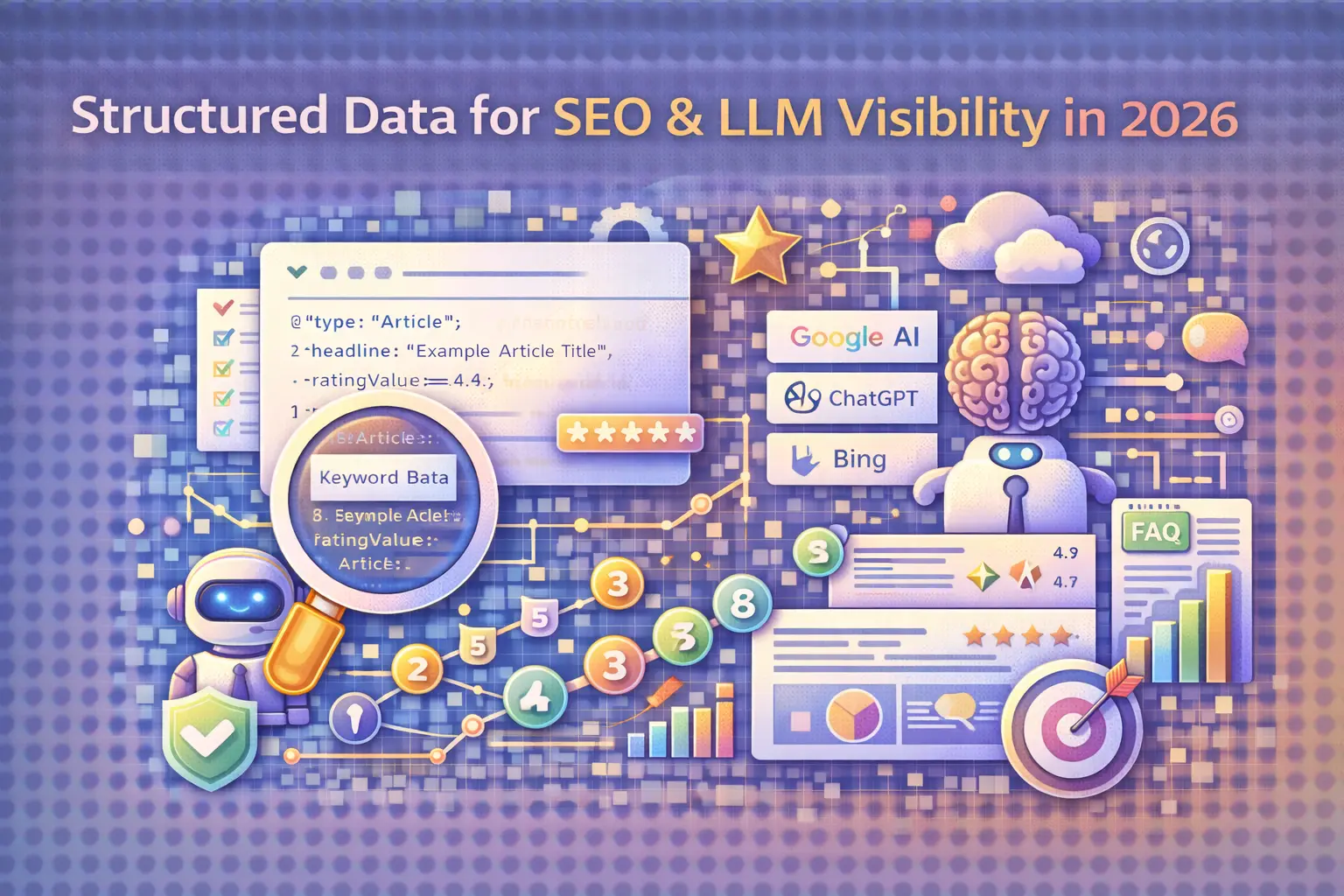

Structured data has evolved from an optional SEO enhancement to a fundamental requirement for digital visibility in 2026. As AI-powered search engines like Google’s AI Overviews, ChatGPT, and Perplexity reshape how users discover content, the brands that implement structured data correctly are the ones being cited, featured, and trusted by both traditional search engines and large language models (LLMs).
At Search Savvy, we’ve witnessed firsthand how structured data implementation can transform a website’s visibility. While many businesses still treat schema markup as an afterthought, the reality is clear: if AI systems can’t understand your content, they won’t cite it. In this comprehensive guide, we’ll walk you through everything you need to know about using structured data to dominate both traditional SEO and the emerging AI search landscape.
What Is Structured Data and Why Does It Matter in 2026?
Structured data is a standardized format for providing explicit information about your web pages so that search engines and AI systems can easily understand, interpret, and display your content. Think of it as adding clear labels to every important piece of information on your website-your business name, product prices, author credentials, and more-in a language that machines can read without guesswork.
The importance of structured data has reached new heights in 2026. According to industry research, Google’s AI Overviews now appear in over 85% of search queries, fundamentally changing how users interact with search results. These AI-generated summaries pull information directly from websites that provide clear, structured data. Without it, your content risks being invisible to the very systems driving modern search behavior.
At Search Savvy, we recommend viewing structured data as your direct communication channel with AI systems. When you implement schema markup correctly, you’re essentially telling search engines: “Here’s exactly what this content is about, who created it, and why it matters.” This clarity is what separates websites that get cited in AI answers from those that remain buried in traditional search results.
How Does Structured Data Work for Search Engines?
Structured data works by transforming your unstructured HTML content into a machine-readable format using standardized vocabularies from Schema.org. When search engine crawlers visit your site, they look for these structured signals to understand not just what keywords appear on your page, but what entities, relationships, and facts your content contains.
The technical implementation involves adding JSON-LD (JavaScript Object Notation for Linked Data) scripts to your web pages. JSON-LD is Google’s recommended format because it’s clean, easy to maintain, and doesn’t disrupt your existing HTML structure. Unlike older formats like Microdata or RDFa, JSON-LD code sits separately in your page’s <head> section, making it simpler to implement and less error-prone.
Structured data enables search engines to create rich results-those enhanced search listings that display star ratings, product prices, event dates, FAQ dropdowns, and other eye-catching features. According to case studies documented by Backlinko, Nestlé achieved an 82% higher click-through rate for pages appearing as rich results compared to standard listings. Food Network saw a 35% increase in visit-to-add-to-cart metrics after implementing recipe schema. These aren’t minor improvements-they’re game-changing results that directly impact revenue.
Why Is Structured Data Critical for LLM Visibility in 2026?
Structured data has become essential for Large Language Model (LLM) visibility because AI systems rely heavily on structured information to understand, verify, and cite content accurately. In March 2025, Microsoft’s Fabrice Canel officially confirmed that Microsoft uses schema markup to help its LLMs understand web content, particularly for Bing’s Copilot AI. This confirmation from a major tech platform validates what SEO professionals have been observing: structured data directly influences AI-powered search results.
The relationship between structured data and LLM visibility comes down to semantic understanding. When you add schema markup to your pages, you create explicit factual relationships that AI models can extract and reference in generative search results. As noted by Walker Sands, generative AI systems rely on semantic understanding and contextual matching to identify relevant information, and schema markup makes this interpretation significantly easier.
Search Savvy has observed that websites with comprehensive structured data implementation are significantly more likely to appear in AI Overviews, ChatGPT responses, and Perplexity citations. The data is compelling: according to Data World research, AI systems with knowledge graphs achieve 300% higher accuracy than systems without structured data. When AI platforms can trust the structure and accuracy of your content, they’re far more likely to reference your brand as an authoritative source.
How Can You Implement Structured Data on Your Website?
Structured data implementation begins with identifying which schema types are most relevant to your content. The most impactful schemas for 2026 visibility include Organization (for brand identity), Article and BlogPosting (for content), FAQPage (for question-answer content), Product (for e-commerce), and LocalBusiness (for local SEO). At Search Savvy, we typically recommend starting with 1-2 core schema types per page to maintain clarity and avoid overwhelming search engines with redundant information.
The implementation process involves several key steps. First, audit your website to determine which pages need structured data and what types of schema are appropriate. Homepage and about pages benefit from Organization schema, blog posts need Article schema, product pages require Product schema, and so on. Next, use schema generators or tools like Google’s Structured Data Markup Helper to create your JSON-LD code. These tools make it easier to generate properly formatted markup without hand-coding every property.
Once generated, place your JSON-LD code in the <head> section of your HTML pages. Here’s a basic example of Organization schema:
{
“@context”: “https://schema.org”,
“@type”: “Organization”,
“name”: “Search Savvy”,
“url”: “https://www.searchsavvy.com”,
“logo”: “https://www.searchsavvy.com/logo.png”,
“description”: “Expert SEO and digital marketing solutions”,
“sameAs”: [
“https://www.linkedin.com/company/searchsavvy”,
“https://twitter.com/searchsavvy”
]
}
After implementation, validation is crucial. Always test your structured data using Google’s Rich Results Test and the Schema Markup Validator to ensure your markup is error-free and eligible for rich results. According to Search Savvy’s insights, errors in structured data can cause search engines to ignore or misinterpret your markup, significantly impacting visibility.
What Are the Most Important Schema Types for 2026?
Structured data success in 2026 requires focusing on schema types that AI systems prioritize. According to industry analysis, the five most critical schema types are Organization, Article/BlogPosting, FAQPage, Product, and HowTo. Each serves a specific purpose in helping AI understand different aspects of your content.
Organization schema establishes your brand identity and authority signals. It clarifies your business name, logo, social profiles, and contact information so AI systems don’t confuse you with similar entities. This schema type is foundational-every website should implement it on their homepage. Article and BlogPosting schemas clarify key content attributes like publication date, author credentials, and topic focus, reinforcing your content’s authority and freshness.
FAQPage schema is particularly valuable for AI visibility because structured question-answer content is easier for LLMs to interpret and cite in conversational responses. As noted by Semrush, FAQPage schema signals individual question-answer pairs, significantly boosting your chances of being cited in AI-powered answer boxes. Product schema with detailed specifications-including pricing, features, reviews, and availability-helps AI provide accurate product information when users ask for recommendations.
HowTo schema structures tutorials and step-by-step instructions so virtual assistants can easily parse and reference your processes. Search Savvy recommends prioritizing these five schema types because they directly address how users interact with AI search in 2026: asking questions, seeking recommendations, and looking for detailed instructions. Websites that implement these schemas strategically position themselves as go-to sources for AI-generated answers.
How Does Structured Data Improve Click-Through Rates?
Structured data improves click-through rates (CTR) by enabling rich results that make your listings more visually prominent and informative in search results. When your pages display star ratings, pricing information, availability status, or FAQ dropdowns directly in search results, users have more reasons to click even before reading your meta description. This enhanced presentation creates a significant competitive advantage.
The CTR improvements from structured data are substantial and well-documented. According to Search Engine Journal analysis, schema markup can increase featured snippets by 677% and improve average CTR by 30%. Rich snippets naturally grab attention-when users see visual elements like review stars or event dates in search results, these features create immediate credibility and relevance signals that standard blue links cannot match.
Research from Click Forest demonstrates that voice search traffic, which converts 3x better due to more specific user intent, relies heavily on structured data. LocalBusiness schema is essential for “near me” queries, while Google Lens uses structured data for visual search results. The convergence of voice search, visual search, and traditional text search in 2026 means structured data impacts multiple traffic channels simultaneously.
At Search Savvy, we’ve observed that businesses implementing comprehensive structured data strategies see not just higher CTR, but better-qualified traffic. When users can see detailed information before clicking-like product availability, pricing, or review ratings-they arrive on your site with clearer expectations and higher purchase intent. This pre-qualification effect means structured data doesn’t just drive more traffic; it drives better traffic that converts at higher rates.
What Common Mistakes Should You Avoid with Structured Data?
Structured data implementation requires attention to detail because common mistakes can undermine your efforts or even result in search engine penalties. One of the most frequent errors is marking up content that isn’t visible to users. Google’s guidelines are clear: structured data must accurately reflect content that appears on the page. Adding Product schema for items not actually available, or Organization markup with fabricated addresses, violates Google’s structured data guidelines and can result in manual actions against your site.
Another critical mistake is using too many schema types on a single page. Search Savvy recommends limiting structured data to 1-2 schema types per URL to maintain clarity and reduce ambiguity for search engines. Overloading pages with multiple competing schemas can confuse search engines about your page’s primary purpose, diluting the effectiveness of your markup. Focus on the most relevant schema type for each specific page rather than trying to mark up everything possible.
Syntax errors represent another common pitfall. Case sensitivity matters in Schema.org-property names like “streetAddress” must be capitalized exactly as specified. Missing commas, unclosed brackets, or incorrect quote usage can break your entire structured data implementation. Always validate your markup using Google’s Rich Results Test before deploying to production. According to O8 Agency’s guidance, errors in structured data can cause search engines to ignore your markup entirely, wasting your implementation efforts.
Finally, many businesses implement structured data once and never update it. Structured data requires ongoing maintenance-when your business address changes, new products launch, or team members are added, your schema markup must be updated accordingly. Stale or inaccurate structured data erodes trust with search engines and AI systems, potentially harming rather than helping your visibility.
How Will Structured Data Evolve Beyond 2026?
Structured data will continue evolving as AI search becomes more sophisticated and widespread. The trend toward AI-first search experiences shows no signs of slowing-industry forecasts suggest that by late 2026, voice search will account for 35% of all searches, with voice traffic converting at 3x higher rates due to more specific user intent. Structured data will remain the foundation enabling these AI interactions.
The emergence of new standards like LLMs.txt files represents the next frontier. LLMs.txt is an emerging protocol that allows websites to define content permissions, usage policies, and AI-crawlable areas, working alongside schema markup to give brands more control over how AI systems access and cite their content. Search Savvy anticipates that the combination of comprehensive schema markup and LLMs.txt implementation will become standard practice for businesses serious about AI visibility.
Entity-based search will also drive structured data evolution. As search engines transition from keyword matching to entity understanding, the role of structured data in defining entity relationships becomes even more critical. According to SEO Journal, businesses should implement schema markup so AI agents accurately understand pricing, availability, reviews, and specifications. The brands that excel at entity definition through structured data will dominate AI-powered search results.
Search Savvy expects that structured data will increasingly integrate with emerging technologies like AI-ready protocols and MCP servers, creating more sophisticated ways for AI crawlers to discover and understand website content efficiently. The businesses investing in comprehensive structured data strategies today are building the foundation for sustained AI visibility through 2026 and beyond.
Frequently Asked Questions About Structured Data
Q: Does structured data directly improve search rankings?
A: Structured data is not a direct ranking factor according to Google. However, it provides substantial indirect SEO benefits by increasing click-through rates by 20-40% through rich results, improving content understanding for better relevance matching, and enhancing E-E-A-T (Experience, Expertise, Authoritativeness, Trustworthiness) signals through entity validation. While structured data won’t automatically move you to position #1, it makes your existing rankings far more valuable by improving visibility and user engagement.
Q: Which structured data format should I use in 2026?
A: JSON-LD is the recommended format for 2026. Google explicitly recommends JSON-LD because it’s the easiest solution to implement and maintain at scale. Unlike Microdata or RDFa, JSON-LD doesn’t require embedding markup throughout your HTML, making it simpler to implement, less error-prone, and easier to update. All major search engines and AI platforms support JSON-LD, making it the clear choice for future-proofing your structured data strategy.
Q: How long does it take to see results from structured data implementation?
A: Results from structured data can appear within days to weeks, depending on your site’s crawl frequency and the schema types implemented. Rich snippets may appear in search results within 1-2 weeks after proper implementation and validation. However, the full impact on AI visibility and citations may take 1-3 months as AI systems index and incorporate your structured content into their knowledge bases. Consistent implementation and maintenance accelerate results over time.
Q: Can structured data help my local business appear in “near me” searches?
A: Yes, absolutely. LocalBusiness schema is essential for local SEO and “near me” queries in 2026. By implementing LocalBusiness schema with accurate NAP (Name, Address, Phone) information, business hours, service areas, and customer reviews, you significantly improve your chances of appearing in local search results, Google Maps, and AI-powered local recommendations. Voice search, which heavily relies on local intent, uses LocalBusiness schema to identify and recommend nearby businesses.
Q: Do I need to hire a developer to implement structured data?
A: Not necessarily. While technical knowledge helps, many content management systems like WordPress offer plugins (such as Yoast SEO or Rank Math) that automatically generate structured data. For more customized implementations, schema generators and tools like Google’s Structured Data Markup Helper can create JSON-LD code that you can copy and paste into your site’s header. However, for complex sites or e-commerce platforms, working with an experienced SEO professional or developer ensures proper implementation and ongoing optimization.
Q: Will AI platforms like ChatGPT automatically cite my content if I add structured data?
A: Structured data increases the likelihood of AI citations, but doesn’t guarantee them. ChatGPT, Perplexity, and other AI platforms consider multiple factors including content quality, relevance, authority, and freshness when deciding what to cite. However, structured data makes your content significantly easier for AI systems to understand, verify, and reference accurately. Think of schema markup as removing barriers to AI citation rather than automatically ensuring it-it’s necessary but not sufficient on its own.
Take Action on Structured Data Today
Structured data represents one of the most underutilized SEO tactics available to businesses in 2026. While competitors hesitate or delay implementation, the brands that act now gain a decisive advantage in both traditional search and AI-powered discovery. At Search Savvy, we’ve seen structured data transform client visibility repeatedly-the question isn’t whether to implement it, but how quickly you can deploy comprehensive schema markup across your site.
The convergence of AI search, voice queries, and visual discovery means structured data impacts more traffic channels than ever before. Every day without proper schema markup is a day your competitors could be claiming the AI citations, rich snippets, and featured positions that should belong to you. The implementation process is straightforward, the tools are readily available, and the potential rewards-increased visibility, higher CTR, and better-qualified traffic-justify the investment many times over.
Search Savvy recommends starting with an audit of your most important pages, implementing foundational Organization and Article schemas first, then expanding to specialized schemas for products, FAQs, and local business information. Validate everything thoroughly, monitor your rich result eligibility in Google Search Console, and iterate based on performance data. Structured data isn’t a set-it-and-forget-it tactic-it’s an ongoing optimization opportunity that compounds in value over time as AI search continues reshaping the digital landscape.
About Search Savvy
Search Savvy specializes in cutting-edge SEO strategies that prepare businesses for the AI-driven future of search. Our team stays ahead of algorithm updates, AI platform changes, and emerging best practices to ensure our clients maintain maximum visibility across all search channels. From structured data implementation to comprehensive AI optimization strategies, we deliver measurable results that drive sustainable growth. Contact Search Savvy today to discover how our expertise can transform your digital presence.