
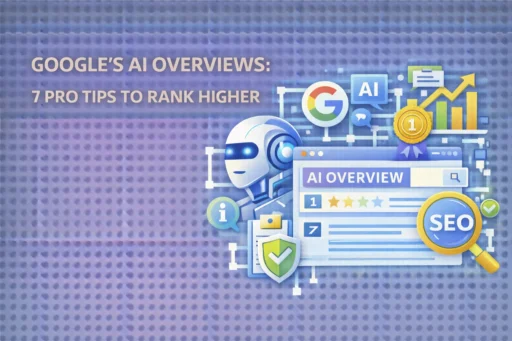

Google’s AI Overviews have fundamentally transformed how users discover content in 2025. These AI-generated summaries now appear in over 50% of all search queries-a dramatic increase from just 25% in August 2024. At Search Savvy, we’ve been tracking this seismic shift and helping businesses adapt their content strategies to thrive in this new landscape. The stakes couldn’t be higher: while traditional click-through rates have declined by 30-35% across the board, content that successfully earns citations in AI Overviews sees 35% more organic clicks than those that don’t.
Google’s AI Overviews are reshaping the search ecosystem at an unprecedented pace. Whether you’re an SEO professional, content marketer, or business owner, understanding how to optimize for these AI-generated summaries isn’t optional anymore-it’s essential for visibility in 2025’s AI-driven search environment. At Search Savvy, we’ve analyzed the latest data and identified seven proven strategies that can help your content earn coveted spots in these powerful search features.
What Are Google’s AI Overviews and Why Do They Matter in 2025?
Google’s AI Overviews are AI-generated snapshots that appear at the top of search results, synthesizing information from multiple web sources to provide direct answers to user queries. Unlike traditional search results that simply list relevant websites, AI Overviews use Google’s advanced Gemini 2.0 models to understand context, analyze multiple perspectives, and create comprehensive summaries.
These summaries have evolved significantly since their initial launch in May 2024. According to recent data, AI Overviews now appear in approximately 11-19% of all desktop searches and dominate mobile results, with some studies showing presence rates exceeding 42% for informational queries. Even more striking, queries with eight or more words are seven times more likely to trigger an AI Overview, signaling Google’s commitment to handling complex, conversational searches.
The visual impact is substantial: AI Overviews and Featured Snippets together consume 75.7% of screen space on mobile devices and 67.1% on desktops. This massive footprint means even top-ranking pages can be pushed below the fold, dramatically reducing their visibility. However, the opportunity is equally significant-92.36% of AI Overviews that appeared for tracked keywords linked to at least one domain ranking in the top 10 organic positions.
How Do Google’s AI Overviews Select Content to Feature?
Google’s AI Overviews rely heavily on the company’s core ranking systems, making traditional SEO excellence the foundation of AI Overview success. The selection process prioritizes several key factors that content creators must understand.
Search intent alignment tops the list. AI models look for content that directly satisfies the underlying intent of a query, not just keyword matching. Pages that demonstrate clear expertise and answer questions comprehensively are favored over those that merely include relevant terms.
Authority and trustworthiness play crucial roles in the selection process. Google’s E-E-A-T (Experience, Expertise, Authoritativeness, and Trustworthiness) principles are more important than ever. Content from recognized authorities, backed by credible author bios and transparent sourcing, receives preferential treatment in AI Overview citations.
Content structure and readability significantly influence selection. AI systems prefer content written in natural language with clear hierarchies, short paragraphs, and scannable formatting. Pages using question-based headers, bullet points, and direct answers are more likely to be parsed and featured.
Research from seoClarity shows that 97% of AI Overviews cite at least one source from the top 20 organic results, with an average of five URLs included per Overview. Interestingly, the overlap between AI Overview citations and Google’s top 10 positions dropped slightly from 16% to 15% following the March 2025 core update, suggesting that high-quality content from positions 11-20 now has better chances of being cited.
Why Is Optimizing for AI Overviews Critical for Your Business?
Google’s AI Overviews represent a fundamental shift in how users interact with search results, and the data tells a compelling story. While click-through rates for top positions have declined by 30-35% over the past year, this isn’t a zero-sum game. The businesses adapting quickly are discovering new opportunities for visibility and conversion.
Higher-quality traffic is the silver lining. According to Search Savvy’s analysis of industry data, traffic from AI Overview citations converts at higher rates than clicks from traditional blue links. When users click through from an AI Overview, they’re typically further along in their journey-more informed, more qualified, and closer to making a decision.
Industry impact varies dramatically. Healthcare and education queries now trigger AI Overviews 87% of the time, while B2B tech sees them in 70% of searches. Insurance has jumped from 17% to 63% coverage, and travel increased from 0% to 34%. Meanwhile, e-commerce queries have seen a decline, dropping from 29% to just 4% as Google prioritizes product grids for shopping searches.
Mobile dominance amplifies the effect. With two-thirds of all Google searches conducted on mobile devices, and the majority now showing AI Overviews, mobile users are experiencing an entirely different search landscape. The mobile-first nature of AI Overviews means businesses must prioritize optimization for these smaller screens where AI summaries occupy even more relative space.
The bottom line: brands that appear in AI Overviews maintain visibility while those that don’t risk becoming invisible to a growing segment of searchers. At Search Savvy, we’ve seen firsthand how strategic optimization can turn this challenge into a competitive advantage.
How Can You Structure Content to Rank in AI Overviews?
Google’s AI Overviews favor content that’s immediately accessible and easy to parse. Proper structure isn’t just about aesthetics-it’s about making your expertise digestible for both AI systems and human readers.
1. Lead With Direct Answers
Start with the money shot. The first 2-3 lines of your content should answer the main question directly and concisely. This approach supports both AI Overview inclusion and voice search optimization, as voice assistants tend to read short, direct responses.
For example, if targeting “what is content marketing,” your opening should be: “Content marketing is a strategic approach focused on creating and distributing valuable, relevant content to attract and retain a clearly defined audience. This method drives profitable customer action by providing information that solves problems rather than directly promoting products.”
Position your primary answer within the first 50-70 words, using simple, accessible language that aligns with user intent. According to Search Savvy’s research, pages that place concise answers at the top are significantly more likely to be extracted by AI systems.
2. Use Question-Based Subheadings
Google’s AI Overviews respond exceptionally well to content organized around questions. Structure your H2 and H3 tags as natural questions your audience would actually ask:
- “How does [topic] work in 2025?”
- “Why is [strategy] important for businesses?”
- “What are the benefits of [approach]?”
- “When should you implement [tactic]?”
This question-based structure serves dual purposes: it improves readability for users scanning your content and creates clear extraction points for AI systems parsing your page. The conversational tone also aligns with how people actually search, especially in voice and mobile contexts.
3. Implement Strategic Formatting
Break up dense text relentlessly. Maximum paragraph length should be 3-4 sentences. Use bullet points, numbered lists, and tables to organize complex information. AI systems can more easily extract and synthesize information presented in digestible chunks.
Include “definition” sections for key terms, “summary” or “key takeaways” boxes for longer content, and FAQ sections that address common related queries. Each of these elements creates additional opportunities for AI Overview extraction.
Schema markup amplifies these structural elements. Add FAQPage, HowTo, and Article structured data to help search engines understand your content’s organization. While not required, schema acts as a cheat sheet that tells Google exactly what your content means, not just what it says.
How Does Content Quality Impact AI Overview Rankings?
Google’s AI Overviews prioritize depth, authority, and freshness-all signals that indicate trustworthy, valuable content. At Search Savvy, we emphasize that quality isn’t just about word count; it’s about demonstrating expertise that both AI systems and users can recognize.
4. Demonstrate E-E-A-T Throughout Your Content
Experience, Expertise, Authoritativeness, and Trustworthiness remain foundational to AI Overview inclusion. Google favors pages written by people who understand the topic deeply and can provide first-hand insights.
Build credible author bios that highlight relevant credentials and experience. Include expert quotes, original research, and data from authoritative sources. Link to reputable external sources that support your claims-this demonstrates thoroughness and transparency.
Consider adding “expert reviewed” badges or disclosure sections that explain your editorial process. These trust signals help both AI systems and users evaluate your content’s reliability. Pages that transparently display their expertise and methodology are more likely to be selected for AI Overviews, particularly in YMYL (Your Money or Your Life) topics like health, finance, and legal advice.
5. Keep Content Fresh and Updated
AI Overviews show a distinct preference for recent, regularly updated content. Research from SE Ranking indicates that 28.76% of AI Overview citations come from content published in 2025, with another 26.85% from 2024-together accounting for over half of all cited sources.
However, recency isn’t everything. Only 12.32% of cited sources were published within 30 days, suggesting AI Overviews balance freshness with established authority. The key is maintaining content that stays current while building trust over time.
Implement a regular content refresh schedule. Update statistics, add new examples, and expand sections based on emerging trends. Add timestamps to your articles and clearly indicate when they were last updated. This transparency helps both users and AI systems understand the currentness of your information.
6. Build Topical Authority and Depth
Become the definitive resource, not a one-hit wonder. AI systems prefer sources that demonstrate comprehensive coverage of a topic across multiple pieces of content. Create content clusters around core topics, with pillar pages linking to detailed subtopic articles.
Answer every potential query readers might have about your subject. Use the “5W and 1H” framework (Who, What, When, Where, Why, and How) to ensure comprehensive coverage. Include supporting details, comparisons, pros and cons, and real-world examples that add context and value.
Long-tail keywords play a strategic role in this approach. Target question-based queries that trigger AI Overviews-phrases like “how to optimize for AI search” or “what is the best way to…” These longer, more specific queries are precisely what AI Overviews are designed to answer.
How Should You Optimize Technical Elements for AI Overviews?
Google’s AI Overviews still depend on your website’s technical foundation. No amount of brilliant content can overcome technical barriers that prevent crawling, indexing, or proper rendering. At Search Savvy, we emphasize that technical SEO and content optimization must work in tandem.
7. Ensure Technical Excellence
Crawlability and indexing form the baseline. Verify that your main pages are accessible to search engines by reviewing your sitemap.xml and robots.txt files. Confirm nothing important is being blocked and that your key content is discoverable through internal linking.
Page speed directly impacts your chances of ranking in AI Overviews. Run your pages through Google’s PageSpeed Insights and address issues that slow load times. Optimize images through compression and modern formats (WebP), minimize JavaScript execution, and implement caching strategies for returning visitors.
Mobile optimization is non-negotiable. Google uses mobile-first indexing, meaning the mobile version of your site is the primary version for ranking and AI Overview selection. Ensure your site is responsive, touch-friendly, and provides an excellent experience on smaller screens.
HTTPS security is table stakes. Secure your site with a valid SSL certificate-that little padlock in the browser signals trustworthiness to both users and Google’s systems.
Monitor your Core Web Vitals (Largest Contentful Paint, First Input Delay, and Cumulative Layout Shift) as these user experience metrics influence your content’s competitiveness for AI Overview inclusion. Pages that provide smooth, fast, stable experiences are more likely to be selected.
People Also Ask: Common Questions About Ranking in AI Overviews
How long does it take to rank in Google’s AI Overviews?
Ranking in Google’s AI Overviews doesn’t follow a fixed timeline, as it depends on your content quality, technical foundation, and competitive landscape. Well-optimized content from authoritative sites can appear in AI Overviews within weeks, while newer sites may need months to build sufficient trust and authority. The key is consistent optimization: implement the strategies outlined above, monitor your performance, and refine your approach based on what’s working in your specific niche.
Do I need to rank #1 organically to appear in AI Overviews?
No, you don’t need the top organic position to be cited in AI Overviews. While pages ranking in positions 1-3 have higher inclusion rates, 47% of AI Overview sources rank outside the top 10 positions. This means high-quality content from positions 11-20 now has viable opportunities for visibility through AI citations. Focus on content quality, structure, and E-E-A-T signals rather than obsessing over organic ranking position alone.
Are AI Overviews bad for website traffic?
AI Overviews have reduced click-through rates for traditional organic results, with studies showing declines of 30-35% on average. However, the impact varies by industry and query type. Importantly, traffic from AI Overview citations tends to be higher quality-these visitors are more informed, more engaged, and closer to conversion. The strategy isn’t to avoid AI Overviews but to earn citations within them, which can actually boost your click-through rates by 35% compared to non-cited competitors.
Which types of content perform best in AI Overviews?
Informational content dominates AI Overviews, accounting for approximately 88% of queries that trigger them. How-to guides, definition pages, explanatory articles, and research summaries receive disproportionate AI crawler attention. However, transactional queries are gradually increasing their presence, rising from virtually zero to 12.54% as of September 2025. FAQ sections, comparison articles, and content answering specific questions perform particularly well across both informational and commercial intent queries.
Can small businesses compete for AI Overview visibility?
Yes, small businesses can absolutely compete for AI Overview citations. While high-authority domains have advantages, AI Overviews reward content quality, structure, and relevance over brand recognition alone. Small businesses can succeed by focusing on niche topics where they have genuine expertise, creating highly specific content that answers detailed questions, and building topical authority through comprehensive coverage. Local businesses particularly benefit from the fact that AI Overviews appear in only 7% of local queries, creating opportunities to stand out in local search.
How do I track if my content appears in AI Overviews?
Unfortunately, Google Search Console doesn’t separate AI Overview clicks from regular organic traffic, making direct tracking challenging. The most reliable method is manual monitoring: regularly search for your target keywords and document whether your content appears in AI Overviews. Tools like seoClarity, BrightEdge, and SE Ranking offer AI Overview tracking features that automate this process. Additionally, monitor referral traffic patterns in Google Analytics for increases that coincide with AI Overview appearances, watching for improvements in engagement metrics that suggest higher-quality traffic.
Taking Action: Your Next Steps with Search Savvy
Google’s AI Overviews represent the future of search, and the businesses adapting now will maintain their competitive edge as this technology continues to evolve. The seven strategies outlined above-from structuring content with direct answers to ensuring technical excellence-provide a comprehensive framework for success in this new landscape.
At Search Savvy, we’ve seen these tactics deliver measurable results for our clients across diverse industries. The key is consistent implementation: audit your existing content against these best practices, prioritize updates for your highest-performing pages, and build new content with AI Overviews in mind from the start.
Remember that Google’s AI Overviews will continue evolving throughout 2025 and beyond. Stay informed about updates, monitor your performance regularly, and remain flexible in your approach. The fundamentals won’t change-quality content, technical excellence, and user-focused optimization-but the tactics may need refinement as Google’s systems advance.
Search Savvy is committed to helping businesses navigate this transformation successfully. The shift to AI-driven search isn’t something to fear-it’s an opportunity to demonstrate your expertise, reach more qualified audiences, and build sustainable visibility in an increasingly competitive digital landscape.
Ready to optimize your content for Google’s AI Overviews? Start by implementing these seven pro tips today, and watch as your visibility transforms in 2025’s AI-powered search ecosystem.