How to Create a Content Marketing Strategy from Scratch

Here is the gap that separates brands that grow steadily from those that publish endlessly without results: 73% of B2B marketers and 70% of B2C marketers now have a documented content marketing strategy, and those organisations generate three times more leads per dollar spent than those without one.
In this article14 sections
A content marketing strategy is the difference between random posting and a deliberate plan where every piece of content has a role, a goal, and a place in a bigger picture. Without one, even talented writers end up producing content that looks busy but never compounds into measurable business results.
A content marketing strategy has become more, not less, important in 2026, even as AI tools make production faster than ever. Generative AI has commoditised shallow content; the winning move now is going deeper with original research, first-hand experience, and unique data, not simply publishing more.
A content marketing strategy built today also has to account for a search landscape that has genuinely changed. Organic clicks are declining as AI Overviews, ChatGPT, and Perplexity answer queries directly, meaning content now needs to earn visibility on surfaces beyond the traditional blue links.
At Search Savvy, we build every content marketing strategy around this reality – documented goals, real audience research, and content structured to be cited by both Google and AI tools. This guide walks through exactly how to build one from scratch, step by step.
What Is a Content Marketing Strategy?#
A content marketing strategy is a documented plan that ties every piece of content a brand creates to a specific audience, goal, and measurable business outcome, rather than publishing content randomly and hoping it performs.
A content marketing strategy differs fundamentally from content production. Many businesses confuse the two, publishing blog posts that answer obvious questions in shallow, generic articles without any underlying plan connecting that content to revenue.
People Also Ask: Why do businesses need a documented content marketing strategy instead of just publishing content? Short Answer: Documented strategies correlate with three times more leads per dollar spent than undocumented efforts. A strategy ensures every piece of content serves a specific audience and business goal, rather than producing content that looks active but fails to compound into measurable results.
How Do You Build a Content Marketing Strategy Step by Step?#
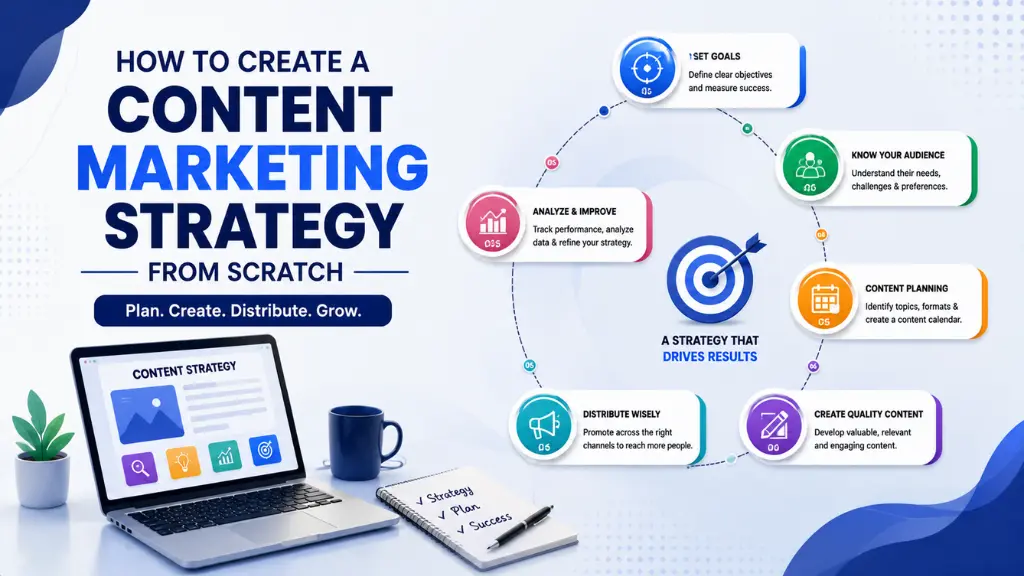
A content marketing strategy is built through a sequential process, and skipping steps to jump straight into content creation is the most common reason programmes stall before they ever produce results.
Step 1: Set Measurable Goals#
A content marketing strategy must start with goals you can actually count, not vague ambitions like “increase traffic.” Specific, time-bound targets – such as 100 organic leads per month within six months, or a 30% blog-to-MQL conversion rate – give the entire strategy a clear direction and a way to measure success.
A content marketing strategy goal should always have an owner, a deadline, and a number attached to it. Avoid vanity goals entirely; tie every objective to a business outcome that a leadership team would actually care about.
Step 2: Define Your Audience and Buyer Personas#
A content marketing strategy needs one to three clearly defined buyer personas, not ten. Defining too many personas means none of them get served well, diluting both the content and the brand voice across every format you produce.
A content marketing strategy built around genuine audience understanding asks a sharper question than keyword volume alone: what is this brand genuinely authoritative on, and where does it have real proof, real depth, and real credibility? That authority area, not a keyword list, should define your content surface.
Step 3: Audit Your Existing Content#
A content marketing strategy cannot be built on a broken foundation, and more content cannot outrun bad content already published. A thorough audit – deleting outdated posts, merging overlapping ones, and refreshing pieces with genuine potential – is a necessary step before adding anything new.
People Also Ask: Should I delete old underperforming blog content when building a new strategy? Short Answer: Often, yes. A content audit typically reveals posts that should be deleted, merged with similar pieces, or refreshed rather than left untouched. One documented case found a team auditing 200 blog posts deleted 70, merged 40, and refreshed 50 – leaving a cleaner, stronger foundation to build on.
Step 4: Choose Content Pillars and Formats#
A content marketing strategy should organise around three to five core content pillars – broad topic areas aligned with your audience’s primary questions and your core products or services – rather than scattering effort across unrelated topics.
A content marketing strategy benefits from format diversification, but trying every format at once burns the team and dilutes brand voice. Short-form video currently generates the highest ROI of any single channel, while long-form content builds trust and authority, and podcasts or newsletters build ongoing connection.
- Short-form video – fastest-growing discovery channel, especially repurposed from long-form pillar content
- Long-form blog content – builds topical authority and trust over time
- Podcasts and webinars – build connection and can be repurposed into 15+ short-form clips
- Email newsletters – owned audience asset, increasingly important as algorithms grow unpredictable
Step 5: Build a Content Calendar#
A content marketing strategy needs a calendar that ties publishing cadence to actual capacity, not ambition. Businesses that blog consistently, even at a modest frequency, see 13 times more positive ROI than sporadic publishers, according to HubSpot’s 2026 State of Marketing Report.
A content marketing strategy calendar often follows a 70-20-10 allocation: 70% proven, low-risk content that reliably performs, 20% innovative content building on existing successful formats, and 10% experimental content testing genuinely new ideas.
Step 6: Create and Distribute Content#
A content marketing strategy succeeds or fails on distribution as much as creation. Plan content for the platforms your specific audience actually uses, and consider how a single long-form piece can be repurposed across formats rather than creating every asset from scratch.
Step 7: Measure Results Against Pipeline, Not Just Traffic#
A content marketing strategy should be measured against pipeline contribution, not pageviews. Traffic is an intermediate metric; the only number that justifies content investment to a CEO or CFO is the revenue content-influenced contacts actually generated.
People Also Ask: What is the biggest measurement mistake in content marketing strategy? Short Answer: Measuring only traffic instead of pipeline impact is the most common mistake. Traffic and visibility have decoupled in 2026, since content can be widely cited in AI Overviews while driving fewer direct clicks. Define KPIs tied to leads, conversions, or revenue contribution instead.
Why Is a Content Marketing Strategy Important in 2026?#
A content marketing strategy matters more in 2026 because the gap between organisations that measure properly and those that don’t keeps widening. Only 42% of marketers can currently prove content ROI, but the businesses in that group unlock significantly more budget growth as a result.
A content marketing strategy also needs to account for AI’s growing role in how people find information. ChatGPT and Perplexity do not run a traditional link graph; they evaluate topical depth, author credibility, and query resolution directly, meaning strong backlinks alone no longer guarantee citations.
A content marketing strategy that wants AI citations needs content to rank in Google’s top 10 results first, since 76.1% of AI citations come from already top-ranking content. Freshness also matters significantly: roughly 65% of AI bot crawling activity targets content published within the past year.
- 73% of B2B marketers now have a documented content marketing strategy
- Content marketing generates roughly $3 for every $1 invested, compared to $1.80 for paid advertising
- 97% of content marketers plan to use AI to support their efforts in 2026
- Businesses publishing consistently see 13x more positive ROI than sporadic publishers
How Should a Content Marketing Strategy Account for AI Citations?#
A content marketing strategy in 2026 needs to write for citability, not just readability. AI models extract and cite specific, verifiable, well-structured statements – statistics, definitions, and direct step-by-step answers – far more readily than hedged, meandering prose.
A content marketing strategy should structure each section as a direct answer to a question, include real data points with clear source attribution, and use explicit heading structures that let AI systems identify exactly which part of the content answers which question.
A content marketing strategy built for AI visibility also benefits from query fan-out thinking – anticipating the follow-up questions a reader (or an AI system generating a conversational answer) would naturally ask next, rather than addressing only the single, original search term.
How Should Indian Businesses Build a Content Marketing Strategy?#
A content marketing strategy for Indian businesses should weave in local context deliberately – INR pricing, regional platforms like Justdial or IndiaMART, and city-specific examples – since generic, internationally-written content rarely resonates with India’s distinct buyer behaviour.
A content marketing strategy in India should also account for the country’s mobile-first audience, with over 60% of website traffic globally coming from mobile devices and India among the most mobile-dominant search markets, making mobile-optimised content formats a baseline requirement rather than an afterthought.
According to Search Savvy’s insights from building content programmes for Indian SMBs and D2C brands, the businesses that compound results fastest are the ones that commit to a sustainable, lower-frequency publishing cadence with genuine depth, rather than chasing high volume with shallow, generic posts.
Conclusion: Strategy Before Volume#
A content marketing strategy is not a presentation that gets built once and filed away. It lives in your calendar, your editorial decisions, and the way you talk to your market every week – adapted as data comes in, not treated as a one-and-done project.
Search Savvy helps brands build content marketing strategies grounded in measurable goals, genuine audience research, and content structured for both Google’s top 10 and AI citation, because that combination is what actually compounds into revenue over time.
FAQ: Content Marketing Strategy – Your Questions Answered#
Q1: How long does it take to build a content marketing strategy from scratch? The foundational work – goal-setting, persona definition, content audit, and pillar identification – typically takes the first 30 days. The first 90 days overall should focus on building this foundation rather than rushing into high-volume content production.
Q2: How many buyer personas should a content marketing strategy include? One to three is generally ideal. Defining too many personas spreads content too thin to serve any of them well, diluting both messaging and brand voice across formats.
Q3: What is the 70-20-10 rule in content marketing strategy? It is a content allocation framework: 70% proven, low-risk content that reliably performs, 20% innovative content built on existing successful formats, and 10% experimental content testing entirely new ideas or formats.
Q4: How often should a business publish content for the best ROI? Consistency matters more than frequency. Businesses that blog consistently, even at a modest pace, see roughly 13 times more positive ROI than sporadic publishers. Start with a cadence you can sustain rather than overcommitting and burning out.
Q5: Does content marketing strategy still need keyword research in 2026? Yes, but it is no longer the starting point. Keyword research remains a meaningful input, still accounting for a significant share of a strategist’s week, but the starting question is now what the brand is genuinely authoritative on, with keywords mapped to that reality afterward.
Q6: How do I know if my content marketing strategy is actually working? Measure pipeline contribution and revenue impact, not just traffic or pageviews. Define five to seven KPIs tied to business outcomes like lead generation or conversion rate, since traffic and AI-driven visibility have decoupled, making pageviews an unreliable standalone metric in 2026.
Not sure where to start building a content marketing strategy for your own brand, or whether your current content is actually tied to business goals? Visit Search Savvy for a content strategy audit that maps your content to measurable outcomes from day one.