What Is a Content Pillar and How to Build One That Drives Traffic?
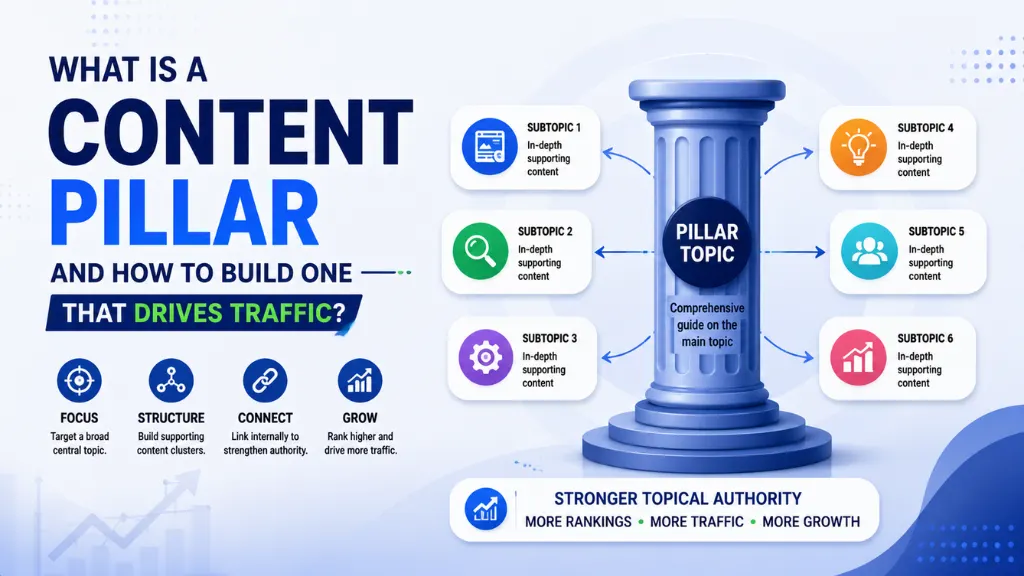

Here is the pattern that separates sites quietly compounding traffic year over year from sites stuck publishing into the void: the first group stopped writing isolated blog posts and started building content pillars instead.
In this article14 sections
A content pillar is a comprehensive resource on a broad topic, surrounded by a structured network of supporting articles that all link back to it. Sites that implement this model correctly see an average 40% increase in organic traffic compared to scattered, non-clustered content strategies.
A content pillar works because Google’s algorithms have grown sophisticated enough to evaluate the depth and coherence of a site’s topical knowledge, not just individual keyword matches. A site with twenty interconnected articles on a subject will consistently outrank a single, technically excellent 5,000-word article standing alone.
A content pillar also matters more in 2026 because AI answer engines like ChatGPT and Perplexity do not just rank pages – they retrieve information based on how completely a site covers a topic, making this structure essential for both traditional search and AI citation.
At Search Savvy, restructuring scattered content into proper content pillars is one of the highest-impact changes we make for clients, often doubling organic traffic within three to six months. This guide breaks down exactly what a content pillar is and how to build one that genuinely drives traffic.
What Is a Content Pillar?#
A content pillar is a long-form, comprehensive piece of content that provides a broad, authoritative overview of a core topic central to your business, acting as the central hub a network of related articles connects back to.
A content pillar differs from a regular blog post in scope and purpose. While a blog post might answer one narrow question, a content pillar aims to be the definitive resource on an entire subject – covering every major aspect at a high level while linking out to deeper, more specific cluster articles for detail.
People Also Ask: What is the difference between a content pillar and a regular blog post? Short Answer: A content pillar is a comprehensive, broad-topic resource that links to multiple supporting cluster articles, while a regular blog post typically answers one specific, narrower question. A content pillar acts as a hub; blog posts and cluster content act as the connected spokes around it.
How Does a Content Pillar Work?#
A content pillar works through a hub-and-spoke structure: the pillar page covers a topic broadly, while individual cluster articles each explore one specific subtopic in depth, and every piece links back and forth to reinforce the relationship.
A content pillar requires the pillar page itself to link out to every cluster article it supports, and every cluster article must link back to the pillar using descriptive, keyword-aligned anchor text. This two-way linking structure is what signals topical completeness to Google, rather than any single page in isolation.
A content pillar creates more than a web of links – it creates a semantic map that helps AI answer engines understand how your content is organised and which pages carry the most authority on a given subject, which matters increasingly for citation in AI Overviews and conversational search tools.
People Also Ask: Why does internal linking matter so much for a content pillar? Short Answer: Internal linking is what physically connects a content pillar to its cluster pages, distributing link equity and signalling topical depth to search engines. Without consistent two-way linking, a pillar page and its supporting articles function as isolated content rather than a coherent authority signal.
How Do You Build a Content Pillar That Drives Traffic?#
A content pillar should be built through a deliberate, sequential process rather than written in one sitting. Skipping the planning stages is the most common reason pillar pages fail to gain traction.
Step 1: Identify Your Core Topic#
A content pillar should be built around a broad topic central to your business that addresses a key problem your audience faces. The topic needs to be broad enough to support roughly 8 to 22 more specific cluster articles, but focused enough to stay clearly relevant to what your business actually does.
A content pillar strategy works best when most businesses limit themselves to three to four core pillar pages directly tied to the main problems their business solves. Trying to build too many pillars at once dilutes both focus and authority – a few exceptionally comprehensive pillars consistently outperform many weak ones.
Step 2: Research Keywords and Competitors#
A content pillar needs a clear “head” keyword – the main, broad term the pillar page targets – along with a list of related long-tail keywords mapped across the planned cluster articles. Analysing top-ranking content for your chosen topic reveals what competitors cover well, what they miss, and where genuine content gaps exist.
A content pillar built around competitive gap analysis tends to outperform pillars built without it. Pages addressing subtopics competitors have not covered capture long-tail traffic and strengthen your overall E-E-A-T signal at the same time.
Step 3: Audit Existing Content#
A content pillar project often does not start from zero. Many businesses already have blog posts that can serve as cluster content once properly linked to a new pillar page. Auditing existing content first reveals which pieces to repurpose, which need expansion, and which genuine content gaps still need to be filled.
Step 4: Outline and Write the Pillar Page#
A content pillar page typically requires 2,000 to 5,000 words of genuinely comprehensive coverage, depending on topic complexity, with each major section corresponding to a subtopic that links out to its own dedicated cluster article for deeper detail.
A content pillar should prioritise quality and depth over hitting a specific word count target. A thin pillar page undermines the authority signal of the entire cluster surrounding it, even if every cluster article underneath it is individually strong.
Step 5: Build the Cluster Articles Around It#
A content pillar is supported by cluster articles, each focused on a more specific, long-tail keyword and exploring one angle of the broader topic in real depth. Most well-developed pillar strategies use roughly 10 to 15 supporting articles per pillar, published systematically over three to four months rather than all at once.
| Pillar Strategy Element | Recommended Range |
| Pillar page length | 2,000–5,000 words |
| Cluster articles per pillar | 10–15 (up to 22 for very broad topics) |
| Core pillars per business | 3–4 to start |
| Internal links per page | Under 100, to preserve link equity |
| Rollout timeline | 3–4 months of systematic publishing |
Step 6: Link Everything Together Strategically#
A content pillar’s internal linking should follow a clear hierarchy – pillar pages linking down to cluster content, and every cluster page linking back up to the pillar – using descriptive, natural anchor text rather than generic phrases like “click here.” Google generally recommends keeping internal links under 100 per page to preserve the SEO value each link carries.
People Also Ask: How many cluster articles does a content pillar need? Short Answer: Most content pillars work well with 10 to 15 supporting cluster articles, though very broad topics can support up to 22. The right number depends on how many genuinely distinct, valuable subtopics exist within the broader pillar topic without forcing overlap between articles.
Why Is a Content Pillar Important in 2026?#
A content pillar matters more in 2026 because Google’s Helpful Content systems evaluate the depth and breadth of topic coverage directly, not just keyword density on individual pages. A site with many interconnected, genuinely useful articles consistently outranks a single standalone page, regardless of how well-optimised that single page is.
A content pillar also supports visibility in AI Overviews and AI Mode specifically, since Google’s AI features rely on the same accessible, structured web content and search systems that traditional rankings depend on. A 2026 measurement study found AI Overviews activating on over half of representative real-user queries, making structured, answer-rich pillar content increasingly relevant to discoverability.
A content pillar compounds rather than plateaus. Sites that sustain cluster publishing for twelve or more months see roughly 40% higher organic traffic than comparable single-page strategies, since authority signals accumulate as Google indexes more cluster pages and internal links continue distributing equity through the structure.
- Content clusters increase organic traffic by an average of 40% over non-clustered strategies
- Pillar page traffic often increases 150–300% within three to six months of cluster content maturing
- AI answer engines evaluate topic completeness, not isolated pages, when selecting sources to cite
- Results compound over 6–12 months rather than appearing immediately after publishing
How Do You Measure Whether a Content Pillar Is Working?#
A content pillar should be measured as a complete ecosystem, not as a single isolated page. Use Google Search Console filters to group all URLs belonging to the same pillar – for example, filtering every page under a specific content hub directory – so reporting reflects the full cluster’s performance, not just the pillar URL alone.
A content pillar’s core performance indicators include organic traffic growth to the pillar and its clusters, keyword ranking movement across the hub, dwell time, bounce rate, conversion rate, and the backlinks and social shares the hub attracts as a unit.
- Organic traffic – visitor growth from search across the pillar and all cluster pages
- Keyword rankings – ranking movement for both the head term and long-tail cluster terms
- Engagement metrics – dwell time and bounce rate signal whether content satisfies intent
- Conversion rate – how effectively the hub moves visitors toward a desired action
People Also Ask: How long does it take to see results from a content pillar strategy? Short Answer: Most content pillar strategies take 3 to 6 months to show meaningful traffic gains as cluster content matures and begins ranking, with results compounding further over 6 to 12 months as authority signals accumulate and internal links continue distributing equity through the structure.
How Should Indian Businesses Build a Content Pillar Strategy?#
A content pillar approach benefits Indian businesses especially well in competitive categories, where scattered, one-off blog posts rarely break through against established competitors already publishing at scale.
A content pillar built for Indian audiences should weave in regional specificity throughout the cluster – INR pricing, city-specific examples, and platforms like Justdial, IndiaMART, or WhatsApp Business – since generic, broadly-written cluster content underperforms against more locally relevant alternatives.
According to Search Savvy’s insights from restructuring content libraries for Indian D2C and service-business clients, starting with a single well-built pillar – rather than attempting three or four simultaneously – consistently produces faster, cleaner results, since focus and depth outperform breadth in the early stages of any pillar strategy.
Conclusion: Build Depth, Not Just Volume#
A content pillar is not a quick SEO hack; it is a fundamental shift in how content gets created, organised, and connected. The businesses winning in search throughout 2026 are not the ones publishing the most content, but the ones publishing the most strategically structured content.
Search Savvy helps brands restructure scattered articles into genuine content pillars with proper cluster architecture and internal linking, because this structural shift consistently outperforms simply producing more isolated content.
FAQ: Content Pillar – Your Questions Answered#
Q1: How long should a content pillar page be? Most content pillars require 2,000 to 5,000 words of genuinely comprehensive coverage, though the right length depends on topic complexity. Quality and depth matter more than hitting a specific word count, since a thin pillar page weakens the authority of the entire cluster around it.
Q2: How many content pillars should a business have? Most businesses should start with three to four core pillars directly tied to the main problems their business solves. Trying to build too many pillars at once dilutes focus and authority; a few comprehensive pillars consistently outperform many shallow ones.
Q3: Can I turn existing blog posts into cluster content for a new pillar? Yes. Auditing your existing content library often reveals posts that can serve as cluster content once properly linked to a new pillar page. This is usually faster than building an entire pillar and cluster set from scratch.
Q4: Does a content pillar strategy help with AI Overview visibility? Yes. AI answer engines like ChatGPT and Perplexity retrieve information based on how completely a site covers a topic, not just isolated page quality. A well-built content pillar with deep cluster support signals exactly this kind of topical completeness.
Q5: How many internal links should connect a pillar page to its clusters? Every cluster page should link back to the pillar, and the pillar should link out to every cluster, using descriptive anchor text. Keep total internal links under roughly 100 per page to preserve the SEO value each link carries.
Q6: How soon will a content pillar start driving meaningful traffic? Most pillars take three to six months to show meaningful traffic growth as cluster content matures and begins ranking, with pillar page traffic often increasing 150% to 300% within that window as the surrounding cluster content gains traction.
Sitting on a library of scattered blog posts that never quite take off – or unsure how to structure your first content pillar? Visit Search Savvy for a content architecture audit that maps your existing posts into a pillar-cluster strategy built to compound.