
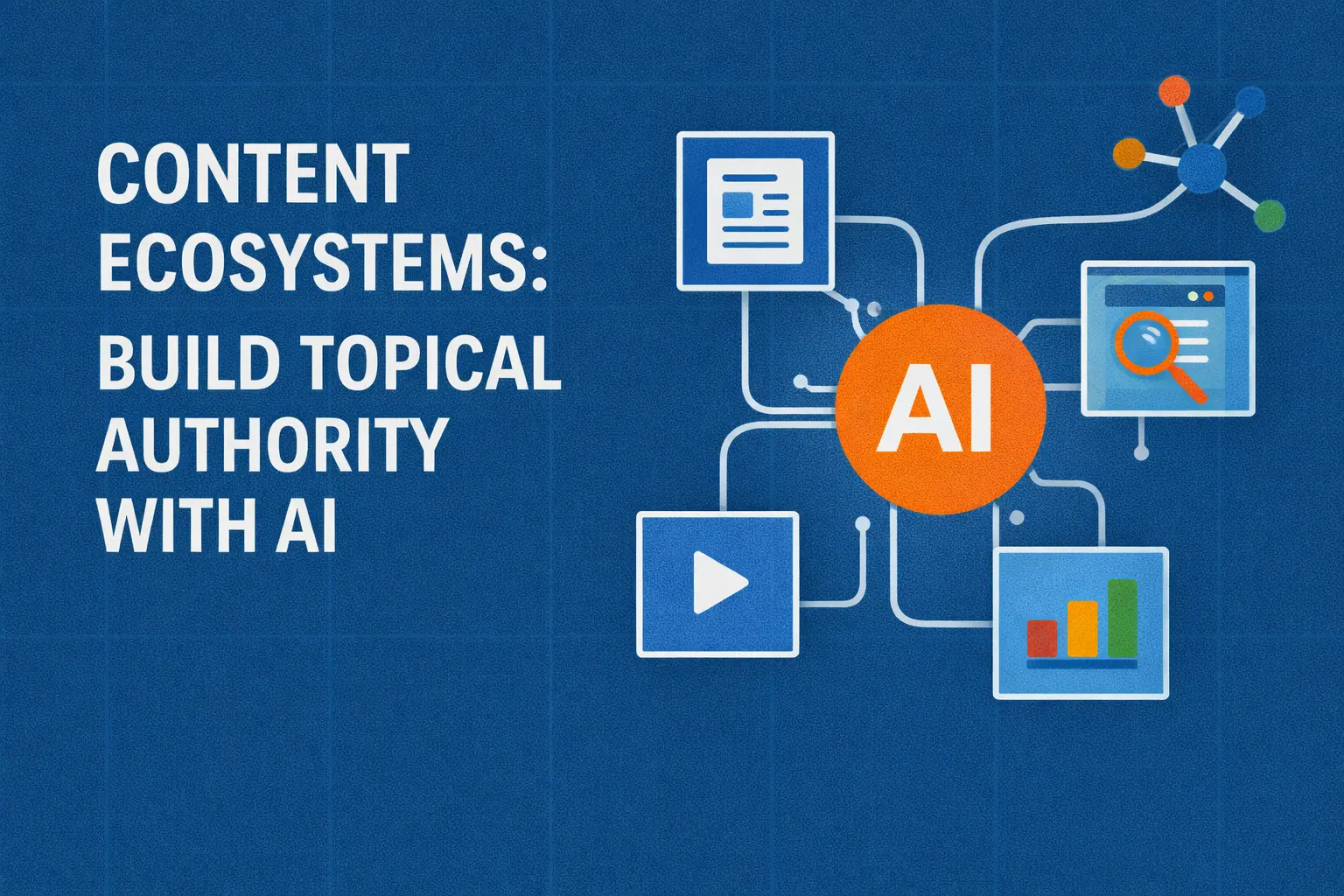

The digital landscape has fundamentally transformed. In 2026, success isn’t about publishing individual blog posts-it’s about creating interconnected AI-driven content ecosystems that establish your brand as the definitive authority in your niche. At Search Savvy, we’ve observed how brands that embrace this strategic shift are capturing visibility not just in traditional search engines, but across AI platforms like ChatGPT, Perplexity, Claude, and Google’s AI Overviews.
AI-driven content ecosystems represent a paradigm shift from keyword-focused strategies to comprehensive topic networks. According to recent industry data, AI platforms like ChatGPT, Google AI Overviews, and Perplexity now influence between 9.7% of B2B revenue and 11.4% of B2C revenue, despite sending less traditional traffic. This means prospects research inside AI tools long before they visit your website. At Search Savvy, we help businesses build content ecosystems that capture attention across both human search and AI-powered discovery platforms.
The stakes have never been higher. Google no longer relies on exact keyword matches-it recognizes semantic relationships, cross-references claims with authoritative sources, and rewards websites that comprehensively answer user questions. Brands dominating search in 2026 aren’t those with the most content, but those with the most strategically connected content.
What Are AI-Driven Content Ecosystems?
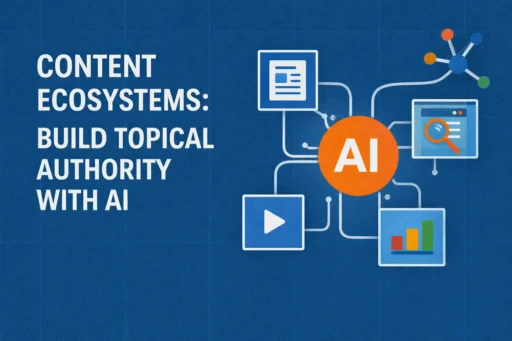
AI-driven content ecosystems are strategically interconnected networks of content that work together to establish topical authority and maximize visibility across both traditional search engines and AI platforms. Unlike scattered blog posts or isolated articles, these ecosystems function as cohesive knowledge hubs where each piece of content reinforces and amplifies the others.
AI-driven ranking systems now prioritize concept-based signals rather than matching words on a page. When your content is organized as an ecosystem-with pillar pages, supporting cluster content, and strategic internal linking-AI engines can clearly understand your subject expertise and reward you with higher visibility.
At Search Savvy, we define a content ecosystem as having three essential components: comprehensive pillar content that covers broad topics authoritatively, cluster content that explores specific subtopics in depth, and strategic internal linking that connects everything into a semantic web that both users and AI can navigate effortlessly.
Why Is Topical Authority Important for AI Visibility in 2026?
Topical authority has emerged as the dominant ranking factor in 2026, eclipsing traditional keyword density. Search engines evaluate how thoroughly and consistently your entire site covers a subject area, not just whether individual pages include specific keywords. This shift fundamentally changes how content marketing works.
Keyword density is officially dead-AI ranks content creators who demonstrate actual expertise through deep content ecosystems with pillar pages, semantic clusters, and structured internal linking. Brands that continue relying on keyword-stuffed articles without broader context are experiencing declining visibility.
The impact is measurable. Businesses that effectively employ topic cluster strategies experience a 97% increase in organic search traffic. According to Search Savvy’s insights, this happens because topical authority signals to AI that your brand provides complete, trustworthy information rather than surface-level content.
AI platforms like ChatGPT and Google’s AI Overviews prioritize citing sources that demonstrate comprehensive knowledge. Brands with robust knowledge graph presence see 35% higher AI visibility, as AI models cross-reference for accuracy. When you build topical authority, you’re not just improving rankings-you’re positioning your brand as the go-to resource that AI systems cite when users ask questions.
How Do Content Clusters Build Topical Authority?
Content clusters form the structural foundation of any effective AI-driven content ecosystem. These clusters create a web of pillar pages and supporting assets that signal expertise to AI crawlers. The architecture is straightforward but powerful: one comprehensive pillar page covering a broad topic, linked to 10-15 cluster articles that explore specific subtopics.
The Pillar-Cluster Architecture
Your pillar page serves as the authoritative hub-a comprehensive resource of typically 2,000-3,000 words that provides a complete overview of your core topic. For example, if your pillar topic is “Content Marketing Strategy,” this page would cover fundamentals, benefits, frameworks, and best practices at a high level.
Cluster content then dives deeper into specific aspects: “How to Create Buyer Personas,” “Email Marketing Tactics That Convert,” or “Measuring Content ROI.” Each cluster article targets long-tail keywords and answers specific user questions, while linking back to the pillar page and cross-linking to related cluster content.
Why This Structure Works for AI
When articles, videos, and supporting pieces connect around one theme, they help search engines understand the subject from multiple angles, giving the brand more authority because each piece reinforces the others. AI models analyze these connections to determine topic depth and expertise.
According to Search Savvy’s research, this interconnected structure solves a critical challenge: a single post on a topic without internal links or broader context appears shallow to search engines, even if well-written. Content clusters demonstrate that you’re not just touching on a topic-you own it.
What Is GEO and How Does It Differ from Traditional SEO?
Generative Engine Optimization (GEO)-also called Answer Engine Optimization (AEO)-represents the evolution of search optimization for AI-powered platforms. GEO focuses on optimizing content so AI assistants cite your brand when answering user queries, targeting platforms like ChatGPT and Perplexity rather than just search engines.
Understanding the GEO Landscape
ChatGPT processed over 2 billion queries monthly as of late 2024, with AI Overviews appearing on at least 13% of all search engine results pages. This creates massive new opportunities for brand visibility-but only for those who optimize for how AI systems understand and cite content.
The key difference is fundamental: traditional SEO optimizes for ranking in search results lists, while GEO optimizes for being selected as the authoritative source in AI-generated answers. Research from Princeton University shows that GEO methods can boost visibility by up to 40% in generative engine responses.
Critical GEO Strategies for 2026
At Search Savvy, we recommend implementing these core GEO tactics:
Structured FAQ Content: AI engines prioritize clear, concise answers. Create FAQ sections that directly answer common questions in 40-60 words. Use FAQ schema markup so AI systems can easily parse and cite your responses.
Entity-Rich Content: AI systems convert content into numerical representations for semantic similarity matching, understanding how terms relate to each other through entity recognition. Naturally incorporate relevant entities-people, places, concepts, tools, standards-throughout your content.
Passage-Level Optimization: Content should be structured in sentences, paragraphs, or passages that can be independently evaluated for relevancy. Each section should stand alone as a potential answer to user queries.
Citation-Worthy Format: Use clear subheadings (H2 and H3 tags), bullet points for key information, and short paragraphs. AI systems favor content that’s well-structured and scannable.
How Should You Structure Content for Voice and AI Search?
Voice search and AI platforms fundamentally prefer conversational, question-based content. Between 20% and 27% of people globally use voice search, especially on mobile devices. Optimizing for this behavior requires rethinking content structure.
Question-Based Subheadings
Transform your content structure using question-format headings that mirror how people actually search. Instead of “Content Marketing Benefits,” use “What Are the Key Benefits of Content Marketing?” This aligns perfectly with how users phrase voice queries and how AI systems interpret search intent.
Natural Language Answers
AI platforms reward content written in natural, conversational language. Avoid jargon-heavy technical writing unless your audience specifically requires it. Present information as if you’re having a conversation with someone seeking guidance.
Featured Snippet Optimization
AI-friendly content structured with FAQ formats and schema markup significantly increases citation rates across platforms like ChatGPT, Perplexity, and Google’s AI systems. Create content specifically designed to win featured snippets-concise answers of 40-60 words that directly address common queries.
According to Search Savvy’s content frameworks, the ideal structure includes a clear question as your H2 or H3 heading, followed immediately by a direct answer in the opening paragraph, then supporting details, examples, and related information in subsequent paragraphs.
What Role Does Schema Markup Play in AI Visibility?
Schema markup has become mission-critical for AI visibility. This structured data helps AI systems understand exactly what your content represents, making it significantly more likely to be cited in AI-generated responses.
Essential Schema Types for 2026
FAQ Schema: Marks up your questions and answers so AI platforms can extract them directly. This is the single most impactful schema type for GEO.
Article Schema: Identifies your content type, author, publication date, and key details that establish credibility.
Organization Schema: Establishes your brand as an entity in knowledge graphs, influencing 25% of AI responses through verified entity recognition.
How-To Schema: Perfect for instructional content, providing step-by-step guidance that AI systems love to cite.
Implementation Strategy
Use AI tools like ChatGPT or Claude to create schema markup in JSON-LD format based on your content, then validate it using Google’s Rich Results Test. This ensures your markup is correct and eligible for rich results.
At Search Savvy, we’ve seen clients achieve 30-50% improvements in AI visibility simply by implementing comprehensive schema markup across their content ecosystems. The investment is minimal, but the returns are substantial.
How Do You Build Content Ecosystems That AI Systems Trust?
Building trust with AI systems requires demonstrating expertise, authority, and reliability through your content ecosystem’s structure and substance.
E-E-A-T Optimization
Google cross-references site claims with widely accepted sources and factual knowledge. Your content ecosystem must demonstrate Experience, Expertise, Authoritativeness, and Trustworthiness. This means citing credible sources, providing original research or insights, and maintaining consistency across your content.
Comprehensive Topic Coverage
If a user might ask 10 follow-up questions, AI rewards websites that already address all of them. Map out every possible question related to your topic and create content addressing each one. This completeness signals authority.
Regular Content Updates
AI models favor fresh, actively maintained content clusters. Set a schedule to review and update your pillar pages every 3-6 months. Add new statistics, refresh examples, incorporate new cluster content, and ensure all information remains current.
Strategic Internal Linking
Create a robust internal linking structure that connects related content. Link from cluster articles back to pillar pages, cross-link between related cluster content, and use descriptive anchor text that helps AI understand relationships between topics.
What Tools Can Help Build AI-Optimized Content Ecosystems?
The right tools streamline the process of building and optimizing content ecosystems for AI visibility.
Content Research and Planning
Use tools like Semrush, Ahrefs, and AnswerThePublic to identify topic clusters and question-based content opportunities. MarketMuse focuses on AI-driven content strategy with topic modeling, competitive analysis, and content brief generation for building topical authority.
AI Visibility Tracking
Platforms like Conductor provide end-to-end AEO capabilities, combining AI visibility tracking with content creation and real-time site monitoring. These tools help you understand how AI platforms cite your brand and identify optimization opportunities.
Content Creation and Optimization
AI writing assistants can help generate content briefs, outlines, and first drafts-but always require human expertise to ensure accuracy, originality, and brand voice. By leveraging AI, teams can generate detailed content briefs in minutes and design content ecosystems that establish topical authority.
Schema Implementation
Use Google’s Schema Markup Generator and Rich Results Test to create and validate your structured data.
At Search Savvy, we emphasize that tools accelerate execution, but strategy comes first. Start with a clear content ecosystem plan, then deploy tools to execute efficiently.
How Can You Measure Success of Your AI-Driven Content Ecosystem?
Measuring performance requires tracking both traditional SEO metrics and AI-specific visibility indicators.
Traditional SEO Metrics
- Organic traffic growth to pillar and cluster pages
- Keyword rankings for target terms
- Time on page and engagement metrics
- Internal link click-through rates
- Backlink acquisition to pillar content
AI Visibility Metrics
Success measurements should focus on visibility within AI-generated responses and brand authority establishment through citations. Track how often AI platforms cite your brand, monitor sentiment in AI-generated responses, measure brand mention volume across AI tools, and analyze which content types receive the most AI citations.
Business Impact Metrics
Ultimately, success ties to business outcomes. Monitor lead generation from content ecosystem pages, conversion rates for ecosystem visitors, sales pipeline influence from AI-sourced traffic, and customer acquisition cost improvements.
According to Search Savvy’s methodology, review your content ecosystem performance monthly, conduct comprehensive audits quarterly, and refine your strategy based on both quantitative data and qualitative insights from AI citations.
What Are Common Mistakes to Avoid When Building Content Ecosystems?
Even well-intentioned efforts can fail without proper execution. Avoid these critical mistakes:
Publishing Without Strategy: Producing content takes time, energy, and budget-if that content isn’t part of a larger structure, it often gets lost in search results and underperforms. Always plan your ecosystem before creating individual pieces.
Weak Internal Linking: Content ecosystems derive power from connections. Failing to implement strategic internal linking means AI systems can’t understand relationships between your content pieces.
Neglecting Content Updates: Refreshing important content every 3-6 months helps maintain rankings and prevents outdated information penalties. Stale content signals declining authority.
Chasing Too Many Topics: Don’t jump to unrelated topics-build authority one category at a time. Depth beats breadth when establishing topical authority.
Ignoring Schema Markup: Skipping structured data implementation dramatically reduces your AI visibility. This is a foundational requirement, not an optional enhancement.
At Search Savvy, we see these mistakes regularly. The good news is they’re all preventable with proper planning and execution discipline.
How Will AI-Driven Content Ecosystems Evolve Beyond 2026?
The trajectory is clear: AI will continue playing an increasingly dominant role in content discovery and consumption. The industry is converging on terminology that blends AI, search, and optimization-with AISO appearing in 11,001 active job postings, outpacing traditional SEO roles.
Emerging Trends
Multimodal Content: Video, images, podcasts, and text will integrate more seamlessly within ecosystems. YouTube dominates AI citations, frequently appearing as an authoritative source for visual how-to guides and explainers.
Real-Time Optimization: AI platforms increasingly value freshness. Content ecosystems will need dynamic updating capabilities to maintain competitive advantage.
Personalized Content Delivery: AI systems track real-time intent shifts, mapping customer journeys with precision. Future ecosystems will adapt content presentation based on individual user context.
Voice-First Experiences: As voice search continues growing, content ecosystems optimized for conversational discovery will dominate.
According to Search Savvy’s future outlook, brands investing in comprehensive content ecosystems today are building sustainable competitive advantages that will compound over time.
FAQ
What is an AI-driven content ecosystem?
An AI-driven content ecosystem is a strategically interconnected network of content pieces-including pillar pages, cluster articles, multimedia assets, and supporting resources-designed to establish topical authority and maximize visibility across both traditional search engines and AI platforms like ChatGPT, Perplexity, and Google’s AI Overviews.
How long does it take to build an effective content ecosystem?
Building a complete content ecosystem typically requires 3-6 months for a single topic cluster, including one comprehensive pillar page and 10-15 supporting cluster articles. However, you can start seeing results within 4-8 weeks as individual pieces begin ranking. The key is consistency and strategic planning rather than rushing to publish.
Can AI-generated content work within content ecosystems?
AI tools can assist with research, outlining, and drafting, but human expertise remains essential for ensuring accuracy, originality, and brand voice. Google and other platforms don’t penalize AI-generated content by default-they penalize low-quality, generic, or unhelpful content regardless of how it’s created. Focus on creating valuable, expert-driven content whether you use AI assistance or not.
How many pillar pages should a website have?
Start with 2-3 pillar pages focused on your core business topics and expand gradually. Quality and depth matter more than quantity. Each pillar requires substantial supporting content and ongoing maintenance, so don’t overextend. Small businesses should focus on 1-2 pillars initially, while enterprises might manage 5-10 or more across different business units.
What’s the difference between GEO and traditional SEO?
Traditional SEO optimizes for ranking in search engine results pages, while GEO (Generative Engine Optimization) optimizes for being cited in AI-generated answers on platforms like ChatGPT, Perplexity, and Google’s AI Overviews. GEO emphasizes structured data, FAQ formats, entity recognition, and citation-worthy content formatting, while traditional SEO focuses on keywords, backlinks, and technical optimization.
How do I know if my content ecosystem is working?
Monitor organic traffic growth to your pillar and cluster pages, track keyword rankings, measure engagement metrics like time on page, observe backlink acquisition, and most importantly, use tools to track citations in AI-generated responses. Business metrics like lead generation and conversion rates from ecosystem pages provide the ultimate success indicator.
Building AI-driven content ecosystems represents the future of digital marketing. The brands that embrace this strategic approach-creating interconnected content networks that demonstrate deep topical authority-will dominate visibility across both traditional search and emerging AI platforms. At Search Savvy, we’re committed to helping businesses navigate this transformation and capture the opportunities that AI-driven discovery creates.
Start building your content ecosystem today, and position your brand as the authoritative source that both humans and AI systems trust and cite.