
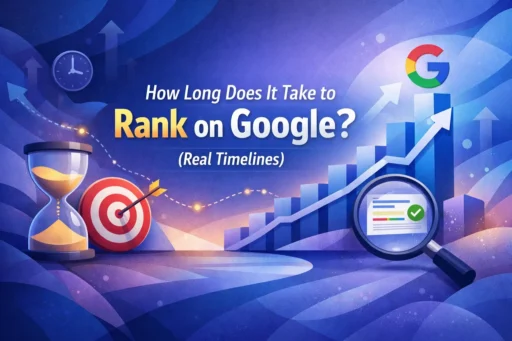

Ranking on Google is the ultimate goal for any business with an online presence – but how long does it actually take? At Search Savvy, we get this question almost every day, and the honest answer is: it depends. But that doesn’t mean you have to fly blind. With the right data and realistic expectations, you can build an SEO strategy that delivers results – on a timeline you can actually plan around.
In this post, we break down the real Google ranking timelines for 2026, the key factors that speed things up or slow them down, and what you can do right now to start climbing the search engine results pages (SERPs).
What Does It Actually Mean to “Rank on Google”?
Ranking on Google isn’t a single event – it’s a progression through several distinct stages. Understanding each stage helps you set realistic milestones:
- Indexing – Google discovers and stores your URL (usually within days to a few weeks).
- Impressions – Your page starts appearing for queries, even if it’s on page 5 or 6.
- First Keyword Movement – You begin ranking for long-tail, low-competition queries.
- Top 10 (Page 1) – You break onto the first page of results.
- Top 3 – Where clicks become truly meaningful (positions 1–3 capture over 50% of all clicks).
- Stability – Your rankings hold consistently over time, surviving algorithm updates.
Each of these stages has its own timeline, and most businesses jump straight to thinking about page one – without realising that indexing and first impressions are the critical foundations that come first.
How Long Does It Take to Rank on Google in 2026?
Ranking on Google in 2026 takes longer than it did even three years ago. Here’s what the latest data tells us:
- A May 2025 Ahrefs study analysed millions of URLs and found that only 1.74% of newly published pages reach the top 10 within one year – down sharply from 5.7% in 2017.
- The average #1 ranking page is now 5 years old, more than double the 2-year average seen in earlier studies.
- Pages ranking in the top 10 that are older than 3 years increased from 59% to 72.9% between 2017 and 2025.
- However, of pages that do achieve a top 10 ranking, 40.82% get there within the first month – suggesting that early momentum from strong content and smart targeting is still very achievable.
What Does This Mean for Your Business?
Ranking on Google is a long game for competitive keywords, but it doesn’t have to be a waiting game. The key is targeting the right keywords at the right stage of your website’s authority.
Here’s a practical breakdown by scenario:
| Scenario | Estimated Timeline to Page 1 |
| New website, competitive keywords | 12–24+ months |
| New website, long-tail keywords | 3–6 months |
| Established site, new content | 1–3 months |
| Established site, optimised existing content | 2–6 weeks |
| Local SEO (Google Maps / Local Pack) | 3–6 months |
Why Is It Harder to Rank on Google in 2026?
Ranking on Google has become significantly more competitive for several interconnected reasons:
- AI-generated content is flooding the SERPs. Current data shows that 17.31% of top 20 search results are now AI-generated (as of late 2025), up from 7.43% in early 2024. This means human-led, experience-backed content is more valuable than ever.
- Google’s E-E-A-T standards are stricter. Experience, Expertise, Authoritativeness, and Trustworthiness are baked into how Google evaluates your content in 2026 – and AI cannot authentically replicate real-world experience.
- Domain age and history matter more. Google is increasingly rewarding established, trusted domains over fresh ones.
- Core algorithm updates are more frequent. Google rolled out multiple broad core updates in 2025–2026, causing ranking volatility even for well-optimised pages.
What Factors Speed Up (or Slow Down) Your Google Ranking?
Ranking on Google faster comes down to controlling the variables you can influence. Here’s what moves the needle:
Factors That Speed Up Rankings
- Targeting long-tail keywords with lower competition and clear search intent
- Building topical authority by publishing clusters of related, high-quality content
- Internal linking – connecting new pages to established, trusted pages on your site
- Earning quality backlinks from authoritative, relevant websites
- Optimising for Core Web Vitals – fast load times, stable layouts, and mobile responsiveness
- Submitting your sitemap and new URLs via Google Search Console
Factors That Slow Down Rankings
- Publishing thin, repetitive, or AI-generated content without genuine expertise or editorial oversight
- Ignoring technical SEO – broken links, crawl errors, slow page speed
- Targeting overly broad, high-competition keywords too early
- Weak internal linking structure
- No backlink profile or link-building strategy
- Failing to update older content as it decays in relevance
According to Search Savvy’s internal analysis of client campaigns, the single most common reason for slow rankings is mismatched keyword targeting – businesses going after head terms before they’ve built the authority to compete for them.
How Does Google Ranking Work for New Websites?
Ranking on Google as a brand-new website comes with an extra challenge known as the “Google Sandbox Effect.” New domains often experience a trust delay, where Google holds back strong rankings while it evaluates the site’s quality, consistency, and backlink signals over time.
Here’s what typically happens in the first year for a new website:
- Months 1–2: Crawling and indexing. Some long-tail impressions may appear in Search Console.
- Months 3–4: First keyword movement. Pages targeting low-competition queries begin to rank.
- Months 5–6: Organic traffic starts to trickle in, particularly from informational content.
- Months 6–12: More competitive terms begin to move, especially if link-building is active.
- Month 12+: Topical authority consolidates; first-page rankings for target keywords become achievable.
Pro Tip from Search Savvy: Don’t start with your hardest keywords. Build a content cluster around long-tail, niche queries first – rank for those, earn trust, then graduate to more competitive terms.
People Also Ask: Google Ranking FAQs
How quickly can a new page rank on Google?
A new page on an established, authoritative website can begin ranking within days to a few weeks for low-competition, long-tail keywords. On a brand-new domain, expect 3–6 months minimum before meaningful organic traffic appears.
Does publishing more content help you rank faster on Google?
Yes – but only if that content is high-quality and topically relevant. Data from Grow and Convert’s analysis of 40+ clients shows that after 20 months of consistent content publishing, clients averaged over 50 first-page keyword rankings. After three years, that figure exceeded 100.
Can you rank on Google without backlinks?
Ranking on Google for very low-competition, long-tail queries is possible without backlinks – particularly for local or niche topics. However, for any competitive keyword category, a backlink profile is essentially non-negotiable. Backlinks remain one of Google’s top three ranking signals.
Does Google rank AI-generated content?
Yes – Google ranks content based on quality and helpfulness, not its origin. However, purely AI-generated content without genuine human expertise, editing, and experience signals tends to underperform for E-E-A-T-sensitive queries. Original research, real examples, and first-hand insights continue to outperform generic AI output.
How Can You Rank on Google Faster? (Actionable Steps for 2026)
Ranking on Google faster isn’t about gaming the algorithm – it’s about executing fundamentals with precision. Here’s a practical roadmap:
Step 1: Start with a Technical SEO Audit Use Google Search Console and Ahrefs or Semrush to identify crawl issues, indexing problems, and page speed bottlenecks.
Step 2: Build a Keyword Strategy Around Realistic Targets Segment keywords by difficulty. Prioritise low-competition, high-intent long-tail keywords first, then layer in broader terms as your authority grows.
Step 3: Create Content Clusters, Not Isolated Posts Build a pillar page around your core topic, supported by several related cluster pages. Link them together naturally. This is how topical authority is earned.
Step 4: Earn Links Strategically Publish original research, useful templates, or definitive guides that other websites naturally want to reference. Even a handful of relevant, authoritative backlinks significantly accelerates rankings.
Step 5: Monitor, Update, and Improve SEO is not publish-and-forget. Revisit your top pages every 3–6 months. Update statistics, improve structure, and align content with evolving search intent.
Frequently Asked Questions (FAQ)
Q1: How long does it take to rank on Google for a competitive keyword?
For highly competitive keywords, ranking on Google’s first page can take anywhere from 6 to 24 months, depending on your domain authority, content quality, and link-building consistency.
Q2: Is 3 months enough time to rank on Google?
Ranking on Google in 3 months is realistic for long-tail, low-competition keywords – especially on an established website. For broad or competitive terms, 3 months will typically show early progress but not first-page results.
Q3: How does Google decide which pages rank first?
Ranking on Google is determined by hundreds of signals including content quality, E-E-A-T, backlink authority, user experience, Core Web Vitals, mobile-friendliness, search intent alignment, and domain history.
Q4: What is the fastest way to rank on Google? The fastest legitimate path to ranking on Google involves targeting low-competition, long-tail keywords; optimising existing content that’s already receiving impressions; improving internal linking; and earning a few high-quality backlinks quickly.
Q5: Does Google rank local businesses differently?
Yes. Ranking on Google for local searches involves additional signals such as yourGoogle Business Profile optimisation, NAP (Name, Address, Phone) consistency, review volume and quality, and proximity to the searcher. Local rankings typically improve within 3–6 months of consistent effort.
Q6: Should I use PPC while waiting to rank on Google?
Absolutely. At Search Savvy, we recommend running a paid search campaign alongside your SEO efforts – particularly in the first 6–12 months.Google Ads delivers immediate visibility while your organic rankings build, ensuring you don’t miss leads during the growth phase.
Final Thoughts
Ranking on Google in 2026 demands patience, precision, and consistency. There are no shortcuts – but there are smart strategies that separate the businesses that rank from those that don’t. The data is clear: early momentum matters, topical authority compounds over time, and quality always wins over volume.
At Search Savvy, we help brands cut through the noise with SEO strategies built on real data, not guesswork. Whether you’re starting from scratch or looking to accelerate an existing campaign, the best time to invest in your rankings is right now.