
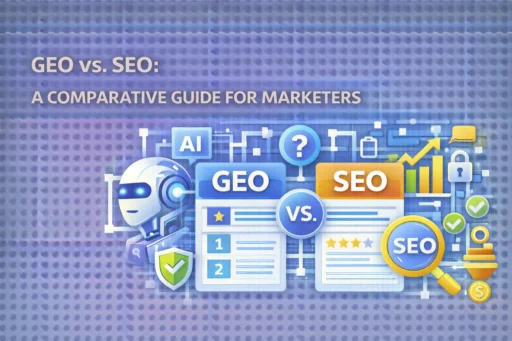

GEO vs. SEO represents the evolution of digital marketing in 2025, where traditional search engine strategies meet artificial intelligence-powered discovery. At Search Savvy, we’ve watched the digital landscape transform dramatically as AI-driven platforms like ChatGPT, Perplexity, and Google’s AI Overviews reshape how users find information online. This comprehensive guide will help you understand both optimization strategies and how to leverage them together for maximum visibility.
The search ecosystem has fundamentally changed. While Google still commands 89.74% of the global search market, AI platforms are rapidly gaining ground, with referral traffic from ChatGPT increasing by 44% and Perplexity by 71% in recent months. According to Search Savvy’s analysis of current trends, AI platforms already drive 6.5% of organic traffic and are projected to reach 14.5% within the next year.
What Is Search Engine Optimization (SEO)?
SEO remains the cornerstone of digital visibility strategies in 2025. Search Engine Optimization involves enhancing your website’s ranking on search engine results pages by optimizing content to align with search algorithms. The practice focuses on using relevant keywords naturally, earning backlinks from trusted sites, ensuring technical health like fast load times, and maintaining mobile-friendliness.
Traditional SEO success is measured through:
- Click-through rates (CTR)
- Keyword rankings and position tracking
- Organic traffic volume
- Time spent on page
- Bounce rates
- Backlink quality and quantity
SEO operates within a well-established ecosystem where search engines like Google, Bing, and DuckDuckGo use crawlers to discover and index content, then rank pages based on hundreds of signals. The goal is straightforward: appear in the top results when users search for relevant terms, driving clicks to your website.
What Is Generative Engine Optimization (GEO)?
GEO vs. SEO represents a fundamental shift in how content gets discovered. Generative Engine Optimization is the practice of adapting digital content to improve visibility in results produced by generative artificial intelligence platforms. The term was first introduced by researchers at Princeton University in November 2023, and has rapidly become essential for brands seeking visibility in AI-generated responses.
Unlike traditional search engines that provide lists of website links, generative engines synthesize information from multiple sources to create comprehensive, conversational answers. Platforms leveraging this technology include ChatGPT, Google Gemini, Claude, Perplexity AI, and Microsoft Copilot.
GEO success is measured differently:
- Citation frequency in AI responses
- Brand visibility within generated answers
- AI share of voice metrics
- Attribution rates across platforms
- Generative appearance scores
At Search Savvy, we’ve identified that GEO strategies can boost visibility by up to 40% in generative engine responses, according to research from the original Princeton study. This optimization focuses on making content easy for AI models to parse, understand, and cite as authoritative sources.
How Does GEO Work Compared to SEO?
GEO vs. SEO differences lie primarily in their fundamental approaches and target platforms. While both aim to increase online visibility, they operate in distinctly different environments with unique requirements.
Target Platforms
SEO focuses on:
- Traditional search engines (Google, Bing, Yahoo)
- SERPs (Search Engine Results Pages)
- Link-based discovery models
GEO targets:
- AI-powered generative platforms (ChatGPT, Perplexity, Gemini)
- Conversational AI interfaces
- Context-based answer generation systems
Content Optimization Strategies
SEO strategies emphasize keyword density, backlink profiles, meta descriptions, title tags, and technical site architecture. The content is structured around specific keywords with measurable search volume, and success depends heavily on earning links from authoritative domains.
GEO approaches content differently. It prioritizes conversational language patterns, explicit entity mentions, structured data markup, factual precision, and citation-ready formatting. Rather than optimizing for keyword rankings, GEO ensures that AI models can confidently extract, summarize, and attribute information from your content.
User Experience Delivery
SEO drives users to click through multiple search results to find information. The journey often involves reviewing several websites, comparing options, and making decisions based on the available links.
GEO satisfies queries immediately within the conversational interface. Users receive synthesized answers combining information from multiple sources, often without needing to click through to individual websites. This “zero-click satisfaction” model represents a fundamental shift in how people consume information online.
Why Is GEO Important in 2025?
GEO vs. SEO isn’t about choosing one strategy over another-it’s about understanding why both matter in today’s digital ecosystem. According to Search Savvy’s market research, several compelling factors make GEO essential for forward-thinking marketers:
Shifting User Behavior: Younger demographics, particularly Millennials and Gen Z, are increasingly using AI platforms as their primary search method. These users often bypass traditional search engines entirely, asking questions directly to conversational AI.
Traffic Diversification: With 53.3% of all website traffic coming from organic search, brands cannot afford to ignore emerging traffic sources. AI platforms represent a rapidly growing channel that complements traditional search traffic.
Future-Proofing Your Strategy: AI adoption in SEO has reached 86% among professionals, signaling industry-wide recognition that optimization must evolve beyond traditional search algorithms.
Competitive Advantage: Early adoption of GEO practices creates authority signals that compound over time. Brands that establish strong AI visibility now build positions that become harder for competitors to overtake as AI models reinforce successful sources.
Enhanced Credibility: Being cited by AI platforms signals authority and trustworthiness to users. When ChatGPT or Perplexity references your brand as a reliable source, it enhances your reputation across all digital channels.
What Are the Key Differences Between GEO and SEO?
Understanding GEO vs. SEO requires examining how these strategies diverge across multiple dimensions:
Search Results Format
SEO produces: Multiple link options with titles, descriptions, and featured snippets. Users scan results, evaluate options, and select which sites to visit.
GEO generates: Single synthesized responses that combine information from various sources. Users receive direct answers with embedded citations and follow-up conversation capabilities.
Optimization Focus
SEO emphasizes:
- Keyword research and targeting
- Backlink acquisition
- On-page elements (titles, headers, meta tags)
- Technical performance (speed, mobile optimization)
- User engagement signals
GEO prioritizes:
- Conversational query patterns
- Entity recognition and mentions
- Structured data implementation
- Contextual relevance and factual accuracy
- Content clarity and citation-worthiness
Authority Signals
SEO relies heavily on backlinks as the primary trust signal. A link from a high-authority domain significantly boosts your search rankings and credibility in Google’s algorithm.
GEO shifts weight toward entity mentions, even without backlinks. If authoritative sources consistently mention your brand in relevant contexts, AI models begin associating your entity with specific topics or solutions, increasing citation likelihood.
Success Metrics
SEO tracks:
- Organic traffic volume
- Keyword ranking positions
- Click-through rates
- Bounce rates
- Page dwell time
- Conversion rates from organic search
GEO monitors:
- Citation frequency in AI responses
- Brand mention rates
- Share of AI voice
- Attribution rates
- AI visibility scores across platforms
Content Strategy
SEO content often targets specific keyword variations with predictable search volume. Articles are optimized around head terms and long-tail variations, with internal linking structures guiding users through related content.
GEO content answers questions the way people naturally ask them to AI assistants. It uses question-based subheadings, provides comprehensive context, includes relevant statistics and citations, and structures information for easy extraction by language models.
How Can You Implement Both GEO and SEO Successfully?
GEO vs. SEO isn’t an either-or decision. At Search Savvy, we recommend an integrated approach that leverages both strategies for comprehensive digital visibility. Here’s how to implement dual optimization:
Start With Strong SEO Foundations
Your traditional SEO practices provide the foundation for GEO success. Research shows that approximately 50% of sources cited in AI Overviews also rank in the top 10 traditional search results. This means strong SEO fundamentals increase your likelihood of appearing in AI responses.
Focus on:
- High-quality, well-researched content
- Technical site optimization
- Mobile responsiveness
- Fast page load speeds
- Clean site architecture
- Strategic internal linking
Optimize for Conversational Queries
Transform your keyword strategy to include conversational patterns. Instead of targeting “CRM software,” also optimize for “What CRM software works best for small businesses?” or “How do I choose CRM software for my team?”
Use tools to identify question-based queries related to your industry. Structure your content with H2 and H3 subheadings as questions, then provide clear, concise answers in the following paragraphs.
Implement Structured Data Markup
Schema markup helps both search engines and AI models understand your content’s context. Implement relevant schema types like Article, Product, FAQ, HowTo, Organization, and Review to provide clear semantic signals.
Structured data makes it easier for AI platforms to extract specific information and present it accurately in generated responses. This technical enhancement benefits both SEO and GEO simultaneously.
Create Citation-Worthy Content
GEO success depends on producing content that AI models consider authoritative and trustworthy. This requires:
- Original research and data: Conduct surveys, compile statistics, or generate unique insights that other sources will reference
- Expert authorship: Clearly identify authors with relevant credentials and experience
- Factual accuracy: Verify all claims with reliable sources and keep content updated
- Clear attribution: When citing other sources, use proper formatting that AI can easily parse
- Comprehensive coverage: Address topics thoroughly rather than superficially
Optimize for E-E-A-T
Both SEO and GEO heavily emphasize Experience, Expertise, Authoritativeness, and Trustworthiness. These quality signals help algorithms and AI models identify reliable content sources.
Demonstrate experience through first-hand accounts, case studies, and practical examples. Establish expertise by showcasing credentials, certifications, and industry recognition. Build authoritativeness through consistent, high-quality publishing and earning mentions from reputable sources. Maintain trustworthiness with accuracy, transparency, and secure technical infrastructure.
Expand Your Digital Footprint
GEO requires thinking beyond your own website. AI platforms pull information from diverse sources including forums, reviews, social media, industry publications, and third-party platforms.
According to Search Savvy, successful GEO strategies include:
- Active participation in industry forums (Reddit, Quora, specialized communities)
- Consistent review management across platforms
- Guest contributions to authoritative publications
- Social media thought leadership that establishes topical expertise
- Strategic partnerships with complementary brands
Monitor Performance Across Platforms
Track your visibility on both traditional search engines and AI platforms. Use analytics tools to monitor:
- Organic search traffic and rankings
- Referral traffic from AI platforms
- Citation frequency in AI-generated responses
- Brand mentions across digital channels
- User engagement metrics for both traffic sources
Adjust your strategy based on performance data, allocating resources to tactics that deliver the strongest results for your specific business goals.
What Tools Help With GEO Implementation?
The GEO ecosystem has rapidly evolved, with specialized tools emerging to help marketers optimize for AI visibility. While traditional SEO tools remain valuable, several platforms now focus specifically on generative engine optimization:
AI Citation Tracking Tools: Platforms like Otterly AI, Am I On AI, and Senso monitor your brand’s appearance in AI-generated responses across multiple platforms.
GEO Analytics Dashboards: Services including Peec AI, Profound, and Wilgot provide visibility metrics specific to generative engines, tracking citation frequency, share of AI voice, and attribution rates.
Structured Data Generators: Tools that simplify schema markup implementation, making it easier to add the semantic signals AI platforms prioritize.
Conversational Keyword Research: Enhanced keyword tools that identify question-based queries and conversational search patterns prevalent in AI interactions.
Content Optimization Platforms: AI-powered writing assistants that analyze content for both SEO and GEO readiness, suggesting improvements for dual optimization.
At Search Savvy, we use a combination of traditional SEO platforms and emerging GEO tools to provide clients with comprehensive visibility optimization across all search channels.
What Does the Future Hold for GEO and SEO?
GEO vs. SEO will increasingly converge as the lines between traditional search and AI-powered discovery continue to blur. Search Savvy predicts several key developments:
Unified Optimization Strategies: As AI features become more integrated into traditional search engines (like Google’s AI Overviews), the distinction between GEO and SEO will become less pronounced. Marketers will adopt holistic approaches that satisfy both algorithmic ranking factors and AI citation requirements.
New Measurement Standards: Industry-standard metrics for AI visibility will emerge, similar to how DA (Domain Authority) and other SEO metrics became widely accepted. Attribution rates, generative appearance scores, and share of AI voice will become common KPIs.
Platform Evolution: Traditional search engines will incorporate more AI features, while AI platforms will develop more sophisticated discovery mechanisms. The competition between platforms will drive innovation in how content gets surfaced and cited.
Regulatory Considerations: As AI citations impact brand visibility and traffic, discussions around fair use, attribution requirements, and intellectual property rights will intensify. Marketers will need to navigate emerging regulations around AI-generated content.
Skill Set Expansion: SEO professionals will increasingly need to understand how large language models work, how they interpret content, and what signals influence AI decision-making. The discipline will evolve to encompass both algorithmic and AI optimization expertise.
The fundamental truth remains constant: quality content that serves user intent will succeed regardless of whether it’s discovered through traditional search algorithms or AI-powered platforms. Brands that focus on creating genuinely valuable, authoritative content will thrive in both ecosystems.
Frequently Asked Questions
Q: Will GEO replace SEO in the future?
A: No, GEO will not replace SEO-they are complementary strategies. While AI-powered search is growing rapidly, traditional search engines still dominate with over 89% market share. GEO enhances your existing SEO efforts by expanding visibility into AI platforms. Think of GEO as an evolution of SEO rather than a replacement. Successful digital strategies in 2025 integrate both approaches for comprehensive visibility.
Q: How much does GEO optimization cost compared to traditional SEO?
A: GEO implementation costs vary based on your current SEO foundation and business scale. Many GEO practices leverage existing SEO investments-strong content, technical optimization, and authority building benefit both strategies. Additional costs may include specialized GEO tracking tools (ranging from $100-$500+ monthly), structured data implementation if not already in place, and potential content updates to optimize for conversational queries. At Search Savvy, we find that clients with solid SEO foundations can add GEO capabilities with a 15-25% budget increase.
Q: Which platforms should I prioritize for GEO optimization?
A: Focus on platforms where your target audience actively searches. ChatGPT, Google Gemini, Perplexity AI, and Microsoft Copilot represent the largest AI search platforms in 2025. Start by monitoring where your brand currently appears in AI responses, then prioritize platforms showing the strongest user adoption in your industry or demographic. B2B companies often see strong engagement from Perplexity, while consumer brands may prioritize ChatGPT and Google’s AI features.
Q: How long does it take to see results from GEO efforts?
A: GEO results typically manifest faster than traditional SEO rankings, often within 4-8 weeks of implementation. AI models continuously update and retrain on fresh content, meaning well-optimized content can appear in AI responses relatively quickly. However, building sustained authority that leads to consistent citations takes 3-6 months of strategic effort. Early adopters gain compounding advantages as AI models reinforce successful sources over time.
Q: Can AI-generated content rank well for both SEO and GEO?
A: Yes, but quality matters more than generation method. Google and AI platforms focus on content quality, helpfulness, and accuracy rather than how content was created. AI-generated content can perform well if it’s thoroughly reviewed, fact-checked, enhanced with unique insights, and provides genuine value to readers. The key is using AI as a tool to scale quality, not replace human expertise and oversight. Content that combines AI efficiency with human expertise, original research, and E-E-A-T signals performs best for both SEO and GEO.
Q: What’s the single most important factor for GEO success?
A: Citation-worthiness is the single most critical GEO factor. AI platforms prioritize content that’s factually accurate, clearly structured, authoritative, and provides complete answers to user queries. Build citation-worthiness through original research and data, expert authorship and credentials, comprehensive topic coverage, proper source attribution, and consistent accuracy. Content that AI models consider reliable and trustworthy will naturally earn more citations across platforms, driving sustainable GEO success.