
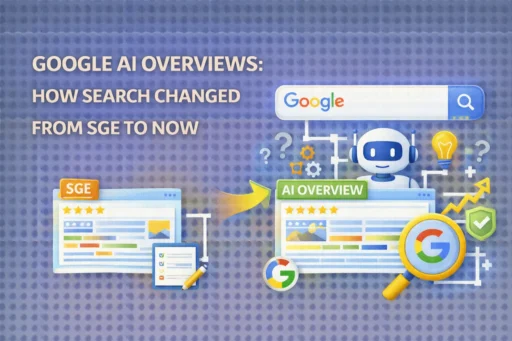

Google AI Overviews have transformed how we search online, evolving from an experimental feature called Search Generative Experience (SGE) into a powerful tool now used by over a billion people worldwide. At Search Savvy, we’ve been tracking this evolution closely since its inception, and the changes have been nothing short of revolutionary. This comprehensive guide will help you understand what Google AI Overviews are, how they’ve evolved, and what they mean for the future of search in 2026.
What Are Google AI Overviews?
Google AI Overviews are AI-powered summaries that appear at the top of search results, providing users with immediate, comprehensive answers to their queries without requiring clicks to multiple websites. These AI-powered snippets pull information from various sources to provide insights directly on the search page, eliminating the need to click through multiple websites.
Unlike traditional featured snippets that extract information from a single webpage, Google AI Overviews synthesize data from multiple sources to deliver more nuanced and complete responses. The feature uses Google’s advanced large language models, including the Pathways Language Model 2 (PaLM 2) and now Gemini 2.0, to generate these comprehensive summaries.
People Also Ask: What’s the difference between AI Overviews and featured snippets?
Featured snippets pull content from a single webpage to answer specific queries, while AI Overviews combine information from multiple sources using artificial intelligence to provide more comprehensive, synthesized answers with links to various sources.
How Did Google AI Overviews Start? The SGE Era Explained
Google AI Overviews began their journey as the Search Generative Experience (SGE), announced at Google I/O in May 2023. In May 2023, Google introduced the Search Generative Experience, which they had been experimenting with under Search Labs, a program where people can test early-stage Google Search experiences and provide feedback.
The SGE launch was Google’s strategic response to emerging competitors like ChatGPT and Microsoft’s Bing Chat integration. From the initial launch of the first version of SGE until August 2023, it was available exclusively in the US and only to Search Labs users enrolled in the experiment. This limited rollout allowed Google to test and refine the technology before wider deployment.
During the SGE testing phase, users could access generative AI-powered search results by opting into Google Labs. Search Savvy observed that this experimental approach gave Google valuable insights into user behavior and helped them identify potential issues before a broader launch.
People Also Ask: When did SGE become AI Overviews?
SGE was officially rebranded as AI Overviews and released from beta on May 14, 2024, at Google I/O. This marked the transition from an experimental feature to a core component of Google Search.
Why Did Google Transform SGE Into AI Overviews?
Google AI Overviews represent a strategic evolution from the experimental SGE framework. The transformation wasn’t just a rebranding-it reflected significant improvements in technology, user experience, and global accessibility. According to Search Savvy’s analysis, several factors drove this evolution:
- Technology Maturation: The underlying AI models became more sophisticated and reliable
- User Feedback Integration: Google incorporated feedback from millions of Search Labs participants
- Competitive Pressure: The success of ChatGPT and other AI assistants pushed Google to accelerate development
- Market Readiness: Users demonstrated strong appetite for AI-enhanced search experiences
On May 14, 2024, at 2024 Google I/O, SGE was released from beta for the US market and rebranded into AI Overviews. Its launch marked a shift in traditional search, kicking off a new era of SEO, where the focus is shifting toward optimizing websites for AI Overviews.
How Do Google AI Overviews Work in 2026?
Google AI Overviews in 2026 operate through a sophisticated multi-step process that combines advanced AI models with Google’s vast search infrastructure. The custom version of Gemini 2.0 uses a multistep approach to make a plan, conduct searches to find information and adjust the plan based on what it finds.
The system employs a technique called “query fan-out” that performs multiple concurrent searches across different subtopics and data sources. This approach enables Google AI Overviews to provide more comprehensive answers than traditional search results ever could.
Key Components of AI Overviews Technology:
- Gemini 2.0 AI Model: Launched in the U.S. for coding, advanced math, and multimodal queries
- Knowledge Graph Integration: Access to real-time, structured data about entities and facts
- Shopping Data: Information about billions of products for commerce-related queries
- Multi-source Verification: Cross-referencing information across multiple reliable sources
AI Overviews are one of our most popular Search features – now used by more than a billion people – and we’re continuing to advance and improve the experience to make them even better.
What Major Changes Have Occurred Since SGE Launched?
Google AI Overviews have undergone dramatic expansion and enhancement since their SGE origins. At Search Savvy, we’ve documented every major milestone in this transformation.
Timeline of Evolution:
May-August 2023: SGE available exclusively in the U.S. through Search Labs
August 2023: Expansion to India and Japan
November 2023: By November 2023, it had been rolled out to more than 120 additional countries and territories
May 2024: Official launch as AI Overviews in the United States
August 2024: Google announced on August 15th 2024 that AI Overviews were rolling out in six countries without Search Labs requirement
October 2024: In October 2024, AI Overviews were rolled out in over 100 countries and territories worldwide, no longer requiring Search Labs access
March 2026: European expansion with Germany, Spain, Switzerland, and Italy
May 2026: In late May, at Google I/O 2026, the company announced the expansion of AI Overviews to new countries and languages. With this rollout, AI Overviews are now available in over 200 countries and territories, and in more than 40 languages
Industry-Specific Growth:
Google AI Overviews have shown dramatic increases in specific sectors. Between March 13 and 27, according to data shared with Search Engine Land by enterprise SEO platform BrightEdge, the presence of AI Overviews grew by: 528% for entertainment queries, 387% for restaurant queries, 381% for travel queries during the March 2026 core update.
People Also Ask: In which countries are AI Overviews available?
As of May 2026, Google AI Overviews are available in over 200 countries and territories worldwide, supporting more than 40 languages including English, Spanish, French, German, Italian, Polish, Hindi, Japanese, Portuguese, and Indonesian.
How Does AI Mode Differ From Standard AI Overviews?
Google AI Overviews evolved further in 2026 with the introduction of AI Mode, a more advanced search experience that represents the cutting edge of Google’s search technology. AI Mode, currently available as an opt-in program in Labs, could very well be the future of Google Search. AI Mode uses a custom 2026 Google AI model (a version of Gemini 2.0) to expand AI Overviews with multimodal capabilities.
Key Features of AI Mode:
Concurrent Fan-Out Searches: AI Mode uses a technique called ‘fan-out searches’ to perform multiple concurrent searches based on your prompt, essentially conducting research across multiple sources simultaneously.
Multimodal Understanding: Processes text, images, and video together for comprehensive answers
Follow-up Questions: Allows users to ask sequential questions within the same search session
Visual Search Integration: By combining Gemini 2.5 and our new “visual search fan-out” technique, we’ve unlocked a deeper understanding of images and your natural language questions
According to Search Savvy’s testing, AI Mode represents a significant leap forward in search capability, offering personalized dining recommendations, restaurant reservations, and link-sharing for collaborative planning.
Why Should Businesses Care About Google AI Overviews in 2026?
Google AI Overviews have fundamentally changed the digital marketing landscape, and businesses that ignore this shift do so at their peril. At Search Savvy, we’ve observed that AI Overviews now appear for a substantial percentage of search queries, directly impacting website traffic and visibility.
Impact on Search Behavior:
For keywords with a search volume between 0 and 10, AI Overviews appear at a rate of 30–31% across the board. This is because highly specific long-tail keywords, which are more likely to trigger AIOs, typically have low search volumes. This finding has major implications for long-tail SEO strategies.
Traffic and Visibility Concerns:
Google AI Overviews can reduce click-through rates to websites since users get answers directly on the search results page. However, appearing as a cited source within an AI Overview can drive highly qualified traffic. Search Savvy recommends focusing on creating authoritative, original content that AI systems will want to reference.
Monetization Opportunities:
Google launched US ads for mobile AI Overviews in October 2024, opening new advertising opportunities within the AI-powered search experience. Businesses can now position sponsored content within AI Overviews, reaching users at the exact moment they’re seeking information.
People Also Ask: Do AI Overviews reduce website traffic?
AI Overviews can reduce clicks to websites for simple informational queries, but they can also drive highly targeted traffic when your site is cited as a source. The key is creating high-quality, authoritative content that AI systems recognize as valuable.
How Can You Optimize for Google AI Overviews?
Google AI Overviews require a fresh approach to SEO that goes beyond traditional keyword optimization. Search Savvy has developed a comprehensive strategy for AI Overview optimization based on extensive testing and analysis.
Best Practices for AI Overview Visibility:
1. Create Comprehensive, Authoritative Content
Google AI Overviews prioritize content that demonstrates expertise, experience, authority, and trustworthiness (E-E-A-T). Focus on creating in-depth resources that thoroughly cover topics from multiple angles.
2. Use Structured Data
Speakable structured data is a great place to start. Adding speakable markup to your pages helps AI-powered assistants figure out what part of the content they should focus on when answering search queries. This can significantly increase your chances of being cited in AI Overviews.
3. Answer Questions Directly
Format content to directly answer common questions about your topic. Use clear headers, bullet points, and concise paragraphs that AI systems can easily parse and understand.
4. Build Topic Authority
Create clusters of related content that demonstrate comprehensive expertise in your field. Google AI Overviews favor sources that show consistent authority across multiple related topics.
5. Focus on Original Research and Insights
Google AI Overviews tend to cite sources that provide unique perspectives, original data, or expert analysis rather than generic information available elsewhere.
What’s Next for Google AI Overviews?
Google AI Overviews continue to evolve rapidly in 2026, with new capabilities being added regularly. At Search Savvy, we’re tracking several emerging trends that will shape the future of AI-powered search.
Upcoming Developments:
Expanded Multimodal Capabilities: We’re already working on new capabilities and updates, like adding more visual responses with images and video, richer formatting, new ways to get to helpful web content and much more.
Agentic AI Features: Google is developing capabilities that will allow AI to perform multi-step tasks like ordering groceries or booking reservations directly from search results through partnerships with OpenTable and Resy.
Integration with Other Google Products: AI Overviews are being integrated with Google Maps, Google Shopping, and other services to provide more comprehensive, actionable results.
Personalization: AI Overviews are becoming increasingly personalized based on user history, location, and preferences, offering more relevant results for individual searchers.
Search Savvy predicts that by the end of 2026, AI Overviews will become the default search experience for most queries, fundamentally changing how users discover and interact with online information.
Conclusion: Embracing the AI Overview Era
Google AI Overviews represent the most significant transformation in search since Google’s founding in 1998. What began as an experimental feature called SGE has evolved into a core component of how billions of people find information online.
For businesses and content creators, the message from Search Savvy is clear: adapt or become invisible. Google AI Overviews aren’t going away-they’re expanding and improving every month. Success in this new era requires creating authoritative, comprehensive content that AI systems recognize as valuable and trustworthy.
The journey from SGE to AI Overviews demonstrates Google’s commitment to making search more intuitive, conversational, and helpful. As we move forward, those who embrace these changes and optimize their content accordingly will thrive, while those who cling to outdated SEO strategies will struggle to maintain visibility.
Stay ahead of these changes by partnering with experts who understand the evolving landscape. At Search Savvy, we help businesses navigate the AI-powered future of search, ensuring your content gets the visibility it deserves in this new era.
Frequently Asked Questions (FAQ)
Q: What’s the main difference between SGE and AI Overviews?
A: SGE (Search Generative Experience) was the experimental beta version launched in May 2023 through Google Labs. AI Overviews is the official, production-ready feature that launched in May 2024. While the core technology is similar, AI Overviews are more refined, faster, and available to all users without requiring opt-in.
Q: Do I need to do anything special to see AI Overviews?
A: No special setup is required. AI Overviews appear automatically in search results when Google determines they would be helpful for your query. As of 2026, you don’t need to be signed in to see them, and they work in incognito mode as well.
Q: Can websites opt out of being used in AI Overviews?
A: Not specifically. Blocking Google’s standard Googlebot would prevent your content from appearing in search results entirely, including AI Overviews. Google-Extended blocking only affects training data for Gemini and Vertex AI, not AI Overviews which use real-time search data.
Q: How does Gemini 2.0 improve AI Overviews?
A: Gemini 2.0 provides faster, higher-quality responses and enables AI Overviews to handle more complex queries, including advanced coding questions, mathematical problems, and multimodal searches that combine text and images. It also allows for better reasoning and more accurate information synthesis.
Q: Are AI Overviews showing ads?
A: Yes, Google began showing ads in mobile AI Overviews in the U.S. in October 2024. Sponsored content appears above the AI-generated snapshot and is clearly labeled. This represents a new advertising opportunity for businesses targeting users actively seeking information.
Q: Will AI Overviews kill traditional SEO?
A: No, but they’re changing it. While AI Overviews may reduce clicks for simple informational queries, they drive high-quality traffic to cited sources. SEO is evolving toward creating authoritative, comprehensive content that AI systems want to reference rather than just ranking for keywords.
For more insights on optimizing your content for Google’s AI-powered future, connect with Search Savvy’s team of search marketing experts. We’re here to help you thrive in the age of AI Overviews.
Sources and Further Reading:
- Google Blog: Expanding AI Overviews to 200+ Countries
- Google Blog: Introducing AI Mode in Search
- Google I/O 2024: AI Overviews Announcement
- SE Ranking: AI Overviews Explained
- Search Engine Land: AI Overviews Spike During March 2026 Core Update
- Google Search Central: Creating Helpful Content
- Google Developers: Speakable Structured Data