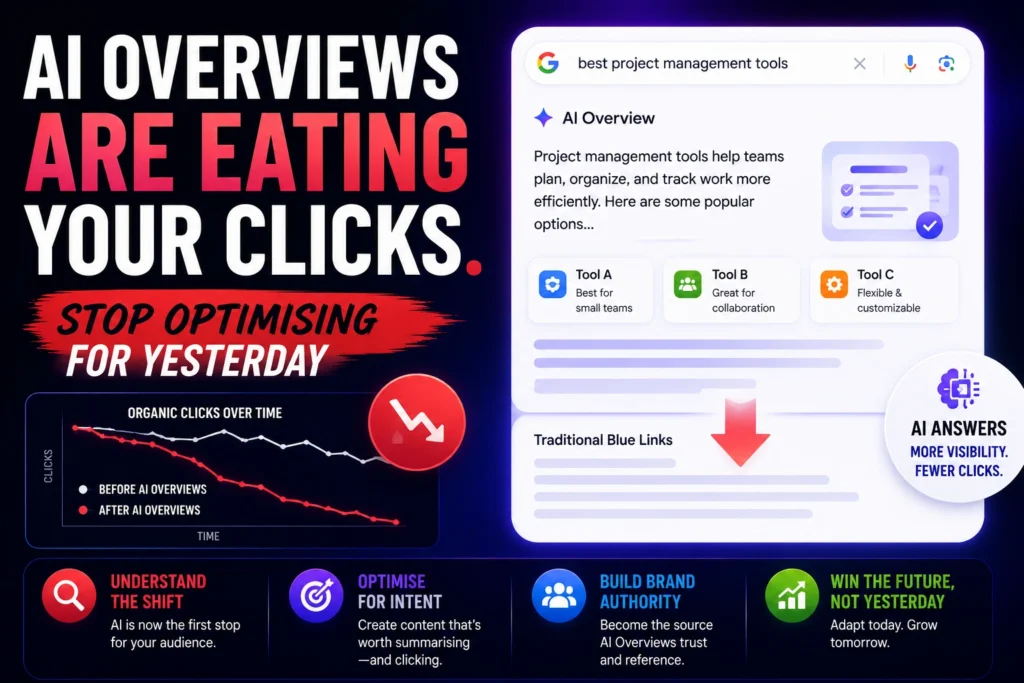
AI Overviews Are Eating Your Clicks. Stop Optimising for Yesterday

You ranked number one on Google. You worked for it – the content, the backlinks, the technical fixes. Position one was the prize.
In this article12 sections
And then Google AI Overviews arrived. Now a large, AI-generated answer sits above your blue link, answers the question your visitor was searching for, and sends them nowhere. They got what they needed without ever clicking. Your ranking still says number one. Your traffic says otherwise.
This is the Google AI Overviews SEO impact that every marketer is now reckoning with – and most content strategies are not built for it. The old playbook was: rank higher, get more clicks. That equation has fundamentally broken down. Ranking higher is still useful. But in 2026, whether you are cited in the AI Overview sitting above those results is what increasingly determines whether a visitor ever reaches your website at all.
At Search Savvy, we have been tracking how AI Overviews affect organic traffic across client sites in India and internationally – and the patterns are clear, consistent, and urgent. This article covers exactly what is happening, what the data says, who it hurts most, and – most critically – the specific steps you can take right now to turn AI Overviews from a threat into a visibility advantage.
What Is the Google AI Overviews SEO Impact in 2026?#
Google AI Overviews SEO impact is best understood through the numbers – because the scale of change is impossible to appreciate without them.
Google AI Overviews now appear on approximately 48–50% of all Google searches in early 2026, up from just 6.49% in January 2025. That is an eight-fold increase in coverage in under 18 months – and the trajectory points toward even broader rollout through the rest of the year.
What those AI Overviews are doing to click-through rates is severe:
| Study / Source | Finding |
| Seer Interactive (Sept 2025, millions of impressions) | Organic CTR fell 61% on queries with AI Overviews present |
| Ahrefs (Dec 2025, 300,000 keywords) | #1 organic position CTR dropped 58% when AI Overview appears |
| Pew Research Center (March 2025, 68,879 searches tracked) | CTR drops from 15% to 8% when an AI Overview is present |
| SparkToro / Datos (2026) | 60% of all Google searches now end with zero clicks |
| Omnibound (2026) | For queries processed through AI Mode, zero-click rate hits 93% |
| Ahrefs AIO analysis (4M AI Overview URLs, 2026) | Only 38% of cited pages also rank in the top 10 organically |
Informational queries saw 30–40% organic traffic declines as AI Overviews handle these query types best. For queries with an AI Overview present, the zero-click rate hits 80–83%.
The Google AI Overviews SEO impact varies dramatically by industry: B2B Technology faces the highest AI Overview exposure at 70%, while e-commerce queries see AI Overviews just 4% of the time.
Here is the number that changes everything: only 38% of pages cited in AI Overviews also rank in the top 10 organic results – down from 76% just seven months earlier. Citation is not a ranking reward. It is an entirely separate outcome that requires an entirely separate strategy.
People Also Ask: How much traffic are AI Overviews taking from organic search in 2026? Short Answer: Google AI Overviews now appear in over 25% of all Google searches, more than doubling from 13% twelve months ago. Ahrefs found that AI Overviews reduce CTR for the top-ranked page by 58%. For queries with an AI Overview present, the zero-click rate hits 80–83%. For informational content specifically, organic traffic declines of 30–40% are being recorded. The impact is real, measurable, and growing.
Why Is Google AI Overviews SEO Impact Worse for Some Industries Than Others?#
Google AI Overviews SEO impact is not distributed evenly – and understanding where your business falls in the impact spectrum determines how urgently you need to act.
The strategic implication is significant: AI Overview rates by search intent reveal that transactional and navigational content faces lower AI Overview exposure – a potential refuge for click-dependent business models.
Here is how exposure breaks down by vertical in 2026:
- Healthcare – AI Overview presence up to 88% of searches
- Education – 83% of searches trigger AI Overviews
- B2B Technology – 82% AI Overview presence
- General informational – 80–83% zero-click rate when AI Overviews present
- E-commerce / transactional – Only 4% AI Overview presence
88% of AI Overview triggers are informational intent queries – the exact content most blogs target. If your content strategy is built primarily on informational, how-to, and explanatory content – the kind that most blog strategies are built on – you are operating in the highest-impact zone.
The practical implication is a content strategy recalibration, not abandonment. Informational content is still worth publishing – but it now needs to be structured specifically for AI citation, not just for ranking. And the balance between informational, commercial, and transactional content in your editorial mix deserves urgent review.
People Also Ask: Which types of content are most affected by Google AI Overviews? Short Answer: Informational content with direct answers is both the most affected by AI Overviews reducing organic clicks and the most eligible for AI citation. 88% of AI Overview triggers are informational intent queries. E-commerce and transactional content is comparatively protected. The strategy shift is: ensure your informational content is structured for citation, while protecting transactional content with strong on-page conversion signals.
What Is the Upside of Google AI Overviews That Most Coverage Misses?#
Google AI Overviews SEO impact is not a story of pure loss – and the upside for cited pages is significant enough to reframe the entire strategic conversation.
Cited pages earn 35% more organic clicks and 91% more paid clicks than competing pages that are not cited. Being named as a source inside an AI Overview does not just protect your traffic – it amplifies it. The AI answer directs attention to you as the authoritative source, driving branded recognition and click intent simultaneously.
AI search traffic converts at 14.2% versus Google’s 2.8%. Visitors who arrive through an AI Overview citation are pre-qualified – they have already consumed an AI-generated answer that identified your brand as trustworthy. They arrive with higher intent, lower friction, and a meaningfully higher probability of converting.
Companies adapting strategies early report growth exceeding pre-AI Overview levels. The key to managing the Google AI Overviews SEO impact is recognising that SEO now operates on two surfaces: traditional rankings and AI visibility.
The businesses losing traffic are the ones optimising only for rankings. The businesses growing are the ones optimising for both ranking and citation. According to Search Savvy’s insights, this two-surface approach is the defining strategic shift for content teams in 2026.
How Does Google Decide What to Cite in AI Overviews?#
Google AI Overviews SEO impact cannot be addressed without understanding the citation selection mechanism – because it is different from traditional ranking in important ways.
To appear in Google AI Overviews, your content needs four things: semantic completeness, strong E-E-A-T signals, clear structural formatting, and fast page speed. Rank position alone does not determine citation.
Google’s selection process for AI Overview citations in 2026 evaluates:
Extractable Answers in the First 100 Words#
To get cited in Google AI Overviews, structure content to answer a query directly in the first 100 words, back claims with statistics and quotes, and publish on a topic where your domain already ranks. AI systems extract answers from the top of content, not the middle. Burying your answer after three paragraphs of preamble is the most common reason otherwise strong content is not cited.
This is the BLUF principle – Bottom Line Up Front – applied to content strategy. Lead with the answer. Support it with evidence. Expand in the body.
Structured Data and Schema Markup#
Properly structured pages show 73% higher selection rates in AI Overviews compared to unmarked content, based on Wellows analysis of 15,847 AI Overview results in 2026. Schema markup does not directly rank your page – but it dramatically increases citation eligibility by making your content’s structure explicit and machine-readable.
65% of pages cited by Google AI Mode include structured data. The gap between schema-marked and unmarked content is one of the most actionable technical opportunities in the current search landscape – especially since the majority of business websites still have zero structured data implemented.
Freshness Signals#
Freshness is a strong ranking signal for AI surfaces. Digital Bloom found that 65% of AI bot hits target content published within the past year. Adding a visible “last updated” date, refreshing statistics each quarter, and revisiting highest-value pages on a fixed schedule are all citation factors.
Stale content with outdated statistics is increasingly deprioritised by AI systems. The quarterly content refresh is no longer optional – it is a citation eligibility requirement.
E-E-A-T Signals and Entity Authority#
A combined SEO, AEO (Answer Engine Optimisation), and GEO (Generative Engine Optimisation) strategy delivers the best results for AI search visibility in 2026. Google’s AI systems are specifically looking for content they can attribute to a credible, identifiable entity.
Adding statistics increased AI visibility by 22% and adding quotations raised it by 37%, according to Digital Bloom’s AI Visibility Report. Citing recognised sources, naming them in the text, and linking out so claims are verifiable – these are the signals that tell AI systems your content is trustworthy enough to cite.
Topical Depth and Query Fan-Out#
Optimise your content for the full set of sub-queries Google generates from your target keyword, not just the keyword itself. This is the single biggest shift from traditional SEO to AI-era search optimisation.
For a query like “best email marketing tools,” Google’s AI system might generate sub-queries covering pricing, integrations, ease of use, deliverability rates, and comparison data. A page that addresses only the surface-level query loses citation eligibility to a page that covers the full topic cluster. A single comprehensive page that addresses the full topic cluster will outperform a fragmented content strategy for AI citations.
People Also Ask: Do you need to rank in the top 10 to be cited in Google AI Overviews? Short Answer: No. Only 38% of cited pages rank in the top 10 for the same query – down from 76% just seven months earlier. Citation is determined by content quality, E-E-A-T signals, and structural clarity rather than ranking position alone. This means well-structured content from lower-ranking pages can earn AI Overview visibility that their ranking would not predict – creating a genuine opportunity for brands that invest in content structure and authority signals.
What Is the Step-by-Step Strategy to Win AI Overview Citations?#
Google AI Overviews SEO impact becomes an opportunity rather than a threat when you implement the right content and technical framework. Here is the approach At Search Savvy, we now apply across every content programme:
Step 1 – Audit which pages are losing clicks to AI Overviews. Open Google Search Console and go to Performance → Pages. Set a comparison date range: last 3 months vs the same 3 months a year ago. Sort by biggest drops in clicks. Pages at the top of that drop list are your highest-impact casualties – note the impressions still being generated, the CTR now versus a year ago, and what type of content it is.
Step 2 – Restructure your highest-value informational pages for BLUF formatting. Rewrite your H1 and opening paragraph to answer the primary query directly in the first 100 words. Remove introductory filler that delays the answer. Add a summary box or key takeaway section at the top of long-form pieces.
Step 3 – Implement comprehensive schema markup. Add FAQPage schema to every FAQ section, Article schema to every content page (with named author entity), and Organisation schema to your homepage with sameAs links. Validate every implementation with Google’s Rich Results Test. Pages with valid schema markup are 2–4 times more likely to appear in Google’s AI Overviews and featured snippets.
Step 4 – Add statistics, external citations, and first-party data. Every factual claim should be supported by a named source with a link. Add original data, survey results, or case study numbers where possible – these are the signals AI systems treat as evidence of genuine expertise.
Step 5 – Refresh content on a quarterly cadence. Update statistics, add new sections addressing emerging sub-questions, and change the “last updated” date visibly. Freshness is a direct AI citation signal.
Step 6 – Build topical depth through content clusters. Identify the full set of sub-queries associated with your primary topics and create a content architecture that covers them comprehensively. A single well-linked cluster page addressing eight related sub-topics outperforms eight isolated pages for AI citation.
Step 7 – Monitor your AI citation performance. Use tools like Google Search Console, Semrush, or SE Ranking to track whether your pages are appearing in AI Overviews. Run manual prompt tests in Google for your key target queries to check citation status directly.
Why Is the Google AI Overviews SEO Impact a Brand Awareness Opportunity Too?#
Google AI Overviews SEO impact extends beyond traffic metrics into brand building – and this dimension is underappreciated by most content teams.
Companies with strong branded search volume are partially insulated from AI Overview traffic loss. Investing in brand awareness through digital PR, thought leadership, and multi-platform presence directly protects organic traffic in the AI Overview era.
When your brand is cited in an AI Overview, that mention appears above the traditional results – at the very top of the search experience – for every user searching that query. Even if they do not click, they see your brand associated with expertise on that topic. Repeated exposure across multiple queries builds the exact brand recognition that protects you from traffic volatility in future algorithm shifts.
The latest data suggests two truths can exist at the same time. AI Overviews have reduced click-through rates for many query classes – especially informational searches. But CTR for queries without AI Overviews has increased, rising from 2.8% in January 2025 to 3.8% in February 2026. The search market is splitting. Brands that build authority and earn citations win on both surfaces. Brands that ignore AI Overviews lose on the first without winning on the second.
At Search Savvy, we now treat AI Overview citation as a core KPI alongside traditional ranking and traffic metrics. The businesses that will lead in organic search through 2027 and beyond are the ones that started optimising for both surfaces in 2026.
People Also Ask: Does being cited in Google AI Overviews help your SEO rankings too? Short Answer: Being cited in Google AI Overviews builds authority even when clicks decline. Page-one rankings alone no longer guarantee visibility in Google AI Overviews – but the brand authority signals generated by consistent citation improve both AI visibility and traditional ranking over time. Citation and ranking are increasingly reinforcing signals rather than independent outcomes.
FAQ: Google AI Overviews SEO Impact – Your Questions Answered#
Q1: Should I block Google’s AI Overview crawler from my website? This is almost always the wrong decision. AI Overviews “divert traffic away from publishers without delivering measurable improvements in user experience” – but blocking them means you lose citation eligibility entirely, surrendering the 35% CTR uplift that cited pages earn. Opt-out is available via Google’s extended crawling opt-out, but the commercial case for citation is strong enough that most businesses are better served by optimising for it. The exception is content behind a paywall or subscription model where free AI summarisation directly cannibalises paid access.
Q2: How long does it take to start appearing in Google AI Overviews after optimising? For existing authoritative content, structural optimisations – adding direct answers, FAQ sections, and schema – can produce AI Overview appearances within 2–6 weeks. For newer sites with lower domain authority, it typically takes 3–6 months of consistent content development. The fastest wins come from restructuring high-traffic pages that already have domain authority behind them – the citation signals compound quickly on a strong technical foundation.
Q3: Is it possible to rank in organic search AND be cited in AI Overviews simultaneously? Yes – and this is the goal. SEO now operates on two surfaces: traditional rankings and AI visibility. The most successful approach is to optimise for ranking through topical authority and backlink building, while simultaneously optimising for citation through content structure, schema, freshness, and E-E-A-T signals. The two strategies reinforce each other – topical authority supports citation eligibility, and citation builds brand recognition that supports ranking.
Q4: My industry is heavily affected by AI Overviews. What should I do first? Start with a Search Console traffic audit to identify your highest-impact pages – the ones with the steepest CTR declines over the past 12 months. Then prioritise restructuring those specific pages for BLUF formatting, add FAQPage and Article schema, and ensure every factual claim is cited with a named source. For businesses in B2B tech, healthcare, or education – the most heavily affected verticals – this audit and restructuring phase should be treated as an emergency priority, not a quarterly project.
Q5: Does Google AI Overviews appear in India the same way as in the US? AI Overviews rolled out in India as part of Google’s global expansion in late 2024 and are now active for Indian users in English and major regional language queries. The rollout is less saturated than in the US – current Indian data suggests lower AI Overview frequency on many commercial queries – which means Indian businesses that start optimising for citation now are doing so ahead of the curve, before the competitive landscape fully catches up.
Q6: Can small businesses compete for AI Overview citations against larger brands? Rank position alone does not determine citation – only 38% of cited pages rank in the top 10 for the same query. Citation is determined by content quality, E-E-A-T signals, and structural clarity rather than ranking position alone. This creates a genuine democratising effect: a small business with a well-structured, thoroughly sourced, schema-rich article on a specific subtopic can earn AI Overview citation ahead of a larger brand with a broader but less precise page. The citation opportunity rewards specificity and structural quality – not just domain size.
Is your content built for the old search – or the one that is actually running in 2026? Visit Search Savvy for a Google AI Overviews visibility audit and a clear, data-backed plan to get your brand cited where your customers are looking.