

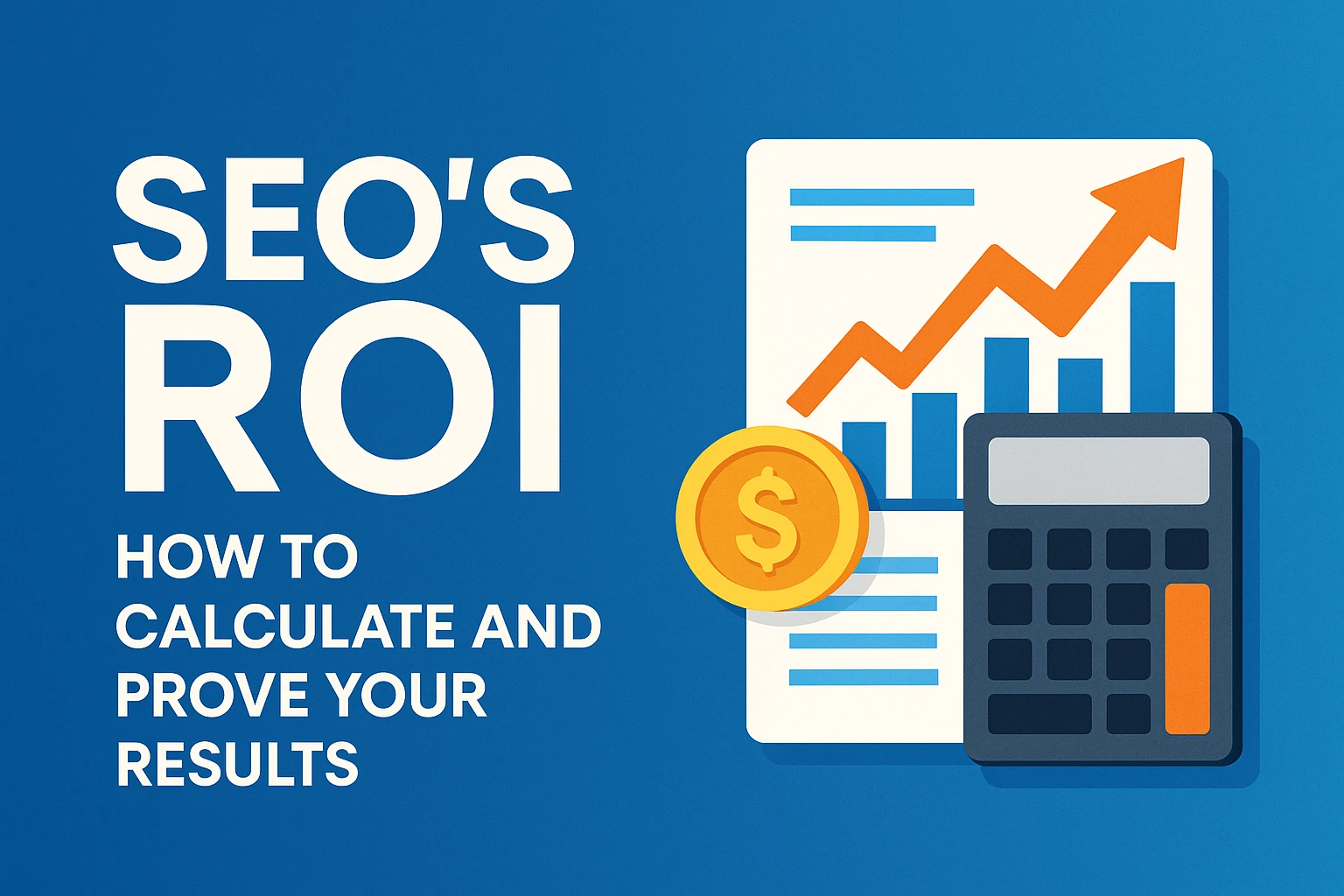

SEO ROI represents one of the most critical metrics for measuring the success of your organic search strategy. If you’ve been investing in search engine optimization but aren’t sure whether it’s paying off, understanding how to calculate and track your return on investment will transform the way you approach digital marketing. At Search Savvy, we’ve helped hundreds of businesses demystify their SEO performance by implementing clear, actionable ROI tracking systems that prove the value of organic search.
The numbers speak for themselves: 49% of marketers say organic search delivers the highest returns, generating 40% of business revenue. Yet many businesses still struggle to quantify exactly what they’re getting back from their SEO investments. This comprehensive guide will walk you through everything you need to know about calculating, tracking, and maximizing your SEO ROI in 2025.
What Is SEO ROI and Why Does It Matter in 2025?
SEO ROI measures the profitability and marketing results generated from your search engine optimization efforts compared to the costs invested. Return on investment is a profitability measurement that compares the profit yielded by an investment to the cost associated with the investment, expressed as a ratio of profit to cost converted to a percentage. Simply put, it tells you how many dollars you earn for every dollar you spend on SEO activities.
Organic search still drives 53% of all website traffic, making it one of the most valuable marketing channels available to businesses today. At Search Savvy, we’ve observed that companies who actively track their SEO ROI make smarter decisions about budget allocation, content strategy, and resource management. Understanding your SEO ROI isn’t just about proving value to stakeholders-it’s about optimizing your marketing spend for maximum impact.
How Does SEO ROI Work?
SEO ROI works by comparing the revenue your organic search traffic generates against the total costs of your SEO activities. Calculating SEO ROI is necessary to see how SEO strategy impacts your business and to understand how your spending budget helps you save money on effective strategies. The calculation considers both the direct costs (like agency fees and tool subscriptions) and the indirect benefits (like increased brand visibility and customer lifetime value).
The mechanism is straightforward: when your website ranks higher in search results for relevant keywords, you attract more qualified traffic. This traffic converts into leads and sales, generating revenue. By tracking these conversions and attributing them back to your SEO efforts, you can determine whether your investment is producing positive returns.
Analysis of over 35,000 websites shows continuous growth in overall organic traffic, because while the percentage of zero-click searches has increased, the total volume of searches has grown even faster, resulting in more traffic to websites than ever before. This means there’s still tremendous opportunity in organic search for businesses that approach it strategically.
What Are the Key Components of Calculating SEO ROI?
SEO ROI calculations require two main components: revenue from SEO and total SEO costs. Let’s break down each element to ensure your calculations are accurate and comprehensive.
Revenue from SEO
Revenue tracking starts with proper conversion tracking in Google Analytics 4 or similar analytics platforms. To calculate SEO ROI, you need to track metrics like leads, sales, and average order value, which inform the revenue your campaigns generate. For e-commerce businesses, this is relatively straightforward-you track completed purchases that came from organic search traffic.
For lead generation businesses, the process requires an additional step. You need to set up a value for every conversion on your site by analyzing customer data to find the dollar figure, then figure out the number of leads converted into sales. Search Savvy recommends using customer lifetime value (LTV) rather than average order value for a more accurate long-term picture of your SEO returns.
Total SEO Costs
Common SEO pricing models include monthly retainers ranging from $500 to $10,000, project-based fees from $500 to $5,000, and hourly rates often ranging from $75 to $100 per hour. However, your total SEO investment extends beyond agency fees.
Consider these cost categories:
- In-house labor costs: Calculate the salaries or hourly rates of employees who work on SEO, even partially
- Agency or freelancer fees: Include all retainer fees, project costs, and consulting charges
- SEO tool subscriptions: Factor in monthly or annual costs for platforms like SEMrush, Ahrefs, or Moz
- Content creation: Account for writers, editors, and graphic designers who produce SEO content
- Link building expenses: Include digital PR costs and outreach campaigns
- Technical implementation: Consider developer time for site speed optimization and technical fixes
How Do You Calculate Your SEO ROI Using the Formula?
The basic SEO ROI formula is remarkably straightforward. SEO ROI is calculated as the gain from SEO investment minus the cost of SEO investment, divided by the cost of SEO investment, then multiplied by 100 to get a percentage.
Here’s the formula written out:
SEO ROI = [(Revenue from SEO – SEO Costs) / SEO Costs] × 100
Let’s walk through a practical example. Suppose your business invested $5,000 per month in SEO (including all costs), and your organic search traffic generated $15,000 in revenue during that same month. Your calculation would look like this:
SEO ROI = [($15,000 – $5,000) / $5,000] × 100 = 200%
This means you earned $2 for every $1 invested in SEO-a strong positive return. At Search Savvy, we typically see clients achieve ROI percentages ranging from 200% to 700%, though a good SEO ROI typically ranges from 200-700%, varying significantly by industry and competition level.
Advanced ROI Calculations
For more sophisticated tracking, you can incorporate additional variables like:
- Click-through rate (CTR): The percentage of searchers who click your listings
- Conversion rate: The percentage of visitors who complete desired actions
- Monthly search volume: The total searches for your target keywords
- Customer lifetime value: The total revenue a customer generates over their relationship with your business
SEO ROI can be calculated using Total Monthly Searches times Click Through Rate times Conversion Rate times Average Order Value minus Costs of SEO per month, divided by Costs of SEO per month. This more detailed formula helps you forecast potential returns before fully committing resources.
When Should You Start Measuring SEO ROI?
SEO ROI timing is critical for accurate measurement. It’s best to measure SEO ROI after 6 months, since SEO strategies take time to generate measurable traffic and conversions. Trying to calculate returns too early will lead to inaccurate, potentially discouraging results that don’t reflect SEO’s true potential.
Positive ROI in an SEO campaign is achieved over a 6-12 month period, with peak results in the second or third year of the campaign. This timeline reflects how search engines gradually recognize and reward quality content and optimization efforts. Google’s algorithms need time to crawl your site, index new content, and determine your authority on specific topics.
During the first few months, you’re building the foundation for long-term success. You’re creating content, earning backlinks, improving technical elements, and establishing topical authority. The traffic and conversions follow as these elements compound over time. Search Savvy always advises clients to maintain realistic expectations during this ramp-up period while tracking leading indicators like keyword rankings and indexed pages.
What Makes a Good SEO ROI Benchmark?
SEO ROI benchmarks vary significantly based on industry, competition, investment level, and business model. There’s no universal “good” SEO ROI-results vary by investment level, lead value, and industry. However, understanding typical ranges helps you set realistic expectations and identify areas for improvement.
A recent study shows that the average ROI on Google ads is 800%, which means $8 for $1 spent. While this statistic refers to paid search, it provides context for what’s achievable in search marketing. Many businesses find that their SEO ROI eventually exceeds their PPC ROI because organic traffic doesn’t require ongoing ad spend-once you rank, you continue receiving traffic without additional per-click costs.
Industry-specific data provides more relevant benchmarks. SEO ROI statistics broken down by industry show varying ROAS (Return on Advertising Spend), ROI percentages, and time to break-even metrics. B2B companies, for example, often see higher ROI percentages due to larger customer lifetime values, while e-commerce businesses may see faster initial returns but lower per-transaction values.
Why Is Tracking SEO ROI Important for Your Business?
SEO ROI tracking delivers benefits that extend far beyond simple number-crunching. Understanding your returns empowers better decision-making across your entire marketing operation.
91% of marketers agree that SEO positively impacts their website performance and marketing goals, but quantifying that impact through ROI measurement takes your strategy to the next level. Here’s why tracking matters:
Budget justification: When you can demonstrate clear returns, securing additional SEO investment becomes significantly easier. By calculating SEO ROI, you can better understand what SEO tactics are bringing in results and continue to invest in the strategies that boost your ROI. Stakeholders respond to data-driven arguments backed by concrete revenue figures.
Strategic optimization: ROI data reveals which aspects of your SEO strategy deliver the highest returns. You might discover that blog content generates better ROI than product pages, or that certain keyword clusters convert at higher rates. These insights allow you to double down on what works and refine or eliminate what doesn’t.
Competitive advantage: Inbound leads such as SEO cost 61% less than outbound leads such as direct mail or cold calling. By tracking this cost efficiency, you can allocate resources more effectively than competitors who rely heavily on expensive outbound marketing tactics.
Long-term planning: ROI tracking helps you forecast future performance and set realistic growth targets. You can model scenarios, estimate the resources needed to achieve specific revenue goals, and make informed decisions about scaling your SEO program.
How Can You Improve Your SEO ROI in 2025?
SEO ROI improvement requires a strategic approach that addresses multiple aspects of your optimization efforts. At Search Savvy, we recommend focusing on these high-impact areas:
Target high-intent keywords: Neil Patel has said, “Don’t optimize for traffic; optimize for the keywords that drive revenue”. Focus on commercial keywords that indicate purchase intent rather than purely informational queries. These convert at significantly higher rates and directly impact your bottom line.
Enhance conversion rates: Traffic means nothing if it doesn’t convert. Improving SEO ROI requires a strategic approach including optimizing conversion rates and creating quality content that serves user intent. Test landing page designs, improve calls-to-action, and reduce friction in your conversion funnel.
Create E-E-A-T content: Experience, Expertise, Authoritativeness, and Trust (E-E-A-T) have become central to Google’s evaluation of content quality. High-quality, authoritative content ranks better and converts more effectively than thin, generic material. Learn more about Google’s E-E-A-T guidelines.
Implement structured data: Make it easier for search engines to understand your content through schema markup. This can lead to rich snippets and featured snippets, which improve click-through rates and drive more qualified traffic. Check out Google’s structured data documentation.
Focus on user experience: Page speed, mobile optimization, and intuitive navigation all impact both rankings and conversions. Investment in quality content and user experience typically yields better long-term ROI than quantity-focused approaches.
Build strategic backlinks: Quality links from authoritative sites in your niche signal trust to search engines and drive referral traffic. Focus on earning links through valuable content, digital PR, and relationship building rather than manipulative tactics.
What Tools Help Track and Measure SEO ROI?
Effective SEO ROI measurement requires the right analytics infrastructure and tracking tools. Here are the essential platforms Search Savvy recommends:
Google Analytics 4: The foundation of ROI tracking, GA4 allows you to set up conversion tracking, attribute revenue to organic search traffic, and analyze user behavior throughout the customer journey. Configure goals for all valuable actions-purchases, form submissions, phone calls, and downloads. Learn how to set up conversion tracking in GA4.
Google Search Console: This free tool provides data on search performance, including impressions, clicks, average position, and click-through rates for specific queries. Use this information to identify optimization opportunities and track ranking improvements over time. Get started with Google Search Console.
SEO platforms: Tools like SEMrush, Ahrefs, or Moz help you track keyword rankings, monitor competitors, identify content opportunities, and measure domain authority. Many include built-in ROI calculators that simplify the measurement process.
CRM integration: Connect your analytics tools to your customer relationship management system to track the complete customer journey from first click to final purchase. This provides the most accurate revenue attribution and reveals the true value of leads generated through organic search.
Call tracking software: For businesses that generate leads through phone calls, implementing call tracking with unique numbers for organic search visitors ensures you capture all conversion data.
Frequently Asked Questions About SEO ROI
How long does it take to see positive SEO ROI?
Most businesses begin seeing positive SEO ROI within 6-12 months of implementing a comprehensive optimization strategy. However, peak results typically occur in the second or third year of the campaign. Early months focus on building foundation elements like content and technical optimization, while later months benefit from compounding effects as your authority grows.
What’s the difference between SEO ROI and ROAS?
ROI (Return on Investment) measures net profit relative to costs, while ROAS (Return on Advertising Spend) measures gross revenue relative to spend. SEO ROAS is calculated as Gross Return on SEO Campaign divided by SEO Campaign Costs, while SEO ROI uses Net Profit from SEO Campaign divided by SEO Campaign Costs. ROAS doesn’t account for business costs beyond marketing spend, making ROI a more comprehensive profitability metric.
Can SEO ROI be negative initially?
Yes, it’s common to see negative or low ROI during the first few months of an SEO campaign. You’re making investments in content, technical improvements, and link building before the traffic and conversions materialize. This is normal and expected-focus on tracking leading indicators like keyword rankings and indexed pages during this period.
How does SEO ROI compare to PPC ROI?
49% of digital marketers say organic search brings in the most return on investment compared to 19% who say paid search does. While PPC delivers faster initial results, SEO typically offers higher long-term ROI because organic traffic continues without ongoing per-click costs. Many successful businesses use both channels strategically.
Should I measure ROI for individual pages or overall site performance?
Both approaches provide value. Overall site ROI gives you a big-picture view of your total SEO investment, while page-level ROI helps identify your highest-performing content types and topics. This granular data informs content strategy decisions and helps you replicate success across your site.
What if my business doesn’t sell online-can I still calculate SEO ROI?
Absolutely. For lead generation businesses, calculate the value of each lead by analyzing your conversion rate from lead to customer and your average customer lifetime value. If you receive 200 lead forms per month and 50 of those leads become customers, that goal has a 25% conversion rate. Multiply lead volume by lead value to determine your SEO-generated revenue.
Take Control of Your SEO Performance Today
SEO ROI represents the difference between blindly investing in optimization and strategically building a high-performing organic search channel. By implementing the tracking systems, formulas, and best practices outlined in this guide, you’ll gain clear visibility into what’s working, what needs improvement, and where to allocate resources for maximum impact.
At Search Savvy, we believe that every SEO dollar should be accountable and every optimization effort should drive measurable business results. The businesses that thrive in 2025’s competitive search landscape will be those that master ROI measurement and use these insights to continuously refine their strategies.
Ready to calculate your SEO ROI and unlock the full potential of organic search? Start by implementing proper conversion tracking, calculating your true SEO costs, and establishing a baseline for comparison. From there, track your progress monthly, optimize based on data, and watch your returns compound over time. The investment you make in understanding your SEO ROI today will pay dividends for years to come.
For more insights on maximizing your digital marketing performance, explore resources like Google’s Search Central documentation, Moz’s SEO Learning Center, and Search Engine Journal’s guides.