
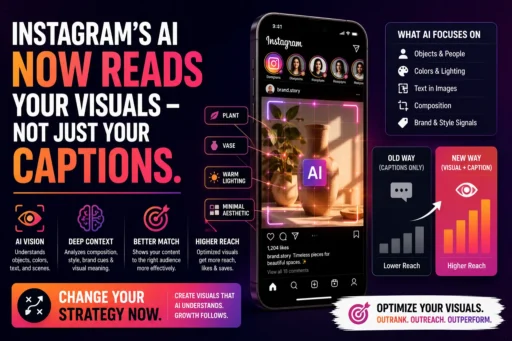
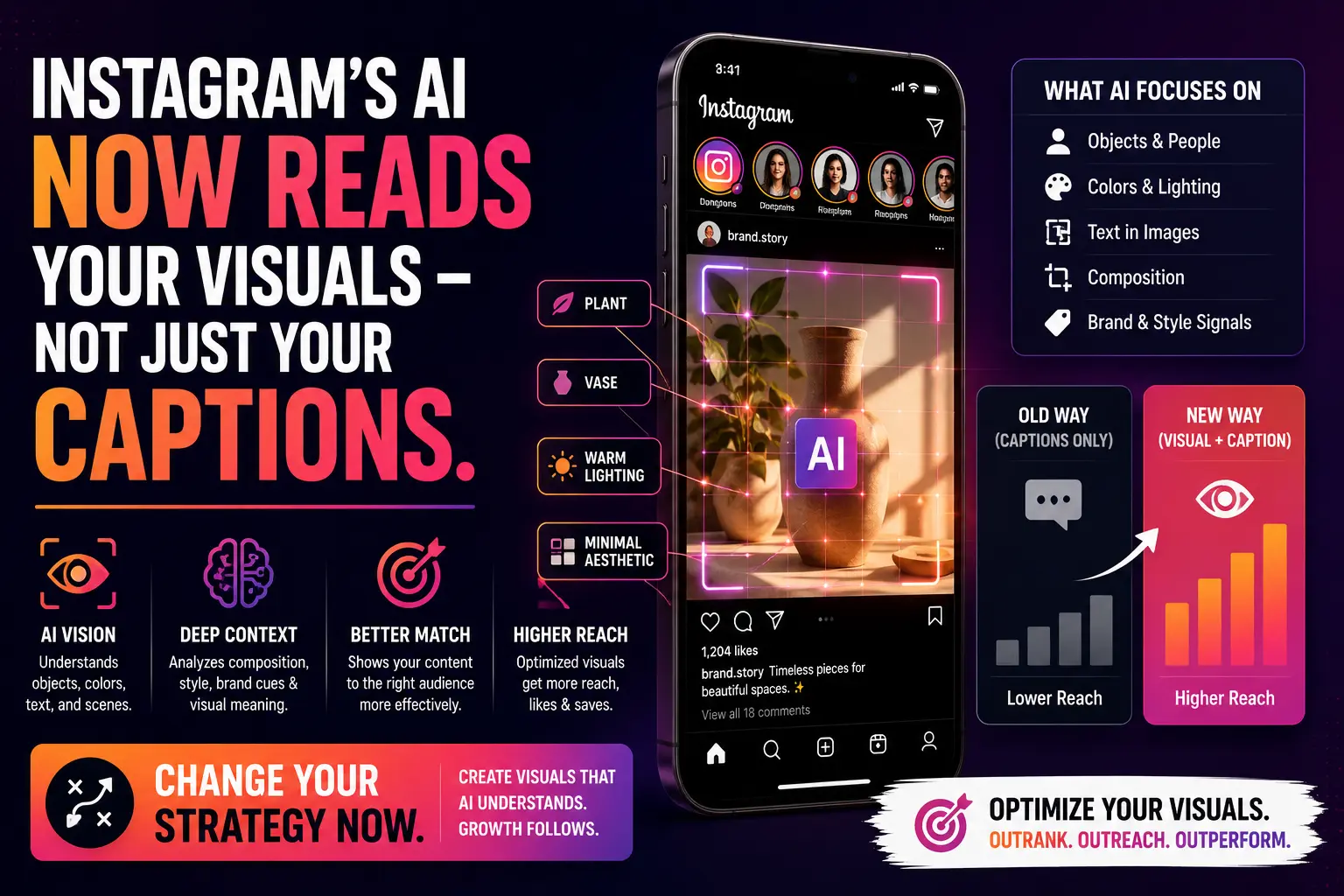

The Instagram AI visual content algorithm changed more fundamentally in 2026 than most brands realise – and the change is not subtle. Instagram’s AI no longer waits for your hashtags, captions, or keyword-rich copy to understand what your post is about. By the time your content goes live, the algorithm has already analysed your video frame by frame, read every word of text visible on screen, processed your audio transcript, and matched your visual aesthetic to content categories it already knows.
Your caption is now the confirmation, not the introduction.
This is the shift that is separating brands seeing strong organic reach from those watching their engagement decline despite posting consistently. If your Instagram strategy was built around hashtag optimisation, keyword-heavy captions, and polished graphic templates – and you haven’t revisited it since this update – you are sending the algorithm signals you never intended.
At Search Savvy, we work with brands across India and globally on content strategies that account for how AI systems actually evaluate and distribute content – not how platforms marketed themselves three years ago. This post breaks down exactly what Instagram’s AI reads, how it uses that information, and what you need to change in your content production to align with it.
What Did Instagram’s AI Visual Content Algorithm Change in 2026?
The Instagram AI visual content algorithm received a confirmed major update in early 2026 that expanded its content classification capabilities beyond anything previously disclosed. Instagram head Adam Mosseri confirmed the three most important ranking signals across all surfaces: watch time, sends per reach (DM shares), and likes per reach. But the more structural change – the one that most brands have not yet adapted to – was the upgrade to Instagram’s content understanding layer.
The 2026 update officially confirmed that Instagram now performs AI-powered content recognition that analyses:
- Frame-by-frame visual analysis – objects, settings, colours, faces, body language, scene context
- On-screen text recognition – words visible in your images or video frames
- Voiceover and audio transcript processing – what is said in your video, not just what music or audio you use
- Video clip context – the sequence and relationship between frames, not just individual moments
- Visual aesthetic matching – the overall “vibe” and style of your content matched to known content categories
The result: Instagram’s AI categorises your content and matches it to the right users completely independently of your captions and hashtags. Hashtag-stuffed captions will not carry content if the actual visuals don’t match the declared topic. And for the first time, visual quality and visual consistency are effectively your new SEO.
This mirrors exactly what is happening across all major platforms – from Google’s AI Overviews evaluating page trust signals to Perplexity’s reading of structured data. Content understanding is moving to the visual and semantic layer, and Instagram moved earlier and more decisively than most brands anticipated.
How Does Instagram’s AI Actually Read Your Visuals in 2026?
The Instagram AI visual content algorithm processes your content through multiple simultaneous recognition systems – and the order in which it processes information matters enormously for how your content gets categorised.
Here is what the algorithm reads, and when:
Instant analysis (before any user engagement): When you post, Instagram’s AI immediately scans:
- The dominant objects and scenes in your image or video frames
- Any text visible in the frame (on packaging, signs, overlays, or graphics)
- Your audio track and any voiceover transcription
- Your visual aesthetic style – muted tones, high saturation, documentary vs. polished, etc.
First-hour analysis (as early engagement arrives): In the first 30–60 minutes, the algorithm combines its visual read with:
- Your caption language and keyword signals
- Your hashtag topics
- Initial engagement patterns – who is watching, saving, sharing, and commenting
- Comments from early viewers, which provide additional context signals
Ongoing recategorisation: As engagement accumulates, the algorithm can actually shift its categorisation of your content based on new context signals. This means a post misaligned between visuals and captions can correct itself – or a well-aligned post can gain reach momentum as the algorithm’s confidence in its categorisation increases.
A documented 2026 case study illustrates this precisely: a creator posted a Reel about vision boards and manifestation, with a white tulip as the visual centrepiece. In the first hours, the algorithm ranked the Reel under “white flower” – because that was the dominant visual signal with no contextual engagement yet. As viewers began commenting about vision boards and 2026 goals, the algorithm rebuilt its understanding. The same Reel then shifted and began ranking under “vision board 2026.” The visual led the categorisation; the text confirmed it.
The implication is fundamental: your visuals are not decoration for your caption. They are the primary signal your content sends to Instagram’s AI.
Why Is Visual Consistency Now More Important Than Hashtag Strategy?
The Instagram AI visual content algorithm rewards aesthetic consistency for a reason that goes beyond aesthetics: consistency is how the algorithm builds confidence in your content’s category.
When your account consistently produces content with recognisable visual themes – consistent colour palettes, consistent settings, consistent on-screen text styles, consistent subjects – the algorithm builds a strong content profile for your account. Each new post you publish is matched against that profile, and the algorithm’s confidence in where to distribute it increases.
Conversely, accounts that post across wildly different visual styles – a flat-lay product photo followed by a motivational quote graphic followed by a behind-the-scenes video with no visual relationship to previous content – give the algorithm a weak, inconsistent profile to work with. Reach suffers not because individual posts are low quality, but because the algorithm cannot confidently categorise where to send them.
The practical guidance:
- Define 2–3 content pillars with a distinct visual language for each – the algorithm can hold multiple profiles for one account if they are consistently maintained
- Use consistent colour treatment across your content – not identical, but recognisably yours
- Establish a visual opening hook for Reels that signals the content category within the first 1–2 seconds – the algorithm reads the opening frames first and with the highest weight
What Are the Top Ranking Signals the Instagram AI Algorithm Prioritises in 2026?
The Instagram AI visual content algorithm uses different ranking systems for each surface – Feed, Reels, Stories, and Explore – but several signals carry across all of them with confirmed weight.
Signal 1: DM Shares (The Most Powerful Signal in 2026)
The single most powerful ranking signal across all Instagram surfaces in 2026 is the Direct Message share. When a user sends your post to a friend, the algorithm treats it as the highest possible quality signal – evidence that your content facilitated a real social connection, which is the core mission of Meta’s platform. DM shares are now weighted 3–5x more than likes for reaching new audiences.
This is a strategic reorientation. Optimising for likes is optimising for the weakest signal. Creating content worth sharing privately – content that makes someone think “you need to see this” – is optimising for the most powerful one.
Signal 2: Watch Time and Completion Rate
For Reels, watch time and completion rate remain the dominant distribution signals. The 3-second threshold is the first critical filter – content that loses viewers before three seconds sees dramatically reduced distribution. Getting viewers past three seconds, then past the halfway point, then to completion and rewatch creates a compounding reach advantage.
The practical implication: your hook is not a creative preference. It is a distribution requirement.
Signal 3: Saves
Saves signal high-value content – content worth returning to. The algorithm interprets a save as: “this viewer found this valuable enough to want it accessible later.” For educational content, how-to content, and content with lasting utility, saves are a primary reach amplifier.
Signal 4: Original Content Priority
The Instagram AI visual content algorithm aggressively identifies and deprioritises recycled or reposted content. Original content receives 40–60% more distribution than reposts. Accounts that post 10 or more reposts within 30 days are excluded from recommendations entirely.
For brands that have relied on curated or reposted content to fill a posting schedule, this is an urgent strategic problem. The algorithm wants original visual content – and it can now tell the difference.
Signal 5: Cross-Meta Engagement
The Instagram AI visual content algorithm now factors in engagement signals from across Meta’s platforms, not just behaviour within Instagram. An active, engaged presence across Meta’s ecosystem – including Facebook and Threads – can contribute positively to how your Instagram content is ranked and recommended.
How Should You Adapt Your Content Strategy to the Visual-First Algorithm?
At Search Savvy, the content strategy adjustments we recommend for clients adapting to the 2026 Instagram AI visual content algorithm fall into three categories: production changes, content design changes, and performance measurement changes.
Production Changes
Film for the frame, not the caption. Every production decision should now be made with the question: “What will Instagram’s AI see in this frame?” If you are creating content about home organisation, every frame should contain clearly recognisable home organisation contexts – the AI should not have to read your caption to know what this content is.
Build on-screen text into your visuals intentionally. The algorithm reads on-screen text as a visual signal, not just a caption supplement. Title cards, text overlays, and on-screen keywords in your video frames contribute to content categorisation. Use them deliberately – your most important topic keywords should appear visually, not only in your caption.
Invest in audio quality for Reels. The algorithm transcribes your voiceover and processes it as a ranking signal. Clear, well-articulated speech – especially when it uses topically relevant language – gives the AI additional classification signal that poor audio or music-only videos cannot provide.
Content Design Changes
Create content worth sharing privately. Since DM shares are the most powerful ranking signal, design a portion of your content specifically for the question: “When would someone forward this to a friend or colleague?” Highly relatable content, surprising information, genuinely useful how-to content, and emotionally resonant content are the categories most consistently shared via DM.
Design carousels for dwell time. Carousels outperform Reels and static images for certain content types in 2026 because they increase time spent – each swipe is a positive engagement signal. The algorithm interprets carousel completion (swiping through all slides) as a strong interest indicator.
Align your first frame with your topic – every time. Given the documented case of content being miscategorised based on dominant visual signals, the opening visual of every piece of content you publish should unambiguously communicate its topic. If you are posting about skincare, the first frame should show skincare – not an aesthetically pleasing but topically ambiguous lifestyle scene.
Performance Measurement Changes
Stop measuring likes as a primary KPI. Likes are the weakest algorithmic signal in 2026. Measuring account health by like count is measuring a signal the algorithm itself has deprioritised. The metrics that correlate with actual reach growth are saves, DM shares, watch time, and completion rate.
Track reach-to-follower ratio, not just total reach. Total reach is influenced by account size. Reach as a percentage of followers – and specifically how that percentage compares to your own historical performance – is a more honest measure of whether the algorithm is distributing your content effectively.
What Does “Raw, Real Content” Mean for Brand Instagram Accounts?
The Instagram AI visual content algorithm has a strong authenticity preference built into its 2026 updates. On December 31, 2025, Adam Mosseri published a year-end memo confirming that Instagram would prioritise “raw, real human content” over AI-generated material throughout 2026.
For brand accounts, this does not mean abandoning professional production values. It means ensuring that your content – however well-produced – communicates genuine human perspective, genuine brand personality, and genuine subject-matter credibility.
The algorithm’s authenticity read comes from:
- Visible human presence – faces and genuine people consistently outperform faceless, object-only content
- Unscripted moments – content that captures real reactions, real processes, and real behind-the-scenes activity
- Specific, non-generic visual contexts – real offices, real clients, real products in real use, rather than stock-photo-equivalent compositions
- Consistent creator voice – the algorithm now factors in account authenticity and posting history, rewarding accounts with a coherent, consistent identity
As one 2026 branding analysis noted: perfectly polished AI content is becoming cheap and abundant. For Instagram’s algorithm, the signal that differentiates genuine content from generated content is increasingly human specificity – the kind of detail and personality that AI cannot fabricate at scale.
FAQ: Instagram AI Visual Content Algorithm 2026
Q1: Does Instagram’s AI read images and videos without captions in 2026?
Yes. Instagram’s 2026 algorithm update confirmed that the platform now performs AI-powered content recognition that analyses visuals, on-screen text, voiceover audio, and video clips completely independently of captions and hashtags. Your caption confirms the topic; your visuals introduce it. Content where the visuals and caption are misaligned will be categorised by the visual signals first, potentially reaching the wrong audience.
Q2: What is the most important Instagram ranking signal in 2026?
Direct Message (DM) shares are now the single most powerful ranking signal across all Instagram surfaces. When a user sends your post to a friend, the algorithm treats it as the strongest possible quality signal – evidence that your content facilitated a genuine social connection. DM shares are weighted 3–5x more than likes for reaching new audiences. Watch time, completion rate, and saves are also critical signals, especially for Reels.
Q3: Do hashtags still matter on Instagram in 2026?
Hashtags now play a reduced role compared to previous years. Instagram’s AI categorises content based on visual signals, on-screen text, audio transcripts, and caption language – meaning hashtags are one signal among many rather than the primary classification tool. Using 3–5 highly specific, relevant hashtags is recommended. Stuffing captions with 20–30 hashtags is now actively detrimental, as Instagram identifies and limits this behaviour.
Q4: Does original content really get more reach than reposted content in 2026?
Yes – significantly. Original content receives 40–60% more distribution than reposts. Accounts posting 10 or more reposts within 30 days are excluded from Instagram’s recommendations entirely. The algorithm actively identifies recycled content and suppresses its reach in favour of the original creator. For brands relying on curated or reposted content to fill their posting calendar, this is an urgent strategic problem requiring a content production rethink.
Q5: How does Instagram’s algorithm handle AI-generated images and videos?
In May 2026, Instagram began testing a dedicated “AI Creator” label for AI-generated content. The algorithm continues to reward content that generates saves, shares, and watch time regardless of whether a human filmed it or AI generated it – but AI-assisted content with a visible human perspective and voice performs significantly better than pure AI generation with no personal layer. The algorithm’s authenticity signals favour content that demonstrates genuine human presence and specific, non-generic perspectives.
Q6: What is the best content format on Instagram in 2026?
Carousels, Reels, and Stories each serve different algorithmic purposes. Carousels generate the highest dwell time and save rates, making them ideal for educational and high-value content. Reels receive the widest non-follower distribution through recommendations, especially when they achieve strong watch time and completion rates. Stories are the primary relationship-building format, with sticker interactions (polls, questions, sliders) generating the “relationship signals” that ensure your Feed posts appear at the top of your engaged followers’ feeds.
The Bottom Line
The Instagram AI visual content algorithm has moved decisively past the era of caption optimisation and hashtag strategy as the primary levers of organic reach. In 2026, your visuals are your strategy. What you show, how you frame it, what text appears on screen, and how consistently you maintain a recognisable visual identity – these are the signals that determine whether Instagram’s AI categorises and distributes your content to the right people.
The brands winning organic Instagram reach right now are not the ones with the most keywords in their captions. They are the ones whose visual content is so clearly, consistently, and compellingly about a specific topic that the algorithm needs no additional signals to know exactly who to show it to.
According to Search Savvy’s social media strategy practice, the transition to visual-first Instagram optimisation is the single most important content strategy adjustment Indian brands and SMBs can make in 2026 – and most have not made it yet. That gap is the opportunity.
If you want a visual content audit and Instagram strategy tailored to the 2026 algorithm, get in touch with Search Savvy – we’ll show you exactly what signals your current content is sending and how to change them.