
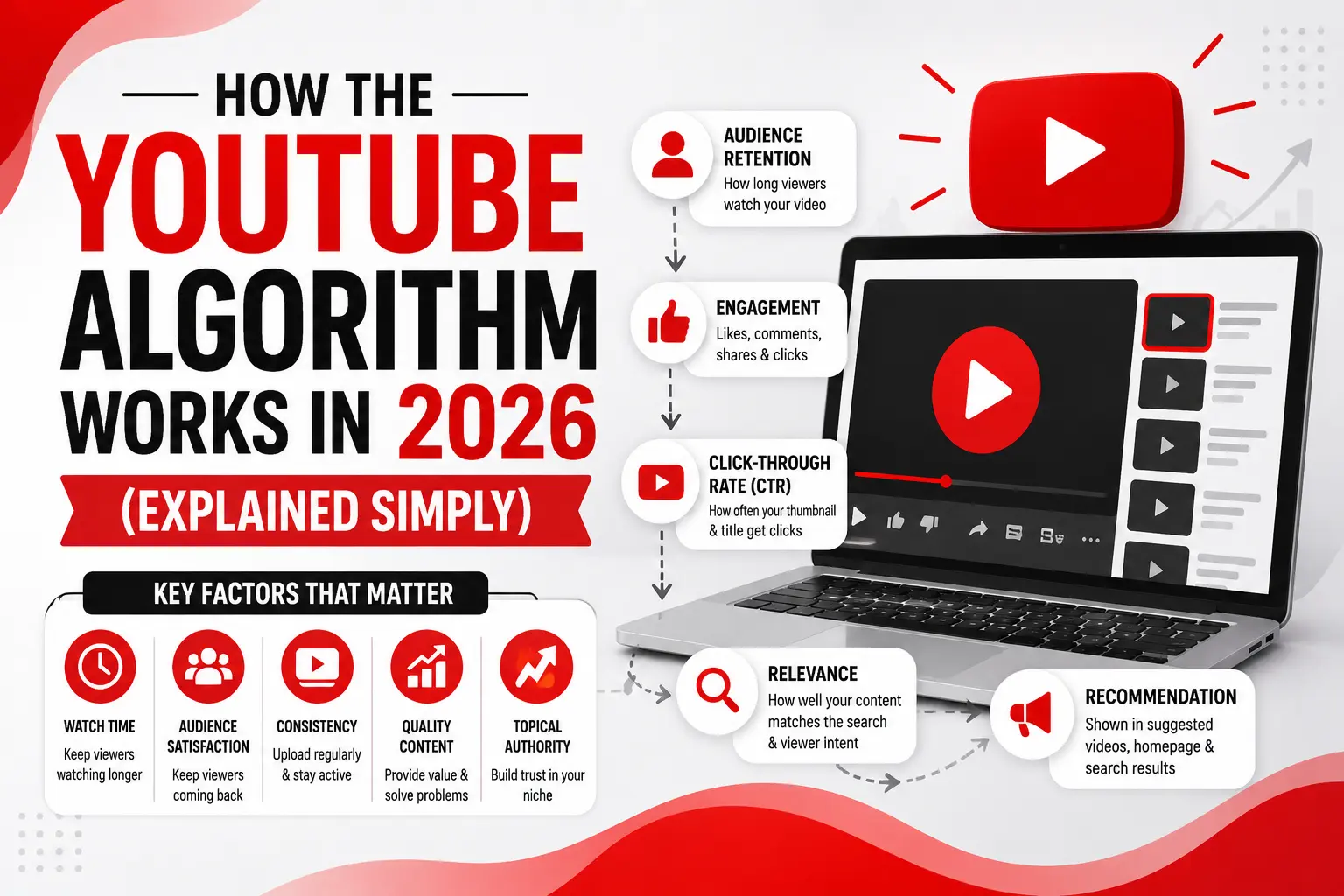

YouTube Algorithm Works – three words that determine whether your videos reach thousands of people or disappear into the void. YouTube is now processing over 500 hours of video uploaded every minute, making algorithmic selection not just helpful but essential for any video ever being seen. What makes 2026 a pivotal year is a fundamental shift in how the platform decides what to recommend: it’s no longer primarily about watch time, and it’s no longer a single system. A Metricool analysis of over 7 million videos from 82,000+ YouTube accounts found that average views per video increased by 76% in the past year – but that growth went predominantly to creators who understood the new algorithm, not those relying on tactics from 2022. At Search Savvy, we study platform algorithms the same way we study search engine algorithms – because in 2026, YouTube is both a social platform and the world’s second-largest search engine, and visibility on it requires understanding both dimensions.
This guide explains exactly how the YouTube algorithm works in 2026, across every surface it operates on, in plain language – with the specific signals and strategies that actually move the needle.
What Is the YouTube Algorithm and Why Does It Matter in 2026?
YouTube Algorithm Works by operating not as one system but as five separate recommendation engines, each running independently for different surfaces of the platform:
- Home Feed – what viewers see when they open YouTube
- Suggested Videos – what appears alongside and after videos they’re watching
- YouTube Search – results when users actively search a term
- Subscriptions Feed – content from channels users have subscribed to
- YouTube Shorts – the fully separate recommendation engine for short-form content
Understanding this is critical because a video that performs brilliantly in Search may never appear in the Home Feed. A Short that gets millions of views may not drive a single view to your long-form content. Each surface has its own signals, priorities, and optimisation requirements – and strategies that ignore this distinction consistently underperform those that don’t.
YouTube’s algorithm matters more than ever in 2026 because it determines the entirety of your organic discovery. Unlike Google, where backlinks and domain authority play significant roles, YouTube’s distribution is determined almost entirely by how the algorithm evaluates your content’s performance with viewers. There are no shortcuts – only signals.
How Does the YouTube Algorithm Work in 2026?
YouTube Algorithm Works through what YouTube calls a “test and expand” loop – a process that repeats for every single video uploaded:
- Initial test: Your video is shown to a small group of viewers – typically your existing subscribers and people who have historically watched similar content
- Signal collection: The algorithm measures how that test group responds – do they click? How long do they watch? Do they share it? How do they feel afterward?
- Expansion decision: If the signals are strong, the video is shown to progressively larger audiences. If signals are weak, distribution slows and eventually stops
- Continued evaluation: Unlike most social platforms, YouTube continues evaluating videos for weeks and months after upload. Some videos experience delayed growth when the algorithm finds a new audience segment that responds well
This feedback loop means your video is never evaluated in isolation – it’s constantly being compared to every other video competing for the same viewer’s attention.
What Are the Most Important YouTube Ranking Signals in 2026?
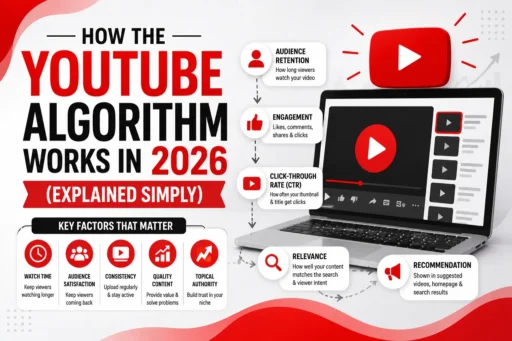
YouTube Algorithm Works through a hierarchy of signals that has shifted significantly in 2026. Here are the factors ranked by their current influence:
1. Viewer Satisfaction (The #1 Signal in 2026)
YouTube Algorithm Works by prioritising viewer satisfaction above all other metrics – a fundamental shift that fully completed in 2026. YouTube CEO Neal Mohan’s January 2026 annual letter confirmed that satisfaction-weighted discovery has replaced watch time as the platform’s primary optimisation goal.
How YouTube measures satisfaction:
- Post-watch surveys – YouTube directly asks viewers: “Was this video worth your time?”
- Repeat views – returning to watch a video again is the strongest satisfaction signal
- Shares – sharing a video signals the viewer found it genuinely valuable
- Likes – positive engagement after watching
- Closing behaviour – do viewers close YouTube after watching your video (session-ending), or continue watching more (session-contributing)?
The key insight: A shorter video that leaves viewers satisfied and returning for more content will outperform a longer video that viewers abandon or rate poorly. A 3-minute video that gets shared beats a 20-minute video that gets abandoned.
2. Watch Time and Audience Retention
YouTube Algorithm Works by still evaluating watch time as a core signal – but now in a satisfaction-weighted context. What matters is not how long your video is, but what proportion of it viewers watch, and how engaged they are throughout.
The specific metrics YouTube tracks:
- Average View Duration (AVD) – the average number of minutes viewers spend on your video
- Average Percentage Viewed (APV) – what percentage of the total video length was watched
- Retention curve shape – YouTube analyses where exactly viewers drop off, which reveals which sections of your content aren’t earning attention
A 720p video with 60% retention will outperform a 4K video with 30% retention every time. YouTube’s algorithm measures viewer behaviour (watch time, engagement, satisfaction), not technical quality. This is one of the most important myths debunked – production quality doesn’t rank videos. Viewer behaviour does.
3. Click-Through Rate (CTR)
YouTube Algorithm Works by using CTR as its primary signal of whether your thumbnail and title combination accurately represents your content and appeals to your target audience. CTR measures the percentage of viewers who see your video in a feed and click on it.
2026 CTR benchmarks:
- Under 2% – poor; thumbnail or title needs significant improvement
- 2–5% – average; room for improvement
- 5–10% – strong performance
- 10%+ – viral-range; one of the hallmarks of breakout videos
However, CTR alone is not the metric to optimise for in isolation. A clickbait title that generates a 12% CTR but causes viewers to leave within 30 seconds tells the algorithm something far worse than a 4% CTR with 70% retention. Keyword matching alone does not guarantee ranking. If viewers click on a video but leave quickly, the algorithm interprets this as low satisfaction, causing rankings to drop.
4. Session Contribution
YouTube Algorithm Works differently in 2026 compared to even two years ago because session contribution has emerged as a major signal for Suggested Video placement. The biggest change in 2026 is increased weight on session contribution. Videos that lead viewers to watch more content afterward receive significantly more suggested placements. Videos that tend to end viewing sessions (viewers close YouTube after watching) receive fewer impressions in suggested.
This means the question isn’t just “did they watch my video?” but “did watching my video make them want to stay on YouTube longer?” Content designed to lead naturally to other videos – whether your own or related creators’ – performs significantly better in Suggested placement.
5. Engagement Signals (Comments, Likes, Shares)
YouTube Algorithm Works by using engagement signals as secondary validation of viewer satisfaction. Comments, likes, and shares all contribute – but their weight varies by format and context.
The engagement hierarchy in 2026:
- Shares – the highest-weight engagement signal, especially cross-platform
- Comments – particularly comments that demonstrate genuine reaction to the content
- Likes – positive engagement, especially when the like-to-view ratio is strong
- Saves (Playlists) – adding a video to a playlist signals deep interest
Note: YouTube CEO Mohan has confirmed that dislikes alone are not a significant ranking penalty as long as the video maintains strong watch time and engagement. A controversial video that viewers watch fully and discuss actively may still rank strongly.
6. Metadata: Titles, Descriptions, Tags, and Thumbnails
YouTube Algorithm Works alongside human behaviour – which means metadata plays a different role than in pure algorithmic systems. Metadata helps the algorithm initially categorise your video and identify relevant audiences to test it with. YouTube can now understand spoken content within videos, which means the words in your video’s audio contribute to its relevance for specific search terms, beyond just the metadata you write.
Title optimisation in 2026:
- Include your primary keyword in the first 60 characters (the visible portion in most feeds)
- Write for human curiosity and click motivation, not just keyword matching
- YouTube’s NLP now understands semantic intent – exact keyword match in titles matters less than clearly answering the searcher’s intent
Thumbnail optimisation:
- High contrast, minimal text, clear focal point
- Thumbnails with human faces showing clear emotion consistently outperform text-only or graphic thumbnails
- Thumbnails should accurately represent the video’s content – misleading thumbnails tank satisfaction scores and hurt long-term performance
How Does the YouTube Algorithm Work for YouTube Shorts in 2026?
YouTube Algorithm Works completely differently for Shorts than for long-form content – and since late 2025, this separation is total. As of late 2025, YouTube fully separated the Shorts recommendation engine from long-form. Shorts are ranked based on swipe-through rate, loop rate, shares, and engagement within the first few seconds.
This is critical knowledge for creators: poor Shorts performance no longer drags down long-form recommendations, and vice versa. You can build each format independently.
The key Shorts ranking signals in 2026:
- Swipe-through rate (viewed vs swiped-away ratio) – the #1 metric. If viewers swipe past your Short instantly, the algorithm stops distributing it. You have approximately 2 seconds to establish interest before a swipe.
- Loop rate – how many viewers watch your Short more than once. Shorts that loop naturally (content that rewards re-watching) earn significantly more distribution.
- Shares – cross-platform shares are the strongest Shorts engagement signal
- Completion rate – watching all the way through to the end is a strong positive signal, especially for Shorts under 60 seconds
New in 2026: YouTube introduced a dedicated Shorts search filter, meaning users can now search specifically for Shorts. This makes keyword optimisation of your Short’s title and description essential for Shorts discovery – the same keyword logic that applies to long-form now applies to Shorts too.
Shorts as a funnel strategy: YouTube increasingly encourages traffic flow between formats. Shorts are often used to introduce viewers to long-form content, guiding them toward longer videos from the same creator. When this flow works, Shorts act as discovery, while long-form videos drive deeper engagement and session time.
How Does YouTube Search Work in 2026?
YouTube Algorithm Works differently in Search compared to its recommendation surfaces. Search is the most SEO-friendly surface on YouTube – and for creators producing educational, tutorial, or evergreen content, it’s the most reliable long-term growth strategy.
YouTube search ranking factors in 2026:
- Relevance – how closely your title, description, tags, and spoken audio match the search query
- Engagement from search traffic – do users who find your video through search continue watching other videos? (Session contribution matters here too)
- Channel topical authority – YouTube evaluates your history of publishing content in a specific niche and how viewers have responded to it over time
- CTR from search results – if your title and thumbnail consistently earn clicks when shown in search, your search ranking improves
Semantic search in 2026: YouTube’s NLP system has become significantly more sophisticated. Semantic understanding for Search means YouTube’s NLP now understands meaning, not just keywords. Exact keyword matches in titles matter less than clearly answering the searcher’s intent. This means optimising for the question a searcher is trying to answer, not just the keyword phrase they type.
What New 2026 Features Affect the YouTube Algorithm?
YouTube Algorithm Works with several new features introduced in 2026 that directly affect how content is distributed:
The Hype Feature Launched in early 2026 for channels with 500–500,000 subscribers, the Hype feature allows fans to “Hype” a video within 7 days of upload, pushing it onto a dedicated leaderboard and giving it a temporary ranking boost in the Explore feed. Designed specifically for creators with 500 to 500,000 subscribers, this allows fans to “Hype” a new video, pushing it onto a dedicated leaderboard and giving it a temporary ranking boost in the Explore feed. This gives smaller channels a critical manual signal to bypass standard retention hurdles.
Multi-Language Support and AI Dubbing YouTube’s AI dubbing feature – which creates native-sounding dubbed audio tracks in multiple languages – significantly expands content discoverability in non-English speaking markets. Videos with multiple audio tracks can now surface in recommendation feeds across language demographics they previously couldn’t reach.
AI Slop Filtering YouTube CEO Mohan’s 2026 letter explicitly mentioned managing “AI slop” as a platform priority. YouTube’s AI content quality filters are increasingly distinguishing between human-created and mass-produced AI content. Original, experience-driven content continues to receive preferential treatment.
At Search Savvy, we recommend treating the Hype feature as a community engagement priority in your first 7 days post-upload. Ask your most engaged subscribers to Hype your new videos as a specific call-to-action in the video itself and in your community posts – this translates directly into wider algorithmic distribution for mid-size creators.
Common YouTube Algorithm Myths – Debunked for 2026
YouTube Algorithm Works on evidence – and the evidence directly contradicts several widely repeated myths:
Myth 1: “You need a lot of subscribers to get views” False. In 2026, YouTube is actively boosting new creators with dedicated algorithm updates. The algorithm focuses more on individual video performance than channel-level metrics. A new channel with one exceptional video will outrank an established channel with a mediocre one.
Myth 2: “Posting every day grows your channel faster” False. If daily posting reduces quality, the algorithm sees lower retention per video and reduces recommendations. YouTube has stated that timing and upload quantity aren’t crucial optimisation factors.
Myth 3: “Higher video quality means higher rankings” False. A 720p video with 60% retention outperforms a 4K video with 30% retention every time. The algorithm measures viewer behaviour, not technical production values.
Myth 4: “The algorithm punishes small channels” False. YouTube’s monetisation status does not affect algorithm distribution. Non-monetized channels can receive the same recommendation treatment as monetized channels.
People Also Ask: YouTube Algorithm Questions
Does the YouTube algorithm favour longer videos?
Not in 2026. YouTube has shifted from rewarding raw watch time to rewarding viewer satisfaction. A short video that viewers watch completely and share will outperform a long video that viewers abandon halfway through. The algorithm optimises for whether viewers feel their time was well spent – not whether the video is long.
How quickly does the YouTube algorithm evaluate a new video?
Most videos receive their initial test impressions within 24–48 hours of upload. However, the algorithm continues evaluating videos for weeks and months after publication. Some videos experience delayed growth when the algorithm identifies new audience segments that respond well – making patience and consistent uploads an important part of the long-term strategy.
Does the YouTube algorithm treat small channels differently from large ones?
No. YouTube has officially debunked the idea that small channels are disadvantaged. The algorithm evaluates individual video performance – CTR, retention, satisfaction – not channel size or subscriber count. Small channels with genuinely valuable content consistently earn significant views in 2026.
Frequently Asked Questions (FAQ)
Q1: How often does the YouTube algorithm change? YouTube updates its algorithm 3–4 times per year with major changes, plus continuous minor adjustments running throughout the year. The core ranking factors (watch time, CTR, engagement) remain stable between updates; what changes is typically how YouTube weighs different formats, new features like Shorts or Hype, and how it handles emerging content patterns like AI-generated content. Monitor your YouTube Analytics weekly for sudden shifts in impressions or CTR that signal algorithm changes affecting your niche.
Q2: What is the single most important thing to optimise for the YouTube algorithm in 2026? Viewer satisfaction – specifically, the combination of high audience retention (how much of your video people watch) and post-watch engagement (shares, repeat views, and positive survey responses). According to Search Savvy’s video content framework, the most reliable way to optimise for satisfaction is to deliver your core value quickly (within the first 30–60 seconds), maintain a consistent pace throughout, and end in a way that leaves viewers feeling they got exactly what they came for.
Q3: How do I optimise my video for YouTube Search specifically? Focus on: (1) including your primary keyword naturally in your title within the first 60 characters; (2) writing a detailed description of at least 150–200 words that covers the full scope of your topic; (3) adding relevant tags that reflect both your specific topic and broader category; (4) speaking your target keywords naturally within the video itself – YouTube’s audio transcription now indexes spoken content for search ranking; and (5) building topical authority by consistently publishing content within a defined niche so YouTube recognises your channel as a credible source for that subject area.
Q4: Do YouTube Shorts help or hurt your long-form channel performance? Neither – as of late 2025, YouTube fully decoupled the Shorts algorithm from long-form. Poor Shorts performance doesn’t negatively affect long-form recommendations. Strong Shorts performance doesn’t directly boost long-form recommendations either. However, Shorts can function as an effective awareness funnel – introducing new viewers to your channel who then discover and subscribe for your long-form content. The best strategy treats Shorts and long-form as complementary but independently optimised content streams.
Q5: Is it true that the YouTube algorithm ignores tags? Tags have reduced in importance compared to 2020–2022. YouTube’s semantic NLP now understands video content from titles, descriptions, audio transcription, and on-screen text – making tags less critical for search discovery than they once were. However, tags still serve as useful categorisation signals, particularly for spelling variations and related terms your title and description don’t explicitly cover. Use 5–10 accurate, relevant tags per video rather than 30–50 broad or unrelated ones.
Q6: How does the YouTube algorithm affect monetisation and ad revenue? YouTube has confirmed that monetisation status does not affect algorithm distribution – non-monetized channels receive the same recommendation treatment as monetized ones. However, certain content categories attract more advertisers and therefore command higher CPMs (cost per thousand views), directly affecting creator revenue. The algorithm’s prioritisation of viewer satisfaction and session contribution means that content keeping viewers engaged on the platform tends to generate more ad revenue per view, regardless of the absolute view count.
Final Thoughts
YouTube Algorithm Works – once you understand what it’s actually optimising for. In 2026, that’s not the longest video, the most frequent uploads, or the highest production budget. It’s the video that leaves viewers satisfied, that makes them want to watch more, and that accurately delivers on the promise its thumbnail and title make.
The shift to satisfaction-weighted discovery is the most significant philosophical change YouTube has made in years – and it actually makes the algorithm more creator-friendly, not less. Because if you make content that genuinely serves your audience, the algorithm will find them for you.
Search Savvy helps businesses and creators build video content strategies optimised for the 2026 YouTube algorithm – from keyword research and title strategy to audience retention analysis and cross-format growth planning.