
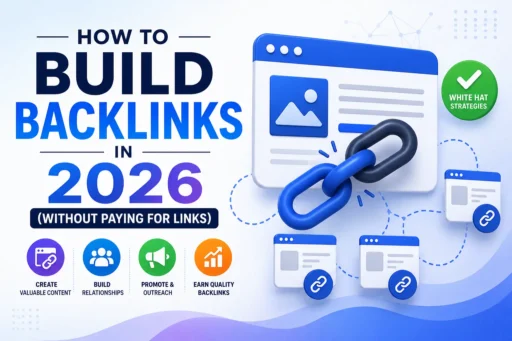

Build backlinks in 2026 – and do it the right way – because the shortcuts are more dangerous and the white-hat strategies more rewarding than at any previous point in SEO history. Google still considers backlinks one of the three most important ranking factors, alongside content quality and user experience. Businesses that blog regularly earn 97% more inbound links than those that don’t. In the era of AI search, quality backlinks now do double duty: they improve your Google rankings and help AI engines like ChatGPT, Perplexity, Google AI Overviews, and Gemini associate your brand with authoritative expertise in your topic area. At Search Savvy, we’ve seen a consistent truth across hundreds of link-building campaigns: the most valuable backlinks are earned through value, relationships, and strategy – not purchased. This guide covers the most effective free link-building strategies available in 2026, exactly how to execute each one, and what not to do.
Why Do Backlinks Still Matter So Much in 2026?
Build backlinks in 2026 and you’re building two things simultaneously: traditional search rankings and AI search authority – because in 2026, these are no longer fully separate channels.
Google’s SpamBrain AI has become exceptionally sophisticated at detecting unnatural link patterns. Paid link schemes that passed undetected three years ago now trigger algorithmic and manual penalties with increasing frequency. But the genuine value of backlinks has not decreased – if anything, it’s increased, because the signal-to-noise ratio has improved as spam is filtered out.
In 2026, quality backlinks affect more than just rankings. They help you earn citations in AI systems like ChatGPT, Perplexity, Gemini, and Google AI Overviews. When relevant sources link to you and mention you alongside specific topics or problems, LLMs start to associate your brand with those areas.
The goal of link building has shifted from SEO authority to discoverability. The best brands in 2026 are earning backlinks AND co-citations – training the internet to associate their name with the right topics.
What makes a high-quality backlink in 2026:
- Relevance – the linking page covers a topic closely related to yours
- Trust – the source has real editorial standards and a real audience
- Context – your link is embedded in body copy that explains what you do, not just a footer citation
- Co-citation – your brand appears near other authoritative names your topic area
- Persistence – the page stays live, updated, and continues to be crawled
One high-quality, contextually relevant backlink from a trusted industry publication is worth more in 2026 than 100 links from unrelated, low-authority directories.
How Do You Build Backlinks in 2026 Without Paying? (8 Proven Strategies)
Build backlinks in 2026 for free using these eight strategies – each one requires time and consistency but zero payment. Executed correctly, they produce links that both Google and AI search engines trust.
Strategy 1: Create Linkable Assets (The Foundation of Everything)
Build backlinks in 2026 by creating content people genuinely want to reference – not blog posts that rehash what others have already said, but original, citable assets that become the default reference for a specific piece of information.
Among the most powerful backlink building strategies is creating original research or expert roundups. When you publish original data or insights, people naturally want to cite you. This creates organic links without direct outreach. No outreach required – just distribution.
High-performing linkable asset formats in 2026:
- Original research or surveys – even a small industry survey with proprietary data attracts backlinks from journalists, bloggers, and industry analysts who need statistics to cite
- Comprehensive “Ultimate Guides” – definitive resources on a specific topic become the default reference other content creators link to for context
- Free tools and calculators – interactive resources that solve a specific problem attract consistent passive backlinks over years
- Infographics and data visualisations – visual representations of complex data are shared and embedded across platforms, each embed potentially generating a backlink
- Original case studies – real-world results with verifiable outcomes that others reference when discussing similar outcomes
The key distinction: a linkable asset answers a question no other page answers as definitively. Content that delivers real value breeds backlinks naturally, especially when it’s unique and reference-worthy.
Promotion matters: Creating the asset is only half the work. Publish it in communities where your audience and writers are active – Reddit, LinkedIn, Quora, and relevant industry forums. The more initial traction a piece generates, the more it becomes part of the citation ecosystem that other content writers draw from.
Strategy 2: Journalist Outreach (HARO and Alternatives)
Build backlinks in 2026 through journalist outreach – pitching your expertise to journalists and content creators who need verified quotes, data, and insights for their articles. This is the fastest way to earn backlinks from high-authority publications without paying for placements.
The most effective platforms in 2026:
- Featured.com (formerly HARO’s primary successor) – journalists post specific questions; you answer briefly and precisely; editorial links often carry significant authority
- Qwoted – connects professionals with journalists across multiple verticals
- Muck Rack – a journalist database where you can proactively pitch relevant reporters
- ProfNet – PR Newswire’s expert sourcing network
- Journalist Twitter/X – many journalists announce source requests using #journorequest and #prrequest
At Search Savvy, we recommend responding to journalist requests within two hours of seeing them. Journalists work with tight deadlines and typically use the first two or three usable responses they receive. Keep your pitch to 100–150 words, lead with your key insight rather than your credentials, and include your name and title clearly so the journalist can attribute the quote accurately.
A single editorial link from a major publication can be worth more for domain authority, brand recognition, and AI citation credibility than a dozen lower-authority backlinks. Editorial links often carry high authority. One placement in a major publication can signal trust to search engines.
Strategy 3: Guest Posting (Done the 2026 Way)
Build backlinks in 2026 through guest posting – but not the way it was done in 2020. Guest posting got a bad reputation for a reason – cranking out low-effort articles and dropping keyword-rich backlinks. But in 2026, that approach doesn’t cut it. Google ignores most of those links – and AI tools don’t trust them either. That doesn’t mean guest posting is dead.
What works in 2026 is strategic, high-quality guest posting on genuinely relevant, high-readership publications in your niche – where the article provides real value to the host site’s audience, and your backlink appears naturally in the context of genuinely useful content.
How to find quality guest posting opportunities:
- Search: your topic + “write for us” or your topic + “guest post” in Google
- Check where your competitors have published guest posts using Ahrefs (free backlink checker) or Semrush to identify the blogs that link to them
- Target sites with real traffic, active readership, and content quality standards – avoid sites that accept any submission without editorial review
The quality signals a guest post must have:
- Unique angle not covered by the host site’s existing content
- Data, examples, or insights specific to your experience
- A natural, contextual backlink to your most relevant existing content – not your homepage
- Author bio with credentials that establish your expertise
Strategy 4: Unlinked Brand Mention Outreach
Build backlinks in 2026 by converting existing brand mentions into links – the highest-conversion, lowest-effort backlink strategy available because someone has already decided your brand is worth mentioning. They just haven’t linked yet.
How to find unlinked brand mentions:
- Set up Google Alerts for your brand name, founder name, and key product/service names
- Use Ahrefs or Semrush’s Brand Monitoring to find unlinked mentions across the web
- Use Google search operators: “Your Brand Name” -site:yourdomain.com
Outreach template approach: Once you find an unlinked mention, contact the website owner or author with a brief, friendly message:
“Hi [Name], I noticed you mentioned [Brand Name] in your article on [topic] – thank you for the reference! I wanted to reach out to see whether you’d be able to add a link to the mention so your readers can easily find us. Here’s the direct URL: [your URL]. Happy to return the favour if there’s ever an opportunity!”
When somebody writes about your brand, product, or service and doesn’t link to you – this is low-hanging fruit. Getting backlinks is also easier if somebody is already talking about your brand.
Strategy 5: Broken Link Building
Build backlinks in 2026 using broken link building – a strategy that earns you backlinks by helping webmasters fix a problem on their own site. You find dead links on relevant pages, let the webmaster know, and suggest your content as the replacement. Everyone wins.
Step-by-step process:
- Use Ahrefs’ broken link checker or Screaming Frog to identify broken outbound links on high-authority pages in your niche
- Check whether you have existing content that would be a suitable replacement for the broken link
- If not – and the opportunity is significant enough – create a page specifically designed to fill that gap
- Email the webmaster noting the broken link (provide the exact URL), explain what the dead link pointed to, and suggest your page as a replacement
The key to high conversion on broken link outreach is making the webmaster’s job as easy as possible: give them the exact broken URL, the anchor text they were using, and your suggested replacement link in a single, clear email.
Strategy 6: Resource Page Link Building
Build backlinks in 2026 from resource pages – curated lists that website owners and educators publish to help their audience find the best tools, guides, and references on a topic. These pages actively want to link to valuable resources – they just need to know yours exists.
How to find resource pages:
- Search: your topic + “resources” or your topic + “useful links” or your topic + “recommended tools”
- Look for academic, governmental, or association resource pages – these carry significant authority
What your pitch needs:
- A clear, concise description of what your resource covers and why it’s uniquely valuable to their audience
- Evidence of quality – your content must be genuinely better or more comprehensive than what’s currently listed
- A specific suggested anchor text and URL
Resource page backlinks tend to be long-lived – these pages don’t update frequently – making them valuable for sustained authority building.
Strategy 7: Digital PR and Original Research
Build backlinks in 2026 by creating newsworthy content that earns media coverage – a strategy that can generate dozens of high-authority backlinks from a single piece of original research.
What constitutes newsworthy content for link building:
- Industry surveys – poll 50–100 professionals in your niche and publish the findings with charts and key statistics
- Original data analysis – analyse publicly available data and present a unique interpretation
- Annual reports or trend roundups – curated expert predictions for the year ahead
- Case studies with specific data – real results from real campaigns with numbers
When you publish original data, journalists covering your industry actively seek it out. A well-distributed piece of original research can earn backlinks from news outlets, industry blogs, and academic resources – all without reaching out to every individual site.
Distribution: Share your research on LinkedIn, Reddit communities in your niche, and in journalist communities. Pitch it directly to 10–15 relevant journalists who cover your industry.
Strategy 8: Competitor Backlink Replication
Build backlinks in 2026 by systematically identifying where your competitors’ backlinks come from – then pursuing the same sources.
How to execute:
- Use Ahrefs’ Site Explorer or Semrush’s Backlink Analytics to pull your top 3 competitors’ full backlink profiles
- Sort by Domain Rating (DR) / Authority Score – focus on sources with DR 40+
- Filter for contextual, editorial links (not automated directories)
- For each high-value backlink: identify why the competitor earned the link (guest post? original data? resource listing?) and replicate the strategy for your own content
Your rival might have a quality backlink because their CEO gave an interview to an industry publication, and you might be able to arrange an interview with the same site. Or perhaps your rival is listed in an industry round-up that could include your brand, too.
What Link-Building Practices Should You Avoid in 2026?
Build backlinks in 2026 only through legitimate means – because the detection systems are sophisticated, the penalties are severe, and the short-term gains are almost never worth the long-term risk.
Avoid all of the following:
- Buying links – Google’s SpamBrain AI flags paid link patterns with increasing accuracy. The FTC also classifies undisclosed paid links as deceptive advertising.
- Mass link exchanges – reciprocal link networks and private blog networks (PBNs) are specifically targeted by Google’s spam policies
- Low-quality directory spam – submitting to hundreds of irrelevant directories generates noise, not authority
- Keyword-stuffed anchor text – an unnaturally high proportion of exact-match anchor text is one of Google’s clearest spam signals
- Sudden link velocity spikes – acquiring 500 links in one week after months of inactivity triggers algorithmic review. Keep the growth gradual: one link every two days performs better than 500 links dumped in a week.
People Also Ask: Building Backlinks in 2026
How long does it take to build backlinks and see results in 2026?
Getting backlinks takes anywhere from a few days to several months depending on the techniques you use. Quick wins like turning unlinked mentions into linked mentions can generate results in a matter of days, while content-based strategies like creating original research or comprehensive guides may take months to attract natural links.
Do nofollow links still matter for SEO in 2026?
Yes – nofollow links from high-authority, relevant sources still provide brand exposure, referral traffic, and co-citation signals that AI search engines use to assess authority. Even nofollow backlinks can lead to shares and organic links from other sites. A diversified backlink profile with a natural mix of dofollow and nofollow links is healthier than one with exclusively dofollow links.
Is it safe to use link exchanges for building backlinks in 2026?
Occasional reciprocal links between genuinely related sites with legitimate editorial reasons are generally acceptable. Building a strategy around systematic link exchanges is risky – Google’s Spam policies explicitly target large-scale link swap arrangements. Focus on earning links through genuine value creation rather than structured exchanges.
Frequently Asked Questions (FAQ)
Q1: How many backlinks do I need to rank on the first page of Google in 2026? There’s no universal threshold – the number required depends on your industry’s competitiveness, your domain’s existing authority, and the quality of the links you’ve earned. For a low-competition niche keyword, 5–10 quality backlinks from relevant sources may be sufficient. For highly competitive terms in crowded verticals, hundreds of authoritative backlinks may be needed. Use Ahrefs or Semrush to analyse the backlink profiles of current top-ranking pages for your target keyword – that’s your real benchmark.
Q2: What is the fastest way to build backlinks in 2026 without paying? The fastest legitimate method is unlinked brand mention conversion – finding existing mentions of your brand that lack a hyperlink and requesting one. Since the site has already decided your brand is worth referencing, the conversion rate is significantly higher than cold outreach. Second fastest is journalist outreach through platforms like Featured.com, where timely, expert responses to reporter queries can earn high-authority editorial links within days.
Q3: Do backlinks from social media count for SEO? Most social media links (Facebook, Instagram, LinkedIn, Twitter/X) carry the rel=”nofollow” or rel=”ugc” attribute, meaning they don’t directly pass PageRank. However, social shares increase content visibility, which leads to genuine editorial backlinks from people who discover your content through social channels. More importantly, brand mentions across social platforms – even without links – contribute to the co-citation signals AI search engines use to assess authority.
Q4: What tools can I use to build backlinks in 2026 for free? The most useful free tools are: Google Alerts for monitoring brand mentions; Ahrefs’ Free Backlink Checker for competitor analysis and link gap identification; Google Search Console for monitoring your own referring domains; and Screaming Frog (free up to 500 URLs) for broken link discovery. Featured.com for journalist outreach is free for basic access.
Q5: How do backlinks help with AI search visibility in 2026? Search Savvy consistently finds that AI search citation rates are strongly correlated with backlink authority. When authoritative, topically relevant sites link to your content and mention your brand alongside specific topics, AI language models learn to associate your brand with those areas of expertise. Co-citation – where your brand appears near recognised authorities in the same piece of content – is one of the clearest signals that AI systems use to evaluate whether to cite a source in their generated answers.
Q6: Is guest posting still an effective backlink strategy in 2026? Yes – when done correctly. High-quality guest posts on genuinely relevant, editorial-standard publications in your niche remain one of the most reliable free backlink strategies available. The critical distinction from the old approach: in 2026, your guest post must provide genuine, unique value to the host publication’s audience and earn its link naturally through content quality – not as a transactional exchange. Google ignores most low-effort guest post links; AI search engines don’t trust them either.
Final Thoughts
Build backlinks in 2026 by building authority – not by chasing links. The two are different strategies with dramatically different outcomes. Authority comes from creating genuinely useful content, establishing your brand across the platforms and publications your audience trusts, and earning the recognition of other credible voices in your niche. Links are the measurable evidence that authority is being recognised.
The businesses that will dominate search rankings and AI citations through the rest of this decade are the ones investing in original research, systematic journalist outreach, resource-worthy content, and genuine relationships with complementary brands. Not the ones buying link placements they’ll have to disavow in twelve months.
Search Savvy builds link acquisition strategies grounded in editorial quality and genuine authority signals – earning backlinks that improve both Google rankings and AI search visibility simultaneously, without risking the penalties that paid or manipulative link schemes inevitably attract.