
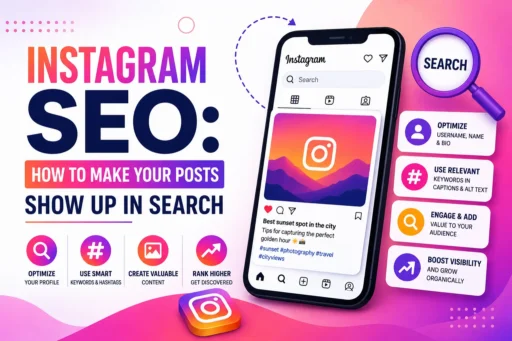
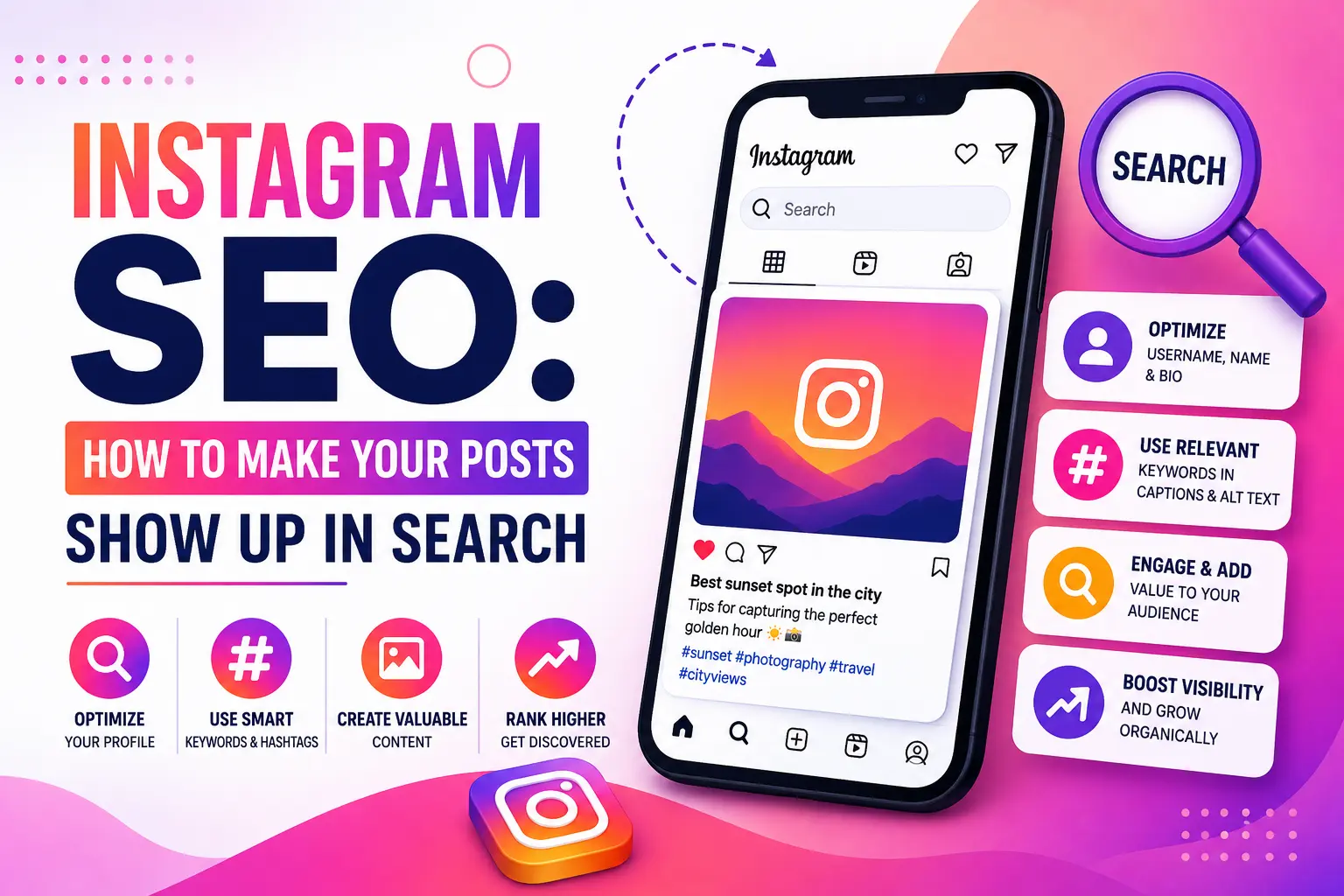

Instagram SEO is no longer optional – and in 2026, it’s not even just about the app. Google and Bing now index public Instagram posts and Reels, meaning your content can appear directly in traditional search engine results alongside websites and blog posts. Instagram’s July 2025 update confirmed this shift: any public professional account with posts from January 1, 2020 onwards is eligible for third-party indexing. At Search Savvy, we’ve watched this change reshape how local businesses, creators, and brands approach their social content – and the businesses treating their Instagram posts like searchable micro-landing pages are the ones pulling ahead in both in-app discovery and Google visibility. This guide covers every Instagram SEO signal that matters in 2026 and exactly how to optimise for it.
What Is Instagram SEO and How Does It Work?
Instagram SEO is the process of optimising your profile, posts, captions, hashtags, alt text, and engagement signals so your content ranks higher in Instagram’s internal search results – and increasingly, in Google and Bing search results too.
Instagram’s search algorithm is a signal-driven ranking engine that evaluates three primary factors when deciding what to surface for any given query:
- Relevance to the search query – how closely your text (bio, captions, hashtags, alt text) matches what a user typed in the search bar. This is the most important factor. Instagram reads your content like a search engine reads a webpage.
- User activity signals – if a user frequently engages with fitness content, Instagram prioritises fitness accounts with high engagement for their searches. The platform personalises results based on individual behaviour patterns.
- Post engagement signals – shares, saves, and comments are the engagement types that carry the most weight. A post with high shares for a specific keyword ranks higher than a post with the same keyword but low engagement. In 2026, shares are the single strongest ranking signal on the platform.
Instagram Head Adam Mosseri has confirmed publicly that the platform reviews bio, username, and name field when indexing profiles for search results. The algorithm reads your account like a mini-website – and if it can’t determine what your account is about from your profile metadata, your posts struggle to rank regardless of how good they are.
Why Is Instagram SEO More Important Than Ever in 2026?
Instagram SEO matters in 2026 for a reason that didn’t exist two years ago: Google now shows Instagram posts in its search results. This is not a marginal update – it fundamentally changes the value of every post you publish.
Consider what this means practically: a post you optimise for Instagram search now has the potential to appear in:
- Instagram’s internal search bar results
- Instagram’s Explore page
- Instagram Reels tab search
- Google Search results (for eligible public professional accounts)
- Bing Search results (and therefore Microsoft Copilot’s AI answers)
The audience reach from a single well-optimised post has multiplied dramatically. Gen Z users are now more likely to search for a coffee shop, skincare routine, or marketing tutorial on Instagram than on Google – and even users who search on Google are frequently directed to Instagram content for visual, real-world answers.
Instagram also introduced a native SEO setting toggle in 2025 that allows business and creator accounts to control which posts are eligible for external search engine indexing. Enabling this for your best-performing, evergreen posts is one of the fastest visibility wins available in 2026.
How Do You Optimise Your Instagram Profile for Search?
Instagram SEO starts with your profile – not your posts. According to Instagram’s own guidance, the platform evaluates three profile elements first when matching accounts to search queries:
1. Username (Handle)
Your username is the single highest-weight metadata field in Instagram’s search algorithm. If your handle is completely unrelated to your business or niche, you’re invisible to intent-driven searches.
Best practice: Include a relevant keyword in your username where possible. @searchsavvy works far better for marketing-related searches than @savvy2024brand. If changing your handle isn’t feasible, focus extra effort on your name field.
2. Name Field (Display Name)
Your display name – the bold text below your profile photo – is separate from your username and is one of the most powerful and most underused Instagram SEO fields. Unlike your username, your name field can be updated freely and serves as prime keyword real estate.
Best practice: Include your primary keyword or service description in your name field. Example: instead of just “Search Savvy”, use “Search Savvy | SEO & Digital Marketing.” This appears in search results and tells both the algorithm and potential followers exactly what your account is about.
3. Bio
Your Instagram bio is indexed by Instagram’s algorithm for search relevance – and since Google now indexes public professional profiles, it effectively functions as your “meta description” in both in-app and web search contexts.
Best practice:
- Include your primary keyword or niche naturally in the first two lines
- Add your location if you serve local customers (business accounts can add this as a dedicated field)
- Include your service or content category in plain language
- Keep it under 150 characters for full visibility on mobile
At Search Savvy, we recommend treating your Instagram bio as you would a Google meta description – it should communicate exactly who you are, what you do, and who you serve, while naturally including the keyword phrases your target audience is searching for.
How Do You Write Instagram Captions That Rank in Search?
Instagram SEO at the post level lives primarily in your captions. In 2026, the one-emoji caption is dead. The algorithm analyses caption text as its primary signal for understanding what a post is about and matching it to relevant search queries.
The 2026 caption optimisation framework:
Place your primary keyword in the first sentence. Instagram’s algorithm – like Google’s – weights the beginning of your caption more heavily than the end. If your post is about “vegan meal prep ideas,” those exact words should appear in your opening sentence, not buried after three lines of storytelling.
Write for humans, with search signals embedded. Keyword stuffing is penalised. The algorithm recognises forced repetition and may suppress your reach as a result. Write naturally, using the exact descriptive language your audience would use when searching for your content.
Aim for 125–150 words for searchable posts. Short captions lack enough semantic context for the algorithm to categorise the content accurately. Longer captions with clear, relevant language consistently rank better in Instagram search for competitive topics.
Use long-tail keyword phrases. Instead of just “fitness tips,” use “beginner home workout for women” – specific phrases that match the intent of real searches. Long-tail keyword phrases attract more qualified, engaged audiences because they match precise user needs.
End with a call-to-action that drives saves and shares. “Save this for later” or “Send this to someone who needs it” directly prompts the two engagement types that most powerfully influence search ranking. Content that gets saved and shared consistently signals high value to Instagram’s algorithm.
How Do Hashtags Work for Instagram SEO in 2026?
Instagram SEO has evolved significantly from the era of “30 hashtags per post.” In 2026, hashtags function as category confirmation tags – they signal to the algorithm what topic bucket your content belongs in, reinforcing the keyword signals already present in your caption and profile.
How to use hashtags strategically in 2026:
- Use 3–5 highly relevant hashtags per post – not 20–30 generic ones
- Choose hashtags that describe the exact topic of your post, not just your broad niche
- Mix hashtag sizes: 1–2 niche hashtags (under 100K posts), 1–2 mid-size hashtags (100K–1M posts), and 1 broader hashtag
- Add 2–3 location or event hashtags for local SEO signals
- Use descriptive hashtags over generic ones: #BeginnerArmWorkout outperforms #Fitness for a specific workout post
Instagram’s official guidance confirms that hashtags are most effective as semantic reinforcement – they work best when they match and confirm the keywords already present in your caption, rather than acting as independent discovery levers.
How Do You Use Alt Text for Instagram SEO?
Instagram SEO now includes image alt text – a feature originally built for accessibility that has evolved into a significant secondary ranking signal. When you add descriptive alt text to your images, you provide a direct text “read” of your visual content to Instagram’s algorithm and to Google’s image indexing system.
How to add alt text to Instagram posts:
- On the final posting screen, tap “Advanced Settings”
- Select “Write Alt Text”
- Describe your image in natural language, weaving in your primary keyword if it fits naturally
Alt text best practices:
- Describe exactly what’s shown in the image as if explaining it to someone who can’t see it
- Include 1–2 relevant keywords where they fit naturally – don’t force them
- Be specific: “woman performing a deadlift in a home gym” outperforms “fitness photo”
- For product posts: include the product name, its use case, and any relevant descriptors
Alt text performs double duty: it improves accessibility for visually impaired users and gives Instagram and Google’s image indexing systems the keyword context they need to categorise and surface your visual content in relevant searches.
How Do Reels Rank in Instagram Search in 2026?
Instagram SEO for Reels operates on additional signals beyond static posts. In 2026, Reels are the highest-reach content format on the platform – and Instagram’s algorithm has developed sophisticated video understanding capabilities that directly influence Reel search rankings.
What Instagram analyses in your Reels:
- Audio and speech – Instagram transcribes spoken words in Reels. If you say your keyword out loud in your video, the algorithm registers it as a content signal.
- On-screen text overlays – text you add directly to your Reel is read and indexed. Include your primary keyword in your on-screen text.
- Watch time and loop rate – Reels that users watch all the way through (and re-watch) are ranked higher. Structuring your Reel to loop seamlessly extends effective watch time and signals higher value to the algorithm.
- Subtitles – adding subtitles to Reels serves both accessibility and SEO. Subtitles help Instagram’s algorithm understand your video’s context for Explore and search ranking.
- Caption keywords – the same caption optimisation rules apply to Reels as to static posts.
A note on originality: Instagram’s algorithm in 2026 deprioritises content that appears to be directly repurposed from other platforms (particularly TikTok watermarked videos). Original, Instagram-native content consistently receives preferential ranking treatment.
What Engagement Signals Affect Instagram SEO Rankings?
Instagram SEO is built on behavioural SEO – the more your account behaves like a consistent, active, genuinely useful presence in your niche, the more prominently it surfaces in search results.
Engagement signals ranked by impact in 2026:
- Shares – the strongest signal. Content shared to Stories or DMs tells Instagram the post sparked a real connection, which is a more valuable signal than passive consumption.
- Saves – the second most important signal. A save indicates the user found the content valuable enough to return to, signalling high utility.
- Comments – shows active engagement rather than passive scrolling. Posts that generate comments early after publishing receive an algorithmic boost.
- Story replies and DMs – private engagement signals that Instagram uses to measure genuine audience satisfaction.
- Profile taps – when search users tap your profile after seeing your post in search results, it signals your content matched their intent accurately.
Content that consistently generates saves and shares is the content Instagram’s algorithm rewards with sustained search visibility. Mini-tutorials, myth-busting posts, and practical tips that make your audience save for future reference are the exact formats that drive this signal pattern.
People Also Ask: Instagram SEO Questions
Does Instagram SEO affect Google rankings?
Yes – directly. Public Instagram posts and Reels from professional accounts (business or creator) with posts from January 1, 2020 onwards are eligible to appear in Google and Bing search results. Optimising your captions, alt text, and profile with relevant keywords means your content can rank in traditional web search results as well as Instagram’s internal search. This dual-channel visibility significantly expands your content’s organic reach.
How long does Instagram SEO take to show results?
Instagram SEO typically shows noticeable results within 2–4 weeks of implementing consistent optimisation across profile, captions, alt text, and hashtags. Accounts that post consistently (3–5 times per week) and generate strong shares and saves within the first hour of posting tend to see ranking improvements fastest. Long-term authority builds over months of consistent, niche-focused posting.
How many hashtags should you use for Instagram SEO in 2026?
Use 3–5 highly relevant hashtags rather than 20–30 generic ones. Instagram’s algorithm in 2026 treats hashtags as category confirmation signals – their effectiveness comes from precision and relevance, not volume. Focus on hashtags that exactly describe your post’s topic, mix niche-size hashtags strategically, and always ensure your hashtags align with the keywords in your caption.
Frequently Asked Questions (FAQ)
Q1: What is the most important Instagram SEO factor in 2026? Keyword relevance across your profile metadata – particularly your name field, username, and bio – is the foundation that determines whether your account surfaces for relevant searches at all. After that, captions with naturally placed keywords at the opening sentence, and engagement signals (especially shares and saves in the first hour of posting) are the most impactful factors for post-level search ranking.
Q2: Do you need a business account for Instagram SEO? Yes – for full Instagram SEO benefit in 2026. Only public professional accounts (business or creator) are eligible for third-party indexing by Google and Bing. Personal accounts are excluded from external search indexing. Additionally, business and creator accounts have access to Instagram’s SEO setting toggle (for controlling which posts are indexed externally) and location fields in the bio – both of which are unavailable on personal accounts.
Q3: How do you do keyword research for Instagram SEO? Use Instagram’s own search bar as your primary research tool. Type your broad topic and observe the autocomplete suggestions – these are the exact phrases real users are searching. Also check the People Also Ask section on Google for your topic (many users now move between Google and Instagram for the same searches). Tools like Semrush and Ahrefs can surface related keyword demand to supplement your in-app research.
Q4: Can a small Instagram account rank in search in 2026? Yes – small accounts can absolutely rank in Instagram search, particularly for niche and long-tail keyword searches where larger accounts haven’t focused their content. Instagram’s algorithm prioritises relevance and engagement signals over follower count for search results. An account with 500 followers that consistently posts highly specific, well-optimised content in a niche topic and generates strong save and share rates will outrank a 50,000-follower account that posts inconsistently across unrelated topics.
Q5: How does posting consistency affect Instagram SEO? Consistency is a direct ranking signal. Search Savvy recommends posting 3–5 times per week as the minimum for building search visibility. Instagram’s algorithm treats consistency as evidence of an active, reliable account – and active accounts receive preferential treatment in both search and Explore placement. Instagram also tends to show accounts with active Stories first in search results, making Stories an additional consistency signal worth maintaining alongside your feed posts.
Q6: What are the biggest Instagram SEO mistakes to avoid in 2026? The most damaging mistakes are: (1) keyword stuffing in captions or bio – the algorithm recognises forced repetition and may suppress your reach; (2) using your handle as a brand name with no relevant keywords while ignoring the name field, which is the easier and more impactful place for keyword placement; (3) publishing low-quality or repurposed content (especially TikTok watermarked videos) – Instagram deprioritises non-original content; (4) posting infrequently – accounts with 30+ day gaps in content show measurable drops in search visibility; (5) ignoring alt text entirely – leaving it blank wastes a significant secondary ranking opportunity.
Final Thoughts
Instagram SEO in 2026 requires the same strategic thinking you’d apply to your website – keyword research, structured metadata, engagement optimisation, and consistent publishing. The difference is in the signals: instead of backlinks, you’re building shares; instead of title tags, you’re optimising name fields and captions; instead of schema markup, you’re adding alt text and subtitles.
The opportunity is significant. With Google now indexing public Instagram posts, a single well-optimised Reel or carousel has the potential to appear in search engine results pages alongside traditional web content – reaching audiences who are searching with buying intent, not just scrolling for entertainment.
The businesses and creators who treat every Instagram post as a searchable micro-landing page – with keyword-optimised captions, descriptive alt text, strategic hashtags, and content explicitly designed to generate saves and shares – are building compounding organic visibility that paid advertising can’t replicate. Search Savvy helps businesses build Instagram SEO strategies that drive both in-app discovery and Google search visibility – integrating social content optimisation into a unified, cross-platform organic growth engine.