
The digital landscape has transformed dramatically. While traditional search engine optimization (SEO) focused on ranking your website on page one of Google, a new paradigm has emerged where being the answer matters more than being a link in the results. This shift is called Answer Engine Optimization (AEO), and understanding it is crucial for businesses looking to maintain visibility in 2025 and beyond.
At Search Savvy, we’ve witnessed firsthand how AI-powered search platforms like ChatGPT, Google AI Overviews, Perplexity AI, and voice assistants are fundamentally changing how people discover information online. Answer Engine Optimization represents the evolution from optimizing for rankings to optimizing for direct answers-and businesses that embrace this change now will dominate the digital conversation in the years ahead.
What Is Answer Engine Optimization?
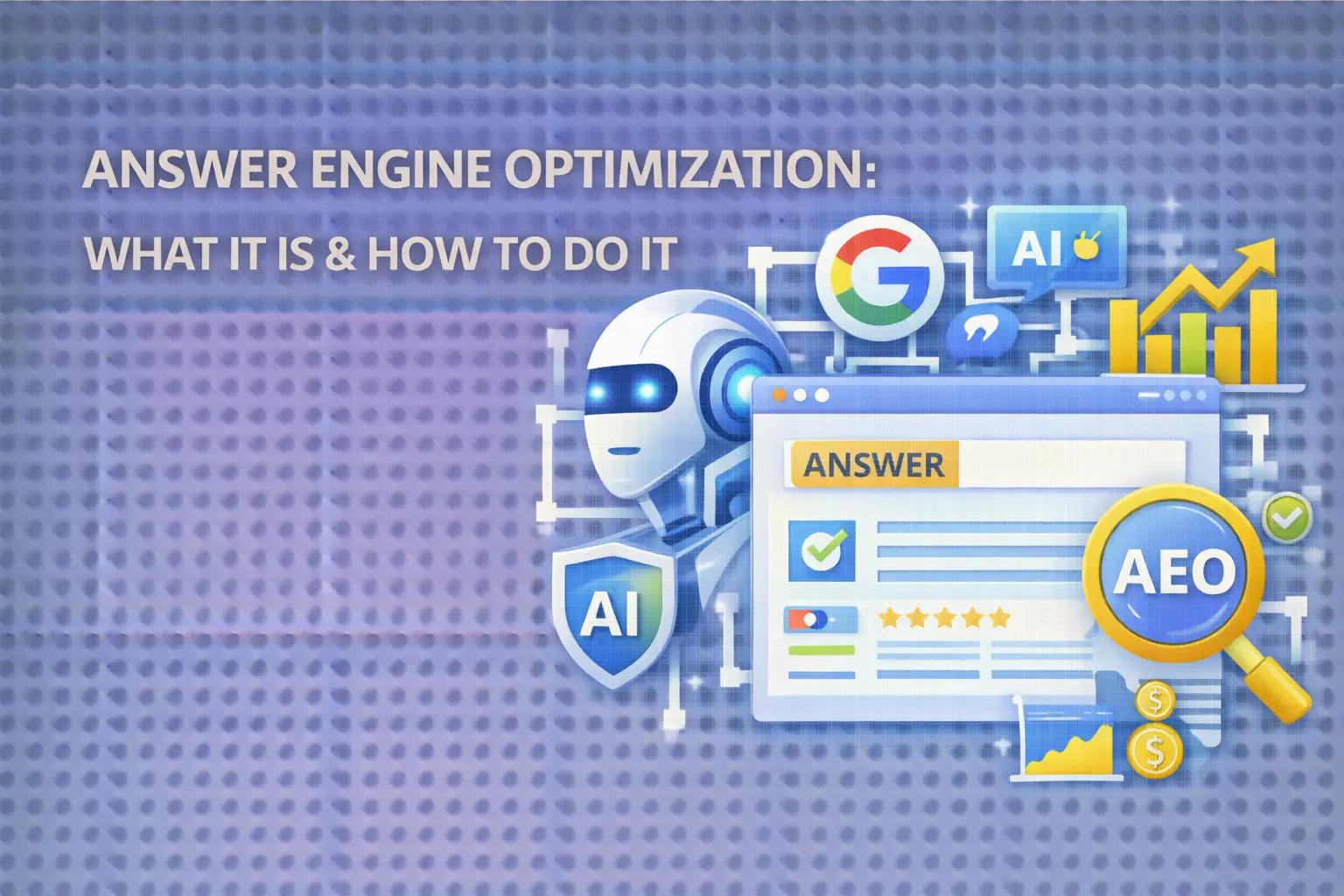
Answer Engine Optimization is the practice of optimizing your content so that AI-powered platforms can directly provide answers to user queries, rather than simply listing links. While traditional SEO aims to improve website ranking and visibility on search engine results pages (SERPs), AEO positions your content as the definitive answer that AI engines deliver to users-whether through featured snippets, voice assistant responses, or AI-generated chat results.
Unlike traditional search engines that provide “the best links,” answer engines aim to deliver “the best answer for you.” These AI-driven platforms use natural language processing (NLP) to interpret the context and intent behind queries, synthesize information from multiple sources, and present a single, comprehensive response. Your goal with AEO is to ensure your content is the source these platforms choose when answering user questions.
Why Is Answer Engine Optimization Important in 2025?
Answer Engine Optimization has moved from emerging trend to business necessity. The numbers tell a compelling story: research firm Gartner predicts that traditional web search traffic will drop 25% by 2026 as users increasingly shift to conversational AI answers. This represents a fundamental change in user behavior that no business can afford to ignore.
Consider the current adoption rates. As of 2025, approximately 153.5 million people in the United States use voice assistants, and over 8.4 billion voice assistants are in use globally-more than the world’s population. Furthermore, 34% of U.S. adults report using ChatGPT, nearly doubling since 2023. These platforms don’t send users to traditional search results; they provide direct answers, and only the most authoritative, well-structured content makes it into those responses.
At Search Savvy, we’ve observed that brands implementing AEO strategies see substantial business impact. While AEO may generate fewer direct website clicks, it drives significant brand visibility and engagement. One noteworthy case study showed NerdWallet reporting 35% revenue growth despite a 20% decrease in site traffic-by ensuring their content and brand expertise reached consumers through snippets and AI-generated answers. This demonstrates that visibility in answer engines translates to real business outcomes, even when traditional traffic metrics decline.
The competitive advantage goes to early adopters. With only 32% of enterprise marketers feeling confident they can diagnose when or why their brand disappears from AI answer blocks, businesses that master AEO now position themselves as trusted authorities before the market becomes saturated.
How Does Answer Engine Optimization Work?
Answer Engine Optimization operates at the intersection of content quality, technical structure, and machine learning. AI-powered answer engines rely on three core capabilities to select which content to feature: natural language processing to understand intent, machine learning to evaluate credibility, and structured data to interpret content context.
When a user asks a question, answer engines don’t simply match keywords-they analyze the semantic meaning, determine what type of answer would be most helpful, and pull information from sources they’ve deemed authoritative. This process happens in milliseconds and involves scanning millions of potential sources. Content that’s clearly structured, factually accurate, and properly tagged with schema markup has a significant advantage in this selection process.
The engine’s decision isn’t static. Research analyzing 80,000 prompts found that LLM citations vary substantially month-to-month. Even if your content is cited today, it might not be tomorrow without ongoing optimization. This makes AEO a continuous strategy rather than a one-time implementation.
Voice search adds another dimension. With over 1 billion voice searches performed monthly and 20.5% of people globally using voice search, optimizing for spoken queries requires understanding conversational language patterns. Voice searches typically use natural, question-like phrasing-requiring content that directly answers “who,” “what,” “when,” “where,” “why,” and “how” questions.
What Are the Key Differences Between SEO and AEO?
Answer Engine Optimization and traditional SEO share some common ground, but their fundamental goals and tactics differ significantly. Understanding these distinctions helps businesses allocate resources effectively.
Goal and Visibility: SEO focuses on improving rankings on search engine results pages to drive clicks to your website. AEO focuses on positioning your content as the answer itself, whether or not users click through. In the AEO model, brand mentions and citations in AI-generated responses become as valuable as website traffic.
Content Optimization Approach: SEO optimizes entire web pages to rank higher using keywords, meta tags, and backlinks. AEO requires optimizing specific content chunks that AI retrieval systems can extract and cite. Since AI answer engines extract snippets rather than whole articles, brands must ensure consistent presence throughout all relevant content sections, not just isolated parts.
Measurement and Tracking: SEO provides transparent, ranked search results based on specific algorithms, allowing brands to track position and adjust strategies accordingly. AEO produces probabilistic and dynamic responses without a fixed ranking system, making it unpredictable when or how a brand’s content will appear. This makes specialized AEO tracking tools essential for monitoring AI visibility across platforms.
Search Intent: SEO targets specific, high-traffic keywords based on what people type into search boxes. AEO focuses on understanding conversational questions and providing direct, authoritative answers. The language is more natural and context-dependent.
Despite these differences, Search Savvy recommends that businesses maintain both SEO and AEO strategies. The two approaches complement each other-strong SEO fundamentals create the foundation that AEO tactics build upon.
How Can You Optimize Content for Answer Engines?
Answer Engine Optimization requires a multi-faceted approach that combines content strategy, technical implementation, and ongoing monitoring. Here’s how to build an effective AEO strategy:
Create Question-Based Content
Start by researching the specific questions your target audience asks. Use tools like Google’s People Also Ask, AnswerThePublic, or keyword research platforms to identify question patterns in your industry. Structure your content around these questions, using them as H2 or H3 subheadings.
Provide direct, concise answers immediately following each question-typically 40-60 words that comprehensively address the query. Voice assistants and AI engines favor answers that are accurate and actionable without requiring users to read extensive explanatory text first.
Implement Structured Data and Schema Markup
Structured data acts as a translator between your content and search engines, telling AI exactly what your content means rather than leaving interpretation to algorithms. Implement Schema.org markup in JSON-LD format for maximum compatibility.
The most effective schema types for Answer Engine Optimization include:
- FAQPage – Formats question-answer pairs that AI models and assistants can easily extract
- HowTo – Breaks processes into clear steps for voice assistants and answer boxes
- Product – Highlights specifications, pricing, availability, and reviews for AI shopping modules
- Organization and Author – Reinforces trust and attribution for branded or expert content
- LocalBusiness – Essential for local businesses targeting voice search queries like “near me”
Use Google’s Rich Results Test to validate your markup and ensure it’s correctly implemented.
Optimize for Featured Snippets
Featured snippets account for approximately 40% of voice search results, making them a critical target for AEO. To capture featured snippets, structure content with clear definitions, numbered lists, bullet points, and tables that AI engines can easily parse and display.
According to Search Savvy’s analysis, the average voice search result is 29 words in length, and content that answers questions concisely has the highest chance of selection. Place your most direct answer at the beginning of relevant sections, then provide supporting details afterward.
Build Authority and E-E-A-T Signals
Answer engines prioritize content quality, relevance, and authority. Google’s E-E-A-T framework (Experience, Expertise, Authoritativeness, Trustworthiness) has become a core ranking factor for AEO. To strengthen these signals:
- Add author bios with credentials and expertise indicators
- Link to authoritative external sources that support your claims
- Update content regularly to maintain accuracy and freshness
- Earn backlinks from reputable industry sources
- Claim and optimize business listings on platforms like Google Business Profile
The credibility of sources referencing your brand significantly enhances your positioning in AI-generated responses.
Monitor and Track AEO Performance
Traditional analytics tools don’t capture AEO performance effectively. Specialized Answer Engine Optimization tools like OmniSEO, Profound, and Writesonic’s AEO tracking reveal when, where, and how often AI engines cite your brand.
At Search Savvy, we recommend tracking citations across multiple platforms-ChatGPT, Perplexity, Google AI Overviews, and Gemini-as research shows only about 11% of domains are cited by both ChatGPT and Perplexity. Test your content manually by searching relevant questions on various answer engines and note when your brand appears.
What Are the Best Practices for Voice Search Optimization?
Voice Search Optimization represents a critical subset of Answer Engine Optimization. With 58.6% of Americans having tried voice search at least once and 75% of households expected to own smart speaker devices by the end of 2025, optimizing for spoken queries is no longer optional.
Voice search requires specific optimization techniques. People speak differently than they type-using longer, more conversational phrases and complete questions. While someone might type “best restaurants downtown,” they’ll ask their voice assistant “What are the best restaurants in downtown Chicago right now?”
Target long-tail, conversational keywords and incorporate natural language phrases throughout your content. Create FAQ sections that mirror how people actually speak. Optimize for local search intent, as 76% of consumers use voice search to find local businesses and 88% of consumers who conduct a local search on their smartphone visit or call a store within a day.
Page speed matters significantly for voice search. The average voice search result page loads in 4.6 seconds-52% faster than average search results. Ensure your website is mobile-friendly, loads quickly, and provides clear, immediate answers to questions.
How Do Answer Engines Select Which Content to Feature?
Understanding the selection mechanism helps optimize effectively. Answer engines use sophisticated algorithms that evaluate content across multiple dimensions simultaneously:
Content Quality and Accuracy: AI systems prioritize content that directly and accurately addresses user queries with factual, verifiable information. Content with clear sourcing, proper citations, and subject matter expertise ranks higher in selection algorithms.
Structural Clarity: Well-organized content with clear headings, bullet points, numbered lists, and logical information hierarchy makes it easier for AI to extract and synthesize answers. Content that “speaks” in the language of structured data through schema markup gains a significant advantage.
Source Authority: The credibility of your domain matters. Answer engines assess author credentials, website reputation, citation frequency from other authoritative sources, and historical accuracy. Building authority in your niche increases the likelihood of selection across all answer platforms.
Freshness and Timeliness: Most LLM citations occur within 2-3 days of content publishing, representing up to 2% of all citations in a niche. This decays quickly to just 0.5% within 1-2 months, emphasizing that freshness signals and consistent publishing cadence are critical.
Semantic Relevance: Advanced natural language processing allows answer engines to understand context, intent, and nuanced meaning. Content that comprehensively covers a topic using semantically related terms and concepts performs better than content optimized for single keywords.
At Search Savvy, we’ve found that brands excelling in AEO combine all these elements into a cohesive content strategy that prioritizes user intent above all else.
What Tools Can Help With Answer Engine Optimization?
Building an effective AEO strategy requires the right technology stack. Several specialized tools have emerged to help brands measure and improve their AI visibility:
AEO Monitoring Tools:
- OmniSEO – Tracks mentions across various AI and answer platforms
- Profound – Provides detailed brand analysis showing how different answer engines describe your company and competitive advantages
- Peec and Otterly AI – Monitor citation patterns and AI visibility
- Nightwatch – Tracks performance across multiple search engines and AI platforms
Content Optimization Tools:
- Writesonic – Combines AEO tracking with content optimization workflows
- AirOps – Helps change citations through optimization strategies
- Semrush – Provides AI Overview tracking showing 13% of queries now triggering AI-generated results
Schema Markup Generators:
- Merkle’s Schema Markup Generator
- Schema.org Documentation
- WordPress plugins like Yoast SEO and Rank Math for automated schema implementation
Question Research Tools:
- Google’s People Also Ask sections
- AnswerThePublic for question discovery
- Ahrefs and SEMrush for query analysis
Search Savvy recommends starting with free tools like Google’s Rich Results Test and Search Console to validate technical implementation, then investing in specialized AEO monitoring tools as your strategy matures.
What Challenges Does Answer Engine Optimization Present?
While Answer Engine Optimization offers significant opportunities, it also introduces unique challenges that businesses must navigate:
Attribution and Measurement Complexity: AI answers rarely pass referral data, making it difficult to directly measure traffic and conversions from AEO efforts. Brands must triangulate log files, answer snapshots, and branded search lift to estimate impact-a more complex process than traditional SEO analytics.
Unpredictable Citation Patterns: Unlike SEO’s relatively stable rankings, AEO produces dynamic, probabilistic responses. Your content might be featured today and absent tomorrow based on factors including the specific phrasing of the query, user location, conversation history, and real-time model updates.
Multi-Platform Optimization: Different AI platforms have different preferences and citation patterns. Research shows minimal overlap-only 11% of domains are cited by both ChatGPT and Perplexity. This means businesses must optimize for multiple platforms simultaneously or accept that different audiences will discover them through different channels.
Reduced Direct Traffic: Zero-click searches mean users get answers without visiting your website. While this increases brand awareness, it can reduce traditional traffic metrics. Businesses must adapt their KPIs to value visibility and brand mentions alongside direct traffic.
Skill Gap: According to recent surveys, 62% of marketers have seen traffic declines from search engines, but only 32% feel confident diagnosing when or why their brand disappears from AI answer blocks. Building internal AEO expertise requires training and potentially new hires with specialized knowledge.
Despite these challenges, Search Savvy believes the businesses that solve these problems first will capture disproportionate market share as AI search adoption continues accelerating.
How Will Answer Engine Optimization Evolve in the Future?
The Answer Engine Optimization landscape continues evolving rapidly. Several trends will shape AEO’s future:
Increased Personalization: AI engines will increasingly personalize answers based on individual user preferences, search history, and context. This requires more nuanced optimization strategies that account for varied user segments rather than one-size-fits-all approaches.
Multi-Modal Content Integration: As AI engines incorporate images, videos, and audio into responses, optimization must extend beyond text. Visual content with proper tagging, video transcripts with timestamps, and audio content with structured metadata will become essential.
Real-Time Content Adaptation: Future AEO tools may automatically adjust content based on AI citation patterns, using machine learning to identify what content structures and phrasings perform best across different platforms.
Voice Commerce Integration: With voice commerce projected to reach $80 billion annually, optimizing transactional content for voice-based purchasing will become critical for e-commerce businesses.
Cross-Platform Citation Optimization: As the number of AI platforms multiplies, tools will become more sophisticated at optimizing citations across ChatGPT, Google AI Overviews, Perplexity, Copilot, Claude, and emerging platforms simultaneously.
Answer Engine Optimization represents the next frontier in digital marketing. Businesses that adapt quickly-prioritizing clear, authoritative, well-structured content that AI engines can confidently cite-will thrive in this new paradigm.
Frequently Asked Questions About Answer Engine Optimization
Q: How long does it take to see results from Answer Engine Optimization?
A: Schema fixes can appear in AI answers within days, but building entity authority through consistent content, authoritative backlinks, and brand mentions typically takes one to three months. Most LLM citations peak within 2-3 days of content publishing, emphasizing the importance of consistent publication schedules.
Q: Can small businesses compete with enterprise brands in AI citations?
A: Absolutely. AI engines often prioritize content quality and relevance over brand size. Well-optimized content from smaller businesses that directly addresses user intent can outperform larger competitors. The focus on expertise and specific, accurate answers levels the playing field significantly.
Q: Is Answer Engine Optimization replacing traditional SEO?
A: No, AEO complements rather than replaces SEO. The most effective strategies integrate both approaches. Traditional SEO fundamentals-quality content, technical optimization, and authoritative backlinks-remain essential and form the foundation that AEO tactics build upon.
Q: Which AI platforms should businesses prioritize for Answer Engine Optimization?
A: Start with Google AI Overviews, ChatGPT, and Perplexity as they collectively represent the largest user bases. However, citation patterns vary significantly across platforms, so monitor where your target audience is most active. Search Savvy recommends tracking performance across at least three major platforms.
Q: Do I need a developer to implement Answer Engine Optimization?
A: While technical knowledge helps, many AEO tactics don’t require developer expertise. Content optimization, question-based formatting, and FAQ creation can be implemented by content teams. Schema markup implementation can start with user-friendly tools and WordPress plugins before advancing to custom development.
Q: How does Answer Engine Optimization affect website traffic?
A: AEO often reduces direct clicks while increasing brand visibility and indirect conversions. Users may discover your brand through AI answers and later search for you directly or engage through other channels. Success requires tracking brand search lift, citations, and multi-touch attribution rather than solely measuring direct traffic.
The shift from traditional search to answer engines represents one of the most significant changes in digital marketing history. At Search Savvy, we believe businesses that embrace Answer Engine Optimization now-prioritizing authoritative, well-structured content optimized for AI platforms-will dominate their industries for years to come. The question isn’t whether to adapt to this new reality, but how quickly you can implement strategies that ensure your brand becomes the answer users receive when they ask AI their most important questions.