
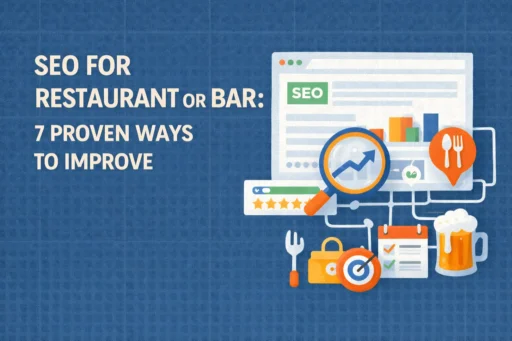

In 2025, having a strong online presence isn’t optional for restaurants and bars-it’s essential. With 88% of diners searching online before choosing a restaurant and 93% checking Google before making a decision, your visibility can make or break your business. At Search Savvy, we understand that optimizing your digital presence is the key to filling tables and attracting loyal customers.
SEO for restaurant or bar websites has evolved dramatically. Today’s customers use voice search, check AI-powered results, and rely heavily on local search to find their next dining destination. According to Search Savvy’s insights, restaurants that implement comprehensive SEO strategies see significant increases in foot traffic and online orders. This guide will walk you through seven proven strategies to improve your restaurant or bar’s search engine visibility and drive more customers through your doors.
How Does Google Business Profile Optimization Work for Restaurants in 2025?
SEO for restaurant or bar websites begins with mastering your Google Business Profile (GBP), formerly known as Google My Business. This free tool is your primary storefront in local search results, and optimizing it properly can deliver remarkable results. Research shows that restaurants optimizing their GBP receive 2.3 times more reviews than competitors and experience at least a 15% increase in customer interactions within six months.
Why is Google Business Profile important in 2025? With 62% of customers turning to Google when looking for a place to eat, your GBP is often the first impression potential customers have of your establishment. At Search Savvy, we recommend treating your profile as a living, breathing asset that requires regular attention.
Essential optimization steps include:
- Complete every field: Include accurate name, address, phone number (NAP), business hours, menu links, and reservation buttons. One-third of diners use Google to search for restaurants, and they expect comprehensive information immediately available.
- Add high-quality photos: Upload 20-30 professional images showcasing your signature dishes, interior ambiance, exterior façade, and team members. Visual content directly influences dining decisions, with 65% of customers saying menu photos affect where they eat.
- Choose accurate categories: Select your primary category (Italian Restaurant, Sports Bar, Sushi Restaurant) first, then add relevant secondary categories. This tells Google exactly when to show your business in search results.
- Update weekly with Google Posts: Share specials, events, live music, seasonal menus, and promotions. Restaurants posting weekly updates gain 3-7 times more direction requests than inactive profiles.
- Enable messaging and Q&A: Respond quickly to customer inquiries and proactively add answers to frequently asked questions through the Google Business Profile help center.
According to Search Savvy, restaurants that maintain consistent, accurate information across their GBP, website, and online directories see up to 30% higher click-through rates in local search results.
Why Are Mobile Optimization and Voice Search Critical for Restaurant Websites?
SEO for restaurant or bar websites in 2025 demands mobile-first thinking. With 59% of restaurant website sessions originating from smartphones and over 50% of all searches now voice-based, your mobile experience can’t be an afterthought.
How does voice search change restaurant SEO? Voice queries are fundamentally different from typed searches. Instead of typing “best Italian restaurant NYC,” users ask complete questions like “What’s the best Italian restaurant near me that’s open now?” Voice searches average 29 words compared to just 1.9 words for text queries.
Mobile and voice optimization strategies:
- Ensure responsive design: Your website must adapt seamlessly to all screen sizes. A mobile-friendly site is non-negotiable when 76% of people who search for something local on their phone visit a business within a day.
- Optimize page speed: Voice search results load 52% faster than average pages. Compress images, minimize code, enable browser caching, and aim for load times under three seconds. Use Google PageSpeed Insights to identify improvement opportunities.
- Use conversational keywords: Target question-based phrases like “Where can I find craft beer in [city]?” or “What restaurants are open late near me?”
- Create FAQ content: Answer common questions in natural language. Format answers concisely-aim for responses under 30 words for voice search optimization.
- Implement structured data: Add FAQ schema and Restaurant schema markup to help voice assistants understand and surface your content.
Search Savvy emphasizes that mobile optimization goes beyond technical performance. Your menu should be easily readable on small screens, reservation buttons should be thumb-friendly, and click-to-call functionality must work flawlessly.
What Is Schema Markup and How Does It Help Restaurant SEO?
SEO for restaurant or bar websites requires speaking Google’s language, and that language is schema markup. This structured data tells search engines exactly what your business offers, dramatically improving your chances of appearing in rich results, featured snippets, and voice search answers.
Why is schema markup important for restaurants in 2025? Restaurants with schema markup see 20-30% higher click-through rates on Google. More importantly, as AI-powered search experiences become dominant, structured data helps your restaurant appear in AI-generated overviews and chatbot recommendations.
Essential schema types for restaurants:
- LocalBusiness/Restaurant Schema: Include your business name, address, phone, hours, price range, cuisine type, and accepted reservations. This is your foundation. Visit Schema.org/Restaurant for complete documentation.
- Menu Schema: Mark up your menu items, descriptions, and prices so search engines can display them directly in search results. See the Schema.org Menu documentation for implementation details.
- Review/Rating Schema: Display your aggregate ratings and review count, building trust before customers even click.
- FAQ Schema: Structure common questions and answers to capture featured snippet positions.
- Opening Hours Schema: Clearly mark regular hours, special holiday hours, and seasonal closures.
At Search Savvy, we recommend implementing schema markup using JSON-LD format, which Google prefers. Test your implementation using Google’s Rich Results Test to ensure proper validation.
Here’s a basic example structure:
{
“@context”: “https://schema.org”,
“@type”: “Restaurant”,
“name”: “Your Restaurant Name”,
“address”: {
“@type”: “PostalAddress”,
“streetAddress”: “123 Main Street”,
“addressLocality”: “City”,
“addressRegion”: “State”,
“postalCode”: “12345”
},
“telephone”: “+1-555-123-4567”,
“servesCuisine”: “Italian”,
“priceRange”: “$$”,
“openingHours”: “Mo-Sa 11:00-22:00”,
“aggregateRating”: {
“@type”: “AggregateRating”,
“ratingValue”: “4.5”,
“reviewCount”: “250”
}
}
How Can Restaurants Leverage Online Reviews for Better SEO?
SEO for restaurant or bar websites is intimately connected to reputation management. Online reviews don’t just influence customer decisions-they directly impact your search rankings and visibility. An impressive 88% of diners trust online reviews as much as personal recommendations, and 72% say positive reviews make them trust a local business more.
Why do online reviews matter for restaurant SEO in 2025? Google’s algorithm considers review quantity, quality, recency, and diversity when determining local search rankings. Restaurants actively managing reviews consistently outrank competitors with similar offerings but neglected reputation management.
Effective review management strategies:
- Request reviews at optimal moments: Ask satisfied customers to leave reviews immediately after positive experiences. Text or email requests within 24 hours see the highest response rates. Seventy percent of restaurant customers will leave a review if asked by a server or manager.
- Respond to every review: Reply to both positive and negative feedback within 24-48 hours. Sixty-one percent of unhappy customers return if their issue is resolved quickly. Personalize responses-generic replies feel inauthentic.
- Monitor multiple platforms: While 46% check Google Reviews first and 23% check Yelp, customers also use TripAdvisor, OpenTable, and Facebook. Search Savvy recommends monitoring all major platforms where your customers gather.
- Address negative reviews professionally: Never get defensive. Acknowledge concerns, apologize when appropriate, offer solutions, and take conversations offline when needed. How you handle criticism publicly demonstrates your commitment to customer satisfaction.
- Encourage video reviews: In 2025, 73% of consumers prefer short-form videos when discovering new experiences. Encourage customers to share Instagram Reels or TikTok videos showcasing their dining experience.
The average restaurant maintains 120-300 online reviews across platforms. However, recency matters tremendously-47% of customers will change their mind about visiting if they see recent negative reviews, emphasizing the importance of continuous reputation management.
What Role Does Local Content Play in Restaurant SEO?
SEO for restaurant or bar websites thrives on locally-focused content that resonates with your community. Creating relevant, engaging content establishes your restaurant as a neighborhood authority while capturing valuable local search traffic.
How does local content improve restaurant SEO? Search engines prioritize content that matches user intent and location. When you create content about local events, neighborhood guides, or community involvement, you signal relevance for local searches while providing value that attracts backlinks and social shares.
High-impact local content strategies:
- Publish neighborhood guides: Write about “Best Things to Do in [Neighborhood]” or “Top Attractions Near Our Restaurant.” These pages attract tourists and locals planning activities.
- Cover local events: Create content around festivals, farmers markets, sports events, and community gatherings. Position your restaurant as the perfect pre- or post-event dining destination.
- Highlight local partnerships: Feature stories about your relationships with local farms, breweries, or suppliers. This content appeals to customers who value supporting local businesses.
- Create seasonal content: Develop pages around holiday menus, summer patio dining, winter comfort foods, or seasonal cocktail programs. Update this content annually to maintain freshness.
- Share behind-the-scenes stories: Blog about chef profiles, ingredient sourcing, recipe development, or staff spotlights. Authentic storytelling builds emotional connections with your audience.
- Use local keywords naturally: Incorporate neighborhood names, landmarks, and local colloquialisms throughout your content. Instead of just “Italian restaurant,” use “Italian restaurant in [specific neighborhood].”
According to Search Savvy, restaurants consistently publishing local content see 15-40% improvements in organic visibility for location-based keywords. Quality matters more than quantity-one well-researched, comprehensive piece monthly outperforms multiple thin posts.
Why Should Restaurants Optimize for Social Media and SEO Together?
SEO for restaurant or bar websites cannot exist in isolation from social media strategy. With 74% of people using social media to decide where to eat and 54% browsing platforms like Instagram and Facebook to pick restaurants, social signals increasingly influence search visibility.
How does social media impact restaurant SEO in 2025? While social media engagement isn’t a direct ranking factor, it drives website traffic, generates brand searches, creates backlink opportunities, and influences behavioral signals Google monitors. Restaurants with strong social presence benefit from increased direct searches, which Google interprets as brand authority.
Integrated social media and SEO tactics:
- Create shareable visual content: Instagram’s #food hashtag contains over 250 million posts. Professional food photography optimized for social sharing increases the likelihood of user-generated content and mentions.
- Optimize social profiles completely: Use consistent NAP information, include website links, and craft keyword-rich descriptions. Your social profiles often rank in search results for branded queries.
- Leverage short-form video: Reels and TikTok videos can earn double the engagement of static posts. Fifty-five percent of TikTok users visit restaurants after seeing menu content on the platform.
- Encourage check-ins and tags: User-generated content serves as social proof. When customers tag your location and share experiences, it expands your reach and can influence search visibility through increased brand mentions.
- Build local community engagement: Interact with other local businesses, participate in community conversations, and share content from neighborhood organizations. These relationships can lead to valuable backlink opportunities.
- Run location-based campaigns: Use geotargeted social advertising to reach nearby customers, then retarget website visitors. This integrated approach reinforces brand awareness across channels.
Search Savvy observes that restaurants treating social media and SEO as complementary strategies rather than separate initiatives see more consistent growth across all digital channels. Since 94% of U.S. restaurants monitor online reviews through social media, the platforms provide valuable feedback for continuous optimization.
How Can Restaurants Build Local Backlinks and Citations?
SEO for restaurant or bar websites gains substantial ranking power from local backlinks and consistent citations across the web. These signals tell Google your business is legitimate, established, and valued within your community.
What are local citations and why do they matter? Citations are online mentions of your business name, address, and phone number (NAP). Consistency across these citations builds trust with search engines. Meanwhile, backlinks from authoritative local sources pass valuable ranking authority to your website.
Effective strategies for building local citations and backlinks:
- List on restaurant-specific directories: Submit your restaurant to OpenTable, Yelp, TripAdvisor, The Infatuation, Eater, and Zagat (when applicable). These high-authority sites drive traffic and improve local SEO, with platforms like OpenTable appearing prominently for queries like “best restaurants”.
- Get listed on general local directories: Include your business in Google Business Profile, Apple Maps, Bing Places, Facebook, and industry-specific directories.
- Ensure NAP consistency: Your name, address, and phone number must be identical across every listing. Inconsistencies confuse search engines and dilute ranking potential.
- Pursue local media coverage: Reach out to local newspapers, magazines, food bloggers, and radio stations. Media mentions often include valuable backlinks to your website.
- Partner with local organizations: Join your chamber of commerce, business improvement district, or restaurant association. Memberships typically include profile pages with backlinks.
- Sponsor local events: Community sponsorships often include website mentions and links from event pages, schools, sports teams, or charities.
- Collaborate with local businesses: Cross-promote with complementary businesses like hotels, theaters, or attractions. These partnerships can result in link exchanges and referral traffic.
- Create link-worthy content: Develop resources like “Ultimate Guide to [City] Dining” or “History of [Neighborhood] Food Scene” that naturally attract links from local sites.
At Search Savvy, we recommend conducting quarterly citation audits to identify inconsistencies and opportunities. Tools like Moz Local, BrightLocal, or Yext can help manage citations across multiple directories simultaneously, saving time while ensuring accuracy.
Conclusion
SEO for restaurant or bar websites in 2025 requires a comprehensive, multi-faceted approach. From optimizing your Google Business Profile and implementing schema markup to managing reviews and building local backlinks, each strategy works synergistically to improve your visibility in search results.
The digital landscape continues evolving rapidly. Voice search is becoming dominant, AI-powered search experiences are reshaping results, and mobile optimization is mandatory rather than optional. Restaurants that adapt to these changes while maintaining focus on fundamental local SEO principles will capture the growing number of customers searching for their next dining experience online.
At Search Savvy, we’ve seen firsthand how restaurants implementing these seven strategies experience dramatic improvements in search visibility, website traffic, and most importantly, filled tables. The key is consistency-SEO is not a one-time project but an ongoing commitment to maintaining and improving your online presence.
Remember, 81% of consumers use Google Search and Maps to find local businesses, and nearly 90% of customers choose businesses appearing on the first page of search results. Your competition is investing in SEO. The question isn’t whether you can afford to optimize your restaurant’s online presence-it’s whether you can afford not to.
Start with your Google Business Profile today, implement schema markup tomorrow, and commit to building a comprehensive SEO strategy that positions your restaurant or bar for long-term success. Your next customers are searching right now-make sure they find you.
Frequently Asked Questions
What is the most important SEO factor for restaurant websites in 2025?
The most critical factor is optimizing your Google Business Profile. With 93% of diners checking Google before choosing a restaurant and 62% using Google specifically to find places to eat, your GBP serves as your primary digital storefront. Ensure complete information, regular updates, quality photos, and active review management for maximum impact.
How long does it take to see results from restaurant SEO efforts?
Restaurant SEO typically shows initial improvements within 3-6 months, with more substantial results appearing after 6-12 months of consistent effort. Google Business Profile optimizations can show faster results, sometimes within weeks, while organic content strategies and link building require more time to mature. Patience and consistency are essential for long-term success.
Do restaurants need to invest in paid advertising if they have good SEO?
While strong SEO reduces dependence on paid advertising, many successful restaurants use both strategies complementarily. SEO provides sustainable, long-term visibility, while paid ads deliver immediate traffic for promotions, new menu launches, or seasonal campaigns. The ideal approach balances both channels based on your specific business goals and budget.
How often should restaurants update their website content for SEO?
At minimum, review and update your website monthly. This includes verifying hours and contact information, adding seasonal menu changes, publishing new blog content, and refreshing photos. Restaurants updating menus quarterly see 15-30% increases in customer excitement and return rates. Regular updates signal to Google that your site is active and relevant.
What are the biggest SEO mistakes restaurants make?
The most common mistakes include neglecting mobile optimization (78% of restaurant websites lack proper mobile optimization), ignoring online reviews, maintaining inconsistent business information across directories, failing to implement schema markup, and creating generic content without local relevance. Many restaurants also set up their Google Business Profile once and never update it, missing valuable engagement opportunities.
Can small independent restaurants compete with large chains in SEO?
Absolutely. Local, independent restaurants often have advantages in local SEO because they can create more authentic, community-focused content and build genuine local relationships. Focus on your neighborhood, cultivate personal customer connections, encourage reviews, and highlight what makes you unique. Many independent restaurants outrank larger chains for location-specific searches through dedicated local optimization efforts.