Digital Marketing Budget Allocation for Q4 2026: A Framework
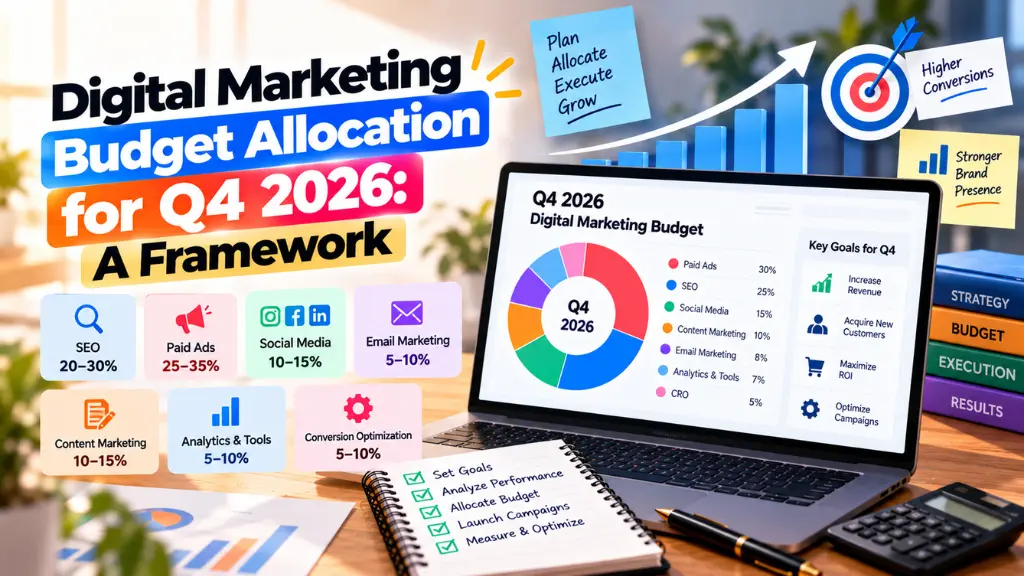

Q4 marketing budget planning fails predictably: teams freeze last year’s channel split, or throw extra money at whichever channel worked in Q3. Neither is a framework, and both waste Q4’s one advantage: demand is already elevated before you spend a rupee on it.
In this article15 sections
This guide gives you a repeatable framework for Q4 marketing budget allocation: how much to shift into Q4, how to split that across channels, how to weigh SEO against paid ads, and where festive marketing spend fits inside the wider quarter. The short version: don’t treat Q4 as “spend more everywhere.” Reallocate toward the channels and moments where demand concentrates, funded by pulling back on lower-return activity for the rest of the year.
What Is a Q4 Marketing Budget Allocation Framework?#
A Q4 marketing budget allocation framework is a structured method for deciding how much of your annual marketing spend to shift into the fourth quarter, and how to split that shift across channels, based on where demand and buying intent actually concentrate, rather than an even split across all twelve months.
Most businesses don’t get extra budget for Q4; they reallocate. The framework below has three layers: how much to shift, where to shift it, and how to sequence spend so you’re not still ramping up when demand peaks.
Layer 1: How Much of Your Annual Budget Should Go to Q4?#
There’s no single correct percentage, because it depends heavily on your category, but two data points are worth anchoring to before you set your own number.
Gartner’s 2026 CMO Spend Survey, based on 401 CMOs (mostly from companies over $1 billion in revenue), found marketing budgets averaging 7.8% of company revenue in 2026, essentially flat after a sharp drop from 9.1% in 2022 to 2023. The CMO Survey (Deloitte/Duke), using a different panel, put the figure at 9.0%, a reminder that even well-regarded surveys disagree on the baseline. If you’re a smaller business, don’t anchor to either figure directly; both skew toward large enterprises, and smaller companies typically need to spend a higher share of revenue to build initial visibility.
Within that annual number, Q4 typically deserves a disproportionate share for any business with even a moderate seasonal pattern. EMARKETER forecasts US advertisers will spend $71.09 billion on retail media in 2026, up from $60.32 billion in 2025, and retail media ad spend rose 33% year-over-year in Q4 2025 alone, according to Skai’s Q4 2025 Digital Marketing Quarterly Trends Report, with paid search CPCs up 16% year-over-year in the same quarter. The practical implication: if your category has any seasonal pull, whether that’s Black Friday, Christmas, or Diwali and the wider Indian festive season, a flat 25% “one quarter out of four” allocation almost always under-invests in Q4 relative to demand.
A reasonable starting range for most seasonal businesses is 30 to 40% of the annual budget concentrated into Q4, funded by trimming spend in historically slower months rather than requesting new budget. Treat this as a starting hypothesis to test against your own historical conversion data, not a rule.
Layer 2: Marketing Budget by Channel#
Marketing budget by channel should follow where your buyers actually are in their decision, not last year’s habit. Gartner’s 2026 survey found awareness and conversion activities together account for 62.6% of total media spend among large enterprises. The same survey found paid media took 31.4% of the marketing budget, labor 24.5%, and martech 19.4% in 2026, up from a 2025 split of paid media 30.6%, martech 22.4%, labor 21.9% and agencies 20.7%. Read these as large-enterprise reference points, not a target to copy; a smaller business’s channel mix should look meaningfully different, with SEO and organic content typically carrying more relative weight.
A practical Q4 channel framework for a small business:
| Channel | Role in Q4 | Typical share of Q4 push |
| Paid search and shopping ads | Captures high-intent demand as it happens | Largest single line for most e-commerce businesses |
| Paid social | Builds awareness and remarkets to warm audiences | Second-largest, scaled with paid search |
| SEO and content | Compounds; work started now often peaks in Q4 itself | Smaller cash outlay, but time-sensitive |
| Email and owned channels | Highest margin recovery lever (cart abandonment, launches) | Low cost, high leverage; often under-resourced |
| Influencer or creator partnerships | Builds trust for specific occasions or products | Growing fastest, worth briefing early |
Later’s 2026 Holiday Research (259 brands, 354 creators) found the share of brands spending over $500,000 on holiday creator campaigns more than tripled, from 2% to 7%, while fixed holiday budgets rose from 30% to 49% of brands. A fixed budget locked in during planning gives less room to shift toward what’s converting, so keep a genuine flexible reserve rather than committing every rupee upfront.
SEO vs Paid Ads Budget: How to Weigh the Two#
The SEO vs paid ads budget question isn’t really “which is better.” It’s about time horizon and what you can still influence once Q4 starts.
- Paid ads are the lever you can still pull in Q4 itself. Budget, targeting and creative can change daily, which is exactly why paid search CPCs spike as everyone competes for the same demand window.
- SEO is the lever you had to pull months ago. A page published in October has a real chance of ranking, and being indexed, before Diwali or Christmas demand peaks. A page published in the second week of November mostly helps you next year.
That means the SEO vs paid ads split isn’t really a Q4 decision at all; by the time Q4 starts, most of your SEO budget for this year’s peak should already be spent. What’s left to decide is how much paid spend fills the gap SEO can’t move fast enough to cover, and how much SEO budget goes toward refreshing pages that already rank rather than building new ones. Search Savvy’s technical SEO audit work done in September, not November, is what actually protects the organic side of this split.
If you’re building out a full content strategy for the next cycle, the lesson from this year’s Q4 should feed directly into next year’s July-to-September SEO calendar, so the timing problem doesn’t repeat.
Layer 3: Sequencing Spend Across the Quarter#
Even with the right total and channel split, Q4 marketing planning fails if all the spend lands in the same two weeks. EMARKETER’s holiday research notes that Gallup-tracked spending intentions dropped from $1,007 in October 2025 to $778 in November, the largest month-over-month decline Gallup has recorded, suggesting October events are already capturing demand that used to concentrate later in the quarter. Separately, one industry report found 71% of US adults plan to start buying before Black Friday, and 46% before November even begins.
A basic three-phase model, adaptable to whichever festive or holiday calendar matters most to your market:
- Early phase (weeks 1 to 3): lighter spend, focused on awareness, early-bird offers, and remarketing list-building, since research-stage shoppers are active and CPCs are still comparatively low.
- Peak phase (the core 2 to 3 week window around your main event, whether Black Friday and Cyber Monday, or Dhanteras through Diwali): the largest share of paid spend, timed to when CPCs and competition peak.
- Late phase (final weeks): urgency messaging around delivery cut-offs, plus retention and post-purchase spend, since one report found Black Friday and Cyber Monday alone pulling in 35% of some advertisers’ seasonal budgets, leaving the rest of the quarter to convert everyone else.
If your business runs on the Indian festive calendar, this three-phase structure maps closely onto the Navratri-through-Diwali planning most Indian D2C brands already do for Google Ads and PPC; this framework applies the same logic to the whole marketing budget, not just one channel.
Building Your Own Q4 Allocation: A Simple Worked Example#
Search Savvy uses this kind of worked table as a starting template with clients, not a benchmark to copy; use your own numbers in its place.
Suppose a business spends ₹40,00,000 (or an equivalent currency amount) on marketing annually and decides, based on its own past Q4 conversion data, to allocate 35% of that to Q4: ₹14,00,000.
| Channel | Share of Q4 budget | Amount | Notes |
| Paid search and shopping | 35% | ₹4,90,000 | Scales up through the peak phase |
| Paid social | 25% | ₹3,50,000 | Front-loaded for awareness, then remarketing |
| SEO and content refresh | 15% | ₹2,10,000 | Mostly spent before the quarter’s midpoint |
| Email and retention | 10% | ₹1,40,000 | Low cost, protected regardless of other cuts |
| Creator or influencer | 10% | ₹1,40,000 | Briefed and contracted before the quarter starts |
| Flexible reserve | 5% | ₹70,000 | Reallocated mid-quarter to whatever’s converting |
These percentages are a starting template, not a formula; a services business, a B2B company and a D2C brand would each build a genuinely different version of this table.
Common Mistakes to Avoid#
- Splitting the annual budget evenly across quarters. Demand isn’t even, so spend shouldn’t be either.
- Copying a large-enterprise channel split. Gartner’s and Deloitte’s figures come from companies mostly over $1 billion in revenue.
- Locking 100% of the Q4 budget upfront. A flexible reserve lets you shift toward what’s actually converting.
- Starting SEO work inside Q4 and expecting Q4 results. Fixes made in November mostly benefit next year’s Q4.
- Ignoring the early phase. If shoppers research in October, a plan that only turns on in late November misses real decisions.
Frequently Asked Questions#
What Percentage of My Annual Marketing Budget Should Go to Q4?#
There’s no universal figure, but 30 to 40% is a reasonable starting range for a business with genuine seasonal demand, funded by reallocating from slower months. Use your own historical Q4 conversion share to refine it rather than copying a benchmark.
Should I Spend More on SEO or Paid Ads in Q4?#
By the time Q4 starts, most of the SEO work that will actually pay off should already be published and indexed, so the real decision is how much paid spend covers what organic can’t move fast enough to influence. Plan next year’s SEO budget for Q4 several months ahead, not during the quarter itself.
How Should I Split My Q4 Budget Across Channels?#
Follow where your buyers actually research and decide, not a fixed formula. A common structure gives the largest share to paid search and social, where high-intent demand shows up, a smaller share to SEO and content, and a protected minimum to email and retention, which typically delivers the highest margin.
When Should Q4 Marketing Planning Actually Start?#
Ideally two to three months before your market’s peak buying window, since SEO content needs time to be indexed and rank, and creator partnerships need lead time to brief and contract. Data on shifting holiday demand shows meaningful spending now starting well before the traditional peak dates.
How Much Extra Should I Expect to Pay for Paid Ads During Q4?#
Expect a real increase, though the exact size varies by category. One 2025 Q4 report found paid search CPCs rose 16% year-over-year as competition intensified, alongside a 33% jump in retail media ad spend, so budgeting flat CPCs into a Q4 plan will likely under-forecast actual cost.
Should Festive Marketing Spend Be a Separate Budget From Q4 Marketing Spend?#
For most businesses, no; treat festive spend as the concentrated core of the Q4 budget rather than a separate pool, since the same demand curve drives both. Keeping them separate risks double-counting spend or leaving gaps between “regular” Q4 activity and festive campaigns.
The Bottom Line#
Q4 marketing budget allocation works best as reallocation with a plan: decide how much of the year’s budget genuinely belongs in Q4, weight channels toward where real demand concentrates, and sequence spend so you’re not still ramping up when the peak arrives. This week, pull your own historical Q4 numbers, test the 30 to 40% starting range against them, and confirm your SEO work for this year’s peak is already live. If you’d like help building or stress-testing your own framework, Search Savvy’s performance marketing services and Google Ads and PPC services are a practical place to start.