LinkedIn Video Is Being Pushed to Professionals Who Don’t Follow You. Use It Now
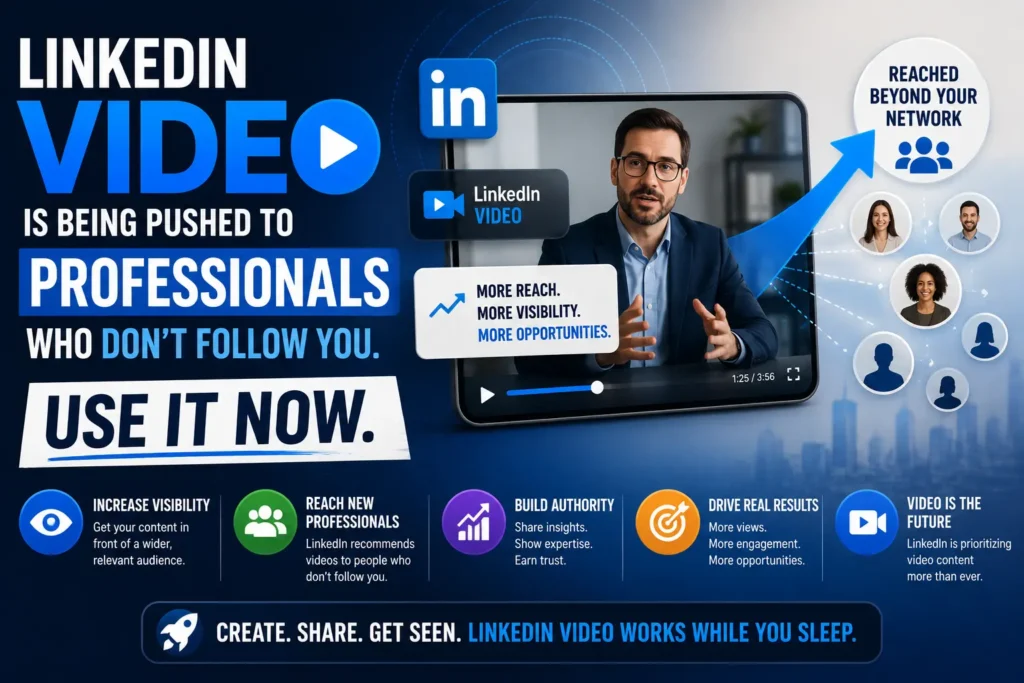

LinkedIn has done something that most social platforms charge for: it is pushing your content to professionals who have never heard of you.
In this article12 sections
Not through ads. Not through sponsored posts. Through a structural algorithm change that, when you understand it, makes LinkedIn the most valuable organic B2B distribution channel available in 2026.
In March 2026, LinkedIn replaced its entire content ranking system with a 150-billion-parameter AI model called 360Brew. This model does not rank content by likes or follower count the way the old system did. It reads your content semantically, evaluates your demonstrated expertise against your profile and publishing history, and then distributes that content to professionals whose declared interests match your topic – whether they follow you or not.
LinkedIn introduced an interest picker during sign-up, allowing new members to indicate topics of interest from the start. The result: your posts can now reach professionals who don’t yet know you, as long as your topics match their declared interests. For teams targeting decision-makers in discovery mode – people who aren’t actively looking for a solution yet, but are forming opinions on a topic – this is a top-of-funnel opportunity that few teams are currently positioned to take advantage of.
A LinkedIn video reach strategy built for this reality is one of the most underused growth levers in B2B marketing today.
At Search Savvy, we track social media algorithm changes across every major platform – and the 360Brew shift is one of the most significant organic reach opportunities we have identified in 2026. This article explains exactly how it works, what LinkedIn video actually does to your distribution, and how to execute a strategy that reaches professionals well beyond your existing network.
What Is LinkedIn’s 360Brew – and How Does It Change Video Reach?#
LinkedIn video reach strategy must start with understanding the engine that now determines who sees your content – because 360Brew operates fundamentally differently from the system most LinkedIn marketers learned on.
Announced in March 2026, 360Brew is a 150-billion-parameter AI model that replaced LinkedIn’s entire content ranking system. The old algorithm was a reaction counter. It measured likes, comments, and shares in the first hour and used those signals to decide whether a post earned wider distribution. 360Brew works differently.
It reads content semantically. It evaluates whether the creator has topical authority based on their profile and posting history. It weights dwell time, saves, and comment depth over raw engagement volume. And it uses cohort-based embedding retrieval – the system learns which audience segments engage with specific content types, then replicates distribution to similar professional profiles outside your network.
The algorithm identifies your “topic DNA” and distributes content based on demonstrated expertise rather than network size. This is a structural advantage for anyone who has been consistently publishing content in a specific professional niche – because each post that earns genuine engagement trains the algorithm about your expertise, making your next post more likely to reach a wider relevant audience.
The interest-picker mechanism is the out-of-network distribution pathway. LinkedIn now categorises new and existing members by declared professional interests. When your content’s semantic topic matches a member’s interest category – regardless of whether they follow you – 360Brew includes your content in their candidate pool. Your post can reach professionals who have never encountered your brand at all.
People Also Ask: What is LinkedIn’s 360Brew algorithm in 2026? Short Answer: 360Brew is LinkedIn’s 150-billion-parameter AI model, announced in March 2026, that replaced the platform’s entire content ranking system. Unlike the previous engagement-first system, 360Brew evaluates content semantically, assesses creator topical authority from their profile and posting history, and distributes content based on professional interest matching rather than follower count. It enables out-of-network distribution to professionals who have declared interest in your topic area – creating genuine organic reach beyond your existing connections.
How Does the LinkedIn Video Reach Strategy Actually Work in 2026?#
LinkedIn video reach strategy works through a specific distribution mechanism – and understanding the mechanism tells you exactly how to produce and publish video that earns out-of-network reach.
When you publish a post, LinkedIn tests it with 2–5% of your network first. How this small group engages in the first 60 minutes determines wider distribution. Only 5% of underperforming posts in the first hour recover to reach broader audiences. This is the “Golden Hour” – the most consequential window in your LinkedIn content strategy.
The signals 360Brew reads during that window are different from what the old algorithm measured:
Dwell time over likes. The algorithm measures how long people actually engage with your content – not just whether they clicked. A post someone reads (or watches) for 30 seconds outperforms one with 50 quick likes. The system now detects “click bounces” – where people click but leave immediately – and deprioritises that content.
Comment depth over comment volume. Meaningful comments from users with strong professional profiles in your niche carry extra weight. A three-line reply from a Director at a relevant company outperforms ten emoji reactions from random accounts. Posts that end with a genuine question consistently outperform those that don’t – because they invite substantive responses.
Saves and private shares. Both are strong signals that content is genuinely useful rather than merely engaging. Content that people save for later reference or share directly to colleagues via DM is telling the algorithm that it has professional utility – a higher-quality signal than public engagement.
Creator authority signals. 360Brew evaluates your publishing history. Consistent posting in a specific niche builds “content identity authority” – the platform’s understanding of your expertise. This authority compounds: the more consistently you publish expertise-driven content in one area, the more confidently the algorithm distributes your next piece to the relevant professional audience.
For video specifically: native video keeps users on LinkedIn – the algorithm rewards that. LinkedIn’s algorithm gives native video a major distribution advantage over static posts and any content with an outbound link. Posts with external links see up to 60% less organic reach because the algorithm deprioritises content that pulls users off the platform.
People Also Ask: Why does LinkedIn video get more reach than other post types? Short Answer: LinkedIn’s algorithm rewards content that keeps users on the platform – and native video, by design, keeps people watching without navigating away. Videos generate higher dwell time signals than text posts, which is the primary 360Brew ranking signal. Posts with external links see approximately 60% less reach. Native video avoids this penalty while generating the session depth signal that triggers out-of-network distribution. The combination makes video the format with the highest ceiling for reaching professionals beyond your existing network.
What Does the Honest Picture of LinkedIn Video Performance Show in 2026?#
LinkedIn video reach strategy requires an accurate understanding of both the opportunity and the nuance – because LinkedIn video has genuine advantages and genuine limitations that a one-sided account misses.
The honest data from 2026 shows two realities existing simultaneously.
The opportunity: LinkedIn’s algorithm genuinely pushes relevant video content to out-of-network professionals. The interest-picker mechanism creates a real top-of-funnel pathway. Video with a real person on camera cuts through AI-generated text skepticism in a way that written content simply cannot. Buyers can’t fake a face – and in a feed increasingly filled with AI-written posts, authentic on-camera expertise is increasingly rare and therefore increasingly valuable.
The limitation: 360Brew has changed the dynamics in a way that matters for production decisions. Video on LinkedIn has always driven high impression counts but shallow engagement. People scroll past video or watch the first few seconds without engaging deeply. Document carousels generate higher dwell time because users swipe through slides – and dwell time is 360Brew’s primary ranking signal. In the 360Brew environment, documents and carousels have been outperforming video on several engagement metrics.
This tension resolves when you understand what video is actually best for on LinkedIn in 2026.
What video wins at:
- Out-of-network discovery from non-followers via the interest matching system
- Building personal brand credibility and trust – a face creates parasocial familiarity that text cannot
- Demonstrating expertise in a way that is immediately credible (you cannot fake competence on camera)
- Generating profile visits from viewers who want to learn more about the person
What documents and carousels win at:
- Deep dwell time and save signals
- Step-by-step frameworks and educational content that users want to reference later
- B2B audiences who prefer to read-scan content at their own pace
The correct strategy is both, used intentionally. Video builds the personal brand and triggers the out-of-network discovery. Documents and carousels convert that discovery into deeper engagement and saves. Each format feeds the other in 360Brew’s interest-matching model.
People Also Ask: Do LinkedIn videos actually reach professionals outside your network in 2026? Short Answer: Yes – through the interest-matching mechanism introduced with 360Brew in March 2026. Your video content can be distributed to professionals who declared matching topic interests during LinkedIn sign-up, regardless of whether they follow you. However, this out-of-network distribution is earned, not automatic – it requires strong first-hour engagement signals (dwell time, meaningful comments, saves) during the Golden Hour. Video that receives shallow engagement (impressions without watch time or responses) will not trigger the out-of-network distribution pathway.
What Are the Key Rules for LinkedIn Video Reach in 2026?#
LinkedIn video reach strategy in 2026 requires adhering to the specific algorithm rules that 360Brew enforces. Several of these are different from what worked in 2024 – and the changes are significant enough to invalidate most legacy LinkedIn video advice.
Rule 1: No External Links in Video Posts#
LinkedIn video reach strategy immediately fails if you include an external link in the post text accompanying your video. Posts containing off-platform links see significantly reduced distribution – approximately 60% less reach. The algorithm penalises bridge behaviour – content that is designed to move users off LinkedIn rather than keep them engaged on the platform.
The workaround: post your video and caption without any links. If you want to drive traffic to an external resource, include the link in the first comment after posting – noting that as of early 2026, even the “link in first comment” workaround has been flagged as a penalty trigger by some practitioners. The safest approach for maximum reach is to make the video itself the complete value delivery, with a verbal CTA (“find the link in the comments or on my profile”) rather than a text link.
Rule 2: The Golden Hour Is Non-Negotiable#
LinkedIn video reach strategy lives or dies in the first 60 minutes. LinkedIn tests new posts with 2–5% of your network initially. How this small group engages determines wider distribution. Only 5% of underperforming posts in the first hour recover to reach broader audiences.
This means: post at a time when your core professional network is actively on LinkedIn. Peak LinkedIn engagement in India occurs on weekday mornings (8–10 a.m.) and early afternoons (12–2 p.m.). Post during these windows, then immediately engage with every response – because your early reply signals to the algorithm that a live, active conversation is developing.
Strategic seeding before posting also works: share the post with a small group of engaged professional contacts first and ask for specific feedback. Their substantive early comments train the algorithm to target your content at the right professional cohort for wider distribution.
Rule 3: Hook in 3 Seconds, Deliver Value in 60#
LinkedIn video reach strategy requires two specific timing benchmarks.
The 3-second hook. LinkedIn auto-plays videos silently in the feed. If the first three seconds of your video do not visually or textually communicate a compelling reason to watch, the viewer scrolls. Silent captions covering 60–80% of the screen are now standard in high-performing LinkedIn video. The opening frame must communicate the video’s value proposition before a single word is spoken.
The 60-second sweet spot. The optimal LinkedIn video length based on 2026 data is 60–90 seconds for educational content. Long enough to deliver genuine value. Short enough that the viewer reaches the end, which maximises dwell time completeness – a strong 360Brew signal. Longer videos (3+ minutes) can work for deep expertise content, but the dwell time completion rate typically drops, reducing the algorithm benefit.
Rule 4: Personal Profiles Beat Company Pages by a Wide Margin#
LinkedIn video reach strategy must be deployed from personal profiles first – because the algorithmic advantage of personal over company page distribution is now too large to ignore.
Company page organic reach dropped roughly 60–66% between 2024 and 2026. Company pages receive just 5% of user feed allocation while personal profiles dominate 65% of feed distribution. Employee reshares reach 561% further than company page posts in 2026’s distribution model.
The practical implication: your C-suite, founders, and subject matter experts should be publishing video content from their personal LinkedIn profiles. CEO content generates 4x more engagement than average posts, demonstrating the platform’s preference for individual authority over corporate messaging. A mid-level employee with 2,000 connections will often outreach a company page with 200,000 followers in the 360Brew model.
This is not a temporary quirk. It is a structural feature. Invest in your team’s personal LinkedIn presence as your primary content distribution channel, with the company page serving a secondary amplification role.
Rule 5: Niche Consistency Builds Distribution Authority#
LinkedIn video reach strategy compounds when it targets a consistent topic niche. The algorithm identifies your “topic DNA” and distributes content based on demonstrated expertise rather than network size. Educational posts with frameworks and data get amplified to users interested in that specific topic, even if they’re not in your network.
Each video you publish in a consistent niche teaches 360Brew’s cohort model who your relevant professional audience is. Over time, this creates a distribution advantage that is entirely unavailable to accounts that post randomly across disconnected topics.
For Indian B2B businesses: the interest-matching mechanism is particularly valuable for reaching decision-makers in specific sectors – manufacturing, fintech, healthcare, SaaS – where the professional audience is defined enough that consistent niche content reliably finds the right people. LinkedIn is a professional network. Its algorithm is designed to prioritise professional value, not entertainment. This is why substance and specificity compound on LinkedIn in a way they do not on Instagram or TikTok.
What LinkedIn Video Content Works Best for B2B and Service Businesses?#
LinkedIn video reach strategy for B2B produces the strongest results with specific content types that align with how professional audiences use the platform.
The content formats with the highest documented performance in 2026:
“What I learned” case studies – First-person accounts of specific business outcomes, with named results and honest analysis of what worked and what did not. These score highly on 360Brew’s experience signal, generate substantive comments from professionals in similar situations, and build the authority that earns progressive out-of-network distribution.
Contrarian takes on industry assumptions – Short, specific videos that challenge a commonly held belief in your niche with evidence. “Everyone says X. Here’s why the data shows Y.” These generate high comment-to-like ratios – exactly the depth signal 360Brew rewards.
Behind-the-process transparency – A genuine, unpolished look at how your team solves a specific problem. Not a polished brand video – raw process documentation that demonstrates expertise without performance. Buyers can’t fake a face, and they cannot fake genuine expertise in action.
“In 60 seconds” frameworks – A single, specific professional principle explained with enough depth to be immediately applicable. These generate saves – the clearest signal that content has professional utility rather than entertainment value.
Hot take responses to industry news – A real-time, direct-to-camera take on a relevant development in your industry within 24 hours of it breaking. These match the freshness signal LinkedIn rewards and are inherently authentic – you cannot pre-produce a response to something that just happened.
According to Search Savvy’s insights from advising clients on LinkedIn content strategy, the single most common mistake in B2B LinkedIn video is producing content that looks like a corporate ad – high production value, low personality, zero risk of a genuine opinion. 360Brew rewards creator authenticity signals alongside topical authority. The most effective LinkedIn video for B2B reach in 2026 is often shot on a phone, in a real office environment, by someone who clearly knows what they are talking about and is not afraid to say something specific.
People Also Ask: What type of video content works best on LinkedIn in 2026? Short Answer: The highest-performing LinkedIn video types in 2026 are: first-person case studies with specific, named outcomes; contrarian takes on industry beliefs backed by evidence; transparent process documentation; 60-second frameworks with immediate professional applicability; and real-time hot takes on industry news. These formats score highest on 360Brew’s signals: dwell time, meaningful comments, saves, and creator authenticity. High-production corporate video consistently underperforms personal, direct-to-camera expertise content.
How Do You Measure LinkedIn Video Reach and Growth Over Time?#
LinkedIn video reach strategy is only improvable with the right metrics – and not all LinkedIn metrics predict actual business impact.
The metrics that matter for 360Brew performance in 2026:
- Unique impressions by audience type – LinkedIn Analytics shows impression breakdown by 1st, 2nd, and 3rd degree connections. Growing 2nd and 3rd degree impression share indicates your out-of-network distribution is activating through the interest-matching mechanism.
- Video watch time completion rate – The percentage of viewers who watch to the end. A 60% completion rate on a 60-second video is a strong dwell time signal. Below 30% indicates a hook problem that is suppressing distribution.
- Comment-to-impression ratio – The depth of conversation relative to how many people saw your content. A rising comment ratio indicates the algorithm is matching your content to more engaged, relevant audiences.
- Profile visits from post views – The number of people who visit your profile after watching your video. This is the conversion metric for personal brand growth – it tells you how many viewers found the content credible enough to investigate further.
- Follower growth rate per video – Tracking which specific videos produced the largest follower count changes identifies your most effective out-of-network discovery content.
At Search Savvy, we recommend building a simple LinkedIn content performance log – tracking these five metrics per video, per week – and reviewing the pattern monthly to identify which content types, topics, and hooks consistently outperform your average. 360Brew rewards consistency and learning, not randomness. The accounts growing fastest are the ones making small, specific improvements to each video based on what the previous one showed.
FAQ: LinkedIn Video Reach Strategy – Your Questions Answered#
Q1: Do LinkedIn videos help reach people who don’t follow me in 2026? Yes – through LinkedIn’s interest-matching mechanism introduced with 360Brew in March 2026. New and existing LinkedIn members can declare professional topic interests, and the algorithm distributes relevant content to these interest segments regardless of whether they follow the creator. This out-of-network distribution is earned through strong first-hour engagement signals (dwell time, meaningful comments, saves). It is not automatic – but for creators publishing consistent, expert-level video content in a specific professional niche, out-of-network reach can significantly exceed in-network reach over time.
Q2: How long should my LinkedIn videos be in 2026? The optimal length for most professional and B2B video content is 60–90 seconds. This is long enough to deliver a complete, valuable idea with enough depth to generate meaningful engagement, while short enough to maintain high watch completion rates – a key 360Brew signal. For deep expertise demonstrations, thought leadership on complex topics, or in-depth case study presentations, 3–5 minutes can work if the content quality is sufficient to sustain watch time throughout. Avoid producing content at a specific length target – produce the length the content genuinely requires, with 60–90 seconds as your default and a 3-second hook as your non-negotiable first frame.
Q3: Should I post LinkedIn videos from my personal account or my company page? Personal account, always, as your primary distribution channel. Company page organic reach dropped roughly 60–66% between 2024 and 2026, with company pages receiving just 5% of user feed allocation versus personal profiles’ 65%. Employee reshares reach 561% further than company page posts in 2026’s distribution model. Post your video from the most senior, expert individual in your organisation whose professional brand is strongest. Use the company page to repost and amplify, not to originate. If your company page has significant followers, amplify top-performing personal posts via Thought Leader Ads for paid reach extension.
Q4: Is LinkedIn video better than document carousels for B2B reach in 2026? Neither format dominates the other – they serve different strategic purposes in 360Brew’s model. Video delivers higher out-of-network discovery reach through the interest-matching mechanism and stronger personal brand trust signals. Document carousels generate higher dwell time per viewer and stronger save rates – the signals that indicate deep professional utility. The highest-performing LinkedIn content strategies in 2026 use both: video for discovery and brand trust, carousels for deep expertise and saves. Building a content calendar that rotates between both formats – with consistent topic focus across all posts – trains the algorithm on your niche authority while maximising both reach and engagement depth.
Q5: What is the “Golden Hour” on LinkedIn and how do I use it? The Golden Hour is the first 60 minutes after you publish a LinkedIn post – the window during which LinkedIn tests your content with 2–5% of your network and determines whether it earns wider distribution. Only 5% of posts that underperform in the first hour recover to reach broader audiences. To maximise Golden Hour performance: post during peak professional activity hours (8–10 a.m. on weekdays), set a reminder to engage with every early comment immediately, notify engaged professional contacts in advance and ask them to share their genuine reaction, and end your video with a specific question that invites substantive professional responses. The goal is depth signals (meaningful comments, saves) in the first hour – not just rapid likes.
Q6: Does LinkedIn penalise AI-generated video scripts in 2026? 360Brew’s creator authenticity signals evaluate whether content reflects genuine expertise – not whether AI was involved in production. Generic, templated content that could apply to any professional in any industry receives lower authenticity signals regardless of how it was produced. AI tools are entirely appropriate for scripting, structuring, and refining your video content – but the perspective, the specific examples, the named outcomes, and the genuine opinion must be yours. The 2026 LinkedIn algorithm and audience increasingly detect generic AI-generated posts. The fix is not to avoid AI – it is to ensure every piece of content has a specific, non-reproducible human perspective at its core.
Building a LinkedIn presence that reaches beyond your existing network – or producing video content that is not converting views into business relationships? Visit Search Savvy for a LinkedIn content strategy audit that maps your current performance to what 360Brew is actually rewarding in 2026.